
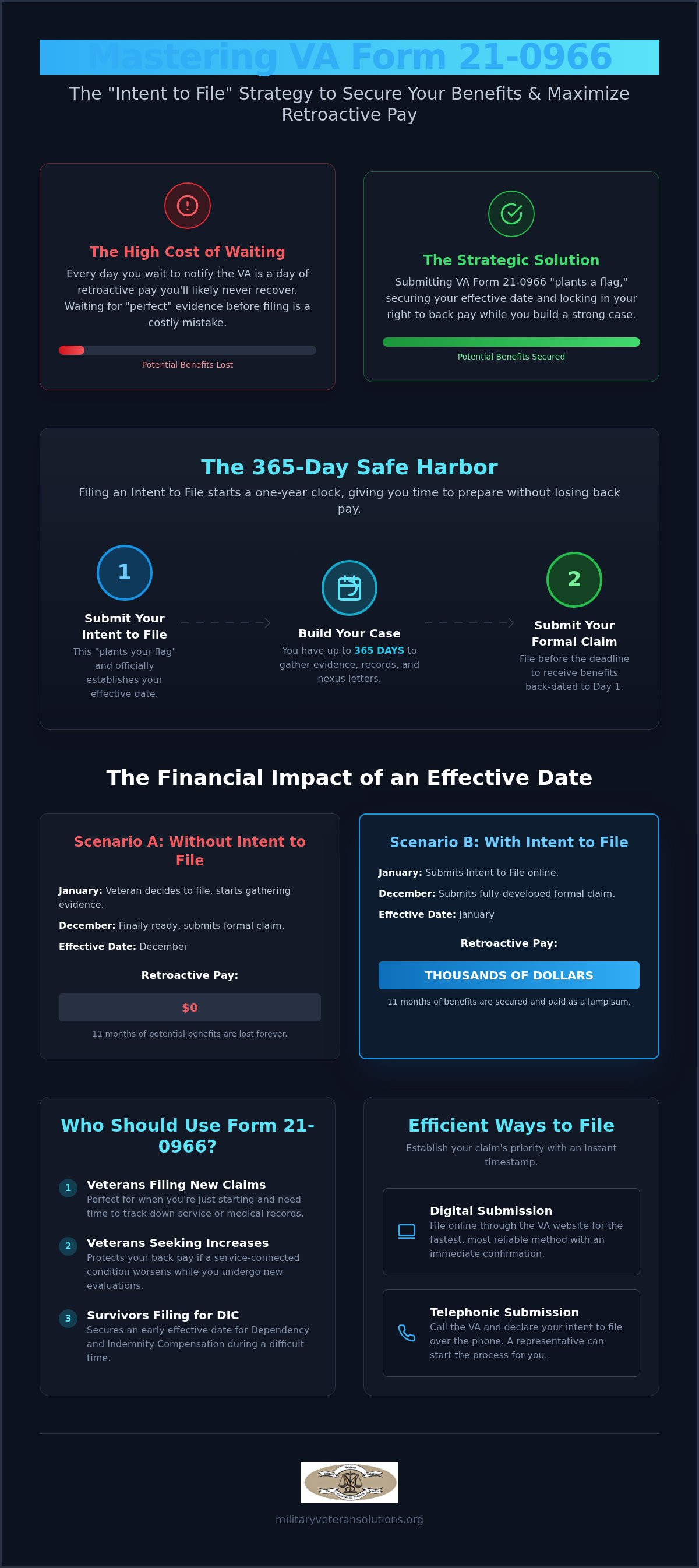
Every single day you wait to notify the VA of your claim is a day of retroactive pay you'll likely never recover. It's a high-stakes gamble that many veterans lose simply because they feel unready to submit a formal application. You shouldn't have to choose between rushing a weak claim and losing thousands of dollars in back pay. By submitting va form 21-0966 intent to file, you effectively plant a flag in the ground. This simple action secures your earliest possible effective date, ensuring the VA owes you from the moment you expressed intent, not just when you finished the paperwork.
We know the uncertainty of the claims process can feel overwhelming. It's frustrating to worry that you lack the perfect evidence to start right now. This guide will show you how to master the 2026 Intent to File process to protect your financial future. We'll walk through the May 2026 form revisions, the strict 365-day deadline, and how to use this one-year window to conduct a thorough military record review. You'll gain the confidence to build a bulletproof file while your effective date remains safely locked in place.
Key Takeaways
- Lock in your effective date immediately to ensure you don't lose a single day of retroactive benefits while you prepare your case.
- Submitting va form 21-0966 intent to file triggers a 365-day "safe harbor" window, giving you a full year to gather medical evidence without sacrificing back pay.
- Learn the most efficient ways to file in 2026, including instant digital timestamping and telephonic submissions that establish your claim's priority.
- Discover how to use your 12-month window for a professional military record review to identify hidden evidence before submitting your formal application.
- Understand the critical distinction between the "placeholder" form and the formal application to avoid common filing errors that delay your benefits.
What is VA Form 21-0966? Securing Your Intent to File
VA Form 21-0966 is your strategic timestamp in the federal benefits system. It's a formal notification to the Department of Veterans Affairs that you plan to file a claim for disability compensation, pension, or survivors benefits. Within the VA Modernization Act framework, this document serves as a placeholder. It allows you to notify the agency of your upcoming application without requiring you to have every medical record or nexus letter ready on day one. Think of it as a protective shield for your financial interests.
This document is arguably the most critical piece of paper in your administrative file. By submitting va form 21-0966 intent to file, you're essentially "planting a flag" to mark the start of your claim. It provides a safe harbor, giving you the time needed to build a strong case while ensuring the VA acknowledges your entitlement from the earliest possible moment. Without it, the clock doesn't start until you submit a fully developed claim, which could be months after you first realized you were eligible for Veterans' benefits.
The Legal Concept of the Effective Date
The effective date is the specific day the VA uses to calculate when your benefit payments should begin. Under 38 CFR § 3.155, an Intent to File establishes the date of claim for retroactive payment purposes. This legal distinction is massive. If you express your intent in January but don't finalize the formal application until the following December, the VA must pay you as if the claim was completed in January. The difference between a January filing and a December filing can mean thousands of dollars in back pay. It's the difference between receiving a full year of retroactive support or starting from zero after months of preparation.
Who Should Use VA Form 21-0966?
The va form 21-0966 intent to file is a versatile tool designed for several specific scenarios. You should use it if you fall into any of these categories:
- Veterans filing for new disabilities: Use this if you're just starting the process and need time to track down old unit logs or private medical records.
- Survivors: Individuals planning to file for Dependency and Indemnity Compensation (DIC) can use this form to secure an early date during a difficult transition period.
- Veterans seeking increases: If your service-connected condition has worsened but you're still undergoing private medical evaluations, this form protects your back pay while you wait for those results.
Using the May 2026 revision of the form ensures you're following the latest regulatory requirements. It's a simple step that provides immediate peace of mind, knowing your financial timeline is secure while you focus on gathering the evidence necessary for a successful outcome.
The 1-Year Clock: How VA Form 21-0966 Protects Your Back Pay
Once the VA receives your VA Form 21-0966, a strictly enforced 365-day clock begins. This one-year window is your "safe harbor." It grants you the breathing room to gather complex medical evidence, secure nexus letters, and organize your service records without the pressure of an immediate deadline. However, you must submit your formal claim before that 365th day expires. If you miss this window by even 24 hours, your original effective date vanishes. You'll be forced to start over, potentially forfeiting thousands of dollars in retroactive payments.
Retroactive payments are calculated from the day the VA receives your va form 21-0966 intent to file to the date your claim is finally approved. For example, if your ITF is received in October 2026 and your claim is granted 14 months later, your first check will include a lump sum covering that entire period. This protection is vital because the average disability claim took 78.6 days to process in May 2026. Without an ITF, you're essentially giving that money back to the government while you wait for a decision.
The Risk of Waiting to File
Many veterans mistakenly wait until they have "perfect" records before notifying the VA. This is a costly error. Rating schedules can change, and legislative shifts may alter how certain conditions are evaluated. By filing early, you lock in the current regulations. If you find yourself struggling to stay on top of these dates, seeking VA claim assistance can help you manage your documentation timeline effectively.
Managing Multiple Conditions
You don't need a separate va form 21-0966 intent to file for every condition. A single submission covers all disability compensation claims you file within that 12-month window. This includes secondary conditions that you identify during your development period. A common mistake is filing a second ITF while one is already active. Doing so won't extend your deadline; it can actually create administrative confusion that delays your benefits. Instead, focus on using that year to build a comprehensive file. If you're unsure how to proceed, a virtual consultation can provide the clarity you need to move forward with confidence.
Step-by-Step: How to Submit Your Intent to File in 2026
Securing your effective date requires more than just filling out a form; it requires a documented submission that the VA cannot dispute. You've worked too hard to let a clerical error derail your back pay. To master the va form 21-0966 intent to file process, you must choose a submission method that provides an undeniable paper trail. The VA updated its systems in early 2026 to prioritize digital interactions, but several reliable paths remain available to you.
- Method 1: Online Submission. Logging into AccessVA or VA.gov is the most secure route. When you start a disability application online, the system automatically creates an ITF timestamp. Save a PDF copy of the confirmation page immediately.
- Method 2: Telephonic ITF. You can call the VA benefits hotline at 800-827-1000. Tell the representative you wish to submit an "Intent to File" over the phone. Request a confirmation number before hanging up to ensure the VA Intent to File Process is officially logged in your record.
- Method 3: Paper Submission. If you prefer the traditional route, you can mail the hard copy va form 21-0966 intent to file to the Evidence Intake Center. This method is slower and requires a specific mailing strategy to protect your interests.
Common Errors on VA Form 21-0966
Even a small mistake can invalidate your submission. One of the most frequent errors is selecting "Pension" when you actually intend to file for "Compensation." These are distinct benefit programs with different eligibility rules. Additionally, ensure you're using the May 2026 revision of the form. Using an outdated version can lead to an automatic rejection. Double check that your VA file number or Social Security Number is legible and accurate. A single transposed digit can cause your form to be filed in the wrong veteran's folder, effectively erasing your one-year protection window.
The "Certified Mail" Strategy
If you choose to mail a paper form, never use standard first-class mail. You must send it via Certified Mail with a Return Receipt Requested. This gives you the "green card" signature from the VA employee who accepted the delivery. This physical proof is your only leverage if the VA later claims your va form 21-0966 intent to file was never received. While digital timestamps are the primary evidence in most modern cases, having a postmarked receipt allows you to rebut administrative errors and preserve your retroactive pay. Keep these documents in a dedicated file alongside your medical records for the duration of your claim.
Intent to File vs. Formal Claim: When to Use Each
Understanding the distinction between a placeholder and a formal application is vital for your financial security. Think of the va form 21-0966 intent to file as a protective scout that secures your position, while the VA Form 21-526EZ is the main force that actually wins the battle. You don't need to have your entire medical history ready to submit the 21-0966. Its only job is to lock in your effective date. In contrast, the formal claim requires specific evidence, service treatment records, and a detailed list of the conditions you're seeking to service-connect.
There are instances where a standalone va form 21-0966 intent to file is redundant. If you log into VA.gov and start an online application for disability compensation, the system automatically generates an ITF timestamp. However, this carries a hidden risk. If you "start" an application but the system glitches or your session data is lost before you finish, that timestamp might disappear. Filing a standalone 21-0966 provides a hard-copy backup that protects you against technical failures. It's the safer choice for veterans who need the full 12 months to build their case.
The Supplemental Claim Exception
Navigating the 2026 rules for Supplemental Claims requires precision. Generally, an Intent to File does not apply to Supplemental Claims (VA Form 20-0995) if you're appealing a decision within one year of the denial. In those cases, the appeal itself preserves the original effective date. This is particularly relevant for PACT Act-related filings where new medical evidence is being introduced to an old claim. If you're unsure how to protect your timeline after a rejection, reviewing a strategic guide to VA appeals can help you identify the correct filing path.
Intent to File for Survivors and Dependents
Survivors and dependents face a different set of administrative hurdles. For Dependency and Indemnity Compensation (DIC) or accrued benefits, the 21-0966 remains a powerful tool. It allows family members to preserve an effective date during a period of transition and grief, providing a one-year window to locate the veteran's discharge papers and death certificates. Wartime veterans seeking pension benefits also require the 21-0966 to secure their financial start date. These claims are often complex and involve strict income requirements. If you're feeling overwhelmed by the paperwork, a veteran claims representative can ensure your family's interests are fully protected from the start.
Beyond the Form: Building Your Evidence During the Intent Window
Filing your va form 21-0966 intent to file is a major victory, but it's just the opening phase of a larger mission. Think of this form as a financial anchor. It holds your place in line while you perform the heavy lifting of evidence gathering. Most veterans rush to submit their formal application because they're afraid of losing months of back pay. By securing your intent first, you gain a strategic 12-month window to conduct a professional military record review. This period is your chance to turn a standard claim into a bulletproof case that's much harder to deny.
During this window, your focus should shift to identifying "Hidden Evidence." Veterans often miss small entries in their service treatment records that could prove a service-connection nexus. A veteran-led advocacy firm looks for these missing links that the VA's automated systems frequently overlook. You've got to connect your current medical diagnoses to specific incidents, exposures, or injuries found in your personnel file. This nexus strategy is the foundation of a successful rating. Use this time to secure strong medical opinions and buddy statements that provide the "how" and "why" behind your conditions.
This preparation also helps you dominate your Compensation and Pension (C&P) exam. Your va form 21-0966 intent to file buys you the time to draft a detailed Statement in Support of Claim. Instead of walking into an exam and trying to remember decades of medical history on the fly, you'll have a clear, documented narrative ready. You can walk into that appointment with the relief that your financial interests are already protected, allowing you to focus entirely on accurately describing your daily limitations.
Why a Professional Audit Trumps a Self-File
Filing a formal claim with incomplete records is a high-stakes gamble that often leads to years of frustration. Military Veteran Solutions, LLC uses over 25 years of advocacy experience to analyze VA decision letters and find clear paths toward a 100% rating. We find the evidence that was previously ignored or misunderstood by the regional office. A thorough record audit during the ITF window is the difference between an immediate grant and a multi-year appeal. Don't leave your future to chance when you have the time to do it right.
Next Steps: From Intent to Award
Your 365-day deadline is absolute. Mark this date on your calendar in multiple places and set reminders for the six-month and nine-month marks. As you finalize your evidence file, consider the value of professional advocacy support to ensure no detail is left behind. We're ready to help you navigate the transition from intent to a successful award. Schedule a virtual consultation today to maximize your one-year evidence window and secure the benefits you've earned through your service.
Take Control of Your Retroactive Pay Today
The 365-day clock is already ticking the moment you consider filing for benefits. You've learned that submitting va form 21-0966 intent to file isn't just a formality; it's a strategic move that protects your financial future by locking in your earliest possible effective date. This window gives you the vital time needed to move beyond guesswork and build a case based on undeniable medical evidence. By securing your spot in line now, you ensure that every day spent gathering records is a day you'll eventually be paid for.
Don't let the complexity of the VA system cost you the benefits you've earned through your service. Military Veteran Solutions, LLC leverages over 25 years of dedicated advocacy and specialized military medical record audits to identify the hidden links the VA often misses. We provide nationwide virtual consultations to ensure every U.S. veteran has access to elite representation, no matter where they're located. It's time to stop worrying about deadlines and start focusing on the results you deserve.
Secure Your Effective Date with Expert Advocacy Help and let us help you turn your intent into a successful award. You've stood for your country; now let us stand for you.
Frequently Asked Questions
Can I file more than one VA Form 21-0966 at a time?
You cannot have multiple active intents for the same benefit category. If you submit a second va form 21-0966 intent to file while one is already pending, the VA typically ignores the second submission. It won't extend your original 365-day deadline. Focus your energy on completing the formal application for all conditions within that initial one-year window to ensure your effective date remains protected across all your claimed disabilities.
How long does an Intent to File last in 2026?
An Intent to File remains valid for exactly 365 days from the date the VA officially receives your notification. This one-year clock is absolute. If you don't submit your formal claim by the 365th day, the placeholder expires, and you lose your "flag in the ground" for retroactive pay. We recommend marking your calendar for the nine-month mark to ensure you have plenty of time for a final record review before the deadline.
Does an Intent to File guarantee I will get back pay?
No, the form itself doesn't guarantee a specific financial outcome. It only secures the "effective date" used to calculate payments if your claim is eventually approved. You still carry the burden of proof to establish a service-connected nexus for your conditions. Think of the va form 21-0966 intent to file as a protective shell. It keeps your potential back pay safe while you work on building the medical evidence required for a grant.
Can I use VA Form 21-0966 for a Supplemental Claim?
Generally, you don't use this form for Supplemental Claims. The VA rules for 2026 specify that a Supplemental Claim (VA Form 20-0995) preserves its own effective date if it's filed within one year of a prior decision. Using a 21-0966 for an appeal can lead to administrative confusion. If you're dealing with a denial, it's better to focus on a professional decision letter analysis to identify the correct path for your appeal.
What happens if I miss the one-year deadline to file my formal claim?
If you miss the 365-day deadline, your original effective date is permanently lost. Any formal claim filed after that point will use a new effective date based on the day the VA receives the completed application. This mistake can cost you thousands of dollars in retroactive benefits that you can't recover. It's vital to track your submission date carefully and finalize your evidence file well before the one-year window closes.
Do I need to submit medical records with my Intent to File?
You don't need to include any medical documentation when you submit your intent. The primary purpose of the form is to notify the VA of your future application, not to prove the claim itself. This gives you a full year to conduct a thorough military record review and gather nexus letters. You'll submit all your supporting evidence later when you file the formal VA Form 21-526EZ or other applicable application forms.
Can my VSO or accredited representative file a 21-0966 for me?
Yes, an accredited representative or VSO can file the form on your behalf. They must have a valid Power of Attorney on file and processed in the VA system to take this action. This is often a smart move if you're feeling overwhelmed by the administrative process. A professional representative ensures the form is filled out correctly, avoiding the common benefit selection errors that can invalidate your effective date and delay your payments.
Is VA Form 21-0966 required if I file my claim online?
It's not technically required because starting an application on VA.gov creates an automatic digital timestamp. However, we often advise veterans to file the paper 21-0966 as a "hard copy" insurance policy. System glitches or lost sessions can occasionally erase digital intents before they're fully logged. Having a confirmed, paper-based submission provides an undeniable backup that protects your financial interests if the VA's digital systems fail to record your initial start date.


