
Over 67% of initial VA disability claims in 2026 are either denied outright or assigned a rating far lower than the veteran deserves. You've served your country with honor, yet opening that thick envelope from the VA often feels like a punch to the gut when the numbers don't match your experience. It's frustrating to see your reality reduced to technical jargon and VA claim denial reasons that seem to ignore the physical and mental toll of your service. You aren't just a claim number. You're a person whose health was impacted by your time in uniform, and feeling ignored by the very system meant to support you is a burden you shouldn't have to carry.
This guide will show you how to transform that confusing letter into a strategic blueprint for your victory. You'll learn to dissect the language of your decision and identify the specific evidence gaps that stand between you and the compensation you've earned. We'll break down the 2026 rating criteria, provide a comprehensive checklist for missing evidence, and outline a clear, actionable path forward for a Higher-Level Review or Supplemental Claim. Your journey doesn't end with a denial; it's simply the starting point for a more focused and effective appeal.
Key Takeaways
- Learn to view your decision letter as a strategic map rather than a final verdict to uncover the path toward your correct rating.
- Identify critical "Duty to Assist" errors and evidence gaps that frequently lead to common VA claim denial reasons.
- Master the anatomy of your rating decision to ensure your effective dates and back pay accurately reflect your service history.
- Discover how to choose between a Higher-Level Review and a Supplemental Claim based on the specific flaws found in your letter.
- Understand how specialized military medical record audits can reveal missed secondary conditions that significantly impact your total disability percentage.
Understanding the VA Decision Letter: Why It Matters
The decision letter you received is the official record of findings from the Veterans Benefits Administration (VBA) regarding your disability claim. It's more than a notification of your rating. It's the VA's legal argument for why they granted or denied your benefits. If you intend to challenge their findings, this document is your primary source of intelligence. You can't build a winning appeal strategy without first dismantling the VA's logic piece by piece.
Analyzing this letter is the vital first step in any successful appeal. With over 67% of initial claims in 2026 resulting in a denial or an underrated percentage, you aren't alone in this struggle. The VA relies on standardized, automated language that often masks the specific VA claim denial reasons unique to your case. While the letter might say your condition isn't service-connected, the real issue could be a missing medical nexus or an overlooked record from your time in service. By identifying these hidden gaps, you move from a position of confusion to one of tactical advantage.
Time is your most valuable asset. In 2026, the legal significance of the one-year deadline to file a Notice of Disagreement (NOD) remains absolute. If you miss this window, your decision becomes final. You lose your original effective date and, consequently, the back pay you've earned. We treat every letter with a sense of urgency because your financial security depends on meeting these strict administrative timelines.
The 2026 Landscape for VA Claims
The claims environment in 2026 is shaped by rapid shifts in policy and technology. The PACT Act continues to influence how the VA evaluates toxic exposure, but it doesn't guarantee an approval. Many veterans still face denials because they don't meet the specific evidentiary thresholds defined in the 2026 Schedule for Rating Disabilities. Keeping pace with these updates is mandatory. A claim that failed a few years ago might be winnable today if you understand how the current regulations apply to your military medical history. The VA's new AI-assisted record analysis means they're processing claims faster, but it also means errors can be replicated at speed if your initial evidence isn't perfect.
Common Reactions to a Denial Letter
It's natural to feel a sense of betrayal when you read "VA-speak." The technical jargon often feels like a deliberate barrier designed to keep you from the benefits you earned. We understand that frustration. However, the most effective way to fight back is to pivot from an emotional response to a tactical analysis. You need to look for the decision's weaknesses. A professional military record review provides an objective, high-level audit of your history. We find the connections that the VA rater ignored and translate the administrative code into a clear path forward. Don't let the complexity of the system stop your pursuit of justice.
The Anatomy of a Decision: Key Sections to Scrutinize
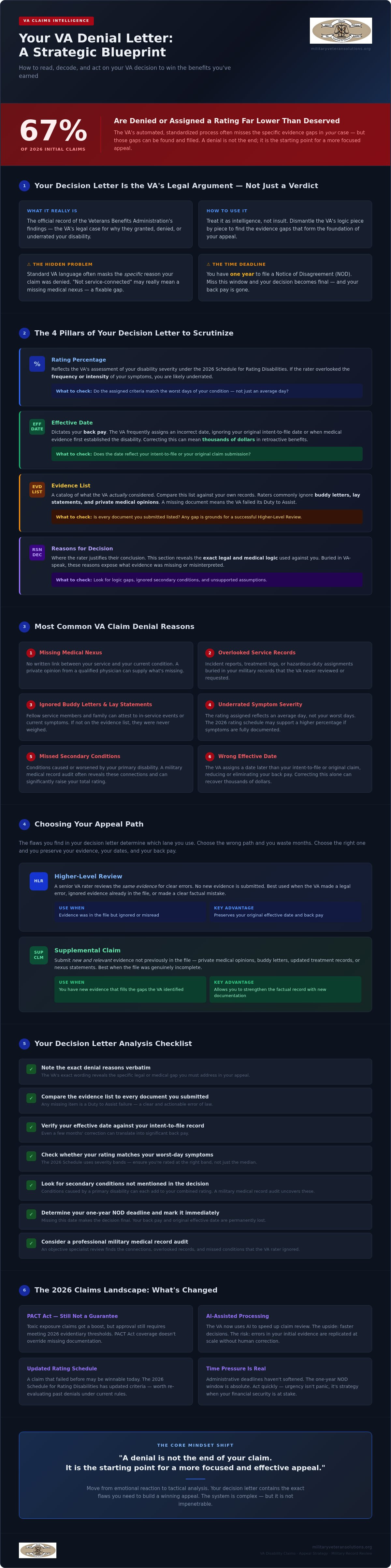
Your decision letter is not just a verdict; it is a strategic roadmap for your appeal. To navigate it effectively, you must scrutinize four specific pillars: the rating percentage, the effective date, the evidence list, and the reasons for decision. Any discrepancy in these sections can be the key to overturning a denial. Errors in these areas provide the legal grounds for a successful challenge.
The rating percentage reflects the VA’s assessment of your disability severity under the 2026 Schedule for Rating Disabilities. If the rater overlooked the frequency or intensity of your symptoms, you might be underrated. The effective date is equally critical because it dictates your back pay. The VA often assigns an incorrect date, failing to account for your original intent to file or the date your medical evidence first established the disability. Correcting an effective date can result in thousands of dollars in retroactive benefits.
The Evidence List Audit
The evidence list is a catalog of what the VA actually considered when making their decision. You must compare this list against your own records or a professional military record review to find gaps. It is surprisingly common for raters to ignore buddy letters, lay statements, or private medical opinions. If a critical document you submitted is missing from this list, the VA has failed in its duty to evaluate your claim fully. This omission is among the top VA claim denial reasons that lead to successful Higher-Level Reviews.
Decoding the Reasons for Decision
This section is where the rater justifies their findings. You need to look for the specific "missing link" they cited. Often, this is a lack of a medical nexus. In 2026, the VA has specific symptom thresholds that must be met for certain ratings. You must also verify if the rater correctly applied PACT Act presumptive service connection rules. If you were exposed to burn pits or other toxins, the law might already presume your condition is service-connected. If the VA ignored these presumptions, you should immediately explore VA decision review and appeal options.
Understanding these VA claim denial reasons allows you to target your appeal evidence precisely. Identifying these legal and factual errors is the first step in building a winning strategy. If you need an expert eye to spot these subtle mistakes, a virtual consultation can help you uncover exactly what the rater missed.
Identifying Critical Errors and Evidence Gaps
Veterans can now access their disability decisions within minutes of a rater's final signature. However, speed doesn't guarantee accuracy. Many individuals find that the VA failed in its "Duty to Assist." This legal requirement mandates that the VA gathers relevant federal records on your behalf. If they didn't obtain your service treatment records or ignored recent private medical reports, they've committed a reversible error. This failure is a common driver behind many VA claim denial reasons that can be overturned on appeal.
Compensation and Pension (C&P) exams are another frequent point of failure. Examiners often rush through the process. They might record how you feel on a "good day" while ignoring the debilitating flares that happen on your worst days. If your decision letter ignores the frequency or severity of your symptoms as documented in your military records, the exam was likely inadequate. You should watch for these specific exam errors:
- The examiner failed to review your complete C-File before the appointment.
- They didn't use a goniometer to measure your actual range of motion.
- They ignored functional loss or pain during movement.
The Nexus Gap Analysis
The Nexus is the medical bridge between your current diagnosis and your military service. Without this link, your claim will fail. In fact, a missing nexus is the #1 reason for VA claim denials across all branches in 2026. You should use your decision letter to determine if the rater acknowledged your diagnosis but simply couldn't find the "bridge" to your time in uniform. If the letter states your condition is "not service-connected," you likely need a formal Nexus Letter from a medical professional to fill this evidentiary hole. This document serves as the expert medical opinion that connects your current health struggles to your past service events.
Logical Inconsistencies in VA Reasoning
Sometimes the VA's own logic collapses under scrutiny. You might find that their conclusion directly contradicts the evidence list they provided. For example, they might acknowledge a buddy statement in the list but then claim there is "no evidence of an in-service event." These boilerplate denials are frustrating. They treat your unique history as a generic template. Utilizing expert VA claim assistance allows you to flag these inconsistencies for a Higher-Level Reviewer. We also look for "pyramiding" errors, where the VA fails to combine ratings correctly or ignores secondary conditions that stem from your primary injury. Don't let a rater's oversight become your permanent reality.
Transforming Analysis into an Appeal Strategy
Once you’ve identified the specific VA claim denial reasons in your letter, you must pivot to a targeted offensive. You can’t just tell the VA they’re wrong. You have to categorize their mistake. Was it a factual error where they missed a date? Was it a legal error where they ignored a presumptive condition? Or was it an evidentiary gap where your medical records weren't sufficient? Knowing the type of error dictates your next move. This classification is the foundation of a winning strategy.
Your analysis leads to a critical decision: choosing the right appeal lane. If the evidence was already in your file but the rater simply made a mistake, a Higher-Level Review (HLR) is often the fastest path to correction. However, if your letter highlights a missing nexus or a lack of current symptoms, you must file a Supplemental Claim. This requires "New and Relevant" evidence that the VA hasn't seen before. Gathering this evidence is a deliberate process. You might need a new medical opinion, buddy statements, or a more thorough record audit to plug the holes the rater identified.
Higher-Level Review (HLR) vs. Supplemental Claims
An HLR is a closed-record review. A senior rater looks at the exact same evidence to find clear legal errors or "Duty to Assist" failures. In 2026, HLRs average about 125 days for a decision. If your letter shows the VA had the proof but ignored it, this is your lane. Conversely, a Supplemental Claim allows you to submit new proof. This lane is currently moving faster, with an average processing time of 58.8 days. Seeking filing VA appeals help early ensures you don't waste months in the wrong lane while your benefits hang in the balance.
The Timeline of a Successful Appeal
You have exactly one year from the date of your decision letter to file your appeal. This 365-day window is non-negotiable if you want to preserve your effective date. Missing this deadline means losing out on potential back pay, which can be substantial given the 2.8% COLA adjustment that took effect in late 2025. Don't wait until day 360 to start your strategy. The 2026 processing landscape favors those who act with precision and speed. Once you've gathered your evidence, draft a clear Statement in Support of Claim (Form 21-4138). Use this form to point the rater directly to the evidence they missed. If you're overwhelmed by the technicalities, schedule a virtual consultation to build a strategy that protects your interests.
Why Professional Decision Letter Analysis Matters
Deciphering VA claim denial reasons requires more than a casual glance at a few pages of text. It demands a forensic medical record audit. While the VA’s automated systems are designed for efficiency, they frequently overlook the nuances of a veteran’s unique history. A professional analysis goes beyond the surface. We don't just read the letter; we cross-reference every statement against your service medical records and current clinical findings to find where the rater went off track. This level of scrutiny ensures that no detail is left to chance.
One of the most significant advantages of expert representation is the discovery of secondary conditions. Many veterans focus solely on their primary injury, but a seasoned advocate identifies how that injury has caused additional health issues over time. For example, a service-connected knee injury often leads to back problems or depression due to chronic pain. These secondary links are frequently the difference between a 30% rating and a much higher entitlement. We look for the connections that the VA’s rater missed or ignored during their initial review.
The Advantage of a Veteran-Owned Perspective
Military Veteran Solutions, LLC is veteran-owned and operated. Founded by a 10-year Army veteran, our firm brings over 25 years of advocacy experience to your case. This isn't just about paperwork; it's a peer-to-peer commitment. We’ve navigated the same administrative hurdles you’re facing now. VSOs often manage massive caseloads that prevent them from performing the deep-dive audits necessary for complex appeals. We take the time to conduct thorough military medical record audits that identify the evidence gaps VSOs often overlook. You deserve an ally who understands the gravity of your service and the technicalities of the system.
Taking the Next Step Toward Your Entitlements
The path from a frustrating denial to understanding how to combine VA disability ratings for 100% starts with a single, informed step. You don't have to face the system alone. Before your virtual consultation, ensure you have your decision letter and your most recent medical records ready. This preparation allows us to provide an exhaustive analysis from the very first minute. We help you identify the VA claim denial reasons that are most vulnerable to a challenge and build a strategy that protects your original effective date. Your service-earned benefits are a right, not a suggestion. Don't let a single letter be the final word on what you're owed. Reach out today to secure the dedicated advocacy you need to win.
Secure the Benefits Your Service Has Earned
Your VA decision letter is more than just a notification of your current rating; it's the tactical blueprint for your eventual victory. By meticulously auditing the evidence list and decoding the rater's specific logic, you transform a discouraging denial into a focused strategy for appeal. Understanding the precise VA claim denial reasons buried in technical jargon is the only way to identify the missing nexus or "Duty to Assist" errors that stand between you and your correct disability percentage.
Don't let the complexity of the 2026 claims process prevent you from receiving the support you deserve. As a veteran-owned advocacy firm with over 25 years of combined experience, we specialize in identifying the evidence gaps that others overlook. We provide the professional expertise and deep-seated empathy required to navigate these administrative hurdles. Take the next step in your journey by choosing to Get a Professional VA Decision Letter Analysis Today. With virtual consultations available nationwide, we're ready to serve as your dedicated ally. You've already done the hard work of serving our country. Now, let us help you ensure the system finally honors that commitment with the benefits you've earned.
Frequently Asked Questions
What is the most important part of a VA decision letter?
The "Reasons for Decision" section is the most critical part of your VA decision letter. This section provides the legal and factual justification for the VA's findings. It's where you'll find the specific logic used by the rater and identify the exact evidence gaps that led to your result. By scrutinizing this text, you can pinpoint VA claim denial reasons and build a targeted strategy to overturn the decision during an appeal.
How long do I have to appeal a VA decision in 2026?
You generally have exactly one year from the date printed on your decision letter to file an appeal in 2026. This timeline applies to both Supplemental Claims and Higher-Level Reviews. If you're appealing a final Board of Veterans' Appeals decision to the U.S. Court of Appeals for Veterans Claims, you must act within 120 days. Missing these windows can cost you thousands in back pay and force you to restart the entire process from scratch.
What does 'service connection denied' actually mean?
A 'service connection denied' status means the VA acknowledges you have a medical diagnosis but doesn't believe it's linked to your time in uniform. This often happens because your file lacks a medical nexus, which is the bridge connecting your current health to an in-service event. It's one of the most common VA claim denial reasons. You must provide a formal medical opinion to prove your condition was caused or aggravated by your military service.
Can I submit new evidence during a Higher-Level Review?
You cannot submit any new evidence during a Higher-Level Review. This lane is a closed-record review where a senior rater looks only at the evidence that was present when the initial decision was made. If you've discovered new medical records or have a fresh nexus letter, you must choose the Supplemental Claim lane instead. Choosing the wrong lane can lead to unnecessary delays in receiving your earned disability compensation and potential back pay.
What is a 'Duty to Assist' error in a VA claim?
A 'Duty to Assist' error occurs when the VA fails to fulfill its legal obligation to help you gather relevant records. This includes missing service treatment records, personnel files, or federal medical reports that could support your claim. If the rater made a decision without obtaining these documents, they've committed a procedural mistake. Identifying these errors during a decision letter analysis often provides the leverage needed to win a Higher-Level Review and secure a new exam.
How do I know if my effective date is correct?
Your effective date is usually the date the VA received your claim or the date your disability first arose, whichever is later. You can verify this by checking your Intent to File records. The VA frequently assigns the date of the C&P exam rather than the actual filing date, which can result in missed back pay. Review your service records and filing history to ensure your date aligns with your original claim submission to maximize your 2026 benefits.
Should I hire a professional for a VA decision letter analysis?
Hiring a professional for analysis is vital because experts identify secondary conditions and evidence gaps that most veterans miss. Military Veteran Solutions, LLC uses over 25 years of experience to conduct deep-dive military record audits. While VSOs are often overwhelmed, a specialized advocate provides a peer-to-peer review that uncovers hidden links to your service. This thoroughness ensures your appeal strategy is built on facts rather than guesswork or the VA's generic templates.
What happens if I miss the one-year appeal deadline?
If you miss the one-year appeal deadline, the VA's decision becomes final. You lose your original effective date and all potential back pay accumulated during the process. While you can sometimes reopen a claim by finding a Clear and Unmistakable Error, it's a much higher legal hurdle to clear. Most veterans are forced to start over with a new claim, meaning their benefits won't be retroactive to their initial service connection date.


