
A "presumptive" condition under the PACT Act isn’t a guaranteed check in your mailbox, and assuming otherwise is the fastest way to see your claim denied. You’ve likely heard that the pact act va changes made everything easier for veterans exposed to burn pits and toxins. However, you’re probably still staring at a list of over 20 new conditions and wondering how to prove your service connection without getting lost in the bureaucracy. It’s exhausting to feel like you’re fighting a second war against a mountain of paperwork just to access the healthcare you earned. We understand that frustration because we’ve seen how easily the system overlooks the fine details of a soldier's history.
This 2026 guide will help you master the complexities of toxic exposure regulations so you can secure the benefits you deserve. You’ll gain a clear understanding of PACT Act eligibility and a tactical strategy for filing or appealing a claim. We’ll also explore how an exhaustive analysis of your military records can uncover the evidence needed to reach your maximum disability rating. It’s time to move past the confusion and take a methodical path toward the resolution you've been waiting for.
Key Takeaways
- Learn how the SFC Heath Robinson Act simplifies your claim by removing the need for a medical nexus for specific conditions.
- Identify if your respiratory illness or cancer falls under the 20+ new presumptive conditions and locations added by the pact act va.
- Discover why a diagnosis alone isn't enough and how to avoid the common pitfalls that lead to VA claim denials.
- Develop a tactical strategy for auditing your military records to uncover the specific "boots on the ground" evidence the VA often overlooks.
- Understand how professional advocacy and decision letter analysis can turn a denied claim into a successful appeal.
Understanding the PACT Act and Your VA Entitlements
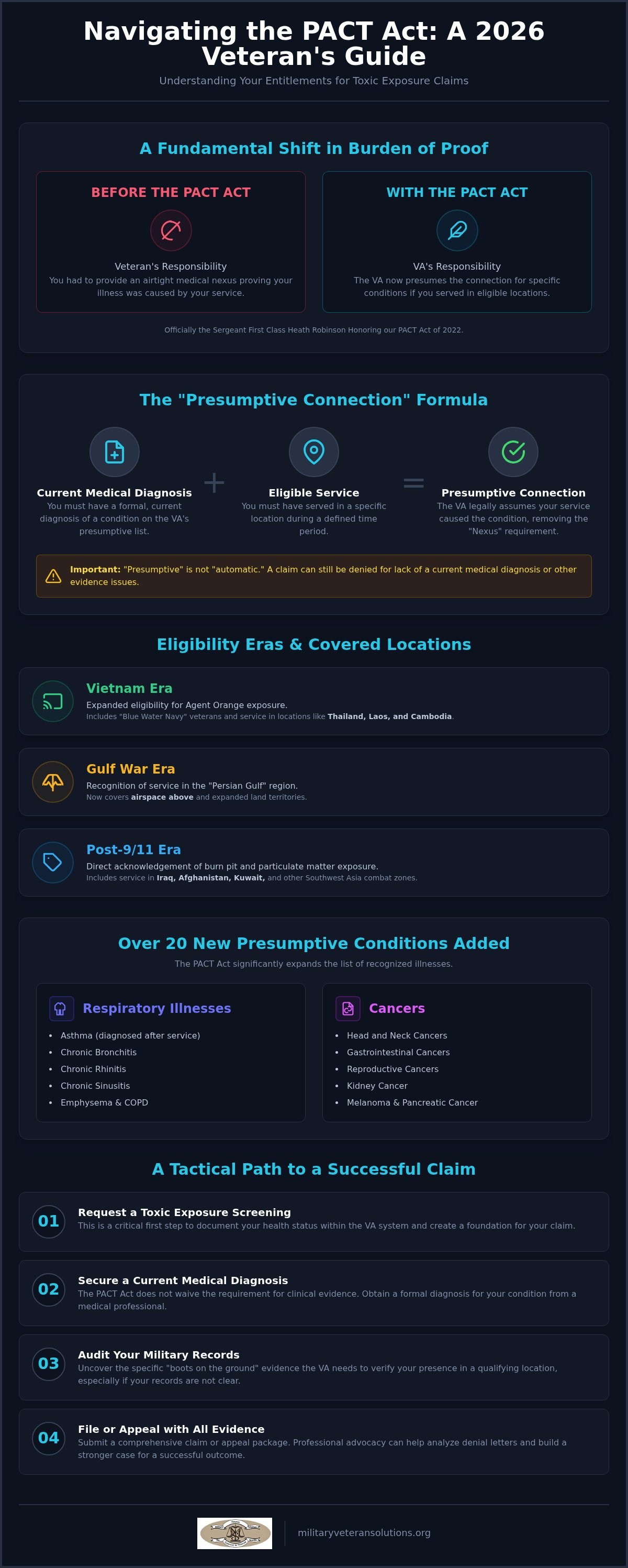
The Honoring our PACT Act of 2022, officially known as the Sergeant First Class Heath Robinson Act, represents the most significant expansion of veteran healthcare in decades. By 2026, the full scope of this law has fundamentally changed how the VA processes toxic exposure claims. It moves the burden of proof away from the veteran and onto the system. In the past, you had to provide an airtight medical nexus to prove your illness was caused by your service. Now, for specific conditions, the VA assumes the connection exists if you served in certain locations at certain times. This shift from a proven connection to a presumptive connection is designed to automate eligibility, but it isn't always a smooth process.
What Does "Presumptive Condition" Actually Mean?
A presumptive condition is a legal shortcut that works in your favor. If you have a diagnosis for a condition on the approved list and served in an eligible location, the law presumes your service caused the illness. You don't need a doctor to write a complex letter explaining the "how" or "why." This removes the "Nexus" requirement that has historically led to thousands of claim denials. However, don't mistake this for automatic approval. The VA still requires a formal, current medical diagnosis. Understanding this distinction is vital because while the pact act va rules simplify the legal link, they don't waive the requirement for clinical evidence of the condition itself. We've seen many veterans assume the VA will find the diagnosis for them, only to face a denial for lack of current evidence.
Eligibility Eras: From Agent Orange to Burn Pits
The expansion covers generations of service members, addressing decades of overlooked exposures. For Vietnam veterans, the law now includes expanded locations like Thailand, Laos, and Cambodia, finally acknowledging exposure to Agent Orange outside of Vietnam's borders. For Gulf War and Post-9/11 veterans, the focus shifts to burn pits and particulate matter. This matters because it opens doors for veterans who were previously told their service locations didn't qualify for benefits.
- Vietnam Era: Expanded "Blue Water Navy" and border locations in Southeast Asia.
- Gulf War: Recognition of service in the "Persian Gulf" now includes air space and expanded land territories.
- Post-9/11: Direct acknowledgement of burn pit exposure in Iraq, Afghanistan, and other combat zones.
Requesting a toxic exposure screening is a critical first step for any veteran serving in these eras. These screenings help document your health status in the VA system, creating a foundation for future claims. As we move through 2026, the opportunity for backdated pay remains a primary motivator for many, making it essential to file correctly the first time. The pact act va framework is a powerful tool, but you must use it with a tactical understanding of how the VA evaluates these eras of service.
Presumptive Conditions and Toxic Exposure Locations
The PACT Act added more than 20 new presumptive conditions to the VA's list, but qualifying requires looking at both your diagnosis and your service location. The law specifically targets veterans who served in the Southwest Asia theater or other designated toxic exposure zones. If you served in Iraq, Afghanistan, Kuwait, or even the airspace above these regions, you may be eligible. You can find the full official list of locations and dates on the VA website under The PACT Act And Your VA Benefits. This expansion also extends critical support to survivors. Families of deceased veterans who suffered from these conditions can now file for Dependency and Indemnity Compensation (DIC). This ensures that the legacy of service is honored through lasting financial security for the people you love most.
Respiratory Illnesses and Particulate Matter
Service in Southwest Asia involved breathing in particulate matter from burn pits, sandstorms, and industrial fires. The pact act va guidelines now include chronic bronchitis, emphysema, and asthma diagnosed after service. Many veterans also suffer from chronic rhinitis or sinusitis. Previously, these were hard to link to service. Now, with a current diagnosis and qualifying service location, the connection is presumed. If your deployment locations aren't clearly documented, a professional military record review can verify your "boots on the ground" status.
Cancers Linked to Toxic Exposure
Gastrointestinal, head, neck, and reproductive cancers are now presumed service-connected. This includes any type of stomach or colon cancer. The VA prioritizes these claims for expedited processing because of their severity. While the nexus is presumed, you still need clear medical records showing the specific malignancy. Your disability rating will depend on the severity and treatment of the cancer. Ensuring your records are exhaustive is the best way to secure your pact act va benefits and protect your family's future.
- Gastrointestinal Cancers: Including colon, liver, and pancreatic cancers.
- Head and Neck Cancers: Such as nasopharyngeal or oropharyngeal types.
- Reproductive Cancers: Including urethral and prostatic cancers.
- Kidney and Bladder Cancers: Often linked to chemical and heavy metal exposure.
Why the VA Denies PACT Act Claims (and How to Fight Back)
Many veterans believe that "presumptive" is synonymous with "automatic." This is a dangerous misconception. While the law simplifies the path to PACT Act VA Benefits, the VA still denies thousands of claims every month. They don't just hand out ratings because you served in a specific zip code. You still have to meet the technical requirements of the law. If your decision letter arrived with a "denied" status, it's likely due to a failure in documentation rather than a lack of eligibility. You need a tactical plan to overcome these administrative hurdles.
The most frequent reason for denial is a lack of qualifying service evidence. Your DD-214 might show you were in the "Southwest Asia theater," but it might not list the specific base or dates required for certain pact act va presumptions. Another hurdle is the "Presumptive Myth." Just because the VA assumes a link doesn't mean they assume you have the illness. If you don't have a current, formal diagnosis from a medical professional, the claim will fail before it even reaches the nexus stage. We've seen many veterans lose their cases because they assumed the VA's duty to assist would fill in the gaps for them.
The Importance of a Formal Medical Diagnosis
The VA does not compensate for symptoms; they compensate for diagnosed conditions. Chronic coughing, shortness of breath, or sinus pressure are symptoms. Asthma, COPD, and Chronic Rhinitis are conditions. If you file a claim stating you "can't breathe well since Iraq," the VA will likely deny it for lack of a diagnosis. You must secure a clinical diagnosis from a doctor before you submit your paperwork. This bridges the gap between your military service and your current health status. It transforms a vague complaint into a compensable legal claim that the pact act va framework can actually support.
When "Presumptive" Isn’t Enough: Rebuttable Presumptions
A presumption is "rebuttable," meaning the VA can argue against it. If they find evidence that your condition was caused by something other than service, they can deny the claim. For example, if you have a respiratory condition but have a long history of heavy smoking, the VA might argue that your lifestyle, not burn pits, caused the damage. This is where strategic advocacy becomes essential. You need a PACT Act claim denied appeal strategy that analyzes your decision letter and rebuts the VA's arguments with evidence. Don't let them use your post-service life to invalidate the sacrifices you made in uniform. We specialize in finding the evidence that keeps your presumptive status intact.
Building Winning Evidence: Record Reviews and Nexus Strategies
Winning a claim is about the strength of your paper trail, not just the validity of your illness. While the pact act va framework simplifies the connection for many, the VA still requires specific evidence to trigger those presumptions. You must approach your claim with a tactical mindset. This begins with a professional military record review to ensure your service dates and locations align perfectly with the law's requirements. Don't rely on the VA to find the "boots on the ground" evidence for you. They often overlook fine details in personnel files that could be the difference between a 0% and a 100% rating. If you've already received a denial, your first step is to analyze that decision letter for specific legal errors or missing evidence that can be corrected in an appeal.
Uncovering Hidden Evidence in Military Records
Many veterans were exposed to toxins that aren't listed on a standard deployment record. Your Military Occupational Specialty (MOS) often holds the key to winning a claim. If you worked with fuels, solvents, or specialized equipment, your personnel file may contain "unreported" exposure events that the VA's automated systems miss. Our VA decision letter review service specializes in finding these winning details. We perform an exhaustive analysis of your records to uncover MOS-specific hazards, such as radiation or chemical exposure, that provide a secondary path to service connection when the standard presumptive list falls short.
Secondary Service Connection and the PACT Act
One of the most effective ways to maximize your disability rating is by identifying secondary conditions. The pact act va rules primarily cover direct presumptions, but many veterans suffer from "secondary" illnesses caused or aggravated by those primary conditions. For example, chronic rhinitis or asthma can often lead to sleep apnea. While sleep apnea isn't a PACT Act presumptive, it can be linked to a presumptive respiratory condition through a nexus letter. This is known as the "Aggravation" rule. If your toxic exposure made a pre-existing condition worse, you're entitled to compensation for that increase in severity. Stacking these secondary conditions allows you to reach a higher overall rating that truly reflects the impact of your service on your health.
Ready to uncover the evidence hidden in your files? Contact us for a virtual consultation to begin your comprehensive record audit today.
Professional Advocacy for Your PACT Act Appeal
Managing the VA system alone is a daunting task. Many veterans turn to VSOs, but these representatives are often overwhelmed by the sheer volume of claims filed since the law passed. When your case involves complex toxic exposure or a history of multiple denials, you need dedicated veteran advocacy services. We don't just fill out forms. We perform a deep-dive analysis of your VA decision letters to identify exactly where the rater missed the mark. Our goal is to transform your denial into a granted entitlement by speaking the VA's language of evidence and law. You've fought for your country; now we'll fight for your benefits.
The Military Veteran Solutions Advantage
We bring a veteran-owned perspective with over 25 years of experience to every case. We understand the high stakes because we've lived them. Our process focuses on exhaustive military record reviews that uncover hidden exposure events the VA often overlooks. We don't settle for surface-level summaries. Instead, we look for MOS-specific hazards and "unreported" incidents that provide the missing link in your pact act va claim. This level of detail-oriented advocacy is designed to drive the VA toward a favorable decision. You deserve a powerful ally who understands the technicalities of the system but remains independent of it to serve your best interests.
Starting Your PACT Act Appeal Today
Time is a critical factor in your appeal. Moving from a denial to a success requires a strategic approach. You can initiate this process by scheduling a filing VA appeals help consultation. We offer virtual consultations nationwide, ensuring you have access to expert representation regardless of your location. To prepare, gather your most recent decision letter and any medical records from the last 12 months. In 2026, the potential for significant back pay remains high for those who file correctly. We'll help you move through the pact act va timeline to ensure you don't miss out on the benefits you earned through your service. Let's start building your winning case now.
- Expert Analysis: We break down the legal language in your denial letter to find the path forward.
- National Reach: Virtual consultations allow us to serve veterans in every state.
- Targeted Results: We focus on the specific evidence needed to overturn "rebuttable" presumptions.
Take Command of Your Toxic Exposure Benefits
Securing the benefits you earned through your service requires more than just meeting basic eligibility criteria. You've learned that while the pact act va framework simplifies the legal link for many conditions, a successful claim still depends on a precise medical diagnosis and exhaustive proof of service. The system often overlooks the fine details of your military history; however, those details are exactly what turn a denial into a granted entitlement. You've fought for your country. Now it's time to ensure the system honors that sacrifice with the healthcare and compensation you deserve.
Military Veteran Solutions, LLC stands as a powerful ally in this daunting administrative environment. With over 25 years of veteran advocacy experience, we specialize in uncovering the hidden evidence in your military records that the VA often misses. We offer virtual consultations nationwide to provide the dedicated representation your case requires. Secure the benefits you earned; schedule your PACT Act claim consultation today. Your health and your family's future are too important to leave to chance. Take the next step toward the resolution you've been waiting for. You don't have to navigate this path alone.
Frequently Asked Questions
Is the PACT Act still accepting new claims in 2026?
Yes, the VA continues to accept new claims under this legislation throughout 2026. There is no set expiration date for filing a claim for pact act va benefits. However, filing sooner rather than later is critical to establish an earlier effective date for your compensation. Whether you are filing for the first time or seeking an increase for a worsening condition, the window remains open for all eligible veterans and their survivors.
What cancers are covered under the PACT Act presumptive list?
The list includes over a dozen types of cancers now presumed to be service-connected. These include brain cancer, gastrointestinal cancers of any type, and various reproductive cancers such as prostate or urethral cancer. Other covered malignancies include head and neck cancers, kidney cancer, and lymphoma. If you served in a qualifying location and have a diagnosis for any of these, the VA assumes the toxic exposure caused the condition.
Can I appeal a PACT Act denial if I was rejected before the law passed?
You can certainly re-file your claim if it was previously denied before the law was enacted. The VA is required to review these cases under the new presumptive standards. This is a significant opportunity for veterans who were told years ago that their condition wasn't service-connected. Using a professional VA decision letter analysis can help identify the best path for your appeal to ensure the new rules are applied correctly.
How much back pay can I get for a PACT Act claim?
Back pay is generally calculated from the date you filed your claim or the date the law was signed in August 2022. The exact amount depends on your assigned disability rating and your effective date. Some veterans may be eligible for years of retroactive payments if they had a pending claim or filed within specific windows. We recommend a thorough review of your decision letter to ensure the VA assigned the correct effective date.
Do I need a Nexus Letter if my condition is on the presumptive list?
You don't technically need a nexus letter for conditions explicitly on the presumptive list. The law creates a legal shortcut that assumes the connection for you. However, you still need a current medical diagnosis. A nexus letter becomes vital if you are trying to link a non-presumptive condition, like sleep apnea, as a secondary illness to a pact act va presumptive condition. Strategic documentation is always your best defense against denials.
What happens if the VA says my toxic exposure isn’t "service-connected"?
This statement is a formal denial that requires a tactical appeal. It often means the VA rater did not find sufficient evidence of your "boots on the ground" service in a qualifying location. We use exhaustive military record reviews to uncover hidden evidence of your deployment or MOS-specific exposures. By identifying these overlooked details, we can provide the proof needed to overturn the VA’s finding and establish the service connection you earned.
Can survivors file for PACT Act benefits for a deceased veteran?
Survivors are eligible to file for Dependency and Indemnity Compensation (DIC) if a veteran died from a condition now covered by the act. This includes cases where a claim was previously denied while the veteran was still alive. These benefits provide monthly tax-free payments to eligible spouses, children, or parents. It is a vital way to secure the financial future of your family while finally acknowledging the veteran’s toxic exposure during their service.
How long does it take for the VA to process a PACT Act appeal in 2026?
Processing times in 2026 vary based on the type of appeal lane you choose. Supplemental claims and Higher-Level Reviews typically move faster than Board of Veterans' Appeals cases. While the VA has hired more staff to handle the influx, the complexity of toxic exposure cases can still lead to delays. A methodical approach and well-organized evidence can help prevent unnecessary requests for more information, which often slows down the final decision process.


