
The VA doesn't rate your hearing based on how much you struggle to follow a conversation; they rate it based on a grid of numbers that often ignores your reality. It's incredibly frustrating to walk out of a C&P exam feeling like the audiologist didn't hear a word you said about your daily life. You know the ringing is constant and the world sounds muffled, yet the decision letter arrives with a 0% rating that blames your age instead of your service. We at Military Veteran Solutions, LLC understand that this feels like a dismissal of your sacrifice, but appealing a low VA rating for hearing loss is often a matter of technical record-review rather than just medical opinion.
In this guide, we'll show you how to master the specific math used in 2026 to calculate your disability. You'll learn how to identify common rater errors in your decision letter, understand the exact decibel thresholds required for a higher rating, and discover how secondary conditions can finally move the needle on your total compensation. It's time to stop guessing and start using a strategy built on data and dedicated advocacy to secure the relief you deserve.
Key Takeaways
- Understand why the Maryland CNC speech discrimination test is the primary gatekeeper for your rating and how word recognition scores impact your claim.
- Learn the specific strategies for appealing low va rating for hearing loss by identifying errors in how the VA maps your "better ear" against your "poorer ear."
- Discover how to overcome the "normal for your age" trap by auditing your service records for specific noise exposure events and temporary threshold shifts.
- Identify the long-term value of a 0% non-compensable rating as a vital foundation for future increases and secondary service connections.
- Maximize your total compensation by learning to link hearing loss to secondary conditions like tinnitus, anxiety, and social isolation.
What Is the Hearing Loss VA Rating and How Is It Tested?
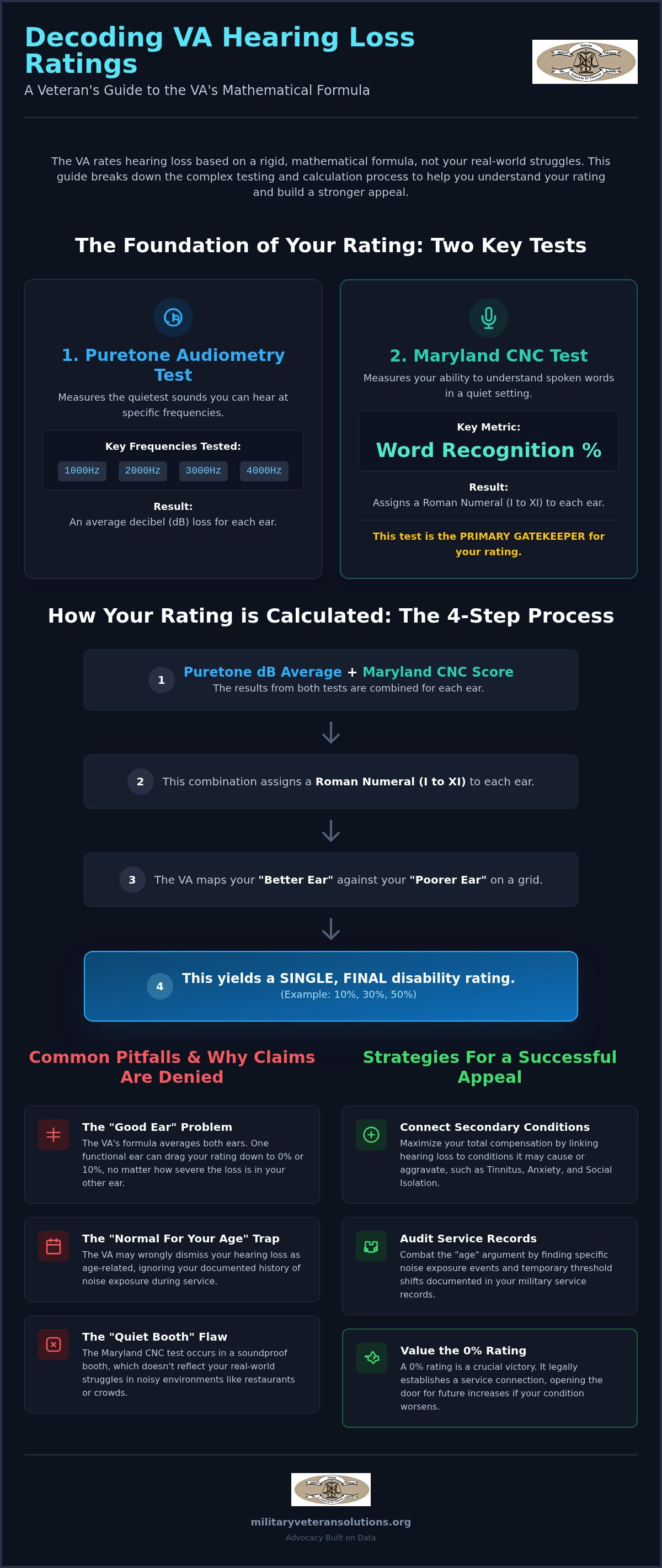
The VA doesn't determine your disability based on how often you ask people to repeat themselves or how loud you turn up the television. They rely on a rigid, mathematical formula. A disability rating for hearing loss is determined by combining your puretone thresholds with your speech discrimination scores. If your private doctor simply writes a letter stating you have "severe hearing loss," the Veterans Benefits Administration (VBA) will likely ignore it. They require evidence gathered through specific testing formats that follow 38 CFR § 4.85. Without the exact Maryland CNC and puretone data, your claim is almost certain to fail. This technicality is often the first hurdle when appealing low va rating for hearing loss.
The Puretone Audiometry Test Explained
Puretone audiometry is the measurement of the quietest sounds a veteran can hear at specific frequencies. During a C&P exam, an audiologist tests your hearing at the 1000, 2000, 3000, and 4000 Hz levels. These specific pitches are critical because the VA averages them to find your puretone threshold for each ear. Your average decibel loss must hit specific, high thresholds to move beyond a 0% non-compensable rating. If your average is even one decibel below the VA’s grid, you won't receive monthly compensation. We often find that a detailed record review reveals the VA used the wrong frequencies or miscalculated the average, which provides a clear path for an appeal.
Speech Discrimination: The Maryland CNC Test
The Maryland CNC (Consonant-Nucleus-Consonant) test acts as the gatekeeper for your compensation level. This test measures your ability to understand spoken words in a controlled, silent environment. It's often the most frustrating part of the process for veterans. You might struggle to follow a conversation in a busy restaurant, but because the test happens in a soundproof booth, your scores might look "normal" to a rater. Your word recognition percentage determines a Roman Numeral designation from I to XI for each ear. A low speech discrimination score can trigger a compensable rating even if your decibel loss is relatively moderate. Common pitfalls during the exam include the audiologist reading the word list too clearly or failing to account for the "functional gap" between the booth and the real world. Identifying these discrepancies is essential when appealing low va rating for hearing loss to ensure your rating actually reflects your level of impairment.
The 2026 VA Hearing Loss Rating Schedule
The VA doesn't look at your hearing as two separate ears; they evaluate your auditory system as a single, bilateral function. When you receive VA disability compensation, the amount is dictated by Table VI and Table VII in the federal rating schedule. These tables act as a grid where your "better ear" is mapped against your "poorer ear" to find a single percentage. This system is notoriously stingy. It's common for a veteran to have significant trouble in one ear but receive a 0% rating because the other ear still performs well within the VA’s narrow parameters. Appealing low va rating for hearing loss requires a deep dive into these tables to see if the rater correctly plotted your test results.
Breaking Down Roman Numeral Designations
The first step in the VA's process is assigning a Roman numeral, ranging from I to XI, to each ear. This numeral is a composite score derived from the intersection of your puretone threshold average and your Maryland CNC speech discrimination percentage. For example, if your speech discrimination is 92% but your puretone average is 55 decibels, you might be assigned a Roman Numeral III. The VA then takes the Roman numeral for your better ear and matches it against the Roman numeral for your poorer ear on a master grid. If you have one "normal" ear (Numeral I), it's very difficult to get a rating higher than 10%, even if your other ear is completely deaf. This "averaging" effect is the primary reason many veterans feel their rating doesn't match their daily struggle.
The Reality of the 100% Hearing Rating
Total disability for hearing loss is exceptionally rare. To hit the 100% mark, a veteran typically must demonstrate near-total deafness in both ears, often with 0% speech discrimination. The VA rates hearing loss as a single bilateral disability rather than two separate ear conditions, which limits the total possible compensation for most. Most compensable ratings fall into the 10%, 30%, or 50% brackets. If you find yourself stuck at a 0% non-compensable level, don't view it as a total loss. A 0% rating is a legal acknowledgment that your hearing loss is service-connected. This makes it much easier to file for an increase later or to link secondary conditions like anxiety or depression to your claim. You can use va claim assistance to help you estimate where your current scores should land on the master grid. If the math doesn't add up, a professional record review can identify the specific rater errors needed to overturn the decision.
Why the VA Denies Hearing Loss Claims: The 'Normal Hearing' Trap
The "Normal for Your Age" excuse is one of the most common ways the VA dismisses legitimate service-related damage. Many veterans receive a decision letter stating their hearing loss is simply a result of aging, which effectively ignores years of exposure to jet engines, gunfire, or heavy machinery. This creates a massive clinical vs. functional gap. You might "pass" a VA booth test in a silent environment, but you still struggle to hear your spouse or follow a conversation in a crowded room. If you've been denied, a thorough VA decision letter analysis is the first step in identifying exactly where the rater went wrong. Most denials stem from a failure to establish a "nexus"-the medical link between your current impairment and your time in uniform.
Under the rules for VA Disability Compensation, the VA is required to consider the totality of your evidence. However, raters often take the path of least resistance. They might ignore your specific job duties or fail to acknowledge documented acoustic trauma in your files. Successfully appealing low va rating for hearing loss requires pointing out these specific oversights with surgical precision.
Common Rater Errors in Hearing Claims
Raters are human and they make mistakes, especially when dealing with the complex math of decibel thresholds. One frequent error is miscalculating the numeric average across the four required frequencies: 1000, 2000, 3000, and 4000 Hz. Even a small mathematical error can keep you at a 0% rating when you should be at 10% or higher. Additionally, many raters fail to apply the Duty MOS Noise Exposure Listing. If your job code is listed as having a "high" probability of noise exposure, the VA should concede that exposure occurred. Ignoring this listing or missing documented acoustic trauma in your Service Treatment Records (STRs) provides a clear basis for an appeal.
Overcoming the 'No Service Connection' Denial
Winning an appeal often means finding the evidence the VA overlooked. You don't have to rely solely on old audiograms. Buddy statements from fellow service members can document "temporary threshold shifts"-those moments after a specific blast or training event where your hearing was muffled or your ears wouldn't stop ringing. These statements provide the missing context for why your hearing began to degrade. A professional military record review service can dig into your personnel and medical files to find these "hidden" exposure events. When you are appealing low va rating for hearing loss, showing a continuous downward trend through post-service audiograms and linking them to your MOS is your strongest weapon to build a bridge between your service and your current struggle.
Tinnitus and Secondary Conditions: Maximizing Your Rating
A low rating for hearing loss doesn't have to be the end of your claim. For many veterans, a 0% or 10% hearing award is simply the starting point for a more comprehensive strategy. When you're appealing low va rating for hearing loss, you must look beyond the audiogram booth to the secondary effects of your service-connected damage. Tinnitus, the persistent ringing or buzzing in the ears, remains the most-claimed disability in the system. As of September 2026, over 3.2 million veterans receive compensation for this condition. Because it's a subjective symptom, it provides a unique opportunity to build a stronger foundation for your total rating even when your decibel loss fails to hit the VA's strict thresholds.
Tinnitus: The 10% Foundation
You can receive a 10% rating for tinnitus even if your hearing loss is rated at 0% non-compensable. This 10% rating currently provides a monthly payment of $180.42 for a veteran with no dependents. For those who served in high-noise MOS codes, such as flight deck operations or artillery, the VA often concedes that noise exposure occurred. However, you must still demonstrate that the tinnitus is "recurrent." Lay statements are vital here. They document the frequency and severity of the ringing in your daily life, providing evidence that clinical tests cannot capture. If the VA denied your initial claim, you should schedule a virtual consultation to identify the specific service records that prove your exposure.
Secondary Mental Health Claims
Communication barriers don't just affect your ears; they impact your mental health and social well-being. It's common for veterans with hearing loss to withdraw from family gatherings or experience social isolation because they can't follow the conversation. This struggle often leads to diagnosed depression or anxiety. These are valid secondary conditions that can be linked to your primary hearing impairment. To succeed, you'll need a medical nexus letter that clearly bridges the gap between your physical hearing loss and your psychological symptoms. Learning how to combine VA disability ratings is the most effective way to move from a low percentage to a total rating that actually reflects your level of struggle.
The 2026 landscape also brings new considerations for toxic exposure under the PACT Act. Certain chemicals and toxins found in burn pits are now recognized as ototoxic, meaning they can cause or aggravate auditory damage. If you served in a recognized exposure zone, your appeal should incorporate these environmental factors. By combining tinnitus, mental health secondaries, and toxic exposure evidence, you can overcome the VA's restrictive "math" and secure the maximum compensation allowed by law.
How to Win Your Hearing Loss Appeal in 2026
Winning a VA appeal in 2026 is less about re-stating your symptoms and more about proving a specific procedural or medical error. Appealing low va rating for hearing loss requires you to treat the decision letter as a technical roadmap. This document reveals exactly where the rater’s logic failed, whether they misapplied the rating schedule or overlooked a critical piece of evidence in your file. Once you identify the specific gap, you can choose the correct legal path to force a revision of your benefits.
The Power of a Professional Record Audit
VA raters are often overwhelmed by the sheer volume of Service Treatment Records (STRs), which leads to missed details. A professional audit looks for the "missing link" that proves your condition began during your service. This might be a single entry about a "temporary threshold shift" after a training exercise or a forgotten complaint about muffled hearing in your medical jacket. Military Veteran Solutions, LLC specializes in matching your specific job duties to the VA’s Noise Exposure Listing. This ensures your claim carries the appropriate weight, even if your exit audiogram didn't capture the full extent of the damage at the time.
Choosing Your Appeal Lane: HLR or Supplemental?
Your strategy for appealing low va rating for hearing loss depends entirely on the type of error you're correcting. If the VA had all your records but simply miscalculated the decibel averages or applied the wrong Roman numeral from Table VI, a Higher-Level Review (HLR) is the most efficient choice. This lane allows a senior rater to fix clear mistakes without you needing to provide new evidence. It’s a "closed record" review that focuses strictly on the application of the law.
If the denial was based on a lack of service connection or a "normal for your age" determination, you must use a Supplemental Claim. This lane allows you to introduce new and relevant evidence, such as a private audiogram or a detailed nexus letter from a specialist. This new data acts as a direct rebuttal to the VA’s initial findings. Stop settling for a rating that doesn't reflect your daily struggle. Get your VA decision letter analyzed by experts today to ensure your appeal is handled with the precision your service deserves.
Take Control of Your Auditory Claim Strategy
The path to a higher rating is paved with technical evidence, not just medical complaints. You've learned that the Maryland CNC test and puretone averages are the true gatekeepers of your compensation. While the VA's system is rigid, it's also predictable. When you identify the specific rater errors in your decision letter and link your hearing loss to secondary conditions like tinnitus or anxiety, the "math" starts to work in your favor. Successfully appealing low va rating for hearing loss is a strategic process that requires precision and persistence.
You don't have to navigate this complex administrative maze alone. As a veteran-owned and operated firm with 25+ years of advocacy experience, we understand the frustration of a low or 0% rating. We specialize in deep-dive technical record audits designed to uncover the noise exposure evidence the VA missed during the initial review. Secure the benefits you earned with a professional VA claim review today. Your service was significant, and your disability rating should finally reflect that reality.
Frequently Asked Questions
Can I get a VA rating for hearing loss if I already have hearing aids?
You can absolutely receive a disability rating even if you already use hearing aids. The VA conducts its testing without the use of any assistive devices to determine your natural auditory function. If your unaided results meet the specific decibel and speech discrimination thresholds, you qualify for compensation. Having hearing aids often serves as evidence that your condition is clinically significant, but it doesn't disqualify you from the rating process or the monthly benefits.
Is hearing loss a presumptive condition under the PACT Act in 2026?
Hearing loss is not a standalone presumptive condition under the PACT Act in 2026. However, the legislation acknowledges that exposure to certain toxins can be ototoxic, meaning they damage the ears. If you served in a recognized PACT Act location, you can use that toxic exposure as the medical link for your claim. This is a powerful tool when appealing low va rating for hearing loss because it provides a clear connection between your environment and your impairment.
Why did the VA give me a 0% rating for my hearing loss?
A 0% rating means the VA acknowledges your hearing loss is service-connected but believes it isn't severe enough for monthly payments. This happens when your puretone averages or speech discrimination scores fail to hit the specific thresholds in the VA rating grid. Even if you struggle in daily life, the VA relies solely on the Maryland CNC test results. A 0% rating is still a win because it establishes the legal foundation for future increases and secondary claims.
What is the maximum VA disability rating for hearing loss?
The maximum rating for hearing loss is 100%, but it's exceptionally rare to achieve. To reach this level, a veteran must demonstrate near-total deafness in both ears, often accompanied by a 0% speech discrimination score. Most veterans fall into the 0% to 50% range. Because the VA rates hearing as a single bilateral disability, they average the performance of both ears, which makes hitting the 100% threshold extremely difficult for anyone who isn't profoundly deaf.
Do I need a Nexus Letter for a hearing loss claim?
You typically need a nexus letter to bridge the gap between your current hearing loss and your military service. This is especially true if you've been out of the military for several years. A medical professional must state that it's "at least as likely as not" that your hearing damage was caused by noise exposure during your time in uniform. Without this specific link, the VA often defaults to blaming your age or post-service activities for the decline.
Can I claim hearing loss decades after I left the military?
You can file a claim for hearing loss at any time, regardless of how long you've been out of the military. There's no expiration date on your right to seek benefits. The challenge lies in proving the connection after so much time has passed. We focus on auditing your military records to find evidence of acoustic trauma or high-noise MOS assignments that establish the original injury, even if it took decades to become functionally disabling for you.
How does the VA combine hearing loss and tinnitus ratings?
The VA uses "VA Math" to combine these ratings rather than simply adding them together. If you have a 10% rating for hearing loss and a 10% rating for tinnitus, your combined rating is 19%, which rounds up to 20% total. Tinnitus is currently capped at a standalone 10% rating. When appealing low va rating for hearing loss, we often look for secondary conditions like anxiety or depression to help push your combined percentage into a higher bracket.
What happens if my hearing loss gets worse after my initial rating?
If your hearing continues to decline, you should file for a rating increase. You'll need to submit new audiometric evidence showing that your puretone thresholds or speech discrimination scores have dropped into a higher bracket on the VA's grid. You don't have to prove service connection again since that's already established. A new C&P exam will be scheduled to verify the current level of your impairment and adjust your monthly compensation to reflect the change.


