
A successful VA disability claim isn't built on the sheer volume of your medical records, but on the strategic analysis of the "Nexus" hidden within them. You’ve likely felt the sharp sting of a decision letter stating "no evidence found," even when you know your injuries are a direct result of your service. It's exhausting to search for military medical records that vanished decades ago, leaving you to fight a system that seems designed to overlook your sacrifice. We understand the frustration of being told your symptoms don't connect to your time in uniform. You are not alone in this fight.
You deserve a rating that accurately reflects your reality, especially as the 2026 COLA increase of 2.8 percent approaches. This article provides the clarity you need to audit your own records and identify the critical proof the VA missed. You'll learn how to leverage a buddy letter for VA claim to fill gaps in your official history and establish a rock-solid connection to service events. We are laying out a clear roadmap to help you secure the benefits you earned, moving past the confusion of decision letters toward the higher rating you deserve.
Key Takeaways
- Understand why systematic evidence analysis is the only way to transform a stack of medical records into a legally undeniable nexus for service connection.
- Identify the three pillars of a high-rating file by connecting your Service Treatment Records with current private medical evidence to prove ongoing severity.
- Learn how to strategically use a buddy letter for VA claim to provide essential eyewitness testimony for service events that were never officially documented.
- Discover the steps to audit your own C-File and cross-reference records to uncover claimable secondary conditions you may have previously ignored.
- Recognize how professional veteran-led advocacy navigates military jargon and complex VA regulations to secure the benefits your service truly warrants.
What is VA Claim Evidence Analysis and Why Does it Matter?
Evidence analysis is the systematic review of medical and service records to establish a legal link between your current disability and your military service. It's more than just a folder of papers; it's a strategic bridge. Many veterans assume that submitting every medical record they own will lead to success. This approach often backfires because it forces a rater to hunt for the truth. The Veterans Benefits Administration (VBA) requires a clear, logical connection. Without it, your claim is just a pile of data waiting for a denial letter.
There's a vital difference between relevant and competent evidence in the eyes of a rater. Relevant evidence relates directly to your condition. Competent evidence comes from a qualified source. A doctor provides competent medical evidence, while a fellow service member provides competent lay evidence through a buddy letter for VA claim. Analyzing these documents before filing allows you to find gaps that a rater will surely exploit. By identifying these holes early, you prevent the months of back and forth that usually follow a "no evidence found" decision. Analysis is your first line of defense against the backlog.
Moving Beyond the DD214
Your DD214 confirms your dates of service and discharge status. It's a vital document, but it rarely contains the specific details needed to prove a service connection. Raters look for probative value, which is the weight or persuasiveness of a piece of evidence. If your medical records are thin, a buddy letter for VA claim can provide the missing context of a specific training accident or combat event. Evidence analysis serves as a strategic bridge between your time in uniform and your current disability rating.
The 2026 Landscape of VA Evidence
As of September 2026, the evidentiary standards are more demanding than ever. While the average claim processing time has dropped to 80.7 days, this speed requires you to submit precise evidence from the start. PACT Act expansions have opened doors for toxic exposure claims, but they've also increased the need for specific medical coding. You must show that your condition meets the current 2026 criteria. Digital record access is faster now, but the VA's automated systems are less likely to look for nuances than a human rater. You must be explicit to win.
The Three Pillars of a Strong VA Evidence File
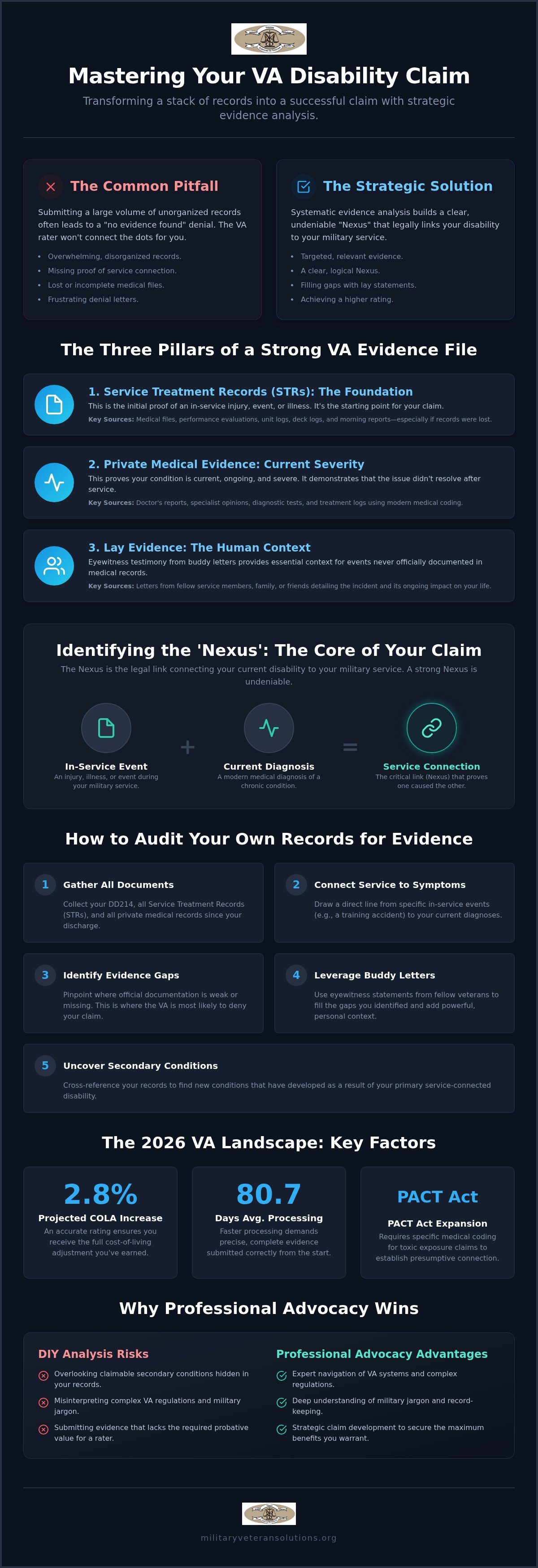
A solid VA claim is not a matter of luck. It's built on three structural pillars that prove your disability is real, current, and connected to your service. These pillars are Service Treatment Records (STRs), private medical evidence, and lay evidence. When these three elements work together, they form an undeniable narrative that forces the VA to take notice. If one pillar is weak, the entire claim risks collapse under the weight of a denial.
STRs are your foundation. They provide the initial proof of an event, injury, or illness that occurred while you were in uniform. However, thousands of veterans face the hurdle of records lost in the 1973 NPRC fire. If your records were destroyed, you must look for alternative evidence. Unit logs, deck logs, and morning reports can place you at the scene of an incident even when your personal medical file is empty. Analyzing these reports requires a meticulous eye, but it is often the only way to reconstruct a lost history.
Private medical evidence is the second pillar. It proves the current severity of your condition in 2026. The VA needs to see that your symptoms didn't stop when you took off the uniform. This evidence must be precise, using modern medical coding to meet the updated 2026 standards. If you are struggling to bridge the gap between your service and your current diagnosis, a Military Record Review can help identify the specific documentation you're missing.
Service Records: The Foundation of Service Connection
Don't limit your search to medical files. Performance evaluations often hold clues to a developing disability. A sudden drop in physical fitness scores or a change in behavioral marks can signal the onset of a condition. For those seeking benefits under the PACT Act in 2026, deployment locations and MOS-specific hazards establish presumptive service connection. You should review the official Evidence Needed For Your Disability Claim to ensure your foundation is complete.
The Power of the Buddy Letter for VA Claim Success
Medical records are often clinical and cold. They fail to capture how an injury changed your life on a daily basis. This is where a buddy letter for VA claim becomes essential. These statements provide the human context that a rater cannot find in a blood test or an X-ray. They bridge the gap between "patient has knee pain" and "veteran can no longer climb stairs to their bedroom."
Spouses, fellow service members, and even civilian supervisors can write these letters. They witness the struggles you hide from your doctor. To ensure the VA gives this testimony the weight it deserves, use VA Form 21-10210. This formalizes the lay evidence and gives it the probative value necessary to tip the scales in your favor. A well-crafted buddy letter for VA claim doesn't just repeat your medical history; it validates your lived experience.
Identifying the 'Nexus': The Core of Evidence Analysis
Identifying the "Nexus" is the single most important step in your evidence analysis. It is the legal and medical glue that connects your current diagnosis to your time in uniform. Without a clear nexus, the VA will likely deny your claim, regardless of how severe your symptoms are today. When you research How to File a VA Disability Claim, you'll find that the VA looks for three things: a current diagnosis, an in-service event, and a link between them. That link is the nexus. It's the difference between a successful claim and a frustrating denial.
There are several ways to establish this connection. Direct service connection is the most common, where you prove an injury or illness happened while you were in uniform. Aggravation is another critical path. If you entered the military with a minor condition that became significantly worse due to your duties, you're entitled to compensation for that increase in severity. This requires proving your baseline health at entry and the specific ways service accelerated the decline. In 2026, the PACT Act continues to expand the list of presumptive conditions. For these, the VA assumes your condition was caused by toxic exposure based on your deployment location, removing the need for you to prove the nexus yourself.
Analyzing Secondary Conditions
Many veterans overlook secondary service connections. This occurs when a service connected disability causes or aggravates a new, separate condition. For example, a veteran with a service connected knee injury might develop lower back pain due to an altered gait. This back pain is claimable as a secondary condition. Similarly, chronic physical pain often leads to mental health struggles like depression or anxiety. You can also link conditions like GERD or sleep apnea to the medications you take for a primary disability. Proving these links requires medical literature and a clear trail of evidence that shows how one issue led to the next.
The Power of the Nexus Letter
A strong nexus letter is not a simple note from your family doctor. It must be a detailed clinical opinion based on a thorough review of your entire file. Generic letters often fail because they don't address the specific "at least as likely as not" standard required by law. If your physician hasn't reviewed your military records, their opinion carries less weight. While a buddy letter for VA claim provides the "when" and "where" of an injury, the nexus letter provides the "why" from a medical perspective. Utilizing a Professional Military Record Review Service ensures that every piece of evidence is analyzed to support the doctor’s conclusion. This level of detail is what turns a weak claim into a winning one.
How to Audit Your Own Military Records for Evidence
Auditing your own records is the only way to ensure the VA sees the full picture of your service. You cannot rely on a rater to find the needle in the haystack for you. Taking control of your narrative starts with a methodical review of every page in your file. This process identifies exactly where the "Nexus" is strong and where it needs reinforcement. Don't wait for a denial to start this work. Do it now to secure your 2026 benefits.
Follow these four steps to conduct a professional-grade audit:
- Step 1: Request your C-File. Your Claims File is the blueprint the VA uses to judge your case. It contains every piece of evidence, medical record, and C&P exam note the VA has ever collected. You must know what they have before you can fix what they're missing.
- Step 2: Cross-reference your STRs. Lay your Service Treatment Records next to your current medical diagnoses. Look for continuity. If you were treated for back pain in 2005 and have a diagnosis in 2026, you need to show the VA that the pain never truly went away.
- Step 3: Search personnel files for markers. Evidence isn't always medical. Look for a sudden loss of rank, frequent sick call visits, or a drop in performance evaluations. These are often indicators of an undiagnosed condition or a traumatic event.
- Step 4: Use VA Form 21-4138. Use this Statement in Support of Claim to tell the story your records cannot. It's your chance to explain the "why" behind the data points.
If this process feels overwhelming, we can help. Our team provides expert VA Decision Letter Analysis to pinpoint exactly where your evidence fell short and how to bridge those gaps effectively.
Searching for 'Hidden' Markers
Many PTSD claims fail because there is no specific medical record of a stressor. However, your personnel file might show a "behavioral marker" like an unauthorized absence or a sudden request for a transfer. These changes in duty performance provide probative evidence that something occurred. For toxic exposure, look at your deployment orders and MOS-specific training manuals. These documents prove you were in the vicinity of hazards even if your medical file is silent. When records are incomplete, a buddy letter for VA claim from someone who served alongside you can act as the primary evidence for these events.
Analyzing the VA Decision Letter
Your denial letter is actually a roadmap for your appeal. Look for the "favorable findings" section. The VA may have already conceded that you have a current diagnosis or that an event occurred in service. If they have, don't waste time re-proving those points. Focus your energy entirely on the "missing link" cited in the letter. If you need a deeper strategy on how to flip a denial into an approval, read our guide on Filing VA Appeals Help. Your goal is to provide the specific evidence the rater claimed was missing, often through a buddy letter for VA claim or a refined nexus statement.
Why Professional Advocacy Wins Where DIY Analysis Fails
Professional advocacy bridges the gap between your lived experience and the VA's rigid legal framework. While DIY analysis is possible, it often lacks the specialized perspective needed to challenge a seasoned rater’s logic. We bring a Veteran-to-Veteran advantage that understands the nuances of military culture, jargon, and specific MOS hazards that a civilian reviewer might miss. When we evaluate a buddy letter for VA claim, we don't just look at the date; we ensure the testimony aligns with historical unit movements and known service events to create a bulletproof narrative.
Expert reviewers at Military Veteran Solutions, LLC identify the secondary conditions that veterans frequently overlook. You might be focused on a primary back injury, but we see how that injury has led to depression or weight-gain-related sleep apnea. We use our access to the VBMS and VACOLS systems to track your evidence in real-time. This level of technical oversight provides an exhaustive second set of eyes on a previously denied claim, ensuring every piece of evidence is positioned for maximum impact before the appeal reaches a rater’s desk.
The Military Veteran Solutions, LLC Approach
Our 25+ years of dedicated advocacy translates into an analysis process that is both faster and more accurate than individual efforts. Military Veteran Solutions, LLC focuses on finding the "hidden" markers in your file that the VA often ignores. We perform meticulous Military Record Reviews to locate evidence from decades ago, reconstructing your history when the official record is thin. Our virtual consultations remove geographic barriers, making expert advocacy accessible to any veteran across the country. We act as your strategic partner, ensuring the system respects your sacrifice.
Securing Your Earned Entitlements
The transition from a 70 percent rating to a 100 percent rating is a life-altering financial milestone. As of September 2026, a 100 percent disability rating provides $3,938.58 per month for a veteran with no dependents. This isn't just a number; it's the security required to manage your health without the stress of financial instability. Beyond your own compensation, proper evidence analysis protects your family through survivor benefits and Dependency and Indemnity Compensation (DIC). Ensuring your buddy letter for VA claim and medical nexus are perfect today secures their future tomorrow. Schedule a virtual consultation with an expert advocate today.
Secure the Benefits Your Service Earned
Winning a claim in 2026 is about the quality of your analysis rather than the quantity of your paperwork. You've seen how auditing your records and identifying a clear medical nexus can turn a frustrating denial into a successful approval. By integrating a buddy letter for VA claim with your official medical files, you create a cohesive narrative that the VA cannot ignore. Military Veteran Solutions, LLC understands that every record tells a story of sacrifice that deserves to be heard and properly rated.
Our firm was founded by a 10-year Army Veteran who knows exactly what is at stake for you and your family. With over 25 years of advocacy experience, we provide the exhaustive second set of eyes needed to find the evidence that the VA overlooked. Through our nationwide virtual consultations, we ensure that every veteran has access to high-level representation and deep-dive record reviews, regardless of where they are located.
Get a Professional Analysis of Your VA Decision Letter to start the path toward the rating you’ve earned. You served your country with honor; now let us serve you by unlocking the proof hidden within your records. Your future is worth the effort of a professional review, and we are ready to stand in your corner.
Frequently Asked Questions
What is the most important piece of evidence for a VA claim?
The nexus is the most critical element because it bridges your current diagnosis to an in-service event. Without it, the VA will deny the claim even if your disability is severe. Evidence like medical records or a buddy letter for VA claim helps establish this link, but the legal "at least as likely as not" connection is the deciding factor. You must prove that your current health struggles are a direct result of your time in uniform.
Can I win a VA claim without medical records from my time in service?
Yes, you can win by using alternative evidence like unit logs, deck logs, or performance reports. Lay evidence is also vital in these cases. A buddy letter for VA claim from a fellow service member can testify to an event or injury that was never officially documented in your medical file. This provides the probative value needed to establish service connection when official records are missing or were destroyed in the 1973 NPRC fire.
What happens if the VA says there is no nexus in my evidence?
If the VA denies a claim due to a lack of nexus, it means they don't see a clear link between your service and your condition. You must then provide new and relevant evidence, such as a formal nexus letter from a medical professional. This is a primary reason for filing VA appeals. It requires a strategic review of the decision letter to understand exactly what evidence the rater found missing before resubmitting your case for another review.
How do I get a copy of my C-File for evidence analysis?
You can request your Claims File (C-File) by submitting a Freedom of Information Act (FOIA) request to the VA using Form 20-10206. This file contains all the evidence the VA has used to make decisions on your claims, including C&P exam results and service records. It's an essential tool for identifying gaps in your evidence. Knowing exactly what the VA has allows you to fix errors and prepare a much stronger appeal for benefits.
Can lay statements from my spouse or friends count as evidence?
Lay statements are considered competent evidence if the person writing them has personal knowledge of your symptoms or the event. Your spouse can describe how your condition affects your daily life, while friends can testify to behavioral changes. These statements provide the human context that clinical medical records often lack. They are powerful tools for proving the severity and continuity of a disability, especially when used to support a claim for secondary conditions or mental health.
How does the PACT Act change the evidence I need to submit in 2026?
The PACT Act establishes presumptive service connection for many toxic exposure conditions based on your deployment location. In 2026, this means you don't necessarily have to prove a specific event caused your illness if you served in a designated area. You still need to provide a current diagnosis and evidence of your service in those locations. This legislation simplifies the process by assuming the link between your environment and your current health struggles, removing the nexus hurdle.
Is a nexus letter required for every single disability claim?
A formal nexus letter isn't always required, especially for presumptive conditions or injuries clearly documented in service treatment records. However, for complex claims like secondary service connections or mental health issues with no clear stressor, a nexus letter becomes indispensable. It provides the medical expert opinion necessary to meet the VA’s legal standards for service connection. This letter bridges the gap when the record is otherwise silent about the specific cause of your current disability.
How long does it take to perform a full military record review?
The duration of a review depends on the size and complexity of your C-File and service records. While the VA has reduced average claim processing times to 80.7 days, a thorough professional review of decades of documentation usually takes several weeks. This exhaustive analysis ensures every marker, unit log, and buddy statement is identified. Taking the time to perform this audit correctly prevents the delays associated with submitting incomplete or disorganized evidence to the VA.


