
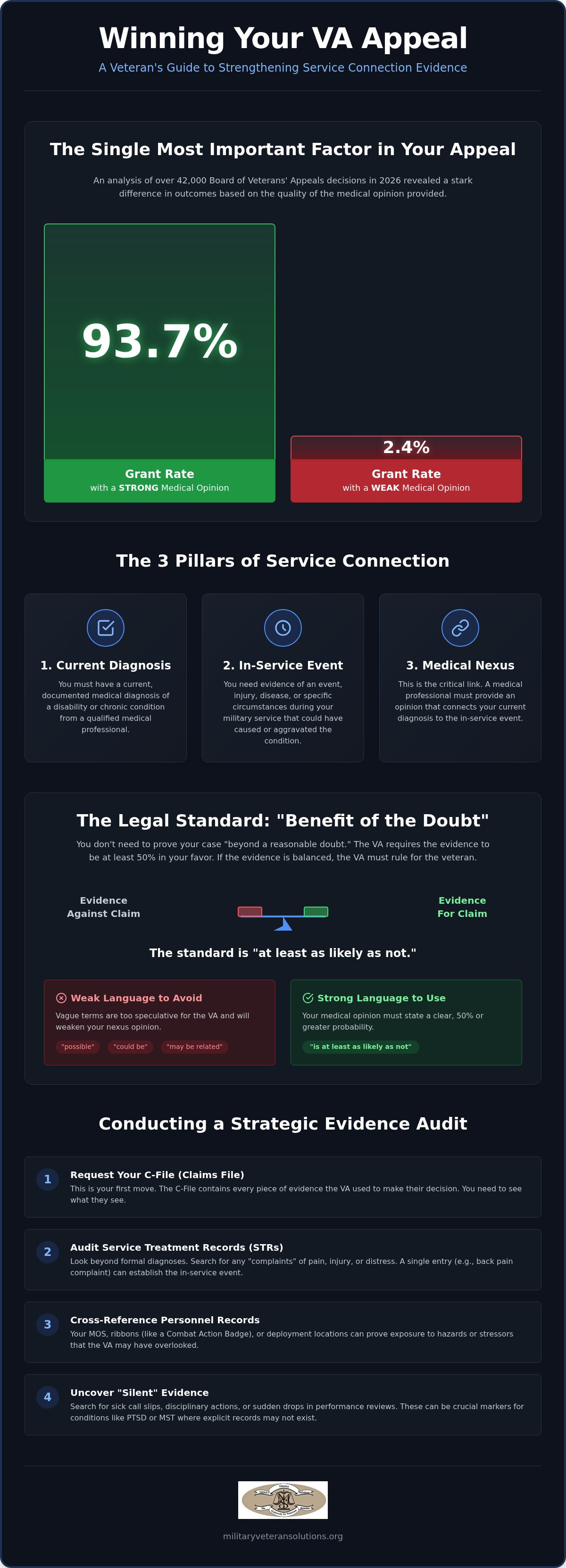
In 2026, an analysis of over 42,000 Board of Veterans' Appeals decisions revealed a staggering reality: claims supported by a medical opinion the Board deemed "strong" were granted 93.7% of the time. Conversely, those with a "weak" opinion saw a grant rate of only 2.4%. This data confirms that the quality of your evidence is the single most important factor in overturning a VA denial.
It's frustrating to open a decision letter only to feel like the rater ignored your medical history or dismissed your injury because of a missing nexus. You've likely felt the weight of that one-year deadline pressing down while you struggle to understand what the VA actually requires. You deserve a system that recognizes your service, not one that hides behind complex jargon or administrative hurdles.
This guide will show you that strengthening service connection evidence for appeal isn't about submitting more of the same paperwork. You'll learn the exact strategies to identify the gaps in your denial, gather high-quality evidence the Board respects, and present a case that's difficult to ignore. We'll provide a clear checklist for your evidence audit and explain how to fix a "no nexus" denial to secure the back pay you've earned.
Key Takeaways
- Master the three essential pillars—current diagnosis, in-service event, and medical nexus—that form the legal foundation of every successful service connection claim.
- Learn how to conduct a strategic audit of your C-File and service records to uncover "hidden" evidence that the VA may have overlooked during the initial review.
- Discover the specific requirements for strengthening service connection evidence for appeal by ensuring your medical nexus letters carry high probative value.
- Identify how to leverage secondary conditions and lay evidence to create a "cascade effect" that links multiple health issues back to your time in service.
- Determine whether a Supplemental Claim or Higher-Level Review is the right path for your specific denial while navigating 2026 PACT Act updates.
The Three Pillars of Service Connection: Why Appeals Fail
Service connection is the legal bridge between your military service and your current disability. Without this link, the VA cannot pay benefits. To establish this connection, your claim must stand on three specific pillars. If even one pillar is weak, the entire claim will likely be denied. These pillars include a current medical diagnosis, evidence of an in-service event or injury, and a medical nexus linking the two.
The most common reason for a denial is the lack of a competent and credible medical nexus. Statistics from 2026 indicate that the quality of this link determines your success. When a veteran presents a "weak" medical opinion to the Board of Veterans' Appeals, the grant rate is a dismal 2.4%. Strengthening service connection evidence for appeal starts with identifying exactly which pillar the VA believes is missing.
Decoding Your VA Decision Letter
Your VA notification letter is not just a rejection. It's a roadmap for your next steps. You must look past the initial "denied" status and locate the "Reasons for Decision" section. This area details the specific "Evidence Gap" that stopped your claim. For instance, if the VA states "no records found," you have a gap in the in-service event pillar. If they claim your "condition is not chronic," the issue lies with your current diagnosis. A professional VA Decision Letter Analysis helps you use these reasons as a checklist for the new and relevant evidence you need to gather.
The Legal Standard for Evidence: "At Least as Likely as Not"
The VA operates under a unique legal standard known as the "Benefit of the Doubt" rule. Unlike a criminal trial where proof must be "beyond a reasonable doubt," you only need to meet a 50% threshold. This is defined as the condition being "at least as likely as not" related to your service. If the evidence for and against your claim is perfectly balanced, the law requires the VA to rule in your favor.
Vague language will kill your appeal. Doctors often use words like "possible," "could be," or "may" when discussing medical links. In the eyes of a VA rater, these terms are too speculative. A successful appeal requires a medical opinion that clearly states the connection is at least 50% probable. When you focus on strengthening service connection evidence for appeal, you are moving your case from the realm of "maybe" into the legal standard of "likely."
Conducting a Strategic Evidence Audit: Mining Your Records
Winning an appeal requires you to see exactly what the VA sees. Most veterans assume the rater reviewed their entire history, but administrative errors occur frequently. Your first move is requesting your complete Claims File (C-File). This document reveals every piece of evidence the VA used to justify your denial. Strengthening service connection evidence for appeal begins with knowing the "map" the VA used to navigate your claim.
Don't just look for formal diagnoses in your Service Treatment Records (STRs). Audit them for "complaints." A single entry about back pain during a post-deployment health assessment is often more valuable than a current private diagnosis because it establishes the required in-service event. Next, cross-reference your Personnel Records. Ribbons, badges, or your specific MOS can prove exposure to hazards or combat stressors that the VA's initial review may have overlooked. If military data is thin, identify specific dates and locations where private medical records can bridge the timeline and prove your condition has been chronic since discharge.
The Professional Military Record Review
A professional military record review service can be the difference between a grant and a remand. Experts look for "silent" evidence like sick call slips, disciplinary actions, or sudden performance drops that signal an underlying mental or physical health issue. These "markers" are essential for PTSD or MST claims where the injury isn't explicitly labeled in old records. For a comprehensive look at the types of documentation the VA requires, review the official list of Evidence Needed For Your Disability Claim. Finding these hidden details provides the objective proof needed to overturn a subjective denial.
Reconstructing Evidence for Lost or Destroyed Records
If you are one of the thousands of veterans affected by the 1973 NPRC fire, your official records may be gone. This isn't the end of your claim. You can reconstruct your history using unit morning reports, deck logs, or even social media groups to find witnesses who served alongside you. This "Alternative Evidence" serves as a vital substitute when the VA's primary sources are unavailable. Gathering buddy statements from fellow service members can provide the "competent and credible" testimony required to verify an in-service injury. If you feel overwhelmed by the search for missing data, a virtual consultation can help you organize these disparate pieces into a cohesive strategy for your appeal.
Strengthening the Medical Nexus: Opinions That Win
The medical nexus is the most scrutinized part of any appeal. It's the expert bridge that connects your current disability to your military service. Without a clear, professionally written nexus letter, your claim lacks the "competent and credible" evidence required for a grant. Strengthening service connection evidence for appeal often means replacing a vague or missing nexus with a high-quality medical opinion that meets specific legal standards.
Probative value is the concept that determines how much weight the VA gives to a doctor's statement. For an opinion to have high probative value, the physician must explicitly state they reviewed your entire C-File. If a doctor offers a diagnosis without reviewing your service treatment records, the VA will likely dismiss the opinion as speculative. You must ensure your medical evidence aligns with current VA evidence requirements to avoid an immediate rejection. If you've received new medical evidence after a denial, you'll typically need to file a Supplemental Claim, as the Higher-Level Review lane does not allow for new documentation.
What Makes a Nexus Letter "Bulletproof"?
A "bulletproof" nexus letter doesn't just state a conclusion. It provides a detailed rationale. The doctor must explain exactly why and how your service caused the condition. They should cite specific medical literature or peer-reviewed studies to support their findings. Most importantly, they must use the correct legal language. The essential phrase is that the condition is "at least as likely as not" related to your service. This indicates a 50% or greater probability. Opinions from private specialists often carry more weight than a standard C&P exam because specialists have more time to conduct a thorough analysis of your unique history.
C&P Exam Rebuttal: Challenging a Negative VA Opinion
You don't have to accept a negative finding from a VA examiner. If your C&P exam was inadequate, you have the right to challenge it. Common errors include an examiner failing to use a goniometer for range-of-motion tests or admitting they didn't read your file. When you face a "less likely than not" finding, a private medical opinion acts as a direct rebuttal. You can request a new exam based on procedural errors or a lack of examiner expertise. This proactive approach is a vital part of strengthening service connection evidence for appeal, ensuring the VA's decision is based on facts rather than a flawed five-minute evaluation. If you aren't sure where to start, a virtual consultation can help you identify the specific weaknesses in your previous C&P exam.
Leveraging Secondary Conditions and Lay Evidence
Secondary service connection is often the most overlooked strategy for increasing a disability rating. It focuses on conditions caused or aggravated by an already service-connected disability. This "Cascade Effect" is common. For example, a veteran with a service-connected knee injury may develop back issues due to an altered gait, or suffer from GERD as a side effect of NSAIDs taken for chronic pain. Strengthening service connection evidence for appeal in these cases requires proving that the secondary condition would not exist "but for" the primary one.
You must also use lay evidence strategically to fill gaps in medical records. VA Form 21-10210, the Lay or Witness Statement, is designed for "buddy statements" from those who served with you or see you daily. This differs from VA Form 21-4138, which is your personal Statement in Support of Claim. These documents are vital for proving "continuity of symptomatology." They show the VA that your symptoms have persisted from the time of the original injury until today, even if you went years without seeing a doctor.
Maximizing VA Back Pay for Secondary Conditions
Secondary claims are a powerful tool for reaching a 100% rating. Because secondary conditions are tied to the primary disability, they can significantly increase your combined rating and monthly compensation. To succeed, you must prove a "nexus of aggravation." You need to show how your primary service-connected condition made a non-service-connected issue worse. This is often the most effective pathway for a successful appeal because it relies on current medical reality rather than decades-old military records. If you are struggling to link your current health issues to your past service, a virtual consultation can provide the expert analysis needed to build a winning secondary claim.
Crafting a Persuasive Statement in Support of Claim
When writing your statement, focus on "Functional Loss." The VA rater needs to know what you cannot do because of your disability, not just that it hurts. Describe how your condition affects your ability to work, stand, or interact with your family. You must detail the "Frequency, Severity, and Duration" of your flare-ups. Family members can provide "competent" lay evidence here by describing observable symptoms. They can testify to your inability to lift groceries or the frequency of your migraines. This personal testimony provides the human context that medical codes often miss, making your case much more persuasive to a rater or judge.
Finalizing Your Appeal Strategy: Professional Filing in 2026
Selecting the correct appeal lane is the final tactical decision in your journey toward a successful rating. You've already done the hard work of auditing your records and securing medical opinions. Now, you must decide how to present that work to the VA. If you've gathered new nexus letters or witness statements as discussed in previous sections, the Supplemental Claim lane is your best path. This lane allows you to submit "new and relevant" evidence that the VA hasn't seen before. It's the primary tool for strengthening service connection evidence for appeal when your initial filing was thin.
Conversely, if you believe the evidence already in your file is sufficient but the rater simply ignored the law, a Higher-Level Review (HLR) is more appropriate. In 2026, the PACT Act continues to evolve, providing new opportunities for veterans with toxic exposure or presumptive conditions. By choosing the correct lane, you're finalizing the process of filing VA appeals help that began with your initial record audit. Remember, you have exactly one year from the date on your decision letter to file. Missing this deadline means losing months or years of potential back pay.
The Higher-Level Review (HLR) Strategy
An HLR is a powerful tool when the VA makes a clear legal error. A Senior Claims Adjudicator reviews your file from scratch. They don't look at the previous rater's notes; they only look at the evidence. The highlight of this lane is the "Informal Conference." This is where an advocate argues your case directly to the senior rater over the phone. You cannot submit new evidence during an HLR. If you discover a missing piece of documentation during this stage, you must switch to a Supplemental Claim to ensure the evidence is considered. This strategic pivot is a core component of strengthening service connection evidence for appeal when the VA's internal logic fails.
The Advocacy Advantage: Virtual Consultations Nationwide
Navigating these lanes alone is a daunting task. Professional representation significantly increases the likelihood that a denial will be overturned because advocates understand the technicalities that raters look for. Our virtual consultations provide expert record analysis and advocacy regardless of where you live. We bridge the gap between a confusing administrative system and the benefits you earned through service. Don't let a single procedural mistake stand between you and your rating. Get a professional VA claim assistance review today to ensure your appeal is filed with precision and authority.
Secure Your Benefits with a Strategic Appeal
A VA denial is a setback, but it isn't the final word on your claim. By focusing on the three pillars of service connection and auditing your records for missed medical complaints, you can turn a rejection into a roadmap for success. Strengthening service connection evidence for appeal requires a methodical approach that identifies exactly where the VA's logic failed. Whether you're leveraging secondary conditions or challenging an inadequate C&P exam, the right evidence makes your case undeniable.
You don't have to navigate this complex administrative system alone. Military Veteran Solutions, LLC was founded by a disabled veteran who understands the frustration of the process firsthand. With over 25 years of experience in veteran advocacy, we provide the thorough evaluation needed to identify hidden evidence in your military records. Our virtual consultations are available nationwide, ensuring you have expert eyes on your claim regardless of your location. Don't let your one-year appeal window close without taking action. Get a professional analysis of your VA decision letter today and take the first step toward the rating you deserve. You've served your country; now it's time to secure your future.
Frequently Asked Questions
What is the most common reason for a VA service connection denial?
The most common reason for a VA denial is the lack of a competent and credible medical nexus. Without a clear link between your current disability and an in-service event, the VA will deny the claim. Recent 2026 data shows that opinions deemed "weak" by the Board lead to a denial over 97% of the time. This highlights why strengthening service connection evidence for appeal by securing a detailed medical opinion is your most effective strategy.
How much new evidence do I need to file a Supplemental Claim?
You only need one piece of "new and relevant" evidence to trigger a Supplemental Claim. This evidence must be information the VA didn't consider in the previous decision. It could be a new medical diagnosis, a private nexus letter, or even a buddy statement. The goal isn't just quantity. You must submit evidence that specifically addresses the gaps listed in your decision letter to prove the missing element of your claim.
Can a "buddy statement" really prove my service connection?
A buddy statement is a form of lay evidence that can verify an in-service event or injury. While it doesn't replace a medical diagnosis, it provides the competent testimony required to prove something happened during your service. This is especially vital when official records are thin or missing. These statements, filed on VA Form 21-10210, help document the continuity of your symptoms from discharge until your current diagnosis in 2026.
What should I do if the VA says my military records are missing?
You should immediately look for alternative evidence to reconstruct your service history. If your records were lost or destroyed, like those in the 1973 NPRC fire, you can use unit morning reports, deck logs, or medical records from private providers. A professional military record review can often uncover secondary evidence, such as performance reports or sick call slips, that the VA rater missed during their initial search of your file.
Is a nexus letter required for every VA disability appeal?
A nexus letter isn't technically required, but it's often the most effective way to win an appeal. If your denial was based on a lack of service connection, a medical nexus letter provides the professional rationale the VA needs. Strengthening service connection evidence for appeal usually involves getting a specialist to state that your condition is at least as likely as not related to your service, which satisfies the legal threshold for a grant.
How long do I have to appeal a VA decision in 2026?
You have exactly one year from the date printed on your VA decision letter to file an appeal. This deadline applies to Supplemental Claims, Higher-Level Reviews, and Board Appeals. Filing within this twelve-month window is critical because it preserves your original effective date. If you miss this deadline, you'll lose out on significant back pay, as your effective date will reset to the day you refile your claim in the future.
Can I appeal a presumptive condition denial under the PACT Act?
You can certainly appeal a PACT Act denial, especially as covered conditions and exposure locations continue to be refined in 2026. Many veterans are denied because the VA claims their condition doesn't meet specific diagnostic criteria. An appeal allows you to submit personnel records proving your presence in a covered area or a private medical opinion clarifying your diagnosis. This ensures your claim is evaluated under the most current presumptive service connection standards.
How do secondary conditions affect my VA back pay?
Secondary conditions can significantly increase your total disability rating and the resulting back pay. When a secondary condition is granted, the effective date usually matches the date you filed the claim for that specific issue. If the secondary issue is linked to an ongoing appeal for a primary condition, you might secure a substantial lump sum payment. These claims are often the most direct way for veterans to reach a 100% disability rating.


