
VA claims aren't lost on facts; they are lost on the connection between those facts. It's frustrating to feel ignored by a system that was built to serve you, especially when you're already dealing with the physical and mental toll of your service. If you're feeling overwhelmed by medical evidence requirements or anxious about missing strict deadlines, you aren't alone. Understanding the common VA claim mistakes to avoid is the first step toward moving your file out of the backlog and into the approved pile.
We've spent over 20 years helping veterans navigate this complex administrative maze. This guide identifies the critical errors that lead to VA claim denials so you can finally secure the disability compensation you earned. We'll examine how to build a bulletproof medical evidence file, the importance of a thorough military record review, and how to handle the 2026 PACT Act updates. By the time you finish reading, you'll have a clear roadmap to a successful claim or appeal. This clarity provides the relief from administrative burdens you deserve, positioning you for a successful outcome in a system that often feels designed to keep you waiting.
Key Takeaways
- Learn how to bridge the evidence gap by securing a formal diagnosis and a critical Nexus letter that connects your service history to your current symptoms.
- Identify the common VA claim mistakes to avoid during your C&P exam, including the "Stoic Veteran" trap that often leads to undervalued disability ratings.
- Discover why relying on the VA's "Duty to Assist" is a strategic risk and how to take proactive command of your own medical evidence gathering.
- Master a 5-step evidence audit to verify your C-File and ensure your military records align perfectly with your ongoing medical treatments.
- Understand how professional advocacy and military record reviews can identify the specific evidence needed to overturn a denial and win your appeal.
The Reality of VA Claims in 2026: Why Most Veterans Struggle
In the context of disability benefits, a mistake is any error or omission that breaks the service-connection link between your time in uniform and your current health. This is a high-stakes environment. One oversight can lead to years of exhausting appeals. While the Veterans Benefits Administration (VBA) processed over 2 million disability claims in Fiscal Year 2025, the massive volume of paperwork means that your specific story can easily get lost. Understanding the common VA claim mistakes to avoid is essential because the system doesn't automatically correct your errors. It's a rigid process that requires precision from the moment you file.
The 2026 landscape is defined by the massive expansion of the PACT Act. Since August 2022, 739,000 veterans have enrolled in VA healthcare under these new rules. While this expansion is a victory for veterans, it has also created a surge in applications. Even with the average claim completion time reduced to 80.7 days, the pressure on raters is immense. If your evidence isn't presented clearly, it's easier for the VA to issue a denial than to spend hours deciphering a disorganized file. You aren't just filing a claim; you're building a legal case for the compensation you earned.
To understand why the link between service and health is so vital, watch this breakdown on overcoming denials:
The 'Duty to Assist' vs. Personal Responsibility
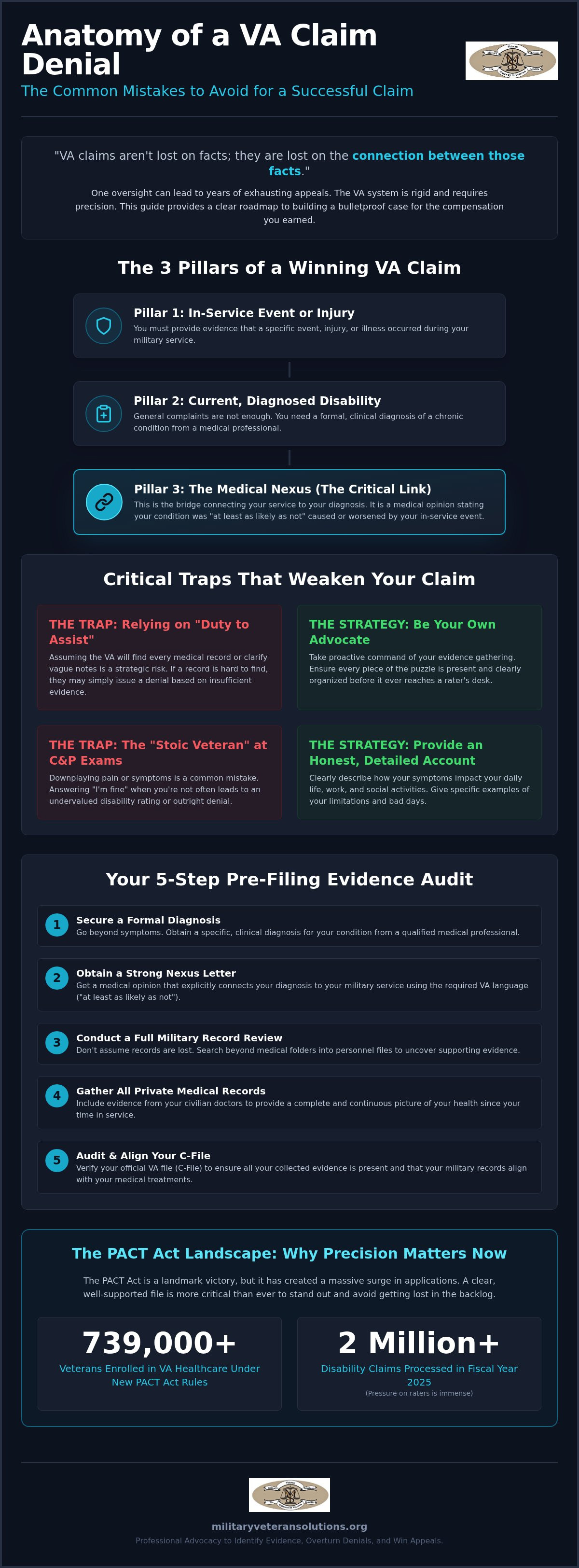
The "Duty to Assist" is a legal mandate requiring the VA to help you gather evidence. However, this is often a trap for the unwary. It's a common misconception that the VA will hunt down every missing medical record or clarify vague notes from a private doctor. They won't. If a record is hard to find, they may simply issue a denial based on insufficient evidence. You must be your own best advocate from day one. Taking personal responsibility means ensuring every piece of the puzzle is present and clear before it reaches a rater's desk. Don't leave your future in the hands of a backlogged system.
Understanding the Three Pillars of a Successful Claim
A winning claim stands on three specific pillars. First, you need an in-service event or injury. You must prove something happened during your service. Second, you need a current diagnosis. General complaints aren't enough; you need a formal clinical diagnosis from a medical professional. Finally, you need the Nexus. This is the critical link that most veterans fail to document. It's the medical opinion stating that your current diagnosis was at least as likely as not caused by your service. Without all three pillars, your claim will collapse under the weight of common VA claim mistakes to avoid.
The Evidence Gap: The #1 Reason for VA Denials
Evidence is the bedrock of your claim. Without it, even the most severe injury remains uncompensated. One of the most common VA claim mistakes to avoid is filing an application based solely on symptoms rather than a clinical diagnosis. Telling the VA "my back hurts" is a description, not a diagnosis. The official VA claim filing process requires proof of a chronic condition. If your records don't contain a specific medical term for your ailment, the rater has no choice but to deny the claim for lack of a current disability.
Many veterans believe their records were lost in a fire or simply misplaced by the military. In reality, these "lost" records are often just unsearched. They might be buried in personnel files rather than medical folders. Relying only on what the VA pulls for you is a gamble you don't have to take. You should also include private medical records. Ignoring evidence from your civilian doctors is a missed opportunity to provide a complete picture of your health. A thorough Military Record Review can often uncover the very evidence you thought was gone forever.
The Power of the Nexus Letter
The Nexus letter is the bridge between your service and your current diagnosis. It's a medical opinion that must use specific language, such as stating your condition is "at least as likely as not" caused by your time in uniform. Many doctors write letters that are too vague or non-committal, which the VA will quickly dismiss. This is where Military Record Reviews become invaluable. We identify the specific service-connected events that your doctor needs to reference to create a winning Nexus letter. We help you present a professional case that speaks the VA's language.
Leveraging Lay Statements
Your own words and the testimony of those who served with you carry significant weight. These "buddy statements" provide the context that clinical notes often miss. A common mistake is writing a long, emotional narrative that lacks specific dates or details. Instead, focus on functional loss. Don't just say you have pain; describe how that pain prevents you from lifting your child or performing your job duties. Keep your statement concise and grounded in facts. When you provide clear, date-specific evidence of how your life changed after service, you make it much harder for the VA to ignore your claim.
Procedural and Psychological Traps in the Claims Process
Even if you've gathered perfect evidence, the way you navigate the VA's procedural requirements can still lead to a denial. The claims process isn't just about what's on paper; it's about how you present yourself and how you manage the timeline. Many veterans fall into psychological traps that are deeply rooted in military culture. These habits served you well in uniform, but they can be a liability when you're seeking the benefits you've earned. Understanding these common VA claim mistakes to avoid is essential for protecting your rating and your back pay.
The C&P Exam: Your Worst Day, Not Your Best Day
The "Stoic Veteran" mindset is a significant hurdle during the Compensation and Pension (C&P) exam. In service, you were taught to push through pain and say "fine" when asked how you're doing. During a C&P exam, this habit is dangerous. If you tell the examiner you're having a good day, they will document that as your baseline. This is one of the most common VA claim mistakes to avoid. You must describe your symptoms as they are on your worst day. If you struggle to walk three days a week but happen to feel okay on the morning of the exam, the rater needs to hear about those three bad days in detail. Don't tough it out; be honest about your limitations, your flare-ups, and the functional impact your condition has on your daily life. Once the exam is over, request a copy of the results immediately to check for any inaccuracies that could sink your claim.
Secondary Conditions: The Rating Multiplier
Another trap is ignoring secondary conditions. Many veterans leave significant compensation on the table because they don't realize that one injury often causes another. For example, a service-connected knee injury might change your gait, eventually causing chronic back pain. Filing the back pain as a new primary claim is often a mistake because it lacks a direct link to a specific service event. However, linking it as a secondary condition to your knee injury makes the medical connection clear. Understanding how to combine va disability ratings to get 100 is a strategic way to ensure you're compensated for the full scope of your disabilities. Conditions like sleep apnea or anxiety are frequently secondary to primary physical injuries, and failing to link them is a missed opportunity for a correct rating.
Finally, keep a close eye on the calendar and your contact information. You have exactly one year from the date of a decision letter to file an appeal. If you miss this window, your claim closes, and you lose your original effective date. This error wipes out any potential back pay you were owed. Additionally, missing a single VA-scheduled appointment or failing to update your address can result in an immediate denial. The VA assumes that if you don't show up, you are no longer interested in the claim. Stay organized and stay responsive to ensure the system works for you, not against you.
The Pre-Filing Evidence Audit: A 5-Step Checklist
Preparation is the difference between a monthly check and a denial letter. Many veterans rush to submit paperwork because they feel the pressure of deadlines or the urgency of financial need. However, filing an incomplete application is one of the most common VA claim mistakes to avoid. Before you hit send, you must perform a rigorous audit of your own evidence. This proactive approach ensures that the VA has no choice but to acknowledge the link between your service and your health. If you want to bypass the years of frustration that follow a denial, follow this 5-step checklist.
- Step 1: Secure your C-File. Your Claims File is the complete record of everything the VA knows about you. You can't fix what you haven't seen.
- Step 2: Cross-reference your records. Compare your military service records against your current medical treatments. Look for consistency in symptoms and frequency of care.
- Step 3: Hunt for 'silent' entries. Find minor entries in your records, like a single sick call visit for a headache, that indicate the early onset of a chronic condition.
- Step 4: Draft fact-based lay statements. Use specific dates and descriptions of functional loss to fill in the gaps where medical records might be thin.
- Step 5: Review previous denials. Perform a VA decision letter review if you've been denied before to identify exactly which pillar of your claim was missing.
Auditing Your Service Treatment Records (STRs)
Your Service Treatment Records are the foundation of your claim. You should look for more than just major injuries. Sick call slips, temporary profile changes, and post-deployment health assessments often contain the clues needed to prove service connection. If you find that records are missing, don't give up. You can use secondary evidence like unit logs, morning reports, or even news articles from your deployment to prove you were in a specific location at a specific time. A professional audit can often find these hidden connections that a layman might overlook. If your records feel like a jigsaw puzzle with missing pieces, contact our team for a professional military record review.
Analyzing the 'Reasons for Decision'
If you've already received a denial, the VA has actually given you a roadmap to success. The "Reasons for Decision" section of your letter explains exactly why they said no. One of the most common VA claim mistakes to avoid at this stage is filing a brand-new claim for the same condition. This is a procedural error that usually results in an immediate rejection. Instead, you must file a Supplemental Claim with new and relevant evidence. Using va claim assistance can help you decipher the complex legalese in these letters. When you understand the VA's logic, you can provide the specific evidence needed to overturn their decision and preserve your original effective date for back pay.
The Advocacy Advantage: Why Professional Representation Matters
Filing a claim on your own is a testament to your independence, but it often leaves you vulnerable to the common VA claim mistakes to avoid that we've detailed throughout this guide. The VA system is a massive bureaucracy that speaks its own language. An expert advocate acts as a translator and a protective guide. We understand the nuances of the 2026 regulatory environment, including the latest PACT Act presumptive list updates and the specifics of service connection. Having a partner who understands the difference between a simple diagnosis and a bulletproof legal case can be the deciding factor in your outcome.
Professional representation is particularly effective at identifying the specific evidence needed to overturn a denial. While a general law office might treat your file like any other administrative case, a veteran-owned firm approaches it with shared history and deep-seated empathy. Our team, founded by a 10-year Army veteran, brings over 25 years of combined experience to every military record review. We don't just look at the surface; we perform an exhaustive analysis to find the hidden links between your current health and your time in uniform. This level of dedicated advocacy is essential when seeking filing VA appeals help to secure the back pay you are legally entitled to receive.
Virtual Consultations: Expert Help Nationwide
You don't have to be limited by your location when seeking elite representation. Our virtual consultations allow us to serve veterans across the nation, providing the same high level of scrutiny and strategy regardless of where you live. This modern approach takes the administrative burden off your shoulders. We handle the VA decision letter analysis and record reviews so you can focus on your health and your family. We move from broad concepts of support to specific, actionable steps, creating an organized path toward a successful disability rating.
Next Steps: Your Path to an Entitled Rating
The path to a successful claim is built on thorough documentation and early intervention. Don't let another deadline pass or another symptom go undocumented. You served your country with honor; now, it's time to ensure your country fulfills its promise to you. We've navigated these difficult paths before, and we're committed to helping you do the same. Relief and security are within reach. Contact Military Veteran Solutions, LLC today for a virtual consultation and let us help you bypass the common VA claim mistakes to avoid while securing the disability compensation you earned.
Secure the Disability Benefits You Earned
Navigating the VA system in 2026 requires more than just filling out forms; it requires a strategic approach to evidence and a clear understanding of the common VA claim mistakes to avoid. By bridging the evidence gap with a solid medical Nexus and avoiding the psychological trap of downplaying your symptoms during exams, you position yourself for a successful rating rather than a years-long appeal. Your service history is a record of sacrifice. Your disability compensation must reflect the full scope of that impact.
You don't have to face this complex administrative burden alone. Military Veteran Solutions, LLC is a veteran-owned and operated firm with over 25 years of combined advocacy experience. We specialize in winning difficult VA appeals by performing exhaustive military record reviews that uncover the proof others miss. Schedule your virtual consultation with Military Veteran Solutions today to start your path toward an entitled rating. You served your country with honor; now, let us serve you by securing the relief and security you deserve.
Frequently Asked Questions
What is the most common reason for a VA claim denial?
The primary reason for denial is a lack of medical evidence that proves a service connection. Many veterans fail to provide a formal diagnosis or a clear link between their time in uniform and their current health struggles. This is one of the most common VA claim mistakes to avoid if you want to bypass the appeals backlog. Without a documented in-service event and a corresponding medical opinion, the rater cannot legally approve your benefits.
Can I fix a mistake on a VA claim after I've already submitted it?
You can submit additional evidence to your file while the claim is still pending. If you realize you've made an error, you should upload a Statement in Support of Claim to clarify the mistake immediately. Proactive communication with the VA can prevent a denial before it happens. However, once a decision is made, you must use the formal appeals process to correct the record and preserve your original effective date for back pay.
What should I do if my C&P examiner was dismissive of my symptoms?
You should document the examiner's behavior and submit a formal complaint to the VA as soon as possible. Write a detailed lay statement explaining how the examiner ignored your symptoms or failed to perform the required range of motion tests. Requesting a new examination through the VA's medical center or the contractor is your right. Don't wait for a denial letter to address a flawed or dismissive C&P exam experience; act while the memory is fresh.
Is it better to file a Higher Level Review or a Supplemental Claim for a mistake?
A Supplemental Claim is usually the better choice if you need to add new and relevant evidence to fix an error. A Higher-Level Review does not allow for new evidence; it only permits a senior rater to look at what was already submitted. If your mistake was leaving out a key medical record or a Nexus letter, a Supplemental Claim is the only way to get that information into your file and win your appeal.
How long do I have to appeal a VA decision before I lose my back pay?
You have exactly one year from the date on your VA decision letter to file an appeal and maintain your original effective date. Missing this deadline is a critical error that can cost you thousands of dollars in back pay. If you miss the one-year window, you can still file a new claim, but your monthly payments will only start from the new filing date. This effectively wipes out the history of your previous claim.
Can I use a civilian doctor's medical opinion for my VA claim?
You absolutely can and should use a civilian doctor's medical opinion to strengthen your claim. Private physicians often have more time to review your full history than VA doctors do. A civilian doctor can provide a detailed Nexus letter that uses the specific "at least as likely as not" language the VA requires. Just ensure your doctor reviews your military service records so their opinion carries the necessary weight with the rater during evaluation.
Will filing for an increase in one condition trigger a review of my other ratings?
It is a possibility that the VA will review your entire file when you ask for an increase. While the VA typically focuses on the specific condition you're appealing, they have the authority to re-evaluate any existing rating if they see evidence of improvement. You should ensure your medical documentation for all service-connected conditions is current and accurate before filing for an increase. This proactive step protects your existing disability rating from unexpected reductions.
What is a 'Nexus' letter and do I really need one?
A Nexus letter is a formal medical opinion that connects your current disability to your military service. While it isn't always mandatory for presumptive conditions under the PACT Act, it is essential for almost every other type of claim. This letter provides the "bridge" the VA needs to see. Without a strong medical Nexus, establishing a service connection is difficult, making it one of the most common VA claim mistakes to avoid during the filing process.


