

If you think that 50 plus 50 equals 100, the Department of Veterans Affairs has a frustrating surprise for you. In the world of disability benefits, standard addition simply doesn't exist. You've likely opened a decision letter and felt a surge of confusion when your individual ratings didn't add up to the total you expected. Understanding how does the va combined rating calculator work is the only way to stop feeling cheated by a system that often seems designed to keep you from the 100% threshold.
We know it's exhausting to fight for your health only to be met with a calculation that feels like a barrier to your security. This guide will clarify the "whole person" concept and the 2026 COLA adjustments that determine your monthly compensation. You'll learn how the VA evaluates your remaining efficiency and how to use that logic to your advantage. We'll break down the 2.8% cost-of-living increase, the impact of the bilateral factor, and specific strategies to identify secondary conditions that can boost your combined score. By the end, you'll have the confidence to analyze your decision letter and the tools to challenge a rating that doesn't reflect the reality of your service-connected disabilities.
Key Takeaways
- Stop the frustration of "VA Math" by mastering the Whole Person concept, which evaluates your remaining efficiency instead of using simple addition.
- Learn exactly how does the va combined rating calculator work by ranking your disabilities from highest to lowest to ensure every percentage counts toward your total.
- Discover how the Bilateral Factor and secondary conditions can push your rating through the "90% plateau" and toward the 100% threshold.
- View the confirmed 2026 COLA rates to understand how the 2.8% increase affects your monthly compensation for the coming year.
- Find out why a professional analysis of your decision letter is the first step to uncovering missing evidence and correcting calculation errors.
The Logic of VA Math: Why Ratings Aren't Simply Added
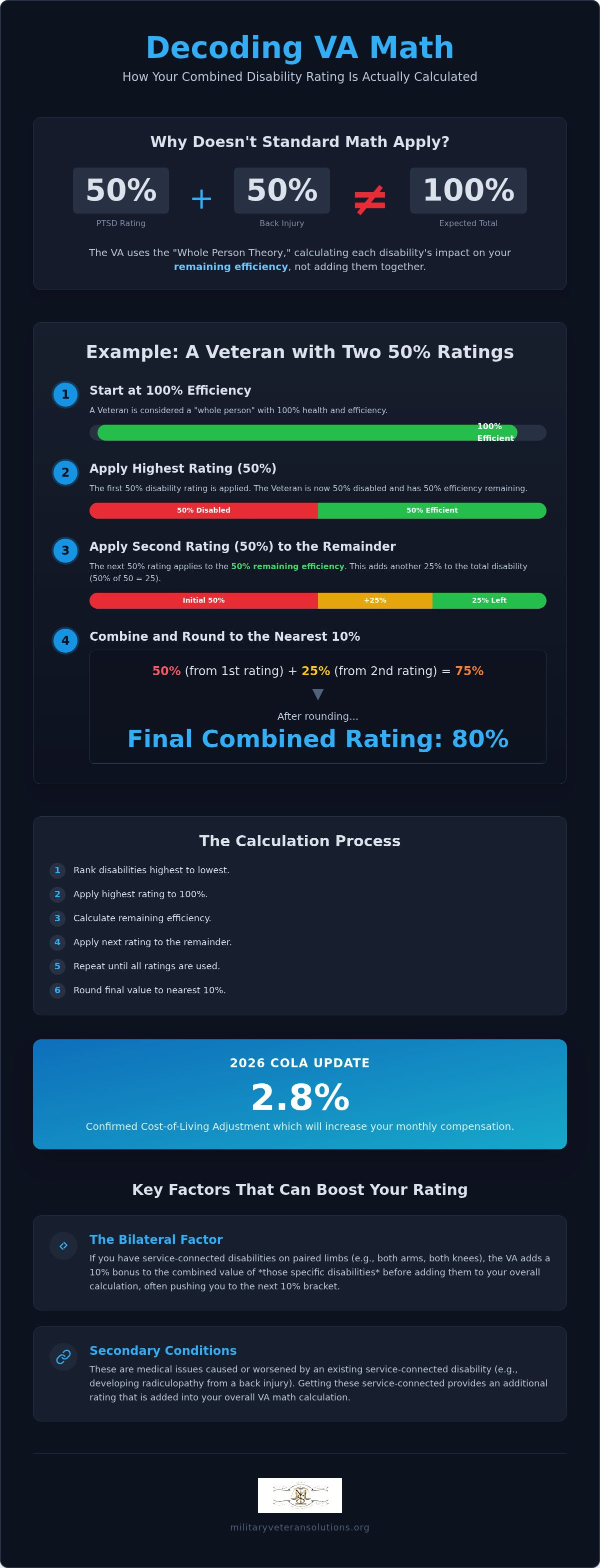
Most veterans expect the claims process to follow the rules of basic arithmetic. If you have a 50% rating for PTSD and a 50% rating for a back injury, it seems logical that your total should be 100%. However, the VA doesn't use standard addition. This discrepancy is the primary source of anxiety for thousands of veterans who feel cheated when their combined rating falls short of the 100% threshold. Understanding how does the va combined rating calculator work requires a fundamental shift in how you view disability. The system isn't designed to measure what you've lost in isolation; it's designed to measure what's left of your ability to function.
In the eyes of the VA, you cannot be more than 100% disabled. Once you reach that ceiling, you're considered totally disabled for compensation purposes. Because of this, each new disability is applied only to the "healthy" portion of your body that remains. This is why a veteran with multiple high ratings can still find themselves stuck at a 90% combined score, even if the raw numbers add up to 160% or more.
The 'Whole Person' Philosophy
To grasp this logic, imagine your health as a 100-unit pie. When you're perfectly healthy, you have 100 units of efficiency. If the VA grants you a 50% disability rating, they've determined that 50 units of that pie are now "disabled." You're left with 50 units of efficiency. If you receive a second 50% rating, the VA doesn't take another 50 units from the original 100. Instead, they take 50% of the 50 units you have left. This leaves you with 25 units of efficiency remaining. Your combined disability is now 75%, which the VA rounds to 80%. Every subsequent rating follows this pattern, chipping away at a smaller and smaller piece of the remaining pie.
Why the VA Uses the Combined Rating Table
The VA relies on the Combined Rating Table, codified in 38 CFR § 4.25, to maintain consistency across the entire agency. Without this standardized tool, claims processors might apply different logic to different veterans, leading to massive legal inconsistencies. The table removes human error by providing a fixed grid where ratings intersect to produce a final value. VA Math is the method of calculating cumulative disability impact on a veteran's remaining efficiency. By using this table, the VA ensures that every claim is processed under the same set of rules, even if those rules feel counterintuitive. Knowing how does the va combined rating calculator work is essential because it allows you to spot when a processor has failed to account for a specific factor, such as the bilateral boost, which can be the difference between an 80% and a 90% rating.
Step-by-Step: How the VA Combined Rating Calculator Works
The process of determining your final disability percentage isn't a random selection of numbers. It's a rigid, sequential calculation that follows a specific hierarchy. To understand how does the va combined rating calculator work, you have to view your service-connected conditions as a stack. The VA doesn't look at your disabilities all at once. They process them one by one, starting with the condition that has the most significant impact on your life. This ensures that the largest impairment sets the baseline for your "whole person" calculation before smaller ratings are applied.
The sequence follows these mandatory steps:
- Rank all service-connected disabilities from the highest percentage to the lowest percentage.
- Apply the highest rating to your initial 100% efficiency.
- Calculate the remaining efficiency after that first deduction.
- Apply the next highest rating to that remaining percentage, not the original 100.
- Repeat this process until every condition, including secondary ratings, is accounted for.
- Apply the final rounding rule to reach a multiple of ten.
Ordering Your Disabilities for Calculation
Order is everything in VA math. If you're looking at an official VA explanation of disability ratings, you'll see that the most severe condition always takes the first "bite" out of your 100% efficiency. For example, if you have a 70% rating for PTSD and a 20% rating for a back injury, the calculator starts at 70%. This leaves you with 30% remaining efficiency. The 20% for your back is then calculated as 20% of that remaining 30, which equals 6. When you add that 6 to the original 70, your combined value is 76%. If the order were reversed, the math would still lead to the same raw number, but the VA's internal systems always prioritize the highest ratings to maintain consistency across claims.
The Rounding Rule: The Difference Between 84% and 85%
The final step is where many veterans experience the "cliff" effect. The VA doesn't pay out at 76% or 84%; they round to the nearest 10% increment. A raw score of 74% rounds down to a 70% payout, while a 75% rounds up to 80%. This one percent difference can result in thousands of dollars in lost compensation over time. It's a high-stakes game of decimals where accuracy is vital. If you feel your current rating is stuck on the wrong side of that rounding line, a professional VA Decision Letter Analysis can help identify if a secondary condition was missed. Understanding these margins is essential when learning How to Combine VA Disability Ratings for 100% in 2026, as reaching the total disability threshold often requires pushing your raw score just past that 95% mark.
Advanced Calculation Factors: Bilateral Boosts and Secondary Conditions
Basic VA math is difficult enough to track, but the calculation becomes even more intricate when you account for specific anatomical rules and secondary ailments. If you have disabilities that affect both sides of your body, or if one service-connected condition has caused a new medical issue, the standard calculation changes. These factors are often the difference between a veteran staying at a 90% rating or finally reaching the 100% threshold. Understanding how does the va combined rating calculator work requires looking beyond individual percentages to see how these "boosts" are applied during the evaluation process.
In 2026, the PACT Act continues to play a massive role in these calculations. Many veterans are now successfully service-connecting presumptive conditions like respiratory issues or cancers. When these are added to existing ratings, they don't just add a flat number; they interact with your "whole person" efficiency. If these new conditions lead to secondary issues, such as depression or anxiety stemming from chronic physical pain, those secondary ratings are integrated into the total stack just like primary conditions.
The Bilateral Factor: A Strategic Advantage
The bilateral factor is a specific rule found in 38 CFR § 4.26 that applies when you have disabilities affecting paired limbs or organs. This includes both knees, both shoulders, or even a combination of a left arm and a right leg. When the VA identifies these bilateral disabilities, they don't just combine them with your other ratings. Instead, they combine the bilateral ratings first, calculate 10% of that combined value, and add that "boost" to the subtotal before moving on to non-bilateral conditions. This small addition happens before the final rounding, which can push a raw score just high enough to round up to the next 10% bracket. This factor is frequently overlooked in self-calculations because it requires a specific mathematical step that most online tools don't clearly explain.
Secondary Conditions: Building Your Rating
Secondary conditions are "offshoot" disabilities caused or aggravated by a primary service-connected condition. For example, if a service-connected back injury causes a veteran to develop a sedentary lifestyle that leads to hypertension, that heart condition can be rated as secondary. These are vital for veterans stuck at the "90% plateau." If you're sitting at a raw score of 94%, the VA rounds you down to 90%. However, if you can service-connect a secondary condition at even a 10% rating, that small addition can push your raw score to 95%. Because of the rounding rule, that single 1% jump moves your payout from 90% to 100%. The bilateral factor can be the 'tipping point' for a 100% rating. You can find more details in the About Disability Ratings guide provided by the VA, which outlines how these complex interactions are officially handled.
The Law of Diminishing Returns in VA Math
Reaching a 50% or 70% rating is often a relatively straightforward climb. However, once you cross into the higher tiers of disability, the path becomes much steeper. This is due to the law of diminishing returns, a mathematical reality that governs the VA's evaluation system. If you've ever wondered how does the va combined rating calculator work when you're already at a high percentage, you've likely encountered the frustration of adding new service-connected conditions without seeing your total score move. The higher your rating, the less "healthy" person is left to disable, making every subsequent percentage point significantly harder to earn.
This creates a tactical challenge for veterans. Filing for a new 10% condition might take months of effort, medical appointments, and paperwork. If that 10% doesn't actually move your combined rating to the next 10% bracket, you've expended significant energy for zero increase in your monthly compensation. Analyzing the cost-benefit of new claims is a critical part of a long-term strategy to secure the benefits you've earned. You must decide if the effort of a new filing is the best use of your time or if a different approach is required to reach your goals.
Understanding the 90% Plateau
The "90% Plateau" is where most veterans feel the weight of VA math most heavily. When you're rated at 90%, the VA considers you 90% disabled and 10% "efficient." If you are granted a new 10% rating for a secondary condition, the calculator doesn't add 10 to 90 to reach 100. Instead, it takes 10% of your remaining 10 units of efficiency. This adds exactly 1% to your total, bringing you to 91%. Because the VA rounds to the nearest ten, 91% still rounds back down to 90%. You effectively stay stuck at the same payout level despite having a new service-connected illness. To move from 90% to 100%, you typically need a raw score of at least 95%, which often requires multiple high-value ratings or the strategic application of bilateral boosts discussed earlier.
TDIU: The Alternative to 100% Combined
When the math simply won't reach 100% despite your best efforts, you shouldn't lose hope. Total Disability based on Individual Unemployability (TDIU) is a vital alternative. TDIU allows the VA to pay you at the 100% rate even if your combined schedular rating is lower, provided your service-connected disabilities prevent you from maintaining substantially gainful employment. This is a recognition that the "whole person" math doesn't always capture the true impact of your injuries on your ability to earn a living. Military Veteran Solutions, LLC conducts a thorough Military Record Review to identify if your evidence supports a TDIU claim, bypassing the diminishing returns of the standard calculator. If your disabilities make working impossible, chasing that final 5% through standard math may not be the most effective path to the financial security you deserve.
How Professional Advocacy Overcomes Calculator Hurdles
Understanding how does the va combined rating calculator work is only half the battle. The calculator itself is a neutral tool, but the data fed into it by the VA is often incomplete or based on flawed medical examinations. When a claims processor overlooks the severity of a symptom or fails to recognize a secondary link, the math will never reflect your true level of impairment. Professional advocacy bridges the gap between what the VA says you deserve and what your medical records actually prove. It's about ensuring the system accounts for every unit of your lost efficiency.
The system is complex, but it isn't infallible. Errors in data entry or medical interpretation happen every day. If you've been stuck at a specific percentage for years, it's likely not because your condition hasn't worsened, but because the evidence in your file hasn't been presented in a way the VA's math requires. By auditing the inputs, we can often change the output without needing to wait for a new diagnosis.
The Power of Decision Letter Analysis
Military Veteran Solutions, LLC starts every engagement with a rigorous VA Decision Letter Analysis. This isn't just a quick glance at your percentages; it's a deep dive into the "why" behind the VA's math. We frequently find cases where the VA has "low-balled" a rating, assigning a 10% value when the medical evidence clearly meets the criteria for a 30% or 50% rating. We also identify "pyramiding" errors. This happens when the VA incorrectly combines distinct symptoms into a single rating, effectively erasing a percentage that should have been calculated separately. If your letter contains these errors, you need a plan to fix them. You can find more details in our guide on Filing VA Appeals Help: A Strategic Guide to Overturning Denials in 2026.
Virtual Consultations for Rating Strategy
While a web-based tool can give you a rough estimate, it cannot build a long-term roadmap. Our Virtual Consultations serve as a professional audit of your entire claims history. We review your military service records to uncover "Nexus" evidence that the VA might have missed years ago. This thorough approach often reveals that the bilateral factor was never applied to your leg or arm ratings, even when the medical records supported it.
Correcting these administrative oversights is often the fastest way to increase your combined score without filing entirely new claims. We don't just explain how does the va combined rating calculator work; we ensure it works for you by providing the high-quality evidence the system requires. This expert oversight turns a confusing mathematical hurdle into a clear path toward your maximum earned benefits, giving you the security you were promised when you took your oath.
Taking the Next Step Toward Your 100% Rating
Mastering the "whole person" theory and identifying hidden bilateral boosts are the keys to overcoming high-tier plateaus. Understanding how does the va combined rating calculator work empowers you to look at your decision letter with a critical eye, ensuring no percentage is left on the table due to administrative oversight or missing evidence. The complexity of the system shouldn't be a barrier to the financial security you earned through your service.
Military Veteran Solutions, LLC was built on the foundation of a 10-year Army veteran's service and carries over 25 years of dedicated advocacy experience. We provide virtual consultations nationally to audit your medical records and find the specific evidence needed to challenge a low combined rating. Our team is committed to ensuring the VA's math reflects the full reality of your service-connected disabilities. Get a Professional VA Decision Letter Analysis to Uncover Your True Rating. You've already done the hard work; now let us handle the calculations to secure the maximum benefits you deserve.
Frequently Asked Questions
Does the VA round up or down for disability ratings?
The VA rounds your combined rating to the nearest 10% increment. If your raw score ends in 1, 2, 3, or 4, they round down to the lower number. If it ends in 5, 6, 7, 8, or 9, they round up to the next highest 10%. This is why a 94% raw score pays at the 90% rate, while a 95% raw score triggers the full 100% disability compensation.
What is the highest VA disability rating you can get?
The highest schedular disability rating a veteran can receive is 100%. While you might have many individual ratings that add up to well over 100 on paper, the VA uses the "whole person" theory to cap your benefits. This ceiling represents a total loss of earning capacity. If your conditions are exceptionally severe, you might qualify for Special Monthly Compensation, but the standard combined rating never exceeds 100%.
How do secondary conditions affect my combined VA rating?
Secondary conditions are integrated into your total score by applying their percentage to your remaining healthy efficiency. For instance, if you're already 70% disabled, a new 10% secondary condition only adds 10% of the remaining 30 units. This contributes 3% to your total, bringing you to 73%. Learning how does the va combined rating calculator work for secondary claims is vital for pushing through high-percentage plateaus.
Can I have a combined rating of more than 100%?
No, you cannot have a combined rating higher than 100%. The VA logic dictates that a person is a single "whole" unit. Once you reach 100% disability, you're considered totally disabled for the purpose of monthly compensation. Adding more service-connected conditions beyond this point won't increase your monthly check, though it may provide additional medical coverage or establish a basis for future survivor benefits for your family.
What happens if my VA math adds up to 94%?
If your raw math adds up to 94%, the VA rounds your rating down to 90%. This "cliff" is a major source of frustration for veterans who are just 1% away from a significant pay increase. In 2026, the difference between a 90% rating ($2,362.30) and a 100% rating ($3,938.58) is over $1,500 per month. Identifying a single 10% secondary condition can often bridge this specific gap.
Does the VA combined rating calculator include the bilateral factor automatically?
Most basic versions of the tool don't automatically account for the bilateral factor. You must manually combine disabilities affecting paired limbs or organs first, then add a 10% "boost" to that subtotal before combining it with other ratings. Understanding how does the va combined rating calculator work with these specific rules is essential. A professional review of your decision letter can confirm if the VA applied this boost correctly to your claim.
Is there a difference between a 100% rating and TDIU?
Yes, there's a significant tactical difference. A 100% schedular rating is based purely on the combined math of your disabilities. Total Disability based on Individual Unemployability (TDIU) pays you at the 100% rate even if your math is lower, such as 70% or 80%. TDIU is granted when your service-connected conditions prevent you from maintaining a job, regardless of whether the "whole person" math reaches the 100% threshold.
How often does the VA update the combined ratings table?
The Combined Rating Table itself, found in 38 CFR § 4.25, is a permanent regulatory fixture and rarely changes. However, the dollar amounts associated with those ratings are updated annually. For 2026, the VA confirmed a 2.8% Cost-of-Living Adjustment (COLA) effective December 1, 2025. While the math used to combine your percentages stays the same, the monthly benefit you receive from those results increases to match inflation.


