
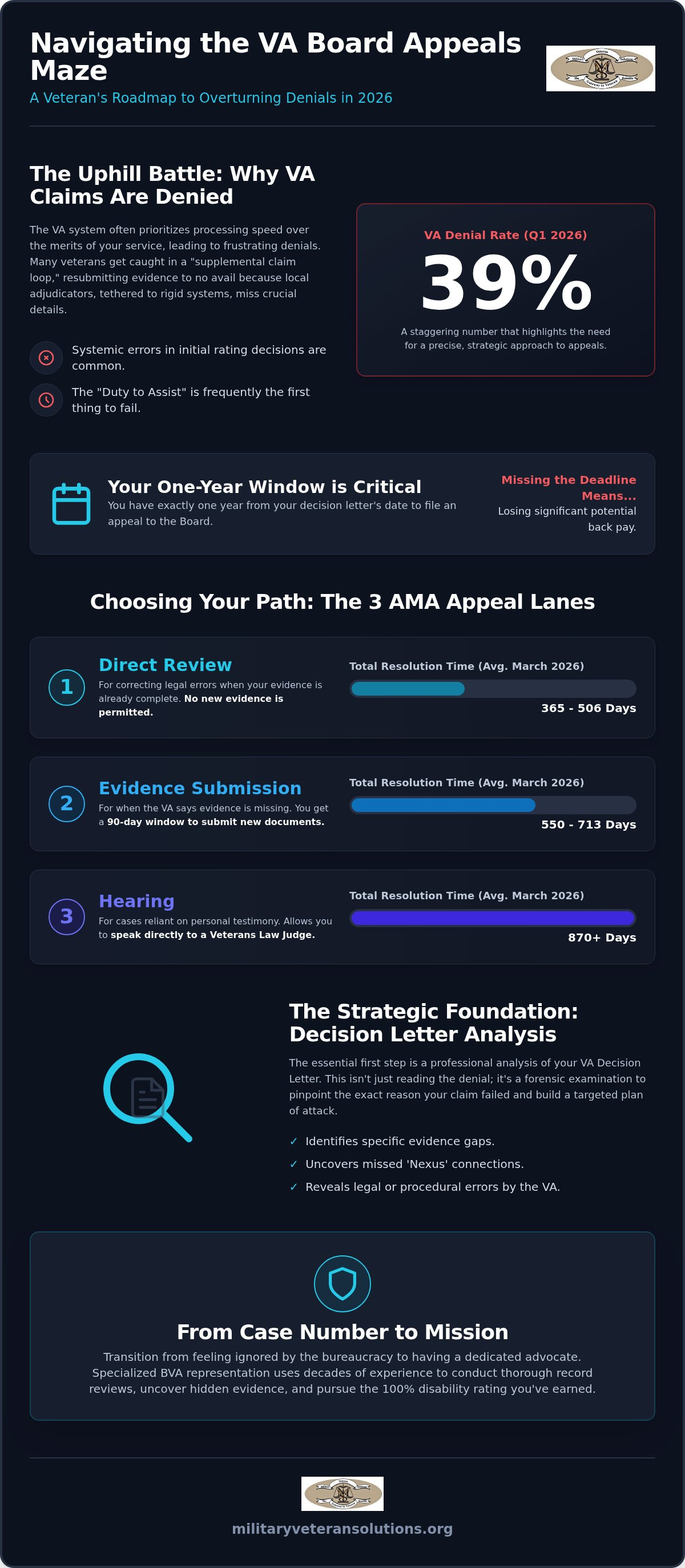
With the VA denial rate reaching a staggering 39% in the first quarter of 2026, standing before a judge without a precise roadmap is a risk you can't afford. You've served your country with honor, yet the very system designed to support you often feels like an impenetrable wall of red tape. It’s frustrating to feel ignored by a bureaucracy that seems to prioritize processing speed over the merits of your service. If you're searching for Board of Veterans Appeals help, you've likely realized that the path to a 100% rating requires more than just persistence; it demands a strategic, surgical approach to your evidence.
We understand the fear of waiting years for a hearing only to face another rejection. You deserve a partner who views your claim as a mission, not just a case number. This article provides a clear strategy to overturn your denial by identifying the specific nexus or missing evidence within your file. We'll preview the three AMA appeal lanes, from Direct Review to the Hearing docket, and explain why a thorough VA decision letter analysis is your most powerful tool for success. You'll learn how to manage these complexities with the confidence of someone who has a seasoned, protective ally in their corner.
Key Takeaways
- Learn how to strategically select between the Direct Review, Evidence Submission, and Hearing lanes to avoid unnecessary delays in the BVA process.
- Discover why a professional VA Decision Letter Analysis is the essential first step in identifying the specific evidence gaps that led to your initial denial.
- Secure specialized Board of Veterans Appeals help to conduct a thorough Military Record Review and uncover the hidden nexus evidence required to prove your claim.
- Transition from feeling ignored by the bureaucracy to having a dedicated advocate who uses decades of experience to pursue your earned 100% disability rating.
Understanding the BVA: Why Veterans Seek Board of Veterans Appeals Help
The Regional Office is often a revolving door of frustration. You submit evidence, wait months, and receive a denial that feels like it was written for someone else. This happens because local adjudicators are often tethered to rigid, automated systems that prioritize speed over accuracy. The Board of Veterans Appeals help you seek is about breaking that cycle. The Board of Veterans' Appeals (BVA) serves as the final arbiter within the VA, providing a higher level of scrutiny that simply doesn't exist at the regional level.
The emotional and financial stakes of this process are high. A denial isn't just a piece of paper; it's a delay in receiving the compensation you need for medical bills, housing, and family support. While the Regional Office might miss the nuances of your service record, the Board is designed to correct those oversights. It's the "supreme court" of the VA system, where legal and factual errors are finally addressed by specialists who understand the law.
The Reality of VA Claim Denials in 2026
The "Duty to Assist" is a legal requirement, yet it's frequently the first thing to fail at the local level. In 2026, systemic errors in initial rating decisions remain common. Raters might ignore a clear nexus or fail to order the correct C&P exam. A Veterans Law Judge provides a fresh look at your case. They aren't bound by the previous rater's mistakes. This de novo review is often the only way to secure a fair evaluation of complex conditions like MST or toxic exposure. It's about getting a judge to see the person behind the file.
When to Transition from Supplemental Claims to a Board Appeal
Many veterans get stuck in the "supplemental claim loop." They keep filing the same evidence hoping for a different result. You've hit a dead end when local adjudicators refuse to acknowledge the "nexus" or the severity of your symptoms. Timing is everything. You have exactly one year from the date of your decision letter to file an appeal and protect your effective date. If you miss this window, you lose the potential for significant back pay. Accessing filing VA appeals help early in your timeline allows you to build a surgical case that addresses the VA's specific objections. Don't wait until you've exhausted yourself with local denials. Move your case to the Board when the facts are on your side but the regional rater is not.
Navigating the Three Lanes: Choosing Your Path to the Board
Choosing the right appeal lane is the most critical decision you'll make after receiving a denial. It isn't just about how long you're willing to wait. It's about matching your specific evidence gaps to the correct procedural path. Many veterans seek Board of Veterans Appeals help because they feel paralyzed by these choices, fearing that one wrong move will lock them into years of additional waiting. According to data from the official Board of Veterans' Appeals website, the BVA has shifted its focus heavily toward Appeals Modernization Act (AMA) appeals, which now account for approximately 87% of adjudicated cases as of late 2024.
Direct Review vs. Evidence Submission
The Direct Review lane is a surgical strike for cases where the evidence is already perfect. If the Regional Office simply misapplied the law or ignored a document already in your file, this is your fastest route. As of March 2026, the total resolution time for this lane ranges from 365 to 506 days. However, there's a significant trap. You cannot submit new evidence. If your denial letter mentions a missing "nexus" or a lack of service connection, the Direct Review lane will likely lead to another denial. In those instances, the Evidence Submission lane is mandatory. It grants you a 90-day window to upload new medical records or expert opinions. While the wait is longer, estimated at 550 to 713 days, it allows you to plug the holes that caused the initial rejection.
Is a Board Hearing Worth the Wait?
The Hearing lane is the slowest option, with average pending times reaching 870 days in 2026. For some, the opportunity to speak directly to a Veterans Law Judge is invaluable. It puts a human face on a cold administrative file. Technology has made this more accessible through virtual hearings, allowing you to testify from your own home. If your case relies on "lay evidence" or personal testimony that isn't captured well in medical records, a hearing might be your best bet. A professional representative ensures you're prepared for the judge's questions, turning a stressful event into a focused presentation of facts. If you aren't sure which path fits your specific denial, a virtual consultation can help clarify your strategy before you commit to a docket.
The Strategic Foundation: VA Decision Letter Analysis
Your VA decision letter is more than just a notification of denial. It's the blueprint for your eventual success. When you seek Board of Veterans Appeals help, the first step isn't filing more paperwork; it's understanding the exact logic the VA used to reject your claim. Most veterans skim the first page and stop at the "denied" status, but the real intelligence is buried in the "Reasons for Decision" section. This document tells you exactly what the rater saw, what they ignored, and precisely which piece of the puzzle is missing.
To win at the Board of Veterans' Appeals, you must decode the VA's specialized jargon. There's a fundamental difference between "Service Connection" and "Disability Rating." Service connection is the "why"—it establishes that your condition was caused or aggravated by your time in uniform. The disability rating is the "how much"—it measures the severity of your symptoms. You can't get a rating without a service connection, but you can have a service connection with a 0% rating if the VA believes your symptoms aren't impactful enough. Understanding this distinction prevents you from arguing about symptoms when the VA's actual objection is the lack of an in-service event.
Success requires identifying the "Missing Link" in what advocates call the Caluza Triangle: a current medical diagnosis, an in-service event or injury, and the "nexus" connecting the two. If any of these three pillars are weak, your appeal will fail. Utilizing a professional VA decision letter review service uncovers these hidden gaps before you commit to a specific BVA lane. It allows you to see your case through the eyes of a rater, giving you the chance to fix the record before a judge reviews it.
Dissecting the 'Reasons for Decision'
This section of your letter is where the VA reveals its hand. You might find they overlooked a specific medical report or failed to consider a statement from a fellow service member. Sometimes, the error is purely legal, known as a Clear and Unmistakable Error (CUE), where the VA's own rules were ignored. By spotting these mistakes early, you can build a rebuttal that forces the Board to acknowledge the evidence they previously dismissed. Decision Letter Analysis is a diagnostic audit of VA denials.
Rating Percentages and the Path to 100%
If you're already service-connected but stuck at a lower percentage, your focus shifts to the severity of your symptoms. The VA's rating schedule is rigid. If your symptoms don't match their specific keywords, you won't get the higher rating. We often see veterans whose primary condition triggers secondary issues, such as sleep apnea secondary to PTSD or back pain secondary to a knee injury. These secondary connections are often the missing pieces in learning how to combine va disability ratings to get 100. Don't accept a partial victory when your service record supports a full 100% rating.
Building Your Evidence: Record Reviews and the 'Nexus' Connection
Winning a BVA appeal requires more than just repeating your story. It requires a forensic reconstruction of your service history. The Board of Veterans Appeals help you need is often hidden within the very pages the VA claimed to have reviewed. Raters at the Regional Office are under immense pressure to move files quickly; they don't always have the time to find a single medical entry in a thousand-page record. A comprehensive Military Record Review changes the dynamic by pinpointing the "lost" evidence that proves your in-service event occurred.
A private "Nexus Letter" is your most powerful weapon against a generic C&P exam. While a VA examiner might spend fifteen minutes with your file, a private medical expert provides a detailed, evidence-backed opinion that connects your current disability to your service. This opinion carries significant weight with a Veterans Law Judge. We also leverage lay statements, or VA Form 21-10210, to provide "buddy" evidence. These statements from fellow service members or family provide the human context that medical codes cannot capture. They bridge the gap between a cold clinical record and the reality of your daily struggle.
Auditing Your Service Treatment Records (STRs)
Chronic conditions often start as minor complaints during sick call. These entries are frequently overlooked because they seem insignificant at the time. If your records are missing or were part of a "fire-damaged" file, we use alternative evidence like personnel files or unit logs to reconstruct your history. Professional VA claim assistance is essential for this kind of deep-dive audit. We identify the evidence you didn't even know was missing, ensuring your file is bulletproof before it reaches the judge's desk.
Proving Service Connection for Secondary Conditions
The "But-For" rule is a vital strategy for maximizing your rating. But for your service-connected PTSD, you wouldn't have developed secondary conditions like sleep apnea or hypertension. This logic allows us to link new ailments to your existing disabilities, increasing your overall compensation. This approach is particularly effective for a pact act claim denied appeal. Toxic exposure claims often require a sophisticated evidentiary bridge to prove that your current respiratory or neurological issues are a direct result of your service environment. If you're ready to build a stronger case, schedule a virtual consultation to start your record review today.
Professional Advocacy: Why Specialized BVA Representation Matters
A Board appeal is a high-stakes legal process, not a clerical task. While many veterans start with a generic Veteran Service Officer (VSO), the complexity of a BVA case often requires a more intensive, specialized approach. VSOs are frequently overwhelmed with high caseloads, which can lead to a "one-size-fits-all" filing strategy. In contrast, seeking specialized Board of Veterans Appeals help ensures that your case receives a forensic level of attention. You need an advocate who doesn't just submit forms but builds a comprehensive legal argument designed to withstand the scrutiny of a Veterans Law Judge.
Military Veteran Solutions, LLC brings over 25 years of institutional knowledge to your appeal. Founded by a disabled veteran with 10 years of Army service, our firm operates with a deep-seated empathy that only comes from shared experience. We don't just see a claim number; we see a fellow service member who has been let down by a rigid bureaucracy. We leverage our expertise to identify the "hidden" evidence in your military records that others routinely miss. This isn't just about representation; it's a dedicated partnership focused on securing the benefits you earned through your service.
The Veteran-to-Veteran Advantage
Shared service history is our most valuable diagnostic tool. We understand the language of your service records, from the shorthand of a field medic's notes to the nuances of unit deployment logs. This allows for a much more thorough evaluation of your history than a civilian-led firm could provide. We take a no-nonsense approach to cutting through VA red tape, focusing on the specific legal triggers that force a judge to grant a claim. Before you commit to a representative, consider consulting with veteran advocacy services to ensure your strategy is tailored to the unique complexities of your specific denial.
Starting Your BVA Journey Today
The path to a 100% rating begins with a single, decisive step. Our onboarding process is designed to be methodical and direct, removing the guesswork from your appeal. It starts with a comprehensive VA Decision Letter Analysis to pinpoint exactly where the Regional Office went wrong. Through our virtual consultations, we provide expert guidance to veterans nationwide, ensuring that your location never limits your access to high-level advocacy. During your initial session, we'll map out a clear progression for your case, from record review to final BVA submission. You've spent enough time feeling ignored by the system. It's time to let a seasoned guide handle the burden of the bureaucracy so you can focus on your future.
Take Command of Your VA Appeal Strategy
The path to overturning a VA denial isn't found in repeating the same arguments that failed at the regional level. Success at the Board requires a surgical analysis of your decision letter to identify missing evidence and the strategic selection of the right appeal lane. By auditing your service treatment records and securing a private medical nexus, you transform a weak claim into a mission-ready appeal. If you're ready to move past the frustration of a bureaucratic stalemate, professional Board of Veterans Appeals help is the catalyst you need to secure your earned disability benefits.
Military Veteran Solutions, LLC is a veteran-owned firm founded by an advocate with 10 years of Army service. We bring over 25 years of experience to every record review, providing nationwide virtual advocacy for all U.S. veterans. You don't have to face this complex system alone. We stand ready to serve as your protective ally and seasoned guide throughout the entire evaluation process. Secure Your Benefits with a Virtual BVA Consultation today. You've fought for your country; now let us fight for the benefits you've rightfully earned.
Frequently Asked Questions
How long does a Board of Veterans Appeals decision take in 2026?
Decision times in 2026 vary significantly based on your chosen docket. The Direct Review lane remains the fastest path; it typically takes between 365 and 506 days for a total resolution. If you select the Evidence Submission docket, expect a wait of 550 to 713 days. The Hearing docket is the slowest option, currently averaging 870 days. Selecting the right lane is a critical part of seeking Board of Veterans Appeals help to avoid unnecessary delays.
Can I submit new evidence to the BVA after I file my Notice of Disagreement?
You can only submit new evidence if you select the Evidence Submission or Hearing lanes. The Direct Review lane is strictly limited to the evidence already in your file at the time of the initial decision. In the Evidence Submission lane, you have a 90-day window starting from the date you file your Notice of Disagreement to upload new documentation. This window is your primary opportunity to include a private nexus letter or updated medical records.
What is the success rate for veterans who have professional representation at the BVA?
While the VA doesn't publish a single representation success rate, the overall Board success rate provides a baseline. In 2025, the BVA issued 109,398 decisions, with 41.8% of cases decided on the merits being granted. Historically, veterans with professional advocacy tend to see higher grant rates because their files are audited for specific legal errors. Professional Board of Veterans Appeals help focuses on identifying the hidden evidence that often leads to these successful outcomes.
What happens if the Board of Veterans Appeals denies my claim again?
If the Board issues a final denial, your journey isn't necessarily over. You have two primary options: appeal the decision to the U.S. Court of Appeals for Veterans Claims (CAVC) within 120 days or file a Supplemental Claim with the Regional Office if you have new and relevant evidence. The CAVC review is purely legal, focusing on whether the Board followed the law, while a Supplemental Claim allows you to introduce new medical facts.
Is a BVA hearing mandatory for all veteran appeals?
A hearing is not mandatory. It's one of three optional lanes under the Appeals Modernization Act. Many veterans choose the Direct Review or Evidence Submission lanes to receive a decision faster. Hearings are most useful when your case relies heavily on personal testimony or lay evidence that isn't clearly reflected in your medical records. If your service treatment records are already comprehensive, a hearing may simply add years to your wait time without changing the outcome.
Can the BVA increase my disability rating even if I only appealed the service connection?
The Board's authority is generally limited to the specific issues you've appealed. If you appeal a denial of service connection and win, the judge will typically remand the case to the Regional Office to assign an initial rating percentage. However, if you're appealing an existing rating, the judge can increase it if the evidence shows your symptoms meet the criteria for a higher bracket. They can also decrease a rating if the evidence shows your condition improved.
How do I choose between a Supplemental Claim and a Board Appeal?
Choose a Supplemental Claim if you have new, relevant evidence and want a faster decision from the local Regional Office. Choose a Board Appeal when you believe the local rater ignored the law or failed to interpret your existing evidence correctly. Supplemental claims keep you within the local bureaucracy, while a Board Appeal moves your case to a Veterans Law Judge for a fresh, independent look at the facts of your service history.
What does it mean when the BVA 'remands' a case back to the Regional Office?
A remand occurs when a Veterans Law Judge determines that your case isn't ready for a final decision. The judge sends the file back to the Regional Office with specific instructions to gather more evidence, such as ordering a new C&P exam or seeking missing military records. While a remand isn't an immediate win, it's often a positive sign that the judge is correcting a Duty to Assist error made by the local rater.


