
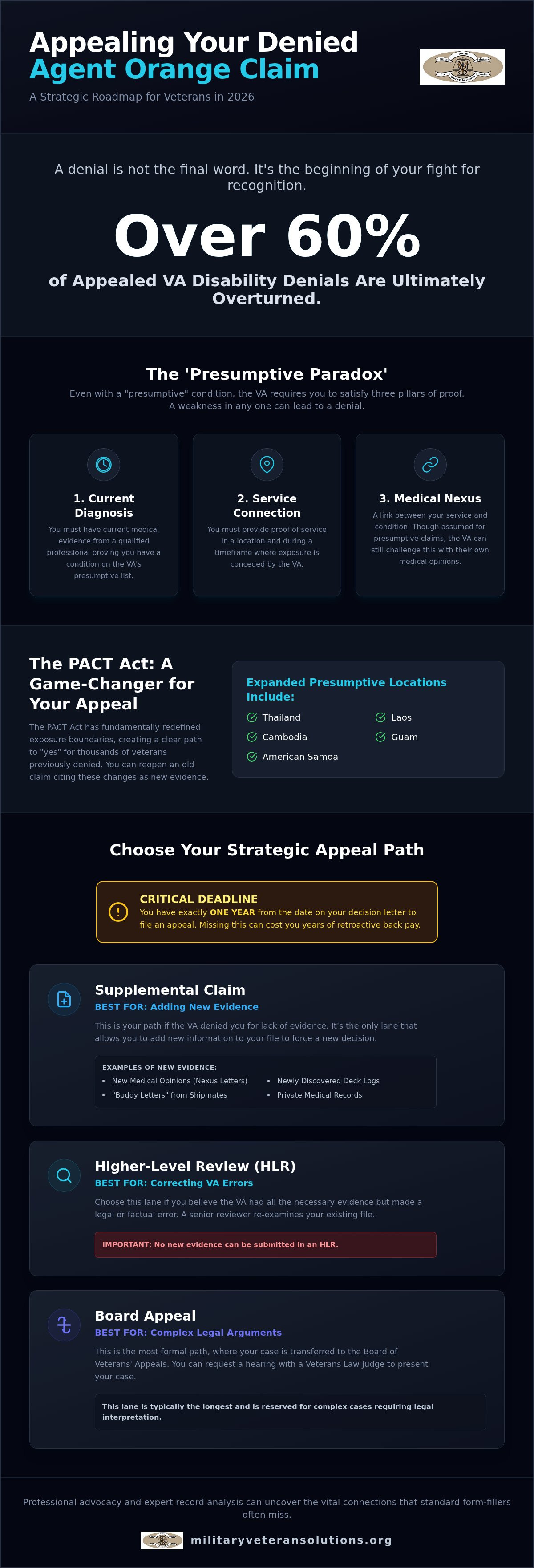
Over 60% of appealed VA disability denials are eventually overturned, a statistic that proves your initial rejection isn't the final word on your service history. It feels like a betrayal when you've spent years dealing with the health impacts of toxic exposure, only to have a bureaucrat tell you your condition isn't service-connected. You might be struggling to distinguish between legacy Agent Orange rules and the newer PACT Act presumptions, leaving you unsure of your next move. If you're currently appealing denied agent orange claim paperwork, you aren't just fighting for a check; you're fighting for the recognition your sacrifice deserves.
This 2026 guide is designed to strip away the confusion and put the power back in your hands. You'll learn how to audit your VA decision letter for the specific legal and medical errors that lead to denials. We'll break down the three-lane appeal system so you can choose the strategy that fits your evidence. From identifying missing nexus links to understanding the updated 2026 COLA rates, we're providing a clear roadmap to secure the benefits you earned decades ago.
Key Takeaways
- Learn why the VA often denies claims for presumptive conditions and how to identify the missing "nexus" or service connection evidence in your file.
- Discover how to choose the most strategic appeal lane between a Supplemental Claim, Higher-Level Review, or a Board Appeal based on your specific evidence.
- Master the process of appealing denied agent orange claim decisions by auditing your VA letter for "Duty to Assist" errors and overlooked medical records.
- Understand why a standard DD-214 is rarely sufficient and how a thorough review of your Official Military Personnel File can provide the proof needed to win.
- Find out how dedicated veteran claims representation and expert record analysis can uncover the vital connections that standard form-fillers often miss.
Why Your Agent Orange Claim Was Denied (The Presumptive Paradox)
The VA classifies certain illnesses as "presumptive" to theoretically simplify your path to benefits, but for many veterans, this promise feels like a hollow gesture. You have the diagnosis. You served during the conflict. Yet, your decision letter still says "denied." This is the presumptive paradox. It occurs because even when the VA concedes that an illness is linked to herbicides, they often find other reasons to reject the claim. To win your case, you must satisfy the three pillars of a VA claim:
- Current Diagnosis: Medical evidence proving you currently have a condition on the presumptive list.
- Service Connection: Proof that you served in a location and during a timeframe where exposure is conceded.
- Medical Nexus: A link between your service and your condition; though often assumed for presumptive claims, the VA may still challenge this with "negative" medical opinions.
The VA frequently attacks the service connection pillar. They might claim your ship wasn't in the correct territorial waters or that your duty station in Thailand didn't qualify for exposure recognition. To understand the historical scope of these chemicals, an Agent Orange overview shows how widely these herbicides were used, often beyond the narrow boundaries the VA initially recognized. These administrative errors are exactly why appealing denied agent orange claim paperwork is a necessary step for thousands of veterans in 2026.
Common Reasons for Agent Orange Denials
Many denials stem from a failure to prove "presumptive exposure" due to missing or incomplete personnel records. If your DD-214 doesn't explicitly place you on the perimeter of a base or on a specific vessel, the VA often defaults to a denial. Another common hurdle involves medical examiners who attribute your condition to age or lifestyle factors, such as smoking, rather than toxic exposure. Finally, many veterans face issues with "effective dates." If you filed a claim years ago and were denied, the VA may try to ignore that earlier filing, potentially costing you years of retroactive back pay.
The 2026 PACT Act Update for Agent Orange Appeals
The PACT Act has fundamentally redefined exposure boundaries. By 2026, the VA has expanded the list of presumptive locations to include specific bases in Thailand, Cambodia, Laos, Guam, and American Samoa. This means many veterans who were told "no" for decades now have a clear path to "yes." You can now reopen a previously denied claim as a Supplemental Claim by citing these changes in law as new and relevant evidence. If you're struggling with a recent rejection under these rules, you can learn more about the specifics in our guide on PACT Act Claim Denied: How to Appeal and Win Your VA Benefits in 2026. Don't let a past denial stop you from using these updated 2026 regulations to secure your rating.
Choosing the Right Appeal Lane: Supplemental, HLR, or Board Appeal
The Appeals Modernization Act (AMA) replaced the old legacy system with three distinct paths, each serving a specific tactical purpose. Choosing the right lane is a strategic decision that depends entirely on why your claim was rejected. For many, VA disability compensation for Agent Orange is denied because of a specific missing piece of data or a technical oversight. You have exactly one year from the date on your decision letter to file your appeal. Missing this deadline can result in the loss of your original effective date, potentially costing you thousands in retroactive back pay.
Supplemental Claims: The Power of New Evidence
If your denial was based on a lack of evidence, the Supplemental Claim lane is often your best move. In an Agent Orange case, "new and relevant" evidence might include a fresh medical opinion or newly discovered deck logs that place your vessel in a presumptive zone. Lay statements and "buddy letters" from former shipmates or platoon members are powerful tools here; they provide the boots-on-the-ground context that a sterile service record might lack. The Supplemental Claim lane is the fastest way to add medical nexus letters to your file and force a new decision based on the updated information.
Higher-Level Review (HLR) vs. Board Appeals
When the VA has all the evidence they need but still got the law wrong, a Higher-Level Review (HLR) acts as a strategic audit. This lane doesn't allow you to submit new evidence, but it does allow a senior reviewer to look for "clear and unmistakable errors" (CUE). You can request an "Informal Conference," which is a scheduled phone call where you or your representative can point out exactly where the previous rater failed to follow PACT Act guidelines or ignored your service dates. This is a high-speed option for appealing denied agent orange claim decisions when the mistake is on the VA's end.
If your case involves complex legal disputes or you've already exhausted the other lanes, a Board Appeal (BVA) puts your claim before a Veterans Law Judge. While powerful, this is the long game. In 2026, average wait times for a BVA decision range between 365 and 550 days. Understanding these trade-offs is essential when seeking filing VA appeals help to ensure you don't waste months in the wrong queue.
Deciding between these lanes requires a cold, objective look at your decision letter. If you're feeling overwhelmed by the technicalities, a professional military record review can help identify which path offers the highest probability of success for your specific service history.
Auditing Your VA Decision Letter: Spotting the Errors
Your decision letter is more than a rejection; it's the VA’s playbook. To successfully navigate appealing denied agent orange claim paperwork, you have to find where the rater missed the mark. Start by flipping past the standard legal definitions to the "Reasons for Decision" section. This is where the VA is forced to justify their denial. If the logic feels thin or relies on boilerplate phrases, you've found a path to an appeal.
Check the "Evidence" list first. This is a roster of everything the rater supposedly reviewed. If your private doctor’s nexus letter or your ship’s deck logs aren't on that list, the VA didn't consider them. This is a direct violation of their "Duty to Assist." The VA is legally required to help you obtain records that are relevant to your claim. If they didn't make a reasonable effort to find your service records, they've committed a procedural error that can be overturned in a Higher-Level Review.
Negative C&P exams are another frequent culprit. These exams often last only minutes, yet the VA uses them to override decades of medical history. Many raters rely on a single examiner's opinion that your condition is "less likely than not" related to herbicide exposure. This ignores the intent of presumptive laws. Investigative work in ProPublica's 'Reliving Agent Orange' series highlights how these systemic barriers frequently block veterans from the benefits they deserve.
Deconstructing the VA's Logic
One of the most frustrating phrases you'll see is "No evidence of an in-service event." For an Agent Orange claim, this is often a legal error. Under the PACT Act, your "in-service event" is your presence in a qualifying location. You don't need to prove you were sprayed; you only need to prove you were there. You should also watch for "Pyramiding" errors. This happens when the VA denies a rating for a second condition, like diabetes, because they claim it’s already covered under your heart disease rating. These are distinct issues that deserve separate evaluations. A comprehensive Decision Letter analysis is the first step in any Military Veteran Solutions representation.
The Role of Professional VA Decision Letter Analysis
A professional review does what the VA won't: it looks for the legal precedents the rater missed. We turn your denial into a road map for a successful Supplemental Claim by identifying exactly which medical or service records are needed to fill the gaps. By leveraging a Professional Military Record Review Service: Unlocking Evidence for VA Claims, you can ensure your next submission is bulletproof. We find the evidence the VA ignored and use it to hold them accountable.
Building a Bulletproof Evidence File with Record Reviews
Most veterans assume their DD-214 is the definitive record of their service. While it's a vital document, it rarely provides the granular detail required when appealing denied agent orange claim decisions. A DD-214 might say "Vietnam," but it won't show that you were on the perimeter of a base in Thailand or that your ship crossed into territorial waters on a specific Tuesday in 1968. To win, you need to dig deeper into your Service Treatment Record (STR) and your Official Military Personnel File (OMPF). These documents contain the raw data that raters often ignore during initial reviews.
The Military Record Audit Process
We look for the specific evidence the VA rater skipped. For Blue Water Navy veterans, this means scanning thousands of pages of deck logs to find the exact coordinates of your vessel at the time of exposure. For Army or Marine Corps veterans, we hunt for daily staff journals, TDY orders, and even pay records that confirm your physical presence in exposure zones. Military Veteran Solutions prioritizes a 25-year expertise in record auditing because we know exactly where the VA hides the evidence that proves your service connection. We don't just fill out forms; we build a historical case for your claim based on the actual events of your service.
Proving Service Connection for Secondary Conditions
Agent Orange exposure often creates a domino effect in your health. Conditions like peripheral neuropathy or ischemic heart disease are frequently denied because the VA fails to connect them to the primary herbicide exposure. You must also consider the "aggravation" rule. If you had a pre-existing condition that exposure made significantly worse, that is a valid path to a rating. Understanding how these pieces fit together is crucial for veterans looking at how to combine VA disability ratings for 100% in 2026. By identifying these secondary links, you increase your chances of a successful outcome when appealing denied agent orange claim paperwork.
A strong Nexus Letter is your final piece of armor. It can't be a generic note from a doctor. It must specifically reference the presumptive law, your medical history, and the specific records found during your audit. It needs to state that your condition is "at least as likely as not" caused by your service. If you're ready to stop guessing and start building a winning file, schedule a military record review today to uncover the evidence the VA missed.
Professional Advocacy: Why Representation Matters in 2026
The VA claims process is an adversarial environment, even if the brochures say otherwise. Filing an appeal on your own often leads to the same boilerplate denials you've already received. In 2026, the difference between a successful outcome and another year of waiting often comes down to the quality of your representation. Many organizations act as simple "form-fillers." They submit the paperwork you provide without questioning the underlying evidence. A dedicated veteran advocate does the opposite. We interrogate the VA’s logic and hunt for the missing links in your service record that "form-fillers" simply overlook.
The 2026 backlog remains a significant hurdle for unrepresented veterans. With average Board of Veterans' Appeals wait times stretching between 365 and 550 days, you cannot afford to submit a weak file. Professional representation ensures your appeal is "fully developed" before it hits a rater's desk. This precision reduces the likelihood of unnecessary remands or further delays. When you are appealing denied agent orange claim decisions, you are fighting against a system that relies on technicalities to deny benefits. You need an ally who speaks the VA’s language and understands the nuances of the PACT Act implementation.
The Military Veteran Solutions Advantage
We take a no-nonsense approach to institutional hurdles because we've navigated them ourselves. Military Veteran Solutions is founded by a 10-year U.S. Army disabled veteran with over 25 years of experience in the claims process. This peer-led perspective provides a level of insight that cold, corporate law firms cannot match. We don't just see a case number; we see a service record that deserves respect. Our virtual consultation model allows us to serve veterans nationwide. You can access expert record analysis and dedicated advocacy regardless of where you live. We bridge the gap between your military history and the VA’s complex requirements by performing exhaustive reviews of your OMPF and service treatment records.
Next Steps: Starting Your Appeal Today
Time is your greatest enemy in the appeals process. You have exactly one year from the date of your decision letter to file a Higher-Level Review or a Board Appeal. If you let this window close, you risk losing your original effective date and the retroactive pay that comes with it. Preparation is the key to a successful virtual consultation. Gather your most recent decision letter and any private medical records you've collected. We will use these to begin a detailed analysis of why the VA failed to recognize your exposure. Don't let another month pass without the benefits you earned through your service. Schedule your VA decision letter analysis and record review today.
Secure the Recognition and Benefits Your Service Deserves
A VA denial letter is a hurdle, not a final verdict. You now have the tools to audit your decision for "Duty to Assist" errors and choose the strategic appeal lane that fits your specific service history. Whether you're submitting new evidence through a Supplemental Claim or requesting a Higher-Level Review to fix a legal mistake, appealing denied agent orange claim paperwork requires a methodical approach to military records. The 2026 PACT Act updates have opened doors that were previously locked, but walking through them requires precision.
You don't have to navigate this administrative maze alone. Military Veteran Solutions is founded by a 10-year Army disabled veteran who understands the weight of your sacrifice. We provide expert analysis of VA decision letters and nationwide virtual consultations to ensure no veteran is left behind. Let us use our 25 years of experience to uncover the evidence the VA missed. You've fought for your country; now let us fight for the benefits you earned.
Secure your earned entitlements with professional VA appeals representation today.
Frequently Asked Questions
How long do I have to appeal a denied Agent Orange claim?
You have exactly one year from the date of your VA decision letter to file an appeal. This deadline is critical for preserving your effective date and maximizing retroactive back pay. If you miss this window, you lose the ability to keep the original claim date active. You can still file a Supplemental Claim later, but your potential back pay will typically only go back to the new filing date.
What is the fastest way to overturn an Agent Orange denial in 2026?
The fastest way to overturn a denial depends on the specific error in your file. A Higher-Level Review is often the quickest route if the VA made a clear legal mistake or ignored existing evidence. However, if your denial was based on missing medical or service records, a Supplemental Claim is the better choice. We use VA decision letter analysis to identify which lane offers the most efficient path to success.
Can I appeal an Agent Orange claim that was denied 10 years ago?
Yes, you can reopen a claim that was denied a decade ago by filing a Supplemental Claim with new and relevant evidence. The PACT Act has expanded presumptive locations for 2026, meaning service that was previously rejected might now be conceded. While you likely won't get back pay to the original date unless there was a Clear and Unmistakable Error, you can secure a current rating based on these updated laws.
Do I need a lawyer to appeal my denied VA claim?
No, you don't specifically need a lawyer for the VA appeals process. Accredited claims agents and veteran-owned advocacy firms like Military Veteran Solutions provide the same level of expertise in appealing denied agent orange claim paperwork. Many veterans find that peer-led representation offers a more personal, no-nonsense approach to record auditing. We focus on the granular details of your military history that traditional law firms might overlook during a review.
What is a 'new and relevant' piece of evidence for Agent Orange?
Evidence is "new" if the VA hasn't seen it before and "relevant" if it addresses the specific reason for your denial. In Agent Orange cases, this often includes private medical nexus letters, newly discovered deck logs, or buddy statements from fellow service members. These documents must prove you were in a recognized exposure zone or link your current diagnosis to herbicides. Our record reviews specialize in finding these missing pieces.
What happens if the VA says my condition is not service-connected?
If the VA claims your condition isn't service-connected, you must provide evidence that links your diagnosis to your time in uniform. For Agent Orange claims, this usually means proving you served in a qualifying location or providing a medical nexus letter. We audit your personnel file to find TDY orders or daily journals that place you on the ground. This evidence forces the VA to apply the presumptive service connection rules.
Can I file a Supplemental Claim and a Higher-Level Review at the same time?
You cannot file a Supplemental Claim and a Higher-Level Review for the same specific issue at the same time. You must choose one lane and see it through to a decision before moving to another. However, if your decision letter denied multiple conditions, you could theoretically choose different lanes for different issues. We help you evaluate which lane provides the strongest tactical advantage before you submit any paperwork to the VA.
How does the PACT Act affect my previously denied Agent Orange claim?
The PACT Act is a game-changer for previously denied claims because it expanded the list of presumptive locations and conditions. Many veterans who served in Thailand, Laos, or Cambodia were denied for years because the VA didn't recognize herbicide use there. Under the current 2026 guidelines, these locations are now conceded. This makes appealing denied agent orange claim decisions much more successful for veterans who were previously excluded.


