
Most veterans believe winning a 100% rating is strictly about medical diagnoses, but Total Disability based on Individual Unemployability (TDIU) is actually a vocational benefit hidden inside a medical claim. Learning how to get tdiu is about more than just listing symptoms; it's about proving that your service-connected conditions make "substantially gainful employment" an impossible goal. You've likely felt the crushing weight of monthly bills while your injuries keep you from maintaining a steady job. It's exhausting to navigate a system that seems designed to confuse you, especially when you're worried that filing for more help might trigger a reduction of your current ratings.
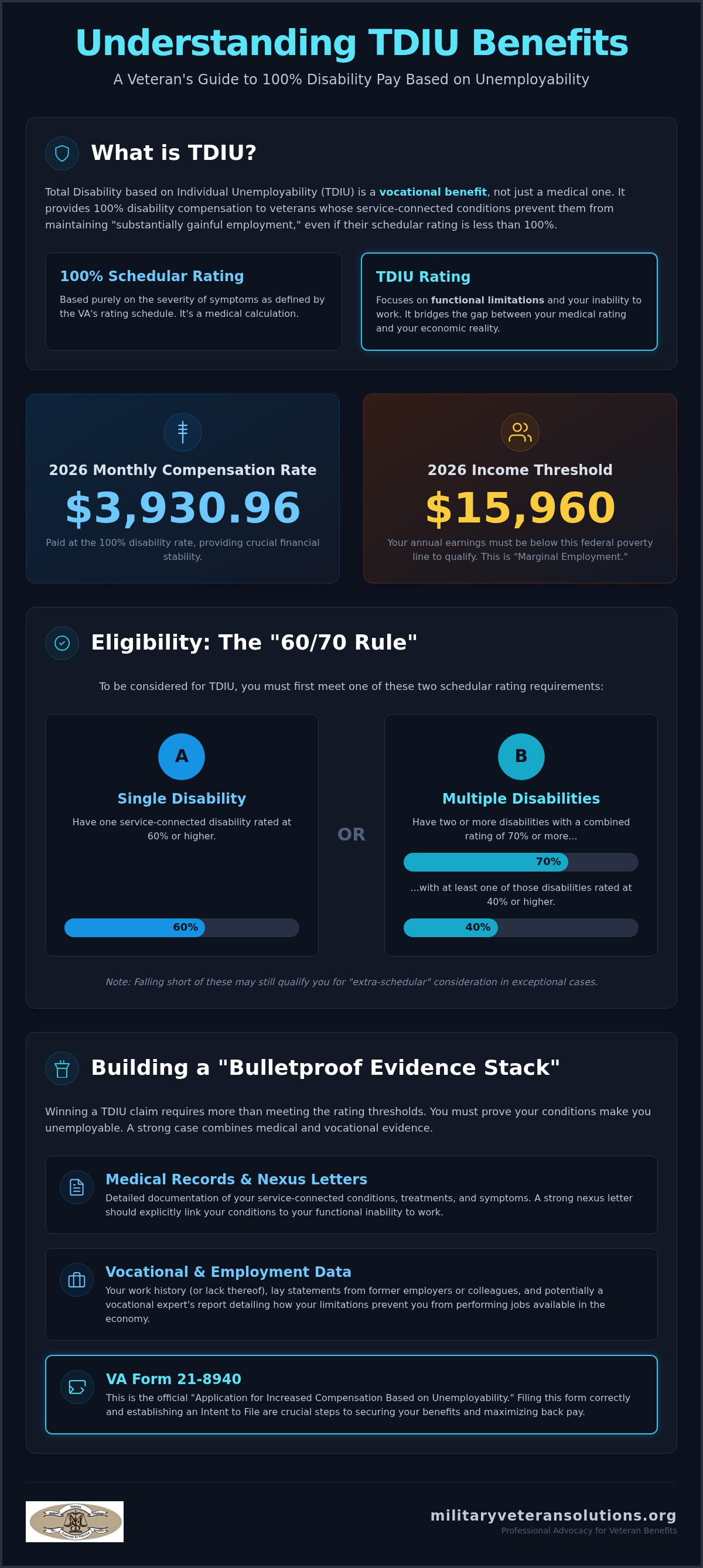
You shouldn't have to choose between financial security and the fear of a VA re-evaluation. The firm is here to help you secure the 100% compensation rate, which has risen to $3,930.96 per month following the 2026 COLA. We'll walk you through the 2026 income threshold of $15,960, the critical details of VA Form 21-8940, and the specific ways to document your functional limitations so the VA can't ignore your claim. It's time to protect your family's future with a clear, tactical path to the benefits you've earned through your service.
Key Takeaways
- Learn the specific "60/70 Rule" requirements that allow you to receive 100% disability pay even if your combined rating is lower.
- Master the strategic steps of how to get tdiu by correctly filing VA Form 21-8940 and establishing a formal Intent to File to secure your back pay.
- Discover how to build a "Bulletproof Evidence Stack" that combines medical records with vocational data to prove you can no longer work.
- Navigate the VA's complex definitions of employment and learn how to protect your current ratings while pursuing increased compensation.
- Identify the most common reasons for initial denials and see how a professional decision letter analysis can turn a "no" into a "yes."
What is TDIU? Understanding Individual Unemployability Benefits
TDIU is a safety net. It's for those whose service-connected conditions make holding a job impossible. It bridges the gap between medical impairment and economic reality. Many veterans feel stuck at a 70% or 80% rating while their symptoms prevent them from working. This is where understanding how to get tdiu becomes vital. It allows you to receive the 100% compensation rate, which sits at $3,930.96 in 2026, without having a 100% schedular rating. The Veterans Benefits Administration (VBA) recognizes that some disabilities are more economically devastating than a standard percentage might suggest.
The distinction between a 100% Schedular rating and TDIU is simple but critical. A schedular rating is based on the severity of your symptoms as they appear in the VA's rating schedule. TDIU, or Individual Unemployability, focuses on your functional limitations. It asks a different question: regardless of the specific percentage, can this veteran actually maintain a job? If the answer is no because of service-connected disabilities, the VA must pay at the maximum rate.
Substantially Gainful vs. Marginal Employment
The VA uses the term "substantially gainful employment" to describe a job that pays more than the federal poverty level. For 2026, that threshold is $15,960 for a single person. If you earn less than this, or if you work in a "protected environment," your work is considered marginal. Marginal employment includes:
- Seasonal or part-time odd jobs that don't provide a steady living.
- Working for a family business where you receive special accommodations.
- Sheltered workshops where the job exists specifically to support disabled individuals.
Your ability to earn a living shouldn't be a guessing game. If your income stays below the 2026 poverty line, you may still qualify for full benefits even if you're working a few hours a week.
Common Misconceptions About TDIU
A common myth suggests you must be 100% disabled to receive the 100% pay rate. This is false. TDIU exists specifically for those who aren't 100% schedular but are functionally unable to work. Another misconception is that you can never earn a single dollar again. You can maintain marginal employment as long as it doesn't cross into "substantially gainful" territory. Protected work environments allow for flexibility that a standard competitive job wouldn't offer, such as excessive breaks or reduced quotas. Understanding these nuances is the first step in learning how to get tdiu and securing your financial future.
Eligibility Criteria: Do You Qualify for the 100% Pay Rate?
Meeting the VA's technical requirements is the first hurdle in understanding how to get tdiu. The agency typically looks for specific "schedular" ratings before they even consider your unemployability. These numbers act as a gatekeeper. If you don't meet them, the VA often assumes you're still capable of holding a job. However, hitting the target percentage is only half the battle. You must also prove that your disabilities, and not other factors like age or a bad economy, are the primary reason you're out of work.
The standard eligibility follows the "60/70 Rule." You qualify for automatic consideration if you meet one of two criteria:
- Requirement A: You have a single service-connected disability rated at 60% or higher.
- Requirement B: You have two or more disabilities with a combined rating of 70% or more, with at least one individual disability rated at 40% or higher.
Even if you meet these thresholds, the VA often issues denials. They frequently claim that while you have a high rating, you still possess the functional capacity to perform sedentary work. This is why submitting VA Form 21-8940 with strong vocational evidence is vital. If you've already received a denial letter, analyzing the VA's reasoning is the first step toward a successful appeal.
The Extra-Schedular Pathway for TDIU
What happens if you fall short of the 60/70 rule? You aren't necessarily disqualified. The VA allows for "extra-schedular" consideration in exceptional cases. This pathway is designed for veterans whose disabilities are so unique or severe that the standard rating schedule doesn't capture their true impact. You might qualify if you face frequent hospitalizations or have functional limitations that make standard employment impossible. Proving these exceptional circumstances requires a deep dive into your records to find the "hidden" evidence that justifies a 100% pay rate regardless of your percentage.
VA Rating Increase Strategy
If you're currently below the 70% threshold, your strategy should focus on identifying secondary conditions. Many veterans have "nexus" conditions that stem from their primary service-connected injury. Linking these can push your combined rating into the eligibility zone. You can learn more about this in our guide on How to Combine VA Disability Ratings for 100% in 2026. If you're unsure where your current rating stands, a thorough Military Record Review can uncover the evidence needed to bridge the gap in your claim.
The Evidence Stack: Building a Bulletproof TDIU Case
Winning a claim isn't just about showing the VA you're sick. It's about showing them you can't work. This requires an "Evidence Stack." Medical records are the foundation, but they rarely tell the whole story. You need a combination of medical data, vocational analysis, and personal testimony to succeed. This is a core part of learning how to get tdiu effectively. Without a multi-layered approach, your claim is just another folder on a reviewer's desk.
Many veterans fail because they assume the VA will find the "nexus" or connection in their files for them. They won't. You must proactively identify these links. Utilizing professional military record review services can help you uncover service records that prove your current unemployability is tied to your time in uniform. Finding these "hidden" pieces of evidence often makes the difference between a denial and a 100% pay rate.
The Power of the Nexus Letter and DBQs
A nexus letter is your doctor's way of telling the VA that your condition is "at least as likely as not" caused by your service. But for TDIU, they must go further. They need to detail your functional limitations, like an inability to stand for more than ten minutes or a lack of concentration due to medication. Disability Benefits Questionnaires (DBQs) translate these symptoms into specific work restrictions. A doctor must link your inability to work directly to service-connected conditions, not age or non-service issues.
Vocational Expert Opinions
While doctors understand medicine, vocational experts understand the labor market. They are often more persuasive because they can analyze your "transferable skills." The VA frequently argues that a veteran with a back injury can simply do "sedentary work." A vocational expert can counter this by proving that your combined physical and mental disabilities, like PTSD-related social impairment or chronic pain, make even desk jobs impossible. This level of detail is a major factor in how to get tdiu when the VA initially pushes back based on a flawed C&P exam.
Lay Statements and Buddy Letters
Don't ignore the power of personal testimony. Using VA Form 21-10210 allows family, friends, or former coworkers to provide "boots on the ground" evidence. They can document things a doctor might miss, such as your inability to follow instructions or your frequent absences from work due to flare-ups. Specific examples, like being let go for angry outbursts or needing help with basic daily tasks, provide the human context that technical medical files lack. These statements turn a clinical diagnosis into a real-world story of struggle.
Step-by-Step: Filing VA Form 21-8940 and Navigating the Process
Filing for benefits is a methodical process that requires precision. It begins with a formal Intent to File, which is a simple but powerful step to lock in your effective date. This date determines when your back pay starts, ensuring you don't lose out on compensation while the VA processes your claim. Once the clock is running, your next priority is the primary application, VA Form 21-8940. This is the document where you explain why your service-connected conditions prevent you from working. Understanding the technicalities of these forms is a major part of how to get tdiu without unnecessary delays.
The process also involves external verification. The VA will send Form 21-4192 to any employers you've had in the last five years to request employment information. After the paperwork is submitted, you'll likely be scheduled for a Compensation and Pension (C&P) exam. This exam is different from standard medical checkups because the examiner focuses on your vocational limitations. Monitoring your claim status through the VA portal is essential, as the agency may send "development" letters requesting more evidence. If you feel overwhelmed by these administrative hurdles, a Virtual Consultation can provide the clarity you need to move forward.
Mastering VA Form 21-8940
When completing VA Form 21-8940, you must list your disabilities in a way that emphasizes their impact on labor. Don't just name the condition; describe how it stops you from performing job tasks. The "Date You Became Too Disabled to Work" is the most critical field on the form. This date must align with your medical records and employment history to justify your back pay. If you've earned "marginal" income, such as the 2026 federal poverty limit of $15,960 or less, disclose it clearly. The VA won't disqualify you for marginal earnings, but failing to report them can trigger a denial for lack of transparency.
Handling Uncooperative Former Employers
A common roadblock occurs when a former boss refuses to sign Form 21-4192 or when a company has gone out of business. You aren't responsible for their silence. If an employer doesn't respond, you must notify the VA that you've made a "good faith effort" to obtain the records. Provide dates and methods of your contact attempts. To keep your claim moving, you can submit Social Security Administration (SSA) earnings records as a substitute. These records provide the VA with the official income data they need without relying on an uncooperative third party. Military Veteran Solutions, LLC often helps veterans navigate these specific evidentiary gaps to ensure the claim stays on track.
Winning Your Appeal: How Professional Advocacy Secures Your Benefits
A denial isn't the end of the road. TDIU claims often face high initial denial rates because the VA overlooks the vocational impact of your injuries. Staying resilient is the first step in learning how to get tdiu after a setback. We know the frustration of opening a letter that ignores your daily struggles. This is where VA decision letter analysis becomes your most powerful tool. By identifying exactly where the VA went wrong, we can build a strategy to correct the record and secure your back pay.
Military Veteran Solutions, LLC brings over 25 years of experience in veteran advocacy to every case. We understand the system because we've lived it. When you're denied, you generally have two paths: a Higher-Level Review (HLR) or a Supplemental Claim. An HLR is a "closed record" review where a senior rater looks for mistakes in the existing file. A Supplemental Claim allows you to introduce new and relevant evidence. Choosing the right path is a tactical decision that depends on whether your evidence was ignored or if you need to add more. Our firm analyzes every detail to ensure you don't waste time on the wrong appeal type.
Strategic Advocacy for Denied Claims
Sometimes the VA makes a "Clear and Unmistakable Error" (CUE) in your rating. These are rare but powerful because they can lead to significant back pay. Most appeals, however, succeed by introducing new vocational evidence that the VA didn't consider. This might include a more detailed expert opinion or specific employment records. For a deeper dive into this process, see our pillar guide on Filing VA Appeals Help: A Strategic Guide to Overturning Denials in 2026. We focus on the functional "bridge" that connects your diagnosis to your inability to maintain a job.
The Value of Virtual Consultations
You don't need to live near a VA hub to get expert help. We offer virtual consultations nationwide to ensure every veteran has access to dedicated representation. A thorough military record review can often uncover "inferred" TDIU claims. These are claims the VA was legally required to address but ignored even though there was evidence of unemployability in your file. We find these missed opportunities and force the system to acknowledge them. Taking the first step is simple. Schedule a consultation with Military Veteran Solutions, LLC today to start your journey toward the 100% compensation you've earned. Learning how to get tdiu is easier with a seasoned ally by your side.
Take Control of Your Financial Future Today
Securing a 100% compensation rate through TDIU is about more than a medical diagnosis. It's about demonstrating the functional bridge between your service-connected conditions and your inability to maintain a job. You've learned that building a bulletproof Evidence Stack and mastering the technicalities of VA Form 21-8940 are the most effective ways to protect your family's financial security. Understanding how to get tdiu is the first step toward reclaiming the stability you earned through your service.
Military Veteran Solutions, LLC is ready to serve as your dedicated ally in this complex process. As a veteran-owned firm with over 25 years of experience, we specialize in finding the hidden evidence in service records and providing expert VA decision letter analysis. Whether you're filing for the first time or fighting a denial, our virtual consultations are available nationwide to guide you through every hurdle. Secure your earned entitlements with a professional VA claim review from Military Veteran Solutions, LLC.
You've carried the burden of your service long enough. It's time to let a seasoned advocate help you secure the benefits you deserve.
Frequently Asked Questions
Can I get TDIU if my rating is only 50%?
Yes, you can qualify for benefits even if your rating is 50% through the extra-schedular pathway. While the standard "60/70 rule" is the most common route, the VA allows for exceptions when a veteran's service-connected conditions are uniquely severe. You must prove that your disabilities prevent gainful employment in a way the standard rating schedule doesn't capture. This often requires detailed vocational evidence and a strong medical nexus to succeed.
Will the VA reduce my current disability rating if I apply for TDIU?
Applying for TDIU is technically a claim for an increased rating, which means the VA can re-examine your current disabilities. If your medical records show significant improvement, a reduction is possible. However, if your conditions have remained stable or worsened, your current ratings are generally safe. It's vital to review your medical evidence thoroughly before filing to ensure your symptoms still support your existing percentages and functional limitations.
Can I work at all while receiving TDIU benefits in 2026?
You can maintain limited employment while receiving benefits as long as it's considered "marginal." In 2026, this generally means your annual earned income must stay below the federal poverty level of $15,960 for a single person. You may also work in "protected work environments," such as a family business or a sheltered workshop, where special accommodations are made. Learning how to get tdiu doesn't mean you must give up all productivity.
How long does the VA take to process a TDIU claim?
Most veterans see a decision within 120 to 150 days, though these claims often take longer than standard disability claims. The delay usually stems from the VA waiting for former employers to return Form 21-4192. If your employers don't respond, the VA must wait through several follow-up periods before moving forward. Proactively providing your Social Security earnings records can sometimes help speed up this administrative timeline and keep the process moving.
Does Social Security Disability (SSDI) guarantee VA TDIU approval?
An SSDI approval doesn't guarantee you'll win your VA claim, but it serves as powerful evidence. The VA is required to consider Social Security records if they are relevant to your service-connected disabilities. Since the SSA uses a different definition of disability, the VA can still deny your claim if they believe your unemployability is caused by non-service-connected factors. You must still prove the medical nexus to your military service to win.
What is the difference between Schedular and Extra-Schedular TDIU?
Schedular TDIU applies when you meet the specific percentage requirements, such as a single 60% rating or a combined 70% rating with one at 40%. Extra-schedular TDIU is for veterans who don't meet these numbers but still cannot maintain substantially gainful employment. These cases are sent to the Director of Compensation Service for a special review. They require a higher level of evidence to prove that your vocational situation is truly exceptional.
What happens if my former employer won't fill out the VA paperwork?
If a former employer refuses to complete Form 21-4192, your claim will not be automatically denied. The VA is required to make a "good faith effort" to obtain the information, but they will eventually move forward without it. You can protect your claim by submitting your own employment history and Social Security earnings records. This ensures the rater has the necessary income data to process your application without waiting on an uncooperative boss.
Is TDIU permanent, or will the VA re-evaluate me every year?
TDIU isn't always permanent. The VA may schedule future re-evaluations if they believe your condition might improve over time. However, if your disabilities are deemed "static" or if you're over a certain age, the VA may grant you Permanent and Total (P&T) status. Once you are P&T, the VA generally stops scheduling routine exams. Understanding how to get tdiu with a P&T designation provides the highest level of long-term financial security.


