
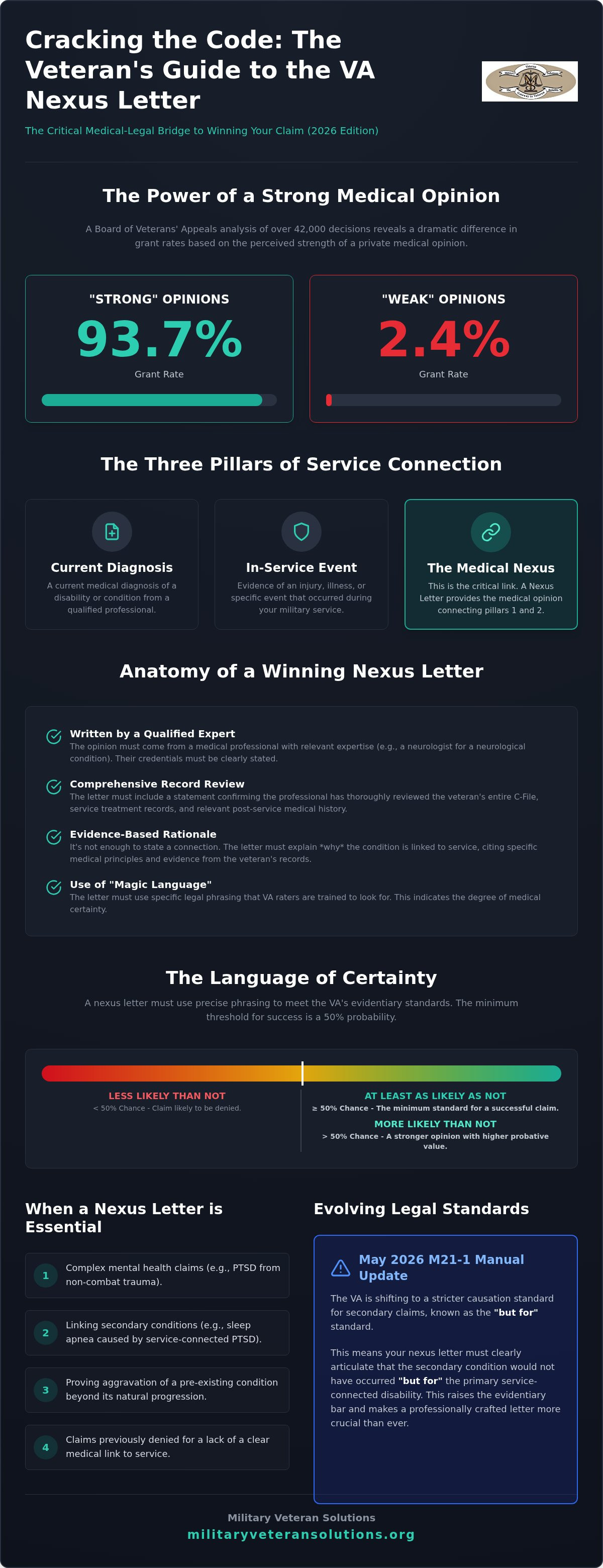
Did you know that a Board of Veterans' Appeals analysis of over 42,000 decisions found that private medical opinions described as "strong" were granted 93.7% of the time, while those labeled "weak" were granted only 2.4%? That massive gap usually comes down to one document. If you've ever walked out of a C&P exam feeling ignored, or if you're struggling to explain how a service injury from twenty years ago caused your current diagnosis, you're likely asking: what is a nexus letter for va claim? It's the missing link in your evidence chain.
We understand the frustration of having your lived experience dismissed by a system that feels designed to say no. You know your condition is service-connected, but translating that reality into the specific legal language the VA demands is a daunting hurdle. You shouldn't have to be a medical expert or a lawyer to get the benefits you earned through your service.
This 2026 guide will show you how a professionally crafted nexus letter serves as the critical medical-legal bridge to winning your claim. We'll detail the strict new "but for" causation standards found in the May 2026 M21-1 manual updates and explain how to secure a letter that the VA won't reject. You'll gain a clear roadmap to linking your diagnosis to your military service once and for all.
Key Takeaways
- Learn exactly what is a nexus letter for va claim and how it functions as the vital link between your military service and your current medical diagnosis.
- Discover why the VA prioritizes medical opinions from specialists who have conducted an exhaustive review of your entire C-File and military history.
- Understand the impact of the May 2026 M21-1 manual updates, specifically the shift toward a stricter "but for" causation standard for secondary claims.
- Identify when a nexus letter is mandatory, particularly for complex mental health claims or linking secondary conditions like sleep apnea to service-connected PTSD.
- Find out how professional record analysis can identify hidden nexus points that VA examiners often overlook during standard C&P evaluations.
Understanding the Nexus: The Missing Link in Your VA Claim
A successful VA claim isn't built on medical records alone. It's built on a specific legal framework. Many veterans assume that if they have a diagnosis and a record of service, the VA will naturally connect the two. That's a dangerous assumption. To win your claim, you must establish a "nexus," which is the essential legal connection between your current medical condition and an event, injury, or illness that occurred during your military service.
Think of your claim as a three-legged stool. If one leg is missing, the whole structure collapses. The three pillars of service connection are:
- A current medical diagnosis from a qualified professional.
- Evidence of an in-service event, injury, or disease.
- A medical nexus linking the diagnosis to the in-service event.
Standard medical records typically document your symptoms and treatment, but they rarely explain why the condition exists in relation to your service. A buddy statement provides context, yet it lacks the medical authority the VA requires for complex cases. This is where understanding what is a nexus letter for va claim becomes vital. It's a formal medical opinion that translates clinical data into the specific legal proof required to move beyond "presumptive" conditions and prove a direct connection.
The Legal Standard of 38 C.F.R. § 3.303
Under 38 C.F.R. § 3.303, the VA requires "direct" service connection evidence. You must show that your disability resulted from a specific incident or chronic disease that began in service. While 38 U.S.C. § 5107 provides the "benefit of the doubt" rule, meaning the VA should favor the veteran when evidence is equally balanced, the reality is often more difficult. A professionally written nexus letter acts as the decisive weight that tips that balance in your favor by providing a clear, evidence-based rationale that an examiner cannot easily ignore.
Direct vs. Secondary Service Connection
Not every condition starts during your time in uniform. While direct service connection links a condition straight to an in-service event, secondary service connection is equally powerful for modern claims. This occurs when a new condition is caused or worsened by an existing service-connected disability. For example, if a service-connected back injury leads to depression, that mental health condition is a secondary connection. A nexus letter is also used to prove "aggravation," which applies when military service made a pre-existing condition significantly worse than its natural progression would suggest.
The Anatomy of a Winning Nexus Letter
A nexus letter is not a casual note written on a prescription pad. It is a formal medical-legal instrument designed to satisfy the specific evidentiary requirements of a VA rater. To understand What is a Nexus Letter? in a practical sense, you must view it as a bridge between your medical history and the law. Credentials are the foundation of this bridge. The VA gives significantly more weight to specialists than general practitioners. If you're filing for a neurological condition, a neurologist's opinion carries more "probative value" than a family doctor's note. High-level expertise commands respect from the Regional Office.
Understanding exactly what is a nexus letter for va claim requires looking at the specific components that make it legally binding. Every effective letter must contain a clear "Record Review" statement. This confirms the physician has analyzed your entire C-File, including your service treatment records and post-service medical history. Without this, the VA may dismiss the opinion as speculative. This is exactly why a comprehensive military medical record review is essential before the doctor ever puts pen to paper. If you're unsure where your evidence stands, a professional VA Decision Letter Analysis can help identify the gaps a doctor needs to fill.
The Five Levels of VA Medical Certainty
VA raters are trained to look for "magic language" that fits specific legal thresholds. Your doctor must use precise phrasing to be successful. "At least as likely as not" is the minimum threshold, meaning there is a 50% or greater probability that your service caused the condition. "More likely than not" indicates a probability greater than 50%, which is the gold standard for approval. You must avoid vague terms like "could be," "may be," or "it's possible." These phrases lack the clinical certainty required to win a claim and often lead to immediate denials.
Supporting Evidence and Clinical Rationale
A simple conclusion isn't enough. The doctor must provide the "why" through a detailed clinical rationale. This involves citing specific entries from your records and referencing peer-reviewed medical journals or the VA’s own adjudication manual. The probative value of a nexus letter is determined by how well the medical expert bridges the gap between clinical evidence and legal causation through a detailed, logical explanation. By providing a clear roadmap of causation, the doctor makes it difficult for a VA examiner to offer a conflicting opinion without appearing unreasonable.
Who Should Write Your Nexus Letter?
Finding the right medical professional is often the most stressful part of the VA disability claim process. Many veterans assume their primary VA physician is the best choice to explain what is a nexus letter for va claim, but they're often met with a flat refusal. VA policy generally discourages their staff clinicians from providing medical opinions for claims. This creates a conflict of interest that leaves you stranded. You need an advocate who isn't bound by institutional red tape.
Specialization is your greatest asset. While your family doctor knows your daily health, the VA rater looks for specific expertise. A cardiologist carries significantly more weight for a heart condition than a general practitioner because their clinical rationale is harder for the VA to dispute. In 2026, the role of Physician Assistants (PAs) and Nurse Practitioners (NPs) has expanded, and their opinions are valid, but they must still demonstrate deep familiarity with your C-File. Professional VA claim assistance helps you navigate these choices so you don't waste time on a letter that lacks authority.
Overcoming the "My Doctor Won’t Help" Hurdle
If your private doctor is hesitant, it's usually because they don't understand the legal requirements. Don't ask for a favor; present it as a clinical necessity for your legal record. Provide them with a concise "fact sheet" that highlights specific events from your service record review. This reduces their workload and ensures they focus on the right evidence. If they still refuse, it's time to seek an Independent Medical Opinion (IMO) from a third-party specialist who understands the 2026 VA adjudication standards, including the new "but for" causation requirements.
The Problem with C&P Examiners
You've likely experienced a Compensation and Pension (C&P) exam that lasted only fifteen minutes. These examiners often provide negative nexus opinions because they lack the time to conduct a thorough record audit. A private nexus letter acts as powerful rebuttal evidence. It forces the VA to weigh your comprehensive, specialist-backed opinion against the brief, often superficial evaluation of their own examiner. Considering that "strong" private opinions are granted 93.7% of the time according to 2026 board data, your well-supported letter is the best defense against a poor C&P exam.
Strategic Use Cases: When a Nexus Letter is Mandatory
Certain VA claims are virtually impossible to win without a high-level medical opinion. While presumptive conditions under the PACT Act offer a streamlined path, many veterans suffer from illnesses that don't fit neatly into those categories. For mental health claims like PTSD or depression, the "markers" in your service record might be subtle or entirely absent if you didn't seek treatment while on active duty. In these cases, understanding what is a nexus letter for va claim is the difference between a denial and a lifelong benefit. A specialist can bridge the gap between your current symptoms and those subtle service markers, providing the clinical logic the VA requires.
Toxic exposure claims under the Gulf War or PACT Act also frequently require this level of evidence. If your condition isn't on the official presumptive list, the burden of proof rests entirely on you to link your diagnosis to environmental hazards. This is a high bar to clear. You need an expert who can cite specific toxicological studies and relate them to your deployment history. If you've already received a denial, don't lose hope. A professionally drafted letter can be the "new and relevant evidence" needed to reopen your case through a supplemental claim. If you're facing a complex denial, our VA Decision Letter Analysis can pinpoint exactly where your evidence failed so we can fix it.
Winning Secondary Condition Claims
Secondary service connection is often the most strategic path for veterans seeking an increase. This involves establishing a "Chain of Causation" where an already service-connected condition (Condition A) causes or aggravates a new condition (Condition B). Common examples include linking sleep apnea to service-connected PTSD or connecting hypertension to a chronic orthopedic injury. These connections are rarely obvious to a VA rater. You must provide a medical opinion that explains the physiological link between the two. Mastering these links is a proven strategy for achieving a 100 percent VA disability rating.
Overturning Denials in 2026
The 2026 adjudication standards are stricter than ever, particularly regarding the May 1, 2026 update to the M21-1 manual. If you've been denied, a nexus letter can clarify conflicting evidence during a Higher Level Review (HLR) or serve as the foundation for a Supplemental Claim. To reopen a previously denied case, a nexus letter must be submitted as new and relevant evidence because it addresses the specific medical gaps that led to the initial rejection. It speaks the language of the law while providing the clinical depth that a standard C&P exam lacks.
Maximizing Success with Professional Claim Advocacy
Attempting to navigate the medical-legal requirements of the VA alone often leads to a cycle of frustrating denials. While you now understand what is a nexus letter for va claim, knowing the definition is very different from executing a winning strategy. A DIY approach frequently fails the "probative value" test because it lacks the clinical depth and legal precision that raters require. Without a professional audit of your records, you risk submitting a document that the VA will simply ignore or dismiss as speculative.
At Military Veteran Solutions, LLC, we identify "hidden nexus" points that standard reviews often overlook. Our process begins with a comprehensive VA decision letter analysis to pinpoint exactly why the VA denied your claim in the past. This strategic audit ensures we aren't just guessing; we're solving the specific evidentiary puzzle presented by the rater. We bridge the gap between your medical diagnosis and the legal standards of service connection.
As a firm founded by a 10-year Army veteran, we understand the specific events of your service and the long-term medical fallout. We don't just see a case number. We see a fellow veteran who has been let down by a complex administrative system. Our advocacy is rooted in the belief that your sacrifices deserve the maximum benefits allowed by law.
The Audit Process: Finding the Evidence the VA Missed
We dig through decades of records to find the subtle "marker" that establishes your service connection. This isn't just about matching dates; it's about aligning clinical findings with your lived experience in a way the VA must accept. We ensure your nexus letter works in tandem with lay evidence from VA Form 21-10210 to create a cohesive, undeniable narrative. By combining medical expertise with strong personal testimony, we build a wall of evidence that is difficult for any examiner to tear down.
Securing Your Earned Benefits
The urgency is real. With the VA processing over two million disability benefits claims in fiscal year 2026, you cannot afford to be stuck in a multi-year appeal backlog because of a weak initial filing. Professional representation simplifies this complex landscape and provides the security you need. We manage the technicalities and the record audits so you can focus on your health and your family. Don't wait for another denial letter to arrive in the mail. Schedule a virtual consultation today to review your records and identify your missing nexus.
Take Command of Your Medical Evidence
Proving a service connection in 2026 requires more than just a diagnosis; it demands a strategic "evidence bridge" that links your current health to your time in uniform. You've seen how a strong specialist opinion can transform a weak claim into a successful grant. Understanding what is a nexus letter for va claim is only the first step. The real victory comes from executing a precise medical-legal strategy that leaves no room for VA examiners to doubt your history. You don't have to navigate this daunting administrative system alone.
Military Veteran Solutions, LLC was founded by a 10-year Army veteran who understands the gravity of your struggle. We specialize in exhaustive military record audits and decision letter analysis to identify the exact gaps preventing your approval. We provide dedicated advocacy for veterans across all 50 states, ensuring your voice is heard and your sacrifices are recognized. It's time to stop the cycle of denials and start the path toward the security you deserve. Secure your earned entitlements with professional VA claim representation from Military Veteran Solutions, LLC. You've fought for your country; now let us fight for your benefits.
Frequently Asked Questions
Does the VA require a nexus letter for every claim?
The VA doesn't require a formal nexus letter for every claim, particularly for presumptive conditions or injuries clearly documented in service records. However, for secondary conditions or claims filed decades after discharge, a medical opinion is often the only way to satisfy the legal requirement for service connection. Understanding what is a nexus letter for va claim is vital for these complex cases where the link isn't immediately obvious to a rater.
What happens if my C&P examiner says there is no nexus?
If a C&P examiner provides a negative opinion, you have the right to submit rebuttal evidence. A private medical opinion from a qualified specialist often carries more weight if it includes a thorough review of your entire C-File. Since Board data from August 2026 shows that strong private opinions are granted 93.7% of the time, a well-crafted letter can effectively overturn a flawed or superficial fifteen minute VA evaluation.
Can I write my own nexus letter for a VA claim?
You cannot write your own nexus letter because it must be a formal medical opinion from a licensed healthcare professional. While you should provide a personal statement using VA Form 21-10210 to describe your symptoms, the VA requires a doctor to provide the clinical rationale. A self-written letter lacks the probative value needed to establish medical causation and will likely result in an immediate denial for lack of competent medical evidence.
How much does a professional nexus letter cost in 2026?
Costs for medical opinions vary widely across the industry based on the complexity of the records and the specialist's credentials. Some providers offer flat fees for record reviews, while others bundle the medical opinion with a Disability Benefits Questionnaire. When researching what is a nexus letter for va claim, ensure any fee you pay covers a comprehensive audit of your military history rather than a generic template that the VA might reject.
Does a nexus letter guarantee that my claim will be approved?
No document can guarantee an approval, but a high-quality nexus letter significantly increases your probability of success. The VA must consider all competent medical evidence, and a specialist's opinion often tips the benefit of the doubt rule in your favor. By addressing the specific gaps identified during a VA Decision Letter Analysis, you provide the rater with the exact clinical logic required to grant the service connection you've earned.
What is the difference between a nexus letter and a DBQ (Disability Benefits Questionnaire)?
A Disability Benefits Questionnaire (DBQ) focuses on the current severity of your symptoms to determine your percentage rating. In contrast, a nexus letter explains the how and why behind the service connection itself. While a DBQ tells the VA how much the condition affects you today, the nexus letter provides the legal-medical link proving that the condition started or was worsened by your time in military service.
How long is a nexus letter valid for a VA claim?
There is no official expiration date for a nexus letter, but it should reflect your most current medical status and the latest VA regulations. If you're using a letter for a supplemental claim years after a denial, it may need an update to address the new "but for" causation standard implemented in May 2026. Keeping your evidence current ensures the VA rater doesn't dismiss the opinion as outdated or clinically irrelevant.
Can a nexus letter be used for a PACT Act claim?
Yes, a nexus letter is often essential for PACT Act claims involving conditions that aren't on the official presumptive list. If you were exposed to toxic substances but your specific illness isn't automatically covered, you must prove the connection yourself. A specialist can use peer-reviewed research to link your diagnosis to the specific toxins you encountered during deployment, providing the evidence needed to win a non-presumptive exposure claim.


