
Did you know that in 2026, approximately 25% of PACT Act claims are still being denied despite the expanded list of presumptive conditions? It feels like a betrayal when you've served your country, only to have the VA reject a claim for a condition they've already acknowledged is linked to your service. You might be asking yourself, can the va deny a presumptive disability when the law seems so clear? The answer is a frustrating yes. It's common to feel overwhelmed by a system that promises a streamlined path but delivers a complex web of red tape instead.
You shouldn't have to navigate this bureaucracy alone, especially when your 2026 disability compensation and years of back pay are on the line. This guide will help you discover why presumptive claims are denied and teach you the strategic steps to overturn a VA decision and secure your earned benefits. We'll examine the critical difference between "presumptive" and "automatic" status, identify the specific medical evidence the VA is looking for, and show you how a professional military record review can serve as the tactical advantage you need to win your appeal. It's time to turn that denial into a path toward the entitlements you've rightfully earned.
Key Takeaways
- Learn how presumptive status simplifies the claims process by removing the medical nexus requirement while still requiring a bulletproof diagnosis.
- Understand the administrative loopholes that explain why can the va deny a presumptive disability even for conditions clearly listed under the PACT Act.
- Identify the specific "exposure gap" in your service records and discover how to document your service to meet strict 2026 VA criteria.
- Master the strategic differences between a Higher-Level Review and a Supplemental Claim to choose the most effective path for your specific appeal.
- Discover how a professional military record review acts as a tactical second set of eyes to find the critical evidence the VA missed.
What Is a Presumptive Disability and Is Approval Guaranteed?
A presumptive disability is a legal standard where the VA assumes your medical condition was caused by your military service. This occurs because you served in a specific location, such as Vietnam or Southwest Asia, during a timeframe where exposure to toxins like Agent Orange or burn pits was common. The Agent Orange Act of 1991 established the foundation for this approach, creating a precedent that allows veterans to bypass the often-difficult task of proving a direct medical link. However, many veterans ask, can the va deny a presumptive disability even if their illness is on the official list? The answer is a definitive yes. Presumptive status is a shortcut for evidence, not a guarantee of payment.
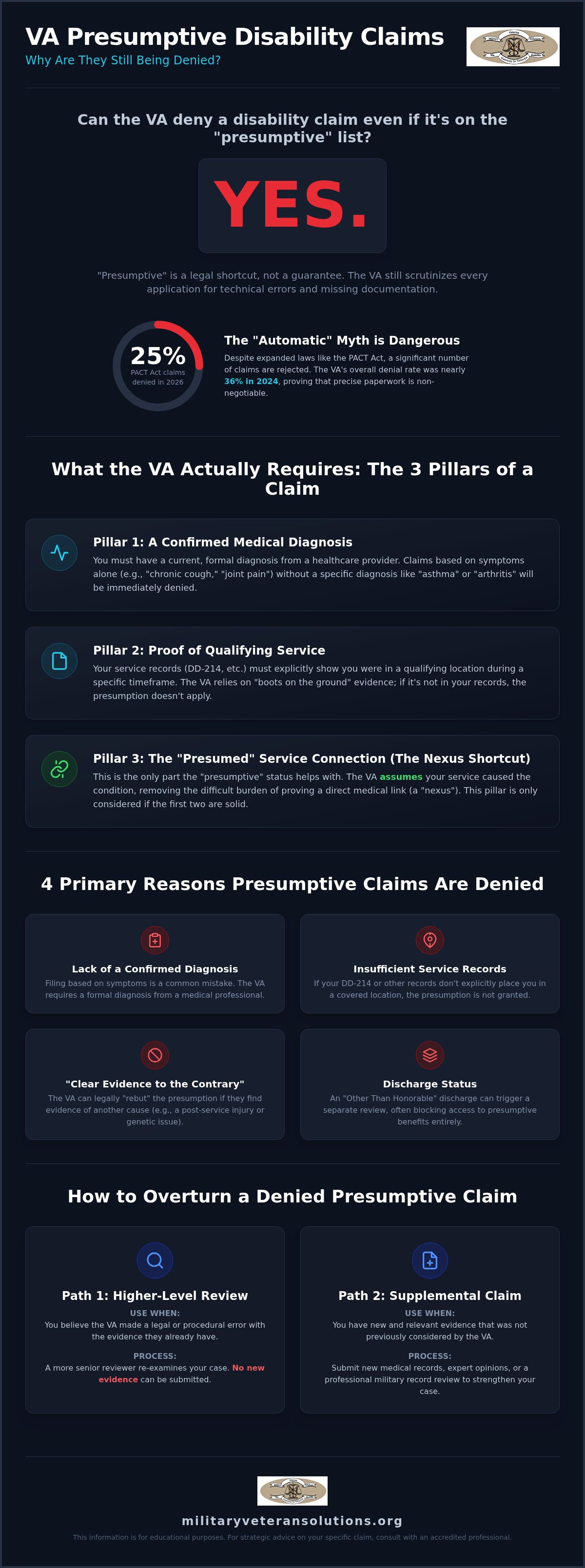
The "Automatic Myth" is one of the most dangerous misconceptions in the veteran community. You might assume that once a condition is added to the PACT Act list, your rating will simply appear in your mailbox. In reality, the VA's overall denial rate remained near 36% in 2024, and PACT Act claims specifically saw a 25% denial rate. These numbers prove that the VA still scrutinizes every application for technical errors or missing documentation. You are fighting a bureaucracy that values precise paperwork over general assumptions.
The Three Pillars of a VA Claim
To win any claim, you must satisfy three specific requirements. Presumptive status only helps with the third one. You still need a current, formal medical diagnosis from a healthcare provider. Symptoms or "suspected" conditions will result in an immediate denial. You must also provide service records proving you were in the qualifying location. If your records don't show "boots on the ground" in a covered area, the VA will reject the claim. Only when these two pillars are solid does the "Missing Nexus" pillar become irrelevant through presumptive law.
Why 2026 is a Critical Year for Presumptive Claims
This year is pivotal because the VA is processing a record volume of claims following recent legislative expansions. With the 2.8% Cost-of-Living Adjustment (COLA) for 2026 now in effect, the financial stakes for your back pay and monthly benefits are higher than ever. The VA is currently balancing a massive backlog, which often leads to rushed reviews and overlooked evidence in military records. Understanding the difference between a "Presumption of Exposure" and a "Presumption of Service Connection" is vital. You might be presumed exposed to toxins, but you still have to prove that exposure led to a specific, diagnosed condition currently recognized by the 2026 regulations.
The 4 Primary Reasons the VA Denies Presumptive Claims
While the law assumes a connection between your service and your illness, the VA doesn't hand out benefits without a fight. Understanding the question can the va deny a presumptive disability requires looking at the technical loopholes the agency uses to protect its budget. Even with 2026's updated COLA rates and PACT Act expansions, the burden of evidence remains heavy on the veteran. Most denials fall into four specific categories that often catch applicants off guard.
- Lack of a Confirmed Diagnosis: You cannot file a claim based on symptoms alone. If you have "chronic cough" or "joint pain" but no formal medical diagnosis for a condition like asthma or arthritis, the VA will deny you. They require a medical professional's signature on a specific diagnosis.
- Insufficient Service Records: If your DD-214 doesn't explicitly show you were in a covered location, such as certain bases in Thailand or specific offshore waters, the presumption doesn't apply. The VA relies on "boots on the ground" evidence.
- Clear Evidence to the Contrary: The VA can use your own medical history against you. If they find evidence that a condition was caused by a post-service injury or a genetic predisposition, they can legally "rebut" the presumption.
- Discharge Status: Generally, you need an Honorable or General (Under Honorable Conditions) discharge. An "Other Than Honorable" status often triggers a separate review process that can block presumptive benefits entirely.
The "Clear Evidence to the Contrary" Rule
The VA operates under a legal framework where a presumption is "rebuttable," meaning they can overturn it if they find convincing proof of another cause. This is detailed in the Presumptive Service Connection and Disability Compensation report provided by the Congressional Research Service. When asking can the va deny a presumptive disability, you must realize they are actively looking for reasons to say your service wasn't the cause. A rebuttable presumption is a legal standard that the VA can overcome with specific evidence. For example, if you claim a respiratory condition due to burn pits but your post-service records show a 20-year smoking habit, the VA may argue that lifestyle, not exposure, is the primary cause. They look for "intervening causes" that happened after you hung up the uniform.
Service Requirement Discrepancies
Incomplete military personnel files are a leading cause of frustration. For Blue Water Navy veterans or those who served in Thailand, proving you were within the specific geographic boundaries required by the VA is a massive hurdle. If your records are thin, the VA won't do the detective work for you. Utilizing military record reviews can bridge these gaps by identifying overlooked deployment orders or unit logs. If you've received a denial letter, having an expert perform a VA decision letter analysis can pinpoint exactly which service record discrepancy triggered the rejection.
The PACT Act and Presumptive Denials: Why Evidence Still Matters
The PACT Act represents the largest expansion of veteran benefits in generations, adding over 300 respiratory conditions and cancers to what the VA considers a presumptive condition. Despite this massive legislative shift, the 25% denial rate for PACT Act claims in 2024 highlights a cold reality for many. You might wonder, can the va deny a presumptive disability even when the law seems to be on your side? They can, and they frequently do. The VA often relies on the "Exposure Gap," where they acknowledge you were near burn pits but claim your specific medical records don't show "chronicity." Chronicity means you must prove your condition is a long-lasting, persistent problem, not just a temporary ailment. If you've faced a rejection, understanding the nuances of PACT Act claim denied appeals is crucial for your 2026 strategy.
Burn Pits and Gulf War Illness
Gulf War veterans often struggle with "Undiagnosed Illnesses," which are a hallmark of Gulf War Syndrome. The VA frequently uses Compensation and Pension (C&P) exams to categorize these complex symptoms as minor or unrelated to toxic exposure. If you served in Afghanistan or Southwest Asia, you must be prepared for an examiner who might downplay your fatigue or respiratory issues. These examiners often look for a single, clear cause, ignoring the reality of multi-symptom illnesses. A tactical advantage in these cases is having a "second set of eyes" review your military records to ensure every mention of illness during deployment is highlighted for the adjudicator.
Agent Orange and Radiation Exposure
For those dealing with Agent Orange or radiation, the "Manifestation Period" trap remains a significant hurdle. Some conditions must have appeared within a certain timeframe after service to qualify for presumption. Additionally, the VA often denies service connection for secondary conditions that stem from an original Agent Orange illness. You can bolster your case by using lay statements, which are personal accounts from you, your family, or fellow service members. These statements provide a vivid picture of your exposure and the progression of your symptoms, filling the gaps that clinical records sometimes miss. In 2026, the VA is under pressure to process claims quickly, which makes these personal narratives even more vital to prevent your file from becoming just another number in the backlog.
How to Overturn a Denied Presumptive Claim
Receiving a denial letter is a gut punch, but it isn't the end of the road. When veterans ask, can the va deny a presumptive disability, they're often looking for a way to fix a system that seems broken. To win, you must move from frustration to tactical analysis. Your first step is to dissect the "Reasons for Decision" section of your VA letter. This isn't just paperwork; it's a map that shows exactly where the VA thinks your claim failed. Whether it's a missing diagnosis or a service record discrepancy, the letter tells you what to fix.
Once you identify the failure point, you must choose the correct appeal lane. You'll typically file either VA Form 20-0995 for a Supplemental Claim or VA Form 20-0996 for a Higher-Level Review. If the VA ignored evidence already in your file, a Higher-Level Review is your best bet. If you need to add a private medical opinion to counter a negative C&P exam, the Supplemental Claim lane is the only way to get that new evidence in front of a rater. Don't let a single bureaucrat's mistake cost you the 2026 COLA-adjusted benefits you've earned.
Higher-Level Review (HLR) vs. Supplemental Claims
Choosing the right lane is a critical tactical decision. An HLR is a "closed record" review. A senior adjudicator looks at the same evidence and determines if the previous rater made a legal error or failed their "Duty to Assist." If you have new proof, like a more specific diagnosis, you must use a Supplemental Claim. Avoid the Board of Veterans’ Appeals (BVA) as your first step. With BVA hearing timelines stretching toward 730 days in 2026, staying within the Supplemental or HLR lanes is much faster for securing your back pay.
The Power of a Professional Decision Letter Analysis
The VA often issues vague denials that don't meet legal standards. They might acknowledge your exposure but claim your condition isn't "chronic," or they may simply ignore a key entry in your military personnel file. A professional analysis finds these "vague denials" and highlights the specific evidence the VA overlooked. If you're struggling to organize your medical history, seeking VA claim assistance ensures your documentation is bulletproof. We act as a second set of eyes to find the exposure markers the VA missed. If you're ready to challenge a wrong decision, contact us for a VA decision letter analysis to identify the exact errors in your denial.
Strategic Advocacy: How Professional Representation Secures Your Benefits
Filing a claim for a presumptive condition seems straightforward, but the bureaucratic reality is often far more hostile. When you ask, can the va deny a presumptive disability, you're recognizing that even "automatic" connections require a mountain of proof. Filing alone often leads to avoidable procedural denials because the VA's rater might miss a single line in your 500-page medical file. At Military Veteran Solutions, LLC, we provide peer-level advocacy backed by over 25 years of experience. We aren't just filing forms; we're conducting a tactical evaluation of your entire military history to ensure no benefit is left on the table.
Our veteran-owned and operated firm specializes in identifying the technical errors and missing medical evidence that lead to rejections. Through national virtual consultations, we offer expert veteran claims representation regardless of where you're located, ensuring every veteran has access to elite advocacy. We act as a dedicated "second set of eyes" that finds the "smoking gun" evidence, such as specific toxic exposure dates or forgotten field hospital visits, that the VA habitually overlooks. Understanding that can the va deny a presumptive disability is a real possibility is the first step in preparing a bulletproof appeal that demands results.
A Detailed Review of Your Service History
A standard VA review often stops at your DD-214, but our process goes much deeper. We audit unit logs, deck logs, and obscure medical markers that prove your presence in toxic environments. Ensuring every presumptive condition is identified and claimed correctly is the only way to maximize your rating and secure your financial future. A professional, exhaustive review of your military records can uncover the evidence needed to reach 100% disability potential and secure the high-level compensation you deserve.
Winning Your Appeal in 2026
The 2026 landscape for VA claims is more competitive than ever due to the massive influx of PACT Act applications, making it easier for your file to be overlooked. You need a tactical advantage to stand out. Having an advocate who speaks the VA’s technical language prevents your appeal from getting lost in the shuffle of a backlogged system. We take the burden off your shoulders, significantly reducing the stress of the VA appeals process by handling the complex analysis and filing requirements. Don't let another year pass without the benefits you earned through your sacrifice. Schedule a virtual consultation today to start your VA decision letter analysis and take the first step toward overturning a wrongful denial.
Secure the Benefits Your Service Earned in 2026
Understanding the answer to can the va deny a presumptive disability is the first step in protecting your financial future. While laws like the PACT Act have expanded your rights, the VA still requires a confirmed medical diagnosis and proof of qualifying service to grant a rating. You don't have to accept a denial as the final word on your claim. By analyzing your decision letter and choosing the right appeal lane, you can correct administrative errors and secure the back pay you've earned through your dedication to this country.
Military Veteran Solutions, LLC is a veteran-owned firm with over 25 years of experience in overturning complex VA denials. We act as a tactical second set of eyes, finding the evidence the VA missed through exhaustive military record reviews. Secure the benefits you earned; schedule your virtual consultation with Military Veteran Solutions today. Our national virtual consultations provide you with expert representation no matter where you live. You've fought for your country; now it's our turn to fight for the entitlements you deserve.
Frequently Asked Questions
Can the VA deny a claim if the condition is on the presumptive list?
Yes. The VA can and does deny these claims for several reasons. You still need a current medical diagnosis and proof of qualifying service in a specific location or timeframe. If your records don't align with the legal requirements or if the VA finds a specific intervening cause, they will issue a denial. Many veterans ask, can the va deny a presumptive disability, and the answer is that presumptive status only removes the need for a medical nexus, not the other pillars of a claim.
How much evidence do I need for a presumptive disability claim?
You need two primary pieces of evidence: a formal medical diagnosis and service records proving your location. While you don't need a medical nexus linking the two, your medical records must show the condition is chronic and current. Your personnel file must clearly place you in a qualifying area, such as the Republic of Vietnam or the Arabian Peninsula, during the dates specified by the VA. Without these two solid pillars, your claim remains incomplete and vulnerable to rejection.
What is clear and unmistakable evidence to the contrary?
This is a legal standard the VA uses to rebut or overturn a presumptive connection. It refers to evidence that proves your condition was caused by something other than military service, such as a post-service injury, lifestyle factors, or genetics. If the VA finds a specific event in your medical history that clearly explains your illness, they can legally deny your claim despite the presumptive list. This is why having a professional second set of eyes to review your file is vital for a successful appeal.
Does the PACT Act guarantee 100% disability for presumptive conditions?
No, the PACT Act only establishes service connection, not a specific disability rating. Once the VA acknowledges your condition is related to toxic exposure, they evaluate the severity of your symptoms to determine a rating between 0% and 100%. For example, a veteran with asthma might be rated at 10%, 30%, or 60% based on lung function tests. You must provide clear evidence of the severity of your condition to reach the higher compensation levels you deserve in 2026.
Can I appeal a denied presumptive claim without a nexus letter?
Yes, you can appeal without a nexus letter because the law already presumes the connection exists. However, you must still address the specific reason for the denial in your appeal. If the VA denied you because they don't believe you served in a qualifying area, you need service records rather than a nexus letter. If they claim you don't have a chronic diagnosis, you need updated medical records. A professional analysis of your decision letter identifies exactly which piece of evidence is missing.
What happens if the VA says my condition existed before service?
If the VA claims your condition was pre-existing, they're using the presumption of soundness against you. You must then prove that your military service aggravated the condition beyond its natural progression. This often requires a detailed review of your entrance physical and subsequent service treatment records to find markers of worsening health. Proving aggravation is complex, but it's a common path to overturning denials for conditions the VA labels as pre-existing or congenital. Tactical advocacy makes a significant difference here.
How do I prove I was exposed to burn pits if it is not in my records?
You can use lay statements, buddy letters, and unit logs to bridge this gap. The PACT Act allows the VA to presume exposure if you served in certain locations during specific dates, even if "burn pits" aren't mentioned in your file. If your service records are thin, a professional military record review can find deployment orders or secondary markers that place you in the path of toxic exposure. This provides the technical evidence the VA rater needs to approve your claim.
Is it better to file a Higher-Level Review or a Supplemental Claim for a presumptive denial?
It depends on why you were denied. If the VA made a clear mistake based on the evidence already in your file, a Higher-Level Review is faster. If you need to add a new diagnosis or more service proof, you must file a Supplemental Claim. Choosing the wrong lane can lead to months of wasted time and missed back pay. An expert evaluation helps you select the most tactical path to secure your 2026 benefits and protect your rights.


