
What if the evidence you need to turn a VA denial into a maximum rating is already in your hands, but it's buried under five hundred pages of medical jargon you can't decode? Many veterans feel completely overwhelmed by the process of interpreting military medical records for va appeal, fearing that their most critical evidence was lost or simply never documented. You've likely spent hours staring at service treatment records, feeling the weight of a system that seems designed to overlook your daily struggles. It's exhausting to receive a decision letter claiming "no service connection" when you remember the exact moment your health changed during your time in uniform.
This guide shows you how a professional review transforms those chaotic files into a persuasive evidence package. We'll reveal how to uncover the hidden nexus that links your current diagnosis to your service, even if the VA previously ignored your claim. You'll discover how to identify secondary conditions that increase your rating and how to organize your records to meet the VA's updated 2026 evidentiary standards. By the end, you'll understand how to bridge the gap between raw data and the disability compensation you earned through your sacrifice.
Key Takeaways
- Learn why a professional review is a forensic audit of your Service Treatment Records rather than just a simple paperwork check.
- Discover how comparing your entrance and exit physicals can reveal continuity of symptoms that the VA often overlooks.
- Understand the specialized skill involved in interpreting military medical records for va appeal to find evidence hidden in complex medical coding and profile codes.
- Identify the critical steps to establishing a medical nexus by linking in-service events directly to your current clinical diagnosis.
- See how analyzing your VA decision letter informs a targeted record search to reverse past denials and secure your earned disability benefits.
Beyond the Paperwork: What is a Strategic Military Medical Record Review?
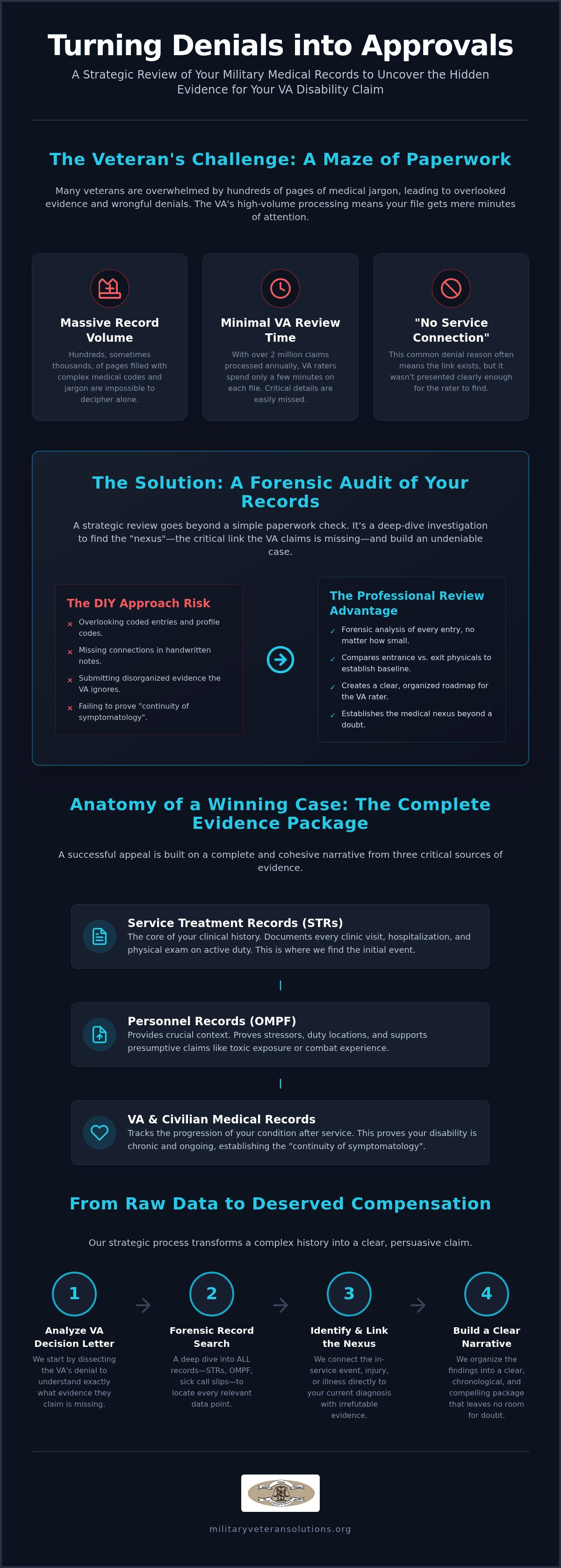
Simply possessing your Service Treatment Records (STRs) isn't the same as having a winning case. Many veterans believe that if an injury happened in service, the VA will naturally find it. This is rarely the case. A strategic military medical record review is a forensic audit. It's a deep dive into your history to find the "nexus" or the link that the VA claims is missing. It requires looking for what isn't there as much as what is recorded on the page.
In 2026, the VA is processing claims at a record pace, handling over 2 million disability claims by mid-year. This high volume means reviewers often spend only minutes on your file. If your evidence isn't organized and obvious, it's likely to be overlooked. Interpreting military medical records for va appeal involves connecting legacy paper files with modern electronic health records. It requires a granular look at every entry; from a single line in a sick call slip to a complex surgical report.
The Components of a Complete Record Set
A successful appeal relies on more than just medical notes. You need a comprehensive view of your time in uniform to build a persuasive narrative. A complete set includes:
- Service Treatment Records (STRs): These are the core of your clinical history, documenting every clinic visit, hospitalization, and physical exam while you were on active duty.
- Personnel Records (OMPF): Your Official Military Personnel File is vital for proving stressors or duty locations. It provides the context for presumptive claims, such as exposure to toxic chemicals or combat zones.
- VA Medical Records: These track the progression of your conditions after you left the service, proving that your disability is chronic and ongoing.
Why the VA Often Overlooks Critical Evidence
The VA has a "duty to assist" veterans, but the reality of high-volume processing often falls short of this ideal. When a reviewer encounters unreadable handwriting or missing pages from a 1990s-era paper file, they don't always go hunting for the truth. They may simply issue a denial based on "insufficient evidence." This is why many cases eventually end up before the Board of Veterans' Appeals, where a more detailed look at the records can reverse a prior mistake.
Don't leave your future to chance. A professional VA claim review is the only way to ensure 100% coverage of your medical history. Interpreting military medical records for va appeal is about finding the specific data points that prove your service connection beyond a shadow of a doubt. It's about turning a stack of paperwork into a clear, undeniable roadmap for the rater to follow.
The Anatomy of Service Connection: What a Thorough Review Uncovers
Possessing your files is only the first step. The real work begins with interpreting military medical records for va appeal to find the specific data points that prove your disability is service-connected. A successful claim often hinges on the "continuity of symptomatology." This means showing that your condition didn't just appear recently, but has been a documented struggle since your time in uniform. We look for the patterns that a high-volume VA reviewer might miss in a five-minute scan.
The foundation of this analysis is the comparison between your Entrance Physical and your Exit Physical. If you entered service with a clean bill of health and left with documented limitations, you've established the baseline for a claim. However, the most compelling evidence often lives in the years between those two exams. Every sick call visit, every profile, and every prescription creates a timeline that makes your current diagnosis undeniable. If you haven't started this process yet, you should begin by obtaining your official military medical records from the National Archives to ensure you have the full picture.
Hidden Evidence in the Fine Print
Don't ignore the small entries. Handwritten sick call slips from decades ago are often the "smoking gun" in a denied case. A single note about a "minor" knee strain in 1994 can be the link needed to prove that your current degenerative joint disease started in service. Prescription logs are equally vital. If your records show years of high-dosage anti-inflammatories, it provides objective proof of the severity of a chronic condition. Even non-medical evidence, such as a sudden decline in performance reports or a change in your military occupational specialty (MOS), can support mental health claims by documenting behavioral changes.
The PACT Act and Presumptive Records
With the implementation of the PACT Act, many conditions are now presumed to be service-connected if you served in specific locations. However, the VA still requires proof of presence in those toxic environments. We audit your records for deployment orders, travel vouchers, and even obscure entries in your personnel file to confirm your exposure. A pact act claim denied appeal is frequently the result of a missed line in a record that places you at a specific base at a specific time. Identifying these details is the key to reversing a denial.
Beyond direct service connection, a thorough review identifies secondary conditions. For example, if you are already rated for PTSD, your records might contain the evidence needed to link sleep apnea or gastrointestinal issues as secondary to your primary disability. If you're struggling to find these connections on your own, a professional record review can provide the forensic analysis needed to secure your benefits.
Professional Record Analysis vs. DIY: Why Veterans Miss Critical Evidence
It's tempting to think you can handle your own record review. After all, nobody knows your body or your service history better than you do. However, this closeness is often the biggest hurdle. When you're interpreting military medical records for va appeal, it's easy to overlook a "minor" entry because you've lived with the pain for so long it feels normal. Professional advocates bring an "expert eye" to the process, identifying subtle patterns and medical codes that a layperson might miss.
A typical 500-page file can take an experienced advocate 20 or more hours to audit properly. This isn't just about reading; it's about forensic analysis. We translate complex military-specific terminology, such as Profile codes and MOS-specific physical requirements, into a language the VA rater understands. While the VA provides a list of the evidence needed for your disability claim, they don't explain how to weave that evidence into a winning narrative. Instead of a "shotgun approach" that hopes something sticks, a professional review creates a focused, chronological story of your disability.
Common DIY Mistakes in Record Review
Many veterans make the mistake of focusing solely on their current diagnosis. If your records don't show that exact name from 20 years ago, you might think the claim is dead. In reality, we look for the underlying symptoms. A note about "recurrent headaches" in 2005 is evidence for a migraine claim today, even if the word "migraine" never appears in your records. Interpreting military medical records for va appeal also requires understanding "negative evidence." If your records are silent on a issue during a specific period, we need to know why and how to fill that gap with buddy statements or private records before the VA uses that silence against you.
The Value of a Third-Party Advocate
Removing the emotional burden of the review is a significant advantage. Reliving the events that led to your injuries is taxing; let us handle the heavy lifting of the data. We provide strategic cross-referencing, linking your clinical history to comprehensive va claim assistance resources to ensure every document supports your goal. This objective analysis allows us to identify exactly where you need a Nexus Letter or an additional Disability Benefits Questionnaire (DBQ) to bridge the gaps in your official records. You've fought for your country. Now let a seasoned guide fight for the benefits you've earned.
Identifying the Nexus: Turning Record Entries into Winning VA Claims
Building a winning claim isn't about luck; it's about logic. The VA requires three specific elements to grant service connection: an in-service event, a current diagnosis, and a medical nexus. When you are interpreting military medical records for va appeal, you are searching for the specific clinical breadcrumbs that lead from your active duty service to your life today. This process requires a methodical approach to ensure no link is left undocumented.
The path to victory follows five distinct steps. First, you must establish the in-service event or injury through a clear entry in your STRs. Second, you need to document your current clinical diagnosis with up-to-date medical evidence. Third, we find the chronicity and continuity in your record timeline to show the condition never truly went away. Fourth, a medical professional must craft a statement confirming the condition is "at least as likely as not" caused by your service. Finally, all of this is packaged into a persuasive evidence bundle for a Supplemental Claim or a Higher-Level Review.
Proving Service Connection for Denied Claims
If you've already faced a denial, don't lose heart. Most denials happen because the VA rater couldn't find one of the three core elements. Using a filing VA appeals help guide allows you to structure your findings to address the VA's specific objections head-on. A common hurdle is the "intervening cause" argument, where the VA claims an event after your service caused the disability. We counter this by using lay evidence, such as statements from family or fellow service members, to fill the gaps that official medical records might have missed.
Calculating Your Potential Rating Increase
Once service connection is established, the focus shifts to the severity of your symptoms. We match your record findings directly to the 38 CFR Part 4, which is the VA's Schedule for Rating Disabilities. This ensures your rating reflects the true impact on your life. Understanding how to combine va disability ratings to get 100 is often about identifying secondary conditions, like radiculopathy secondary to a back injury, that are already documented in your files. The Nexus is the essential legal link that connects your current medical diagnosis to a specific event, injury, or illness that occurred during your military service.
If you're tired of the VA overlooking your evidence, a professional military record review can provide the forensic analysis needed to secure your benefits.
Strategic Advocacy: How Professional Reviews Secure Your Earned Benefits
Military Veteran Solutions, LLC brings over 25 years of experience to every case. Our approach is rooted in veteran-led forensic record auditing. We don't just browse your files; we conduct an exhaustive search for the specific evidence the VA claims is missing. This process is about more than just interpreting military medical records for va appeal. It's about translating your sacrifice into a language the bureaucracy cannot ignore. By positioning ourselves as a bridge between your raw history and a successful outcome, we provide the dedicated representation needed to close the gap between a denial and a service-connected rating.
A critical part of our strategy is VA Decision Letter Analysis. We treat the VA's denial letter as a roadmap for our targeted record search. If the VA says there's no evidence of an in-service event, we go back into your STRs and personnel files to find the specific dates, locations, and clinic visits they missed. Our virtual consultations ensure that veterans nationwide have access to this level of expertise. You don't need to live near a specific office to receive high-level advocacy. We meet you where you are, providing a calm, steady presence throughout the evaluation process.
Winning the Appeal with Evidence, Not Opinions
VA raters are required to follow documented medical evidence, but they often prioritize their own contracted examiners' opinions. A professional record review changes the dynamic. It provides a clear evidence summary that you can take into your Compensation and Pension (C&P) Exam, ensuring the examiner sees the full history. Preparing for a C&P exam often starts with interpreting military medical records for va appeal to ensure you can speak confidently about your documented history. In a Higher-Level Review, a professional summary of findings can be the difference between a quick denial and a granted appeal. It forces the senior reviewer to acknowledge the clinical facts already present in your file.
Next Steps: Get Your Professional Review Started
The path to your earned benefits starts with gathering your complete record set. Once you have your STRs and VA files, the timeline for a comprehensive review depends on the complexity of your history, but our methodical process ensures no detail is lost. Don't let another year pass with a rating that doesn't reflect your reality. Success in the VA system requires organization, persistence, and an expert guide who has navigated these difficult paths before. Schedule your virtual consultation with Military Veteran Solutions, LLC today.
Secure the Benefits You’ve Earned Through Forensic Evidence
Winning your VA appeal in 2026 requires more than just submitting a stack of papers; it demands a forensic strategy that identifies the specific medical nexus the VA rater missed. We’ve explored how a professional audit uncovers hidden continuity in your service treatment records and how to bridge the gap between a denial and a successful rating. Mastering the art of interpreting military medical records for va appeal is the most powerful tool in your arsenal to overturn a previous denial.
Military Veteran Solutions, LLC was founded by a 10-year disabled veteran to ensure no one is left behind by a complex system. With over 25 years of advocacy experience, we specialize in expert VA Decision Letter Analysis to pinpoint exactly where your claim went wrong. You don’t have to navigate this daunting process alone. We stand as your ally, turning raw data into a persuasive evidence package designed to win. It’s time to move forward with confidence and clarity.
Let our veteran advocates review your records and fight for your benefits. Your sacrifice earned these benefits. It’s time you finally received them.
Frequently Asked Questions
How do I get my military medical records for a review?
You can obtain your records by submitting a Standard Form 180 (SF-180) to the National Personnel Records Center or by requesting them through the VA's eBenefits portal. If you served recently, your records are likely digital and accessible through the MHS GENESIS portal. For those who served decades ago, your paper files are housed at the National Archives. Having these documents is the first step before interpreting military medical records for va appeal.
Can I win a VA claim if my military medical records are missing or destroyed?
Yes, you can still succeed by providing alternative evidence to fill the gaps. The VA acknowledges that records were lost in events like the 1973 National Personnel Records Center fire. We look for buddy statements from fellow service members, unit morning reports, and deck logs to establish service connection. These secondary sources act as a bridge when official medical entries are unavailable, ensuring your claim remains viable despite missing paperwork.
How long does a professional military medical record review take?
The timeline for a comprehensive review depends on the size and complexity of your file. A thorough forensic audit of a 500-page record typically requires at least 20 hours of expert analysis. While the initial review may take several weeks, this methodical approach is necessary to identify every possible nexus. We prioritize accuracy over speed to ensure no critical evidence is overlooked during the exhaustive evaluation of your medical history.
What is the Nexus and why is it found during a record review?
The Nexus is the essential legal link that connects your current medical diagnosis to a specific event or injury from your service. During a record review, we search for continuity of symptomatology, which proves that your condition has persisted since you were in uniform. Finding this link is the primary goal when interpreting military medical records for va appeal. Without a documented nexus, the VA will likely deny your claim for lack of service connection.
Will a record review help me increase my current VA disability rating?
Yes, a detailed review often uncovers evidence for a rating increase or new secondary claims. By matching your documented symptoms to the 38 CFR Part 4 rating schedule, we identify if your current disability has worsened. We also look for conditions caused by your primary service-connected disability, such as radiculopathy secondary to a back injury. These findings provide the objective data needed to move your rating toward the maximum compensation you deserve.
Is a professional record review different from what a VSO does?
Yes, the depth of analysis is the primary difference. While Veteran Service Officers (VSOs) provide valuable assistance, their high caseloads often prevent them from performing 20-hour forensic audits on a single file. Our professional review is a deep-dive search for hidden evidence that a standard check might miss. We act as a dedicated bridge between your raw records and a successful appeal, providing the time-intensive analysis required for complex cases.
Can a record review help with PACT Act presumptive condition claims?
Absolutely. Even for presumptive conditions under the PACT Act, you must prove you served in a qualifying location during a specific timeframe. We audit your personnel records and travel vouchers to confirm toxic exposure or presence near burn pits. A record review ensures that your file contains the Toxic Exposure Risk Activity (TERA) documentation required to trigger the presumptive status, preventing the VA from denying a claim based on location errors.
What happens if my records show a pre-existing condition?
You can still receive benefits through the aggravation rule. If your military service made a pre-existing condition worse than it would have naturally progressed, the VA must compensate you for that increase in severity. We review your entrance and exit physicals to document the baseline and the subsequent decline. Proving that service requirements accelerated your condition is a standard part of our strategic advocacy for veterans with complex medical histories.


