
Did you know that 73% of secondary condition claims fail because of insufficient medical evidence? It's a frustrating reality for veterans who know their new health struggles are directly caused by an existing service-connected disability but can't seem to prove it to the VA. You likely feel unheard by C&P examiners and overwhelmed by technical "nexus" requirements that seem designed to keep you from your benefits. It's exhausting to fight a system that should be supporting you, especially when you fear a single missed deadline could cost you years of back pay.
This guide is designed to help you master the technical requirements and evidence strategies needed for appealing denied VA claim for secondary condition so you can finally secure the rating you deserve. We'll walk through the specific "but-for" causation standards updated in 2026 and show you how to leverage the latest court rulings like Spicer v. McDonough. You will learn how to bridge the gap between your medical reality and the VA's rigid criteria. By the end of this article, you'll understand exactly which appeal lane to choose to protect your effective date and increase your overall disability rating.
Key Takeaways
- Identify the specific reasons why the VA frequently denies secondary claims and how to avoid the common evidence gaps that trigger a rejection.
- Learn to construct an unbreakable Nexus Bridge using the three pillars of diagnosis, medical link, and professional rationale to prove your condition's service connection.
- Master the strategy of appealing denied VA claim for secondary condition by choosing the correct lane between a Supplemental Claim and a Higher-Level Review.
- Uncover the value of a professional VA Decision Letter Analysis to pinpoint rater errors and identify missing continuity of care in your medical records.
- Gain the confidence to leverage 2026 legal standards like Spicer v. McDonough to secure the increased disability rating you've earned through your service.
Understanding Why Secondary Condition Claims are Frequently Denied
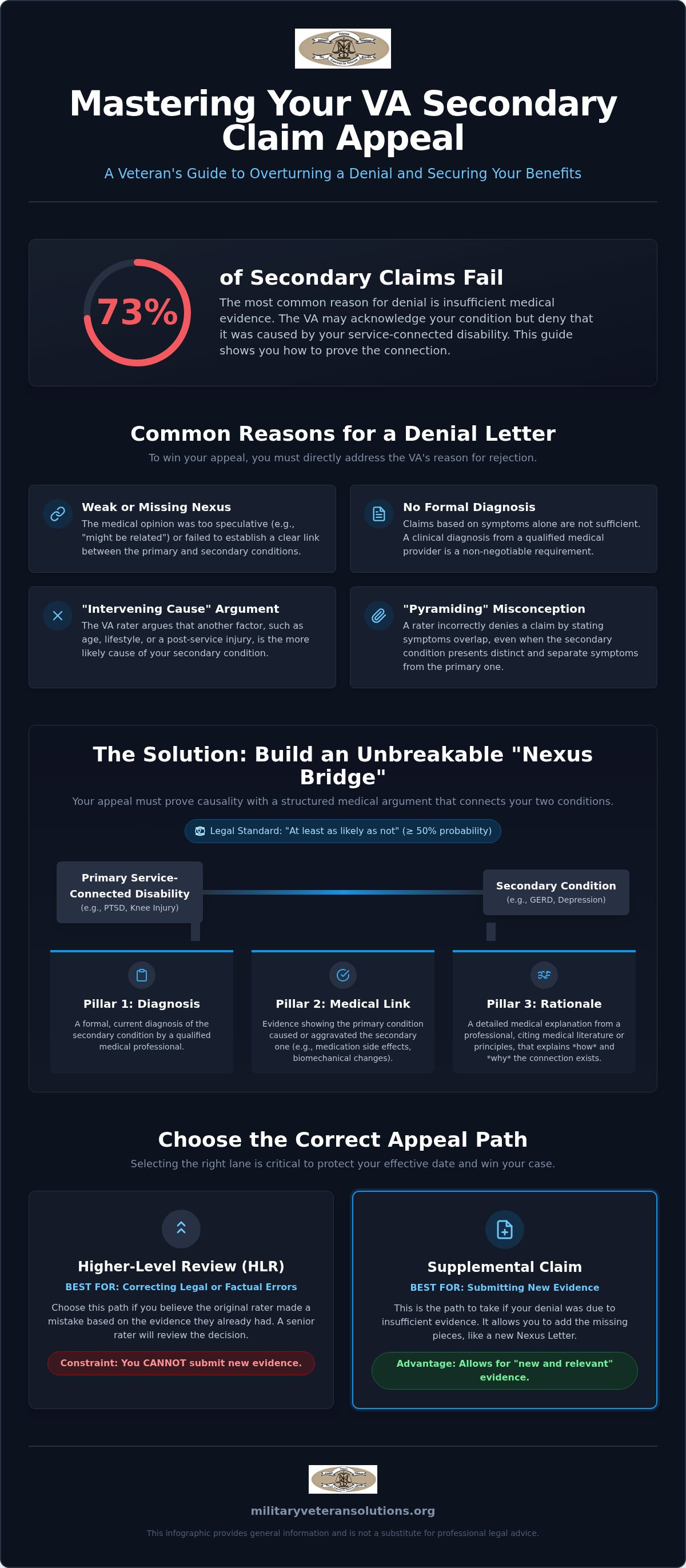
Winning a secondary claim isn't just about showing you're sick. It's about proving causality. While a primary service connection requires a specific in-service event, a secondary connection relies entirely on the "but-for" relationship between two conditions. If you're appealing denied VA claim for secondary condition, you've likely hit a wall where the VA admits you have a disability but denies that your service-connected injury caused it. This is a common hurdle. Research shows that 73% of secondary condition claims fail due to insufficient medical evidence.
The Veterans Health Administration provides the medical framework for these evaluations, but raters often overlook the "aggravation" theory. This theory states that if your service-connected knee injury causes you to gain weight, which then worsens your non-service-connected hypertension, that hypertension should be service-connected. Raters frequently ignore this chain of events. They focus only on the final diagnosis rather than the medical bridge. When you are appealing denied VA claim for secondary condition, you must prove that the new disability wouldn't exist without the original one.
Consider the common pairing of GERD secondary to PTSD. Many veterans take NSAIDs or SSRIs for mental health conditions that eventually irritate the digestive lining. If the C&P examiner doesn't see a direct combat injury to the stomach, they might dismiss the link entirely. This lack of technical scrutiny by examiners is a primary reason for high denial rates in complex pairings like sleep apnea and mental health. Examiners often default to a "not service connected" finding because they lack the specialized expertise to see the pharmacological or physiological link.
The "Pyramiding" Misconception in Secondary Denials
Raters often deny secondary claims because they fear "pyramiding." This is the practice of rating the same symptom twice under different diagnostic codes. However, if your secondary condition has distinct symptoms, it deserves its own rating. For example, if your service-connected back pain leads to secondary depression, the physical pain and the mental health symptoms are separate. You must identify if your denial letter claims an "overlap of symptoms" to determine if the rater made a legal error. Distinguishing between separate ratings for related conditions is essential for a successful appeal.
Common Triggers for a Secondary Condition Denial Letter
A successful appeal requires addressing the specific gap in your evidence. The most frequent trigger is the lack of a formal diagnosis. You can't claim a secondary condition based on symptoms alone; you need a clinical diagnosis from a provider. Another trap is the "intervening cause" where the VA argues that your lifestyle, age, or a post-service accident is the true culprit. Without a strong medical rationale in your nexus statement to counter these claims, the denial will likely stand. You need to show that your service-connected condition is the primary driver of the new illness.
The "Nexus Bridge": Establishing Causality for Secondary Connection
Winning your appeal requires more than just a list of symptoms. You need a Nexus Bridge. The Nexus Bridge is the legal requirement for secondary service connection that establishes a clear medical link between your primary disability and your secondary condition. When you're appealing denied VA claim for secondary condition, this bridge is often the missing piece that caused the initial rejection. It isn't enough to say two conditions are related; you must prove it through a structured medical argument.
A solid secondary nexus stands on three pillars: a formal diagnosis, a clear medical link, and a detailed rationale. The VA uses a specific legal threshold known as "at least as likely as not." This means there's at least a 50% probability that your primary condition caused or aggravated the secondary one. If your doctor simply writes that your conditions "might be related," the rater will likely deny the claim for being too speculative. You need language that mirrors the VA's own evidentiary standards to succeed. Understanding your VA decision review options is the first step in determining how to present this evidence effectively.
Medical Rationale: The Key to Overturning Denials
The medical rationale is the "why" behind the link. It explains the physiological or pharmacological process that connects your health issues. To overturn a denial, your evidence should include peer-reviewed medical literature that validates the connection. If a C&P examiner provided a negative opinion, a private medical opinion can serve as a powerful counter-weight. This expert testimony provides the technical depth that rater-level analysis often misses. If you feel stuck, a professional VA decision letter analysis can help identify exactly where your rationale fell short.
Secondary Aggravation vs. Secondary Causation
In 2026, the standard for secondary connection has broadened thanks to the Spicer v. McDonough decision. This ruling emphasizes a "but-for" causation standard, making it easier to argue that a secondary condition wouldn't have occurred or worsened "but for" the primary disability. This is particularly relevant for "aggravation" claims. In these cases, you aren't claiming the primary condition caused the new illness, but that it made a pre-existing, non-service condition significantly worse.
Take the case of PTSD and hypertension. A veteran may have had mild high blood pressure before service, but the chronic stress and cortisol spikes from service-connected PTSD pushed that condition into a dangerous, ratable territory. To win this type of appeal, you must document the baseline severity of the condition before the aggravation occurred. This level of detail shows the VA that your service-connected struggle is the direct driver of your current health decline. It's a methodical process, but it's the most reliable way to secure the benefits you've earned.
Higher-Level Review vs. Supplemental Claim: Choosing Your Path
You have exactly one year from the date of your denial letter to file your appeal. Missing this deadline means you lose your original effective date, potentially costing you thousands in back pay. When appealing denied VA claim for secondary condition, you must choose between a Supplemental Claim, a Higher-Level Review, or a Board Appeal. Each path serves a specific purpose, and picking the wrong one can lead to another round of frustration and delays.
The Supplemental Claim Strategy for Secondary Conditions
A Supplemental Claim is usually the best choice if the VA denied you because of a "lack of evidence." You'll need to submit "new and relevant" evidence that wasn't considered during the initial decision. This evidence often involves a more precise diagnosis or a medical study that proves Condition A causes Condition B. You might submit new Disability Benefits Questionnaires (DBQs) that specifically address the functional limitations caused by the secondary ailment. This lane allows you to fix the gaps that the initial rater identified in your denial letter regarding your secondary service connection. For more technical advice on this process, read our comprehensive resource on Filing VA Appeals Help: A Strategic Guide to Overturning Denials in 2026.
Higher-Level Review (HLR) for Clear Rating Errors
A Higher-Level Review (HLR) is different. It's for when the evidence was already in your file, but the rater made a mistake. You can't submit new documents in this lane. Instead, a senior reviewer audits the existing record for legal or factual errors. One common error is a "Duty to Assist" violation, where the VA failed to gather records or schedule a necessary exam that could have clarified the link. During an HLR, you can request an Informal Conference to explain these errors directly to the reviewer. This conversation is a tactical opportunity to highlight exactly where the previous rater misapplied a regulation or ignored a critical piece of evidence. It's a high-stakes discussion that requires a calm, methodical approach to the facts.
If these options don't yield results, you can take your case to the Board of Veterans' Appeals (BVA). While the BVA has a much longer wait time, a Veterans Law Judge can provide the high-level legal scrutiny that complex secondary links often require. While appealing denied VA claim for secondary condition can feel like an endless cycle, these lanes are designed to ensure you have multiple chances to prove your case. It's a marathon, not a sprint, but it's the final safeguard for the benefits you earned through your service.
Evidence Strategies to Overturn a Secondary Condition Denial
When appealing denied VA claim for secondary condition, your evidence must be more than just a stack of papers. It needs to be a targeted strike against the specific reasons the VA gave for your denial. Success in 2026 requires a methodical approach that moves beyond general symptoms and into the technicalities of medical causation. You must present a case that is so logically sound that the rater has no choice but to grant the connection. Follow these five essential steps to build a bulletproof evidence file:
- Step 1: Dissect the VA Decision Letter. Perform a deep analysis to find the exact "gap" the rater identified. Did they miss a diagnosis, or did they claim there was no link?
- Step 2: Audit for Continuity of Care. Review both military and private records to show that your secondary symptoms have been persistent and treated over time.
- Step 3: Secure a High-Quality Nexus Letter. This document must include specific medical citations and peer-reviewed studies that validate the connection between your conditions.
- Step 4: Draft a Statement in Support of Claim. Use VA Form 21-4138 to provide your own narrative of how the secondary condition developed.
- Step 5: Gather Lay Evidence. Collect statements from family or coworkers that document the daily impact of the secondary condition on your life and work.
The Power of Lay Evidence in Secondary Appeals
Medical records don't always capture the full story of your daily struggle. Buddy statements from those who see you every day can bridge the gap when clinical notes are sparse. These statements are vital for documenting the "chronicity" of your symptoms. They prove that your condition isn't a temporary flare-up but a lasting disability caused by your primary service-connected injury. For a deeper look at this strategy, see our guide on How to Prove Service Connection for Denied Claims. Lay evidence provides the human context that medical data often lacks; it makes your pain visible to a rater who has never met you.
Analyzing the "Reasons for Decision" Section
The "Reasons for Decision" section of your denial letter is your roadmap for the appeal. You must look for specific keywords like "not service connected," "no nexus," or "not diagnosed." These terms tell you exactly what evidence is missing. Often, the VA ignores evidence you've already submitted; identifying these oversights is the key to a successful Higher-Level Review. A thorough professional military record review service unlocking evidence for VA claims is the first step in any successful appeal. Once you know what the VA is looking for, you can stop guessing and start winning.
If you're ready to stop the cycle of denials, we can help. Schedule a virtual consultation for VA appeal representation today to get an expert review of your case.
Strategic Advocacy: How Professional Representation Wins Complex Appeals
Success in 2026 requires more than just a basic understanding of your medical history. It demands a high level of technical scrutiny that most veterans find difficult to navigate alone. When appealing denied VA claim for secondary condition, you're fighting against a system that often defaults to denial when the link between conditions isn't immediately obvious. Professional representation acts as a shield and a guide. It ensures that every medical citation and legal argument is perfectly aligned with the VA’s current adjudication standards.
An experienced advocate does more than just fill out forms. They coordinate the complex intersection of medical evidence and legal strategy. This involves identifying the specific rater errors that led to your initial denial and finding the precise medical literature needed to counter a negative C&P exam. Because the VA’s overall claim approval rate is roughly 64%, having a dedicated partner to analyze your decision letter can be the difference between a granted rating and another year of waiting. Through virtual consultations, you can access this high-level expertise from anywhere in the country, ensuring your location never limits your access to quality advocacy.
The Military Veteran Solutions, LLC Approach to Appeals
Shared experience is the foundation of effective advocacy. As a veteran-owned firm, we understand the gravity of your situation because we've been in the boots you wore. Our process is exhaustive. We don't just look at your current denial; we perform a deep-dive military record review to uncover "hidden" evidence that might have been overlooked for decades. This allows us to identify the "Nexus" that examiners often miss, creating the unbreakable medical bridge required for secondary service connection. We focus on finding the specific continuity of care markers that prove your secondary condition is a direct result of your service-connected disability.
Taking Action: Your Next Steps to Win Your Benefits
Time is your most valuable asset in the appeals process. You have a strict 12-month window from the date of your denial letter to preserve your original effective date. If you let this clock run out, you risk losing thousands of dollars in back pay that you've earned. Don't let a confusing administrative system stand between you and your security. You can start the process of reclaiming your benefits today. A professional analysis of your decision letter is the first step toward identifying the path forward, whether that involves a Supplemental Claim or a Higher-Level Review. Schedule a consultation with Military Veteran Solutions, LLC to review your denial and let us help you bridge the gap between your medical reality and the VA’s technical requirements. We are ready to stand with you in appealing denied VA claim for secondary condition to secure the rating you deserve.
Take the Next Step Toward Your Deserved Rating
You've served your country with honor, and you shouldn't have to fight a second battle just to get the compensation you've earned. Winning your appeal isn't a matter of luck; it's a matter of technical strategy. By establishing a solid Nexus Bridge and choosing the correct appeal lane, you can overcome the high failure rates that plague most secondary claims. Appealing denied VA claim for secondary condition requires precision and a deep understanding of the VA's 2026 standards like the Spicer v. McDonough ruling.
Military Veteran Solutions, LLC is here to serve as your guide through this daunting system. Founded by a 10-year Army veteran with over 25 years of advocacy experience, we specialize in uncovering the evidence the VA often misses. We provide nationwide virtual consultations to ensure you have a dedicated ally no matter where you reside. Secure your earned benefits with a professional VA appeal review. You don't have to navigate this complex path alone. Results are possible, and your health and security are worth the effort.
Frequently Asked Questions
Can I appeal a denied secondary condition if I don’t have new medical records?
Yes, you can file a Higher-Level Review (HLR) if you believe the evidence already in your file was misinterpreted by the rater. In an HLR, a senior reviewer audits the existing records for clear errors or "Duty to Assist" violations. However, if the denial was based on a lack of medical evidence, you'll likely need to submit new and relevant records through a Supplemental Claim lane to fix the specific gaps in your file.
How long do I have to appeal a denied secondary VA claim?
You have exactly one year from the date on your denial letter to file an appeal and preserve your original effective date. If you miss this twelve-month window, you'll lose out on potential back pay. For those appealing a Board of Veterans' Appeals decision, the timeline is much tighter. You must ensure your Notice of Appeal is received by the Court within 120 days after the Board issues its final decision.
What is the best secondary condition to claim for PTSD?
There is no single "best" condition, but GERD, sleep apnea, and hypertension are among the most common secondary claims linked to PTSD. These links are often established through the side effects of medications or the physiological impact of chronic stress on the body. When appealing denied VA claim for secondary condition related to mental health, focus on the "but-for" causation standard to prove that your secondary struggle wouldn't exist without your service-connected PTSD.
Is a Higher-Level Review or Supplemental Claim better for secondary conditions?
The better lane depends entirely on why the VA issued the denial. If the rater ignored a medical link that was already in your file, a Higher-Level Review is often the faster path to a correction. If the VA stated there was "no nexus" or "no diagnosis," the Supplemental Claim lane is superior. This lane allows you to submit the missing medical evidence or a new nexus letter to bridge the evidentiary gap.
Can the VA deny a secondary condition even with a nexus letter?
Yes, the VA can still deny a claim if they find the nexus letter speculative or if a C&P examiner provides a more persuasive counter-opinion. A nexus letter must be based on a thorough review of your medical history and include specific peer-reviewed rationale. If your letter lacks technical depth, the rater may decide the evidence doesn't meet the "at least as likely as not" threshold required for a successful service connection.
What happens to my back pay if I win my secondary condition appeal?
If you win your appeal and maintained the "chain of appeals" by filing within one year of each denial, your back pay is calculated from your original effective date. This date is usually when you first filed the claim. With the 2.8% Cost of Living Adjustment effective for 2026, a successful appeal that results in a higher combined rating can lead to a significant retroactive payment covering the entire duration of the appeal process.
Do I need a lawyer to appeal a denied secondary VA claim?
You aren't legally required to hire a lawyer, but professional representation is often the key to winning complex secondary cases. Many veterans find that a dedicated advocate can navigate the technical "nexus" requirements more effectively than they can alone. While we don't provide legal representation in civil court, our team specializes in military record reviews and VA decision letter analysis to identify the exact technical errors that lead to wrongful denials.
How much does it cost to get professional help with a VA appeal?
Costs vary depending on the level of service and the complexity of your claim. We focus on providing high-value services like military record reviews and decision letter analysis to empower your appeal. It's important to remember that professional help is an investment in your long-term financial security. We recommend starting with a virtual consultation to discuss your specific case and determine the most effective path forward for securing the benefits you've earned through your service.


