
If you’re asking, “my VA claim was denied now what,” it’s understandable to feel frustrated or unsure where to turn. A denial is a decision to analyze, not automatically a verdict to accept. The decision letter gives you a starting point: it explains what the VA decided and why.
Read the decision carefully before choosing a review option. The reason for denial can help show whether the issue involves missing evidence, a disputed finding, or something else. Timing matters, too. In general, filing a Supplemental Claim, Higher-Level Review, or Board Appeal within one year of the decision may help preserve your original effective date for potential back pay.
This guide explains how to identify the key parts of your decision letter, compare the main review options, and organize a deadline-conscious plan. Reviewing the decision alongside your service records and medical documentation can help clarify what evidence or next step may be relevant. A careful review can make an overwhelming decision easier to address.
Key Takeaways
- If you’re asking “my VA claim was denied now what,” save the decision letter, note its date, and list each denied issue before choosing a next step.
- Use the VA’s stated reasons for each denial to identify whether the concern involves a diagnosis, service connection, supporting evidence, or the assigned evaluation.
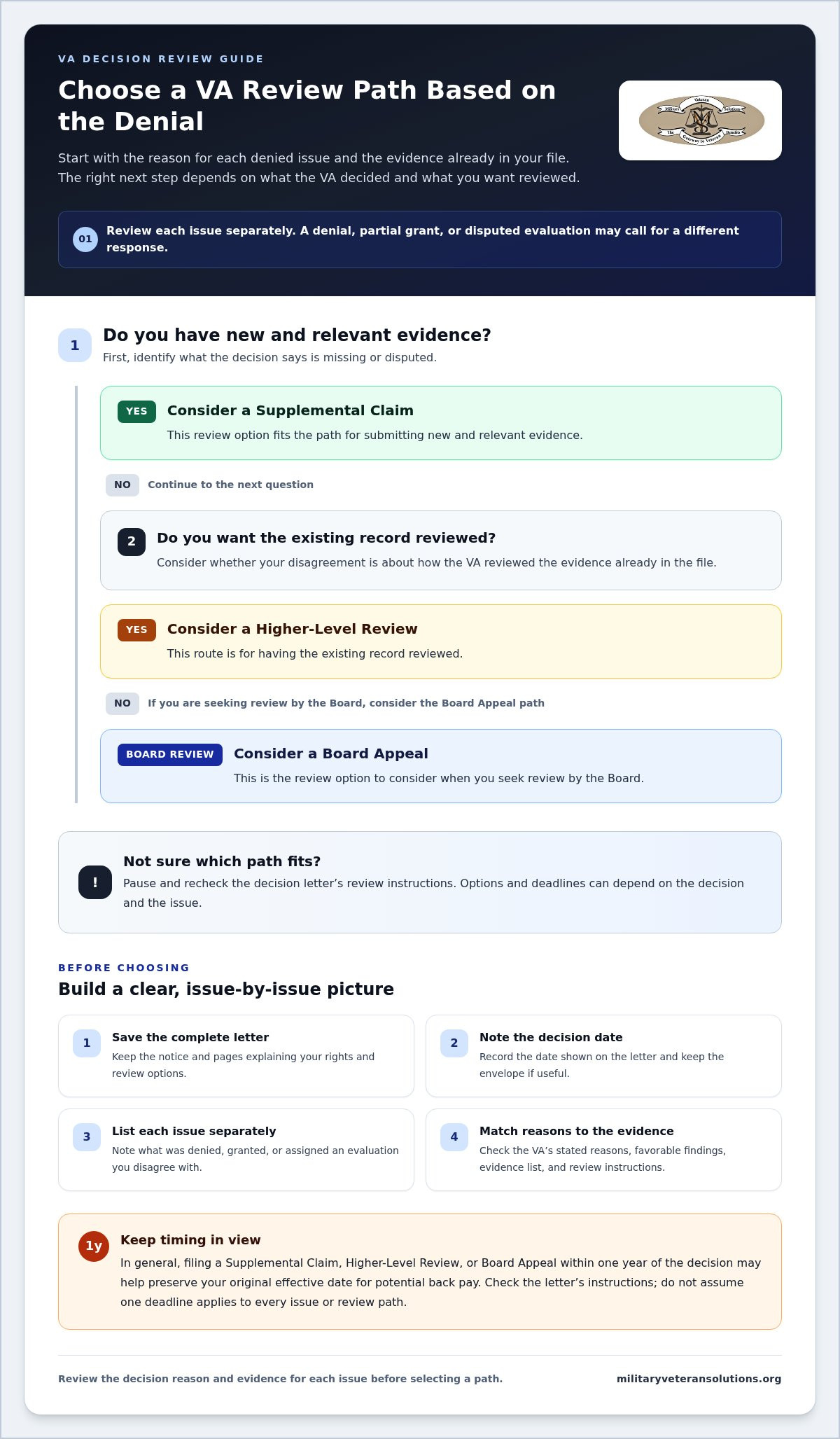
- Compare a Supplemental Claim, Higher-Level Review, and Board Appeal based on whether you have new and relevant evidence, want the existing record reviewed, or seek Board review.
- Build an organized response by matching each denial reason with the evidence already in your file and identifying what may still be needed.
- A decision-letter and military-record review can help connect the VA’s reasoning with your service history and medical documentation as you plan a response.
My VA claim was denied: what to do first
A denial is not automatically the end of your claim. The appropriate next step depends on what the VA decided and what evidence is already in your file. If you’re thinking, “my VA claim was denied now what,” pause before filing anything new. First, get clear on the decision and preserve the records and dates that will guide your response.
A VA decision letter is written notice explaining the outcome for each claimed issue and the reasons behind the VA’s decision. The U.S. Department of Veterans Affairs handles veterans’ benefits decisions. Your letter is where you’ll find the specific result and review instructions for your claim.
Take these steps in order:
- Save the complete letter. Keep a digital copy and the original notice, including pages that explain your rights or review options.
- Note the decision date. Record the date shown on the letter and keep the envelope if it helps document when you received it.
- Identify each issue separately. Write down which conditions were denied, granted, or assigned an evaluation you disagree with.
- Calendar applicable deadlines. Check the letter’s review instructions and record any relevant response date. Deadlines and options can depend on the decision, so don’t assume one date applies to every issue.
A full denial means the VA did not grant the claimed benefit for the issue or issues addressed. A partial grant means some part of the claim was approved, while another issue may have been denied or the assigned evaluation may not match what you believe the evidence supports. Treat each issue separately. The explanation and relevant evidence may differ by condition, and the right response may not be the same for every outcome.
What to check in the decision letter immediately
Start with the outcome for every claimed condition. Then find the stated reasons, any favorable findings, the evidence considered, and the review options described in the notice. These details can show what the VA accepted, what it found unproven, and where the disagreement lies. Record the decision date and any listed response deadline, but don’t assume there’s one universal deadline for every review path or circumstance.
Keep your notes specific to each issue. For example, if one condition was denied while another was granted, separate the two rather than treating the decision as a single yes-or-no result. A careful VA decision letter and evidence review guide can help you connect the letter’s reasoning with the records the VA considered.
What not to do before choosing a review path
Don’t rush into submitting a duplicate claim before you understand the prior decision. Repeating the same request without addressing the stated reason may not resolve the problem. Don’t discard envelopes, upload confirmations, medical records, or VA correspondence, either. Keep them together in one folder, with dates and copies organized by issue. This gives you a clearer foundation for deciding what to do next.
How to understand why the VA denied your claim
The decision’s stated reasons should guide your evidence review, rather than assumptions about what the VA considered or why the claim failed. A denial may involve a missing current diagnosis, a question about whether a condition is connected to service, insufficient supporting evidence, or disagreement over the evaluation assigned. These are different problems. An evidence gap may call for a different response than a dispute about how the VA interpreted records already in the file.
The best next step depends on the specific denial reason and the evidence available to address it. Read the explanation for each denied issue and turn it into a question you can investigate. The VA.gov Decision Review Options page describes the available review routes. Understanding the reason for the decision can help you assess what information may matter before selecting one.
Turn each denial reason into an evidence question
Work on one issue at a time. If the decision says there’s no current condition, check which medical documentation it lists and whether the records you submitted appear there. If it disputes the connection to service, compare that explanation with relevant service records and medical documentation. Note what supports the connection and what the decision says is missing. If evidence seems missing or overlooked, identify the specific document, its date and source, and the issue it may support. Keep the question narrow: “Which part of the VA’s stated reasoning does this record address?”
A disagreement about the evaluation requires a different comparison. Review the decision’s explanation for the assigned evaluation alongside the evidence it considered for that issue. Don’t treat a favorable result on one condition as proof that every other issue was fully addressed.
Build a focused record of what the VA reviewed
Compare the decision’s evidence list with the documents you submitted. Mark records that appear to be included, those you expected to see but can’t find, and any material that may relate to a particular denial reason. Keep upload confirmations, mailing records, and correspondence with the documents themselves. These details can help distinguish between evidence the VA considered and evidence that may not have reached the file.
Organize relevant service records, medical documentation, and prior VA decisions by issue and date. A simple table can help:
- Decision reason: What does the VA say is missing or unresolved?
- Evidence reviewed: Which records does the letter identify?
- Evidence to examine: What document may relate to the stated reason, and what does it show?
This focused comparison is more useful than resubmitting a large, unorganized file. A military record review guide for VA claims can help you consider how service documents relate to the decision. Favorable findings may identify facts the VA accepted. Note them and consider how they relate to the remaining issues without assuming they determine the outcome of a review.
Military Veteran Solutions, LLC provides decision-letter analysis to help connect the VA’s reasoning with your service and medical records and clarify possible next steps.
Which VA review option may fit your denial?
Once you understand the reason for the denial, compare it with the kind of review you need. Under the VA’s decision-review system, the main routes are a Supplemental Claim, Higher-Level Review, and an appeal to the Board of Veterans’ Appeals. They aren’t interchangeable: one centers on adding new and relevant evidence, another asks for review of the existing record, and the Board route brings the case before a Veterans Law Judge.
If you’re asking “my VA claim was denied now what,” start by asking whether you have additional evidence to submit or believe the decision can be challenged based on the record already reviewed. Your answer can help narrow the options, but it doesn’t replace checking the decision letter and current VA instructions. Deadlines, eligibility, and the consequences of choosing a route depend on your decision and circumstances.
When a Supplemental Claim may be worth considering
A Supplemental Claim may fit when you have new and relevant evidence that addresses a reason the VA gave for denying an issue. “New” generally means it wasn’t previously submitted, while “relevant” means it tends to support or challenge a matter in the claim. Examples might include medical documentation not previously considered, a service record that sheds light on an event, or other evidence connected to the denial reason. A document’s existence alone doesn’t guarantee it will change the decision. Consider how it relates to the specific issue.
There’s generally no time limit to file a Supplemental Claim, but filing within one year of the decision may help preserve the original effective date for potential back pay if the claim is later granted. Confirm the current filing requirements and how timing applies to your case before acting.
When Higher-Level Review or a Board Appeal may fit
Higher-Level Review generally asks a more senior VA reviewer to examine the decision using the evidence already in the record. You can’t add new evidence through this review option. It may be worth considering when you believe the VA made an error based on information it had, rather than when your response depends on submitting additional records.
A Board Appeal asks the Board of Veterans’ Appeals to review the issue, with a Veterans Law Judge involved. The Board offers different dockets: Direct Review uses the existing record, Evidence Submission allows new evidence within a specified window, and the Hearing docket provides an opportunity to testify before a judge. Each docket has distinct procedures and timing considerations.
Higher-Level Review and Board Appeals generally must be filed within one year of the decision to maintain the original effective date for potential back pay. Check the decision notice and current VA guidance for the deadline, forms, and rules that apply to your situation. Don’t choose a route based only on its name or perceived speed. Match it to the denial reason, available evidence, and type of review you’re seeking.
For a side-by-side explanation of the options and filing considerations, see the complete guide to filing VA appeals and comparing review options. Use it alongside current VA instructions so your choice reflects both the record and the requirements for your case.
How to prepare a stronger response to a VA denial
A focused response starts with the specific issue the VA denied, not a stack of documents submitted without explanation. For each condition, connect the decision’s stated reason to the records already considered and the information that may still be needed. The evidence that matters depends on the denial and the review option you’re considering, so confirm the current requirements for that route before submitting anything.
Create an issue-by-issue evidence map
Use one row or page for each denied condition. This keeps evidence for separate issues from getting mixed together and makes it easier to see what the VA addressed. For each issue, record:
- VA’s reason: Summarize the decision’s explanation in plain language.
- Evidence considered: Note the records listed in the decision and any submission proof you have.
- Potentially relevant records: Identify service records, medical documentation, or lay evidence that may relate to the reason.
- Open questions: Mark what is missing, unclear, or still needs to be checked.
Keep facts distinct from assumptions. If you’re unsure whether a record was received or what an entry means, label it as uncertain rather than treating it as established. This map can reveal whether evidence relates to the condition itself, an event in service, a connection between the two, or the evaluation assigned. A VA claim assistance resource guide can help you organize documentation as you prepare.
Build a clear timeline and keep submissions organized
Create a chronological record of relevant service events, when symptoms began or changed, treatment and appointments, and communications with the VA. Include dates when known and identify the source for each entry, such as a medical record, service document, letter, or personal recollection. If a date is approximate, say so. A clear timeline helps you check that your descriptions are consistent across records and explain where information comes from.
Be accurate. Describe symptoms and events honestly, in your own words, and don’t embellish details or alter records. If two documents appear inconsistent, note the difference and investigate it rather than changing either account. Accuracy keeps your response grounded in the evidence.
Use the decision letter to identify the response deadline and verify it against current VA guidance for the review route you’re considering. Don’t rely on a date remembered from another claim or assume every option follows the same rules. Keep copies of completed forms, evidence, upload or delivery confirmations, and VA responses together in a secure file. A dated submission log can show what you sent, when you sent it, and which issue it addressed.
Military Veteran Solutions, LLC can help connect the denial’s reasoning to your records and organize a response through VA decision-letter analysis and appeal support.
How VA claim representation can help after a denial
A denial can leave you with a difficult question: “my VA claim was denied now what?” Representation can help turn the decision into a focused review. An advocate can examine the VA’s stated reasons alongside your military records and medical documentation, then identify which denied issues need attention and what the existing file does or doesn’t show.
Military Veteran Solutions, LLC provides VA decision-letter analysis, military-record reviews, veteran claims representation, appeal filing support, and virtual consultations. The organization was founded by a disabled veteran who served ten years in the U.S. Army. Its advocacy focuses on understanding the decision and records, not promising a particular result.
What a thorough denial review should clarify
A careful review should leave you with a clearer picture of the decision, the evidence, and the questions still open. It can help separate issues the VA granted from those it denied, identify the explanation for each denial, and compare that reasoning with the records considered. If relevant information appears missing or unclear, the review can flag it for follow-up without treating assumptions as facts.
The review should also help you understand possible next steps. For example, the denial reason and records may clarify whether additional relevant evidence is central to your response or whether your concern is about how the existing record was considered. That analysis can inform a discussion of review options, but it shouldn’t assume one route fits every veteran or issue. Deadlines and requirements still matter.
Support may include reviewing the decision letter, examining military records and medical documentation, and helping prepare or file an appeal. The aim is to connect the VA’s reasoning to the evidence in an organized way so you can make an informed plan. No review or representative can guarantee what decision the VA will reach.
Decide whether to seek tailored advocacy
You may find it useful to discuss your decision with someone who can examine the details with you, especially if several issues have different outcomes or the evidence list is difficult to interpret. A virtual consultation gives you an opportunity to discuss the letter and your records, clarify questions, and consider possible next steps. Bring the decision notice and organize the records you want to discuss. Note any deadlines so they remain part of the conversation.
If you’re weighing what kind of support may fit, the veteran advocacy services comparison guide can help you understand representation approaches. You can also discuss your VA claim with Military Veteran Solutions, LLC to review your denial and records and talk through a practical path forward.
Take the next step with a clear plan
A denial can make the road ahead feel uncertain, but you don’t have to solve every question at once. Start with one practical action: organize the records tied to a denied issue, write down what you still need to understand, or get support reviewing the decision. A manageable step can help you move from worry to a plan.
If you’re still asking, “my VA claim was denied now what,” discuss your decision and records with Military Veteran Solutions. The organization offers virtual consultations and representation for veterans nationwide, including decision-letter analysis and military-record review. A focused conversation can help you understand the issues and consider a path forward, without promising a particular outcome.
Discuss your VA claim with Military Veteran Solutions and take your next step with clarity. You deserve thoughtful support as you pursue the benefits you believe your service warrants.
Frequently Asked Questions
What should I do first after my VA claim is denied?
Save the complete decision letter and read the outcome for each condition before deciding how to respond. If you’re asking, “my VA claim was denied now what,” list the denied issues and the reason given for each. Note the decision date, then check the letter for review options and applicable deadlines. Keep the notice and related records together so you can refer to the exact language.
How long do I have to respond after a VA claim denial?
The deadline depends on the decision and the review path you may use, so don’t rely on a general timeline. Check the decision letter and compare its instructions with current official VA guidance. For many decisions, filing a Higher-Level Review or Board Appeal within one year may preserve the original effective date for potential back pay; Supplemental Claims have different timing considerations. Confirm how the rules apply to your specific decision.
Can I submit new evidence after the VA denies my claim?
Possibly, but evidence rules differ by review option. A Supplemental Claim is generally the route for submitting new and relevant evidence, while a Higher-Level Review generally examines the existing record without new evidence. Board Appeal procedures depend on the docket selected. Before gathering documents, match each item to the VA’s stated reason. For example, a treatment record may address a diagnosis issue, while a service record may relate to an event during service.
Is a VA claim denial permanent?
No, a denial doesn’t necessarily end the matter. Depending on the decision and applicable requirements, you may have a decision-review option or another way to pursue the issue. The right next step depends on what the VA decided, the records available, and any relevant deadlines. Keep the denial notice and review instructions, because the result for one condition may differ from the result for another condition in the same decision.
Should I file a new claim or challenge the denial?
That depends on whether the issue has already been decided, what the decision letter says, and what evidence or deadlines apply. A previously denied issue may call for a review path that addresses the earlier decision rather than simply filing the same claim again. A new or different issue may require a different approach. Compare the condition and facts involved with the VA’s explanation before choosing. One answer won’t fit every claim.
What happens if I miss the deadline to challenge a VA denial?
Missing a deadline can affect the review options available or the effective date associated with a later grant, but the consequences depend on the decision and your circumstances. Don’t assume a remedy is available, and don’t conclude that no next step exists without reviewing the decision. Check the notice and current VA guidance promptly, noting the decision date and any reason the deadline may have been missed. Military Veteran Solutions can review the decision and records with you to discuss possible next steps.
Can someone help me understand my VA denial letter?
Yes. A representative can help explain the reasons for each decision, identify favorable findings, and compare the VA’s evidence list with your military and medical records. This can make unclear terminology easier to assess and help you identify questions to address before selecting a response. Military Veteran Solutions provides VA decision-letter analysis and virtual consultations to discuss your decision and records, helping clarify possible next steps without promising a particular outcome.


