
The hearing format and the appeal path are two different decisions. Understanding that distinction can help you compare the Board of Veterans' Appeals (BVA) hearing options without confusing where you’ll testify with how the Board will review your case.
It’s understandable to worry that choosing a hearing could delay a decision or affect your appeal. A hearing gives you the opportunity to testify before a Veterans Law Judge, while the Hearing docket also determines when and how you may submit evidence. The format, whether virtual, by videoconference at a VA regional office, or in person in Washington, D.C., is a separate choice.
This guide explains how those formats differ and compares the Hearing docket with Direct Review and Evidence Submission. You’ll learn what each path means for evidence and timing, what to weigh before filing VA Form 10182, and how to prepare to present your case. Reviewing your VA decision and supporting records can help you understand the issues before choosing an appeal strategy.
Key Takeaways
- Compare the Board of Veterans' Appeals (BVA) hearing options by considering where you’ll participate, the technology involved, and any travel needs.
- A hearing gives you a chance to explain your appeal to a Veterans Law Judge, but testimony alone doesn’t guarantee a grant or replace supporting evidence.
- Choose a Board docket based on whether you need to submit evidence, want to testify, and how timing fits your priorities.
- Before filing VA Form 10182, review your decision notice and records, and confirm the deadline that applies to your appeal.
- A focused review of your VA decision and supporting records can help you weigh your options and prepare for the path you choose.
What a Board of Veterans' Appeals hearing does, and does not do
A Board hearing gives you an opportunity to address your appeal directly with a Veterans Law Judge (VLJ). You can explain relevant events or experiences in your own words, and your testimony becomes part of the appeal record. A hearing can add context, but it doesn’t guarantee a favorable decision or replace evidence needed to support your claim.
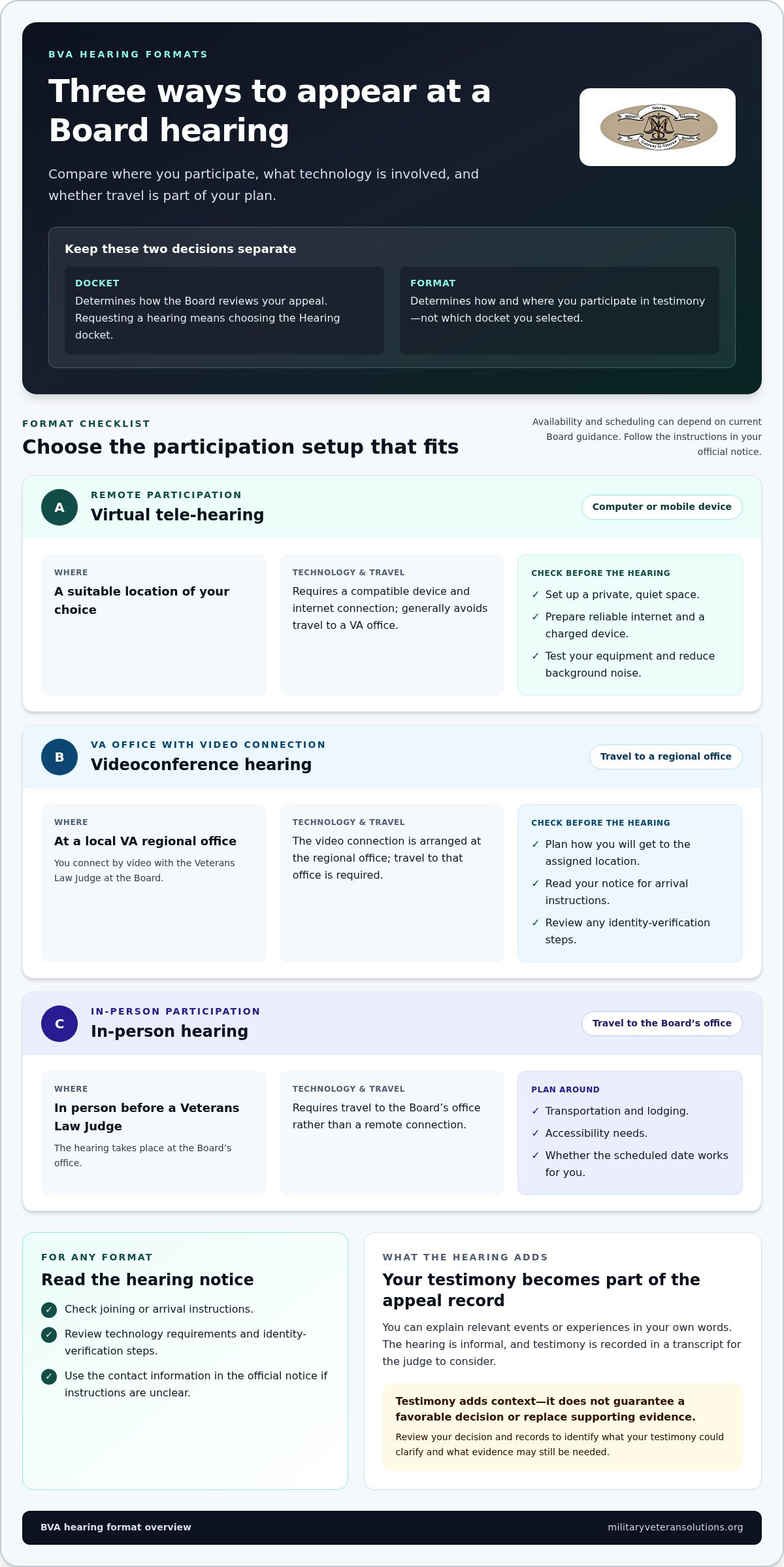
Keep this distinction in mind: the docket determines how the Board reviews your appeal; the hearing format determines how you participate in testimony. Under the Appeals Modernization Act, requesting a hearing means choosing the Hearing docket. Virtual, videoconference, and in-person options are formats for participating in that hearing, not separate dockets. These Board of Veterans' Appeals (BVA) hearing options affect how you appear, not which docket you selected.
For a visual overview of how the Board’s three dockets differ, watch this video:
How a Board hearing fits into the VA appeals process
If you disagree with a VA benefits decision, your review options may include appealing to the Board of Veterans’ Appeals. The Veterans Benefits Administration (VBA) administers benefits claims and issues decisions. The Board reviews appealed decisions. A VLJ considers your case under the rules of the docket you select. A hearing is one way to offer testimony within the Hearing docket, but it isn’t required for every Board appeal.
The Board’s role and place in the VA system are outlined in this Board of Veterans' Appeals overview. For a broader look at appeal steps after a denial, the guide Filing VA Appeals Help: A Strategic Guide to Overturning Denials in 2026 connects the Board process to the larger decision-review path.
What testimony can, and cannot, contribute
Testimony can clarify details that may be difficult to understand from paperwork alone. For example, you might explain when an injury occurred, how symptoms have affected daily activities, or why a sequence of events in your claim matters. The hearing is informal, but your testimony is recorded in a transcript and added to your appeal file for the judge to consider.
Your account is one part of the record. Medical records may document diagnoses and treatment; service records may help establish relevant events or circumstances; and other documents may support specific points in your appeal. A judge weighs the applicable evidence and rules, so testimony doesn’t automatically establish a medical conclusion or replace documentation the case needs. Before selecting a path, review the decision and record to identify what your testimony could clarify and what evidence may still be needed.
BVA hearing options compared: virtual, video, and in-person formats
The Board offers several ways to participate in a hearing, but the format is separate from the docket. You select the Hearing docket to request a hearing; the participation format describes how and where you appear. The Board of Veterans' Appeals (BVA) hearing options differ mainly in location, technology, and travel demands. Format availability and scheduling procedures can depend on current Board guidance, so follow the instructions in your official notice.
Here’s a practical comparison of the three formats described by VA:
| Format | Where you participate | Technology and travel | Practical consideration |
|---|---|---|---|
| Virtual tele-hearing | From a suitable location using a computer or mobile device | Requires a compatible device and internet connection; generally avoids travel to a VA office | Choose a private, quiet space where you can speak without interruption. |
| Videoconference hearing | At a local VA regional office, connected by video with the Veterans Law Judge at the Board | Requires travel to the regional office; the video connection is arranged there | Plan how you’ll get to the assigned location and follow the notice’s arrival instructions. |
| In-person hearing | In person before a Veterans Law Judge at the Board’s office | Requires travel to the Board’s office | Consider transportation, lodging, accessibility, and scheduling needs. |
The Official VA Board Appeals Information explains the Board appeal choices and how to request an appeal. Follow current VA instructions for details about available formats and scheduling, and don’t assume every format is available in every situation.
What to expect from a virtual or video conference hearing
For a virtual tele-hearing, prepare a private space, reliable internet, and a charged device. Test the equipment you plan to use and reduce background noise. For a videoconference hearing, plan to attend at the VA regional office identified in your notice. In either case, read the hearing notice carefully for joining or arrival instructions, technology requirements, and identity-verification steps. If instructions are unclear, use the contact information in the official notice.
When an in-person hearing may be considered
An in-person hearing may suit someone who prefers to appear before the judge rather than connect remotely, but travel to the Board’s office can require advance planning. Consider accessibility, transportation, lodging, and whether the scheduled date works for you. Review current Board guidance and your hearing notice for location and scheduling details. Reviewing your decision and supporting records can also help you prepare. VA appeal support and record review can help you understand the process and organize your appeal.
Hearing docket vs. Evidence Submission and Direct Review
Choosing a Board docket determines whether you can testify and when the Board may consider new evidence. That choice is separate from the hearing format, such as virtual or in person. The three Board of Veterans' Appeals (BVA) hearing options are often discussed alongside docket choices, but only the Hearing docket includes a hearing before a Veterans Law Judge.
Use this comparison to identify which review features matter to your case. Evidence windows are specific, so follow the current VA Form 10182 instructions and any Board notices for your appeal.
| Docket | Hearing? | Evidence rules | Review focus |
|---|---|---|---|
| Direct Review | No | No new evidence may be added through this docket. | The judge reviews the evidence that was in the record when VA made the decision under appeal. |
| Evidence Submission | No | Submit evidence with VA Form 10182 or within 90 days after the Board receives it. | The judge considers the existing record and eligible new evidence submitted within the allowed window. |
| Hearing | Yes | Evidence may be submitted at the hearing and during the 90 days after it. | The judge considers the record, eligible evidence, and testimony. |
What changes when you select the Hearing docket
The Hearing docket gives you a chance to testify to a Veterans Law Judge. It also provides an evidence window tied to the hearing: eligible new evidence may be presented at the hearing or submitted during the 90 days afterward. That timing differs from the Evidence Submission docket, where the window runs from the Board’s receipt of the appeal. Check your notice and current Board instructions for how to submit materials and which dates apply to your case.
Keep the roles of testimony and evidence clear. Testimony can explain your experience or clarify the history behind a claim; documents such as medical or service records can provide supporting evidence. A hearing doesn’t automatically make an appeal stronger or speed up a decision. VA’s July 2026 reported averages were about 2.4 years for the Hearing docket, compared with just under seven months for Direct Review and close to eight months for Evidence Submission. These are averages, not a prediction of an individual case’s timeline.
How the other Board docket choices differ
Direct Review generally fits a case where you want a judge to review the existing record without a hearing or new evidence. Evidence Submission may fit when you have additional documents to provide but don’t want to testify. The Hearing docket combines the opportunity to speak with an evidence window connected to the hearing. None is automatically best. The right choice depends on the record, what you still need to submit, whether you want to testify, and your timing priorities.
Before selecting a docket, compare the VA decision with the evidence already in the file. A careful review can help identify whether the appeal needs additional documentation, an explanation from you, both, or neither. Don’t choose based on a promise of a better result or faster review. Docket rules shape how the Board considers your case, but they don’t guarantee its outcome.
How to request and prepare for a BVA hearing
A well-prepared hearing request starts with the decision you’re challenging, not with the hearing format. Identify the issues, check the deadline, and select the Board docket that matches what you want the judge to consider. These steps can help you organize your appeal before submitting the form.
For most VA decisions, you generally have one year from the date on the decision notice to appeal to the Board. Exceptions may apply, and rules can differ depending on the decision and your circumstances, so verify the deadline and current instructions for your case.
Before filing VA Form 10182
Read the decision notice carefully. It identifies what VA decided, explains the reasons, and provides review information. Compare those reasons with your claim file before choosing among the Board of Veterans' Appeals (BVA) hearing options.
- 1. Identify the decision and issues. Note the date and list each issue you want the Board to review.
- 2. Review the record. Gather relevant service records, medical records, prior claim materials, and the decision notice. Look for evidence VA discussed and information that may be missing or unclear.
- 3. Choose a docket. Decide whether you want a judge to review the existing record, consider additional evidence without a hearing, or hear your testimony. The choice affects evidence rules as well as hearing access.
- 4. Complete VA Form 10182. Select “Hearing with a Veterans Law Judge” to request a hearing, identify the issues being appealed, and submit the form according to current VA instructions.
A professional military record review can help you examine service documentation alongside the decision and supporting claim records as you prepare an appeal.
Preparing for the hearing and its evidence rules
After filing, keep the hearing notice and any Board instructions with your appeal records. Prepare a short outline so you can explain the relevant history clearly without trying to memorize a script.
- List important events in order, including when they happened and why they matter to the issue on appeal.
- Note symptoms or limitations you want to explain, and identify points in the decision that need clarification.
- Organize supporting documents and track the evidence deadline for your docket. For the Hearing docket, current guidance allows evidence at the hearing and during the 90 days afterward. Follow your notice and VA instructions for submission procedures.
- If you can’t attend or need to request a schedule change, act promptly and follow the instructions in your hearing notice. Don’t assume that simply missing the hearing will preserve the same options.
In brief: Use VA Form 10182 to request a Board hearing by selecting the Hearing docket, generally file within one year of the decision notice when that deadline applies, and follow current VA instructions for evidence and hearing logistics. If you need help reviewing the decision and organizing your appeal, get support preparing your VA appeal.
Choosing a hearing path with informed VA appeal support
No single Board appeal path is right for every veteran. Start with the record: what the decision says, what evidence VA considered, and what you want the Board to review. Compare the Board of Veterans' Appeals (BVA) hearing options against your needs, not an assumption that a hearing will guarantee a stronger result or faster decision.
Questions to resolve before choosing a Board appeal path
- Would your personal explanation add important context? Consider whether you want to describe events, symptoms, or circumstances directly to a Veterans Law Judge. Testimony may clarify your account, but it serves a different role from documentary evidence.
- Do you need to submit additional evidence? Direct Review generally uses the existing record and doesn’t include a hearing. Evidence Submission allows new evidence within its designated window without testimony. The Hearing docket includes a hearing and its own evidence-submission rules. Confirm the current deadlines and instructions for your appeal.
- Which format is practical for you? Weigh access, privacy, internet and device needs, travel, mobility, and scheduling. A remote option may be more workable for one person, while another may prefer to appear at a VA location. Follow current Board guidance and your hearing notice for format availability and logistics.
- How does timing affect your priorities? Consider whether a hearing and its associated evidence window meet your needs, while recognizing that choosing a docket doesn’t guarantee when the Board will decide your case.
These questions aren’t a scorecard. For example, wanting to explain a complicated timeline may support considering a hearing, but your choice should also account for what the records already show and what evidence remains available to submit.
How representation can support the next step
A careful review can connect the reasons in your VA decision to the evidence in your file. Military Veteran Solutions, LLC analyzes VA decision letters and reviews relevant military and medical records to help identify the issues on appeal and understand what evidence may matter to the next step. This review can support an informed discussion of docket and hearing choices, but it can’t promise how the Board will rule.
Before settling on a path, organize the decision notice, the records VA relied on, and any documents you believe address the stated reasons for its decision. A focused review may show whether the key question is if the existing record is sufficient, if additional evidence is needed, or if your testimony could clarify an important part of the claim. Keep procedural deadlines and evidence windows in view as you weigh those factors.
You don’t have to sort through the decision and appeal choices without guidance. Explore a virtual consultation with Military Veteran Solutions, LLC to discuss your VA appeal, review the record, and consider a path that fits your circumstances.
Take the next step with a clear plan
Your next move doesn’t have to be choosing a hearing format immediately. Start by setting a clear goal: identify what you want the Board to understand, what the record supports, and what questions remain about your appeal. That focus can make a complex process easier to manage.
The Board of Veterans' Appeals (BVA) hearing options are part of a larger appeal strategy, and your path should reflect your circumstances, not a promise of a particular outcome. Military Veteran Solutions, LLC was founded by a disabled veteran who served ten years in the U.S. Army. Its VA decision-letter analysis and virtual consultations can help you examine your next steps with informed support.
Discuss your VA appeal options with Military Veteran Solutions, LLC and take the next step with greater clarity. You deserve a thoughtful review and a plan grounded in your case.
Frequently Asked Questions
Is a BVA hearing required to appeal a VA decision?
No. You can appeal to the Board without requesting a hearing. The three AMA Board dockets are Direct Review, Evidence Submission, and Hearing. Direct Review generally uses the evidence already in the record, Evidence Submission allows new evidence within its designated window, and the Hearing docket includes an opportunity to testify. For example, if you want the judge to consider additional documents but don’t need to testify, compare Evidence Submission with the other Board of Veterans' Appeals (BVA) hearing options.
Can I choose whether my BVA hearing is virtual or in person?
Possibly, but the formats and procedures that apply to your case can change. Check current VA guidance and your official hearing notice for available participation options and instructions. Consider whether you have a private space and reliable internet for remote participation, or whether travel and accessibility needs make an in-person appearance difficult. Follow official instructions before making arrangements.
How long does it take to get a BVA hearing?
There isn’t one dependable wait time for every appeal. Scheduling may reflect Board workload, case circumstances, and the selected hearing format, so an estimate from an older article may not match your case. Monitor official appeal-status information and read Board notices as they arrive. If you’re coordinating work, caregiving, or travel, avoid making nonrefundable plans until you receive the hearing date and instructions.
What happens if I miss my BVA hearing?
Follow the instructions in your Board notice promptly if you can’t attend or have already missed the hearing. The applicable process and consequences may depend on your circumstances and current rules, so don’t assume the hearing will automatically be rescheduled. Keep copies of the notice, any request you submit, and related communications. If an unexpected issue arises, document what happened and follow the official procedure and deadline described by the Board.
Can I submit evidence at a BVA hearing?
Yes, the Hearing docket generally allows evidence to be submitted at the hearing and during the 90 days afterward, subject to current VA instructions. This is not an open-ended evidence window: a document submitted outside the applicable period may not be considered as you expect. Before sending records, label or organize them so it’s clear which appealed issue each item relates to, and check the notice for submission details.
Does a BVA hearing guarantee that my appeal will be approved?
No. A hearing gives you a chance to explain relevant context, but the Board decides the appeal based on applicable law and the evidence. For instance, testimony about when symptoms began may help clarify your account, while medical documentation may be relevant to other questions. These forms of information serve different purposes. Treat a hearing as one part of presenting your case, not as a substitute for evidence or a guaranteed route to approval.
What form do I use to request a Board hearing?
For most appeals under the current review system, use VA Form 10182, Decision Review Request: Board Appeal, and select the Hearing option to request a hearing. Read the decision notice and latest form instructions before submitting, since the deadline and requirements may depend on the decision and your circumstances. Save a copy of the completed form and proof of submission, then monitor official VA communications for next steps.


