
The best next step after a VA decision may be the one that lets you submit less, not more. If you need higher level review help, VA decision-letter analysis can clarify whether you’re pointing to an error in the existing record or need to provide evidence the VA hasn’t considered.
It’s understandable to feel unsure. A Higher-Level Review doesn’t allow new evidence, while a Supplemental Claim is designed for submitting new and relevant evidence. Choosing the wrong lane could delay your next step. Timing matters, too: filing within one year of the decision can help preserve the original effective date for potential back pay.
This guide explains what each option involves and how to match a review path to your decision letter and available evidence. You’ll learn which parts of the VA’s reasoning to examine, what records to organize, and what to consider before seeking VA appeal assistance. A careful review can bring your options into focus and help you move forward with a clearer understanding of your case.
Key Takeaways
- Choose a review lane based on whether you’re challenging an error in the existing record or need to submit new and relevant evidence.
- Before deciding, identify what the VA said went wrong and which records it considered.
- Higher level review help VA decision-letter analysis can clarify how your decision letter and available evidence may inform your next step.
- Keep filing deadlines in view, since timing may affect the effective date of a potential award.
- Organizing your decision letter, military records, and medical documentation can make it easier to assess your options.
What Is a VA Higher-Level Review, and How Does It Differ from a Supplemental Claim?
An unfavorable VA decision can leave you with a difficult question: should you challenge how the VA evaluated the claim, or provide information it hasn’t considered? Each review path serves a different purpose. A practical place to start is by identifying what’s already in your record and what may be missing.
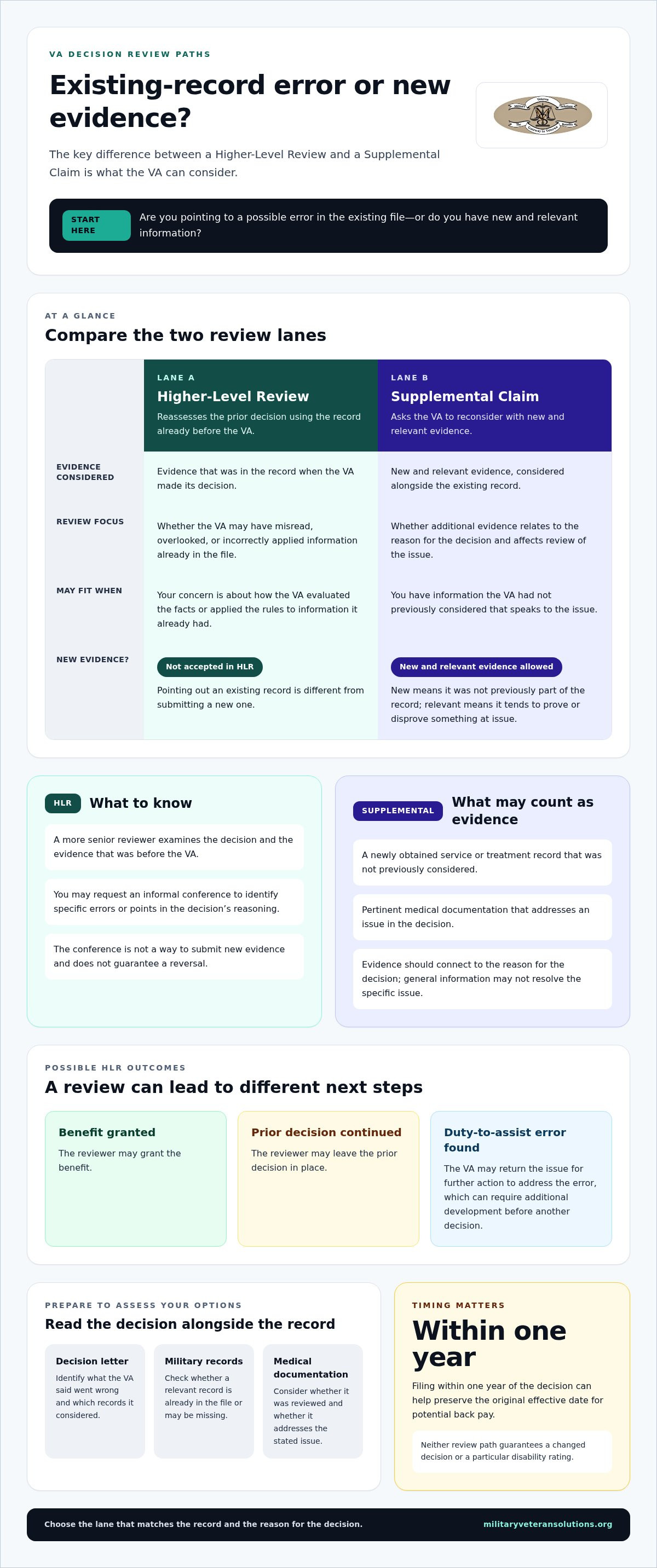
In brief: A Higher-Level Review asks the VA to reassess a prior decision using the evidence already in the record. A Supplemental Claim asks the VA to reconsider a decision based on new and relevant evidence. Neither path guarantees a changed decision or a particular disability rating.
For a general overview of the agency involved, see the Veterans Benefits Administration, which administers veterans’ benefits programs.
This video offers another perspective on what to expect from a Higher-Level Review:
What does a Higher-Level Review ask the VA to do?
A Higher-Level Review (HLR) asks the VA to review an existing decision, not to start a new claim from scratch. A more senior reviewer examines the decision and the evidence that was before the VA when it made that decision. The focus is whether the VA may have made an error in evaluating the facts or applying the rules to the record.
For example, you might believe the decision overlooked a service record already submitted or misread information in your file. Those concerns point to the existing record and the VA’s explanation. An HLR generally doesn’t allow you to add new evidence. If the reviewer identifies a duty-to-assist error, the VA may need to take additional steps to address it, rather than deciding the claim based on a newly submitted document.
What makes a Supplemental Claim different?
A Supplemental Claim is the path for asking the VA to reconsider a decision with new and relevant evidence. “New” means the information wasn’t previously part of the record considered by the VA. “Relevant” means it tends to prove or disprove something at issue in the claim. Examples might include a newly obtained service or treatment record, or pertinent medical documentation that wasn’t previously reviewed.
Submitting a document doesn’t automatically establish that a claim should be granted. The evidence still needs to relate to the issue being decided, and the VA evaluates it alongside the rest of the record. If you’re weighing options, higher level review help VA decision-letter analysis can clarify what the VA relied on and whether your concern is an alleged error in the existing record or information that wasn’t considered. That distinction can guide your next-step assessment without promising a particular outcome.
How HLR and Supplemental Claims Work: Evidence, Review, and Possible Outcomes
The key practical difference is what the VA can consider. An HLR focuses on whether the earlier decision was correct based on the record then before the VA. A Supplemental Claim gives you a way to submit or identify new and relevant evidence for consideration. The VA outlines both paths in its VA Decision Reviews and Appeals information.
| Review path | Evidence considered | Review focus | May fit when |
|---|---|---|---|
| Higher-Level Review | Evidence in the record when the VA made the decision | Whether the decision contains an error | You believe the VA misread, overlooked, or incorrectly applied information already in the file |
| Supplemental Claim | New and relevant evidence, along with the existing record | Whether the additional evidence changes the review of the issue | You have information not previously considered that relates to the reason for the decision |
Evidence rule: HLR generally uses the existing record and doesn’t accept new evidence, while a Supplemental Claim allows new and relevant evidence to be considered.
What can an HLR reviewer consider?
An HLR reviewer can assess whether the VA made an error based on the evidence already in the file. Pointing out that an existing record was overlooked is different from submitting a new record after the decision. The latter generally belongs in a Supplemental Claim, not an HLR.
You may request an informal conference as part of the HLR process by indicating on the request form that you want one. It gives you an opportunity to identify specific errors for the reviewer, such as a relevant record that appears to have been missed or a point in the decision’s reasoning that warrants attention. It isn’t a new-evidence submission, and it doesn’t guarantee that the VA will reverse the decision.
An HLR reviewer may grant the benefit, continue the prior decision, or identify a duty-to-assist error. If the VA failed to help obtain relevant evidence, it may return the issue for further action to correct that error. This can require additional development before another decision is made.
How can new evidence affect a Supplemental Claim?
New and relevant evidence should connect to an issue in the decision. If the VA says the file doesn’t establish a particular fact, for example, a newly obtained record that addresses that fact may be relevant. Medical documentation may also help address a stated gap, depending on the issue and what the record already contains.
General information that doesn’t speak to the reason for the decision may not help resolve the specific issue. No single document automatically changes the outcome; the VA considers evidence in context. Reviewing the decision letter alongside the records can clarify whether new evidence addresses the stated reason or whether your concern is about how existing evidence was evaluated. VA decision-letter analysis from Military Veteran Solutions can help organize the issues and records without promising a result. This is a practical starting point for higher level review help VA veterans can use to understand the available review paths.
Can You Add Evidence in a VA Higher-Level Review? Addressing the Key Misconception
Generally, no. A Higher-Level Review (HLR) is based on the evidence that was in the record when the VA made the decision under review. You can point the reviewer to information already in that record, but you generally can’t use an HLR to submit new evidence for consideration.
This distinction can feel frustrating if you’ve found an important document since the decision. The next step depends on what the decision says, when the evidence became available, and whether the issue is missing information or a possible error in handling the original record. One lane isn’t automatically better for every case.
What if the VA overlooked evidence already in the file?
Start by comparing the decision’s findings with the documents the VA had before it made the decision. Timing matters: a record submitted before the decision may support a concern that the VA overlooked or misinterpreted existing evidence. A document obtained or submitted afterward generally can’t be added to the HLR record, even if it relates to the same issue.
Check the decision letter for the evidence considered and the reasons the VA gives for its conclusion. Then note the specific document you believe was missed, when it was submitted or received, and how it relates to the finding. This doesn’t establish that an error occurred or guarantee a changed decision, but it gives you a clearer basis for assessing the concern. A VA decision-letter analysis can help you focus on the stated reasons and the records connected to them.
What if important evidence became available after the decision?
If relevant information wasn’t before the decision-maker, a Supplemental Claim may be worth evaluating because that path allows new and relevant evidence to be considered. Connect each document to a specific issue in the decision. For instance, if the VA identified a gap in the record, consider whether the new information speaks directly to that gap rather than simply adding general background.
Newness alone isn’t enough: evidence must also be relevant to the matter being reviewed. A broader military record review guide can help explain how record analysis may clarify which documentation relates to a claim. No particular record guarantees a different outcome.
A duty-to-assist concern is different from adding evidence. For example, you might believe the VA failed to make reasonable efforts to obtain relevant records before deciding the claim. An HLR reviewer can identify a duty-to-assist error and return the issue for correction and further action. That doesn’t mean you can submit new evidence during the HLR itself; it addresses a possible problem with the VA’s earlier development of the claim.
For higher level review help, VA decision-letter analysis can help distinguish a potential error in the original record from information that wasn’t previously considered. Organize the decision letter, relevant records, and their submission dates before assessing which review path fits the issue.
How to Choose Between Higher-Level Review and a Supplemental Claim
There’s no single review path that fits every unfavorable decision. The choice depends on what the VA decided, what was in the file at the time, and whether you now have relevant evidence that wasn’t considered. Use this process to organize those details before deciding what to evaluate next.
- Identify the decision. Confirm which claim, issue, and decision you’re responding to. If the VA decided several issues, assess each one separately; the evidence or reason for denial may differ from issue to issue.
- Read the stated reasons. Review the findings and evidence discussion in the notice. Separate “I disagree with the outcome” from a specific concern, such as an existing record that appears to have been misread or a fact the VA says the file doesn’t establish. The VA appeals strategy guide offers broader context for assessing an appeal.
- Sort the evidence by timing. Make two lists: records that were available to the VA before it issued the decision, and evidence obtained or submitted afterward. This makes it easier to distinguish a possible error in evaluating the original record from a need to provide new information.
- Match the concern to a path. If your concern is that the VA made an error based on evidence already in the record, evaluating an HLR may make sense. If you have new and relevant evidence that addresses a reason in the decision, consider whether a Supplemental Claim fits. A possible failure by the VA to help obtain evidence may also raise a duty-to-assist issue, so assess the specific circumstances rather than relying on a blanket rule.
Start with the VA decision letter and the issue it identifies
Be specific. Note the VA’s stated reason, the finding you disagree with, and the document or fact you believe supports a different analysis. For example, “the decision overlooked my record” is more useful when paired with the record’s date, what it contains, and whether it was part of the file before the decision. A detailed review of the letter can help clarify which point needs attention.
Match the record and timeline to the review path
Deadlines matter. Generally, filing an HLR or Supplemental Claim within one year of the decision can help maintain continuous pursuit and preserve the original effective date for potential back pay. A Supplemental Claim may be filed later, but filing after that period can affect the effective date. Review current VA guidance for the deadline and how it applies to your decision before acting.
If you’re unsure how the decision, records, and timing fit together, VA appeal support can help organize the issues and assess a path forward. Higher level review help through VA decision-letter analysis can clarify the basis for your next-step assessment without promising a particular outcome.
How VA Higher-Level Review Help Can Make Your Next Step Clearer
After an unfavorable decision, it can be hard to tell whether the problem lies in the VA’s reasoning, the evidence it considered, or information that still needs to be gathered. Military Veteran Solutions, LLC reviews VA decision letters alongside relevant military records and medical documentation to help clarify what the VA decided and which questions may need attention. That analysis can help you assess a potential review path. It can’t guarantee that a decision will change or establish medical evidence that isn’t in your file.
What can a decision-letter and record review clarify?
The decision letter explains the VA’s findings and reasoning. Comparing those points with records submitted for the claim can help identify questions to examine, such as whether a document appears to have been overlooked or whether the decision identifies an issue that may need additional evidence. The purpose is to organize the facts and understand the options, not to assume every disagreement proves an error.
An advocate can help sort relevant records, connect them to the issue discussed in the decision, and explain potential next steps. Military Veteran Solutions was founded by a disabled veteran who served ten years in the U.S. Army. That service background informs the firm’s perspective, but your claim still needs to be assessed on its own evidence and circumstances.
What to prepare before a virtual consultation
Gather the documents that show what happened and when. A focused set of records can make a virtual consultation more useful:
- The complete VA decision notice, including its reasons and evidence discussion
- Relevant claim correspondence and records you submitted before the decision
- Military records and medical documentation related to the issue under review
- Evidence obtained after the decision, kept separate from earlier submissions
- A brief timeline of decisions, submissions, and newly obtained records
Note any questions you want answered, too. For example, you might want to understand whether a concern involves evidence already in the file, a new document, or a possible failure to obtain relevant records. This preparation supports a more focused discussion; it doesn’t guarantee a particular decision, rating, or benefit.
Virtual consultations and veteran claims representation give you a setting to discuss your individual case and the records connected to it. For higher level review help, VA decision-letter analysis can bring the decision’s reasoning and your available documentation into clearer focus. The goal is a better-informed next step, not a promised outcome.
To discuss your records and potential appeal path, contact Military Veteran Solutions about VA appeal representation.
Move Forward With a Clearer Plan
Your next step can begin with a focused question: what does the decision say, and what does the record show? Use that question to turn uncertainty into a practical plan. Keep the relevant notice and records together, note any deadlines, and write down what you want clarified. You don’t need to have every answer before seeking support.
For higher level review help, VA decision-letter analysis and record review can help you understand the issue and discuss potential options. Military Veteran Solutions has more than 25 years of experience supporting veterans with claims and appeals. No review can promise a particular VA decision, but careful preparation can make the path ahead easier to assess.
Explore support for your VA appeal and take a considered next step with your claim. You deserve clear guidance as you move forward.
Frequently Asked Questions
How long do I have to request a VA Higher-Level Review?
Generally, you have one year from the date on your VA decision notice to request a Higher-Level Review. Filing within that period may help preserve continuous pursuit and the original effective date for potential back pay. Check the notice date and current VA guidance promptly, especially if you’re close to the deadline. Higher level review help through VA decision-letter analysis can clarify which decision and issue you’re considering, but it doesn’t extend a filing deadline.
Can I switch from a Higher-Level Review to a Supplemental Claim?
You generally can’t add new evidence to a pending HLR or simply convert it into a Supplemental Claim. If new and relevant evidence becomes available, you may need to withdraw the HLR and file a Supplemental Claim instead. The sequence and timing can affect your review options and potential effective date, so don’t assume a switch is automatic. Check current VA instructions before withdrawing, and act promptly if the one-year period is approaching.
Is an informal conference required for a Higher-Level Review?
No. An informal conference is optional. If you request one, it gives you an opportunity to point out specific concerns about the decision to the higher-level reviewer. It isn’t a hearing, and it doesn’t allow you to introduce new evidence into the HLR record. Consider whether you can identify a focused issue to discuss, such as a finding that appears inconsistent with a document already in the file.
Does a Higher-Level Review guarantee that the VA will reverse a denial?
No. The reviewer may change the decision, uphold it, or identify an error that requires further action, such as correcting a duty-to-assist problem. A review request isn’t a promise of approval or a higher disability rating. Before filing, identify the specific issue you want reviewed and the part of the existing record or decision that supports your concern. That preparation can clarify your argument, but it can’t determine the VA’s outcome.
Which VA form is used to request a Higher-Level Review or Supplemental Claim?
Use VA Form 20-0996 to request a Higher-Level Review and VA Form 20-0995 to file a Supplemental Claim. They serve different review paths, so select the form that matches the action you intend to take. Before submitting, check that the form version and filing instructions are current, complete the sections relevant to your request, and keep a copy of what you send and any submission confirmation.
Can I request another Higher-Level Review after the VA has decided one?
You generally can’t request another HLR of the same HLR decision. If you disagree with that result, available next steps may include a Supplemental Claim with new and relevant evidence or an appeal to the Board of Veterans’ Appeals. A later, separate VA decision may have its own review options and deadline. Read the new notice carefully and check current VA guidance before choosing a path or allowing a filing period to pass.


