
What if the strongest way to challenge an old VA decision isn’t to submit more evidence, but to show exactly where the decision went wrong? A VA clear and unmistakable error (CUE) claim asks VA to revise a final decision because of an undebatable error of fact or law that would have changed the outcome. This is a narrow standard. Disagreeing with how VA weighed the evidence usually isn’t enough.
If you’re unsure whether a decision contains a qualifying error or whether CUE is the right route, start by separating the decision’s finality from the strength of your argument. CUE isn’t a standard appeal or a way to add new evidence. It generally applies after the ordinary appeal period has closed, while other review options may be available if that period is still open. Although there’s no time limit to request revision for CUE, a motion involving a specific issue is generally a one-time opportunity, so it’s important to identify the issue and alleged error carefully.
This guide explains how to assess a possible CUE, identify the decision and review path that fit your situation, and describe the error and its effect with precision. You’ll also learn how CUE differs from other VA review options and how to prepare a focused request. Reviewing the decision letter alongside the records VA had at the time can help you organize the next steps.
Key Takeaways
- Use a four-step screen to assess a possible VA clear and unmistakable error (CUE) claim: identify the decision, pinpoint the alleged error, check the record available at the time, and explain how the error affected the outcome.
- Match the review route to the decision’s status: compare CUE with an appeal or Supplemental Claim before deciding how to proceed.
- Prepare a focused request by recording the decision date, issuing body, specific issue, and finality status, then clearly cite the factual or legal error and relevant contemporaneous record.
- A request may result in revision or denial. Any effective-date or benefits change depends on the corrected decision and applicable law.
- A careful review of your VA decision letter and supporting records can help clarify the issue and organize your next steps.
What Is a VA Clear and Unmistakable Error (CUE) Claim?
An old VA decision can leave you questioning whether VA missed a fact or applied the wrong rule. That concern deserves a careful review, but a disappointing result or a different interpretation of the evidence doesn’t automatically qualify as CUE. The VA clear and unmistakable error (CUE) claim process is a narrow way to seek revision of a final decision based on a specific error that changed its outcome.
CUE review generally looks backward. VA considers the facts and law that existed when it made the challenged decision, not new evidence developed afterward. The Veterans Benefits Administration handles many VA benefits decisions, while Board of Veterans’ Appeals decisions follow a separate CUE procedure. Start by identifying which body issued the decision, because that affects the procedure you follow.
The Three Parts of the CUE Standard
A persuasive CUE analysis connects three requirements. First, identify a specific error of fact or law by reference to the record and rules that applied at the time. For example, the decision might state a service date that conflicts with a service record already in the file, or apply a regulation incorrectly. A general claim that VA treated you unfairly doesn’t pinpoint an error.
Second, the error must be undebatable. It isn’t enough that another reviewer might interpret the evidence differently. A disagreement over how VA weighed or evaluated evidence, by itself, generally doesn’t meet the CUE standard.
Third, explain why correcting the error would have manifestly changed the outcome. Ask whether VA would necessarily have reached a different result if it had used the correct fact or applied the correct law. If reaching a different result would require reweighing evidence or considering information that wasn’t available at the time, the CUE standard may not be met.
Which VA Decisions May Be Reviewed for CUE?
CUE applies to qualifying final decisions, and the filing procedure depends on who issued the decision. For a final decision by a VA Regional Office, the governing regulation is generally 38 C.F.R. § 3.105(a). A request to revise a Board of Veterans’ Appeals decision is a motion governed by 38 U.S.C. § 7111 and 38 C.F.R. §§ 20.1400-20.1411.
Don’t assume a decision is final just because it’s old or you disagree with it. Review the decision notice, appeal history, and any later VA actions. Whether a decision became final can depend on its procedural history and applicable rules. Some decisions may still be subject to ordinary review rather than CUE. Confirm the decision’s status and the correct procedure before filing. If it isn’t final, a CUE motion may be the wrong route.
How to Test a Possible VA CUE Claim Against the Original Record
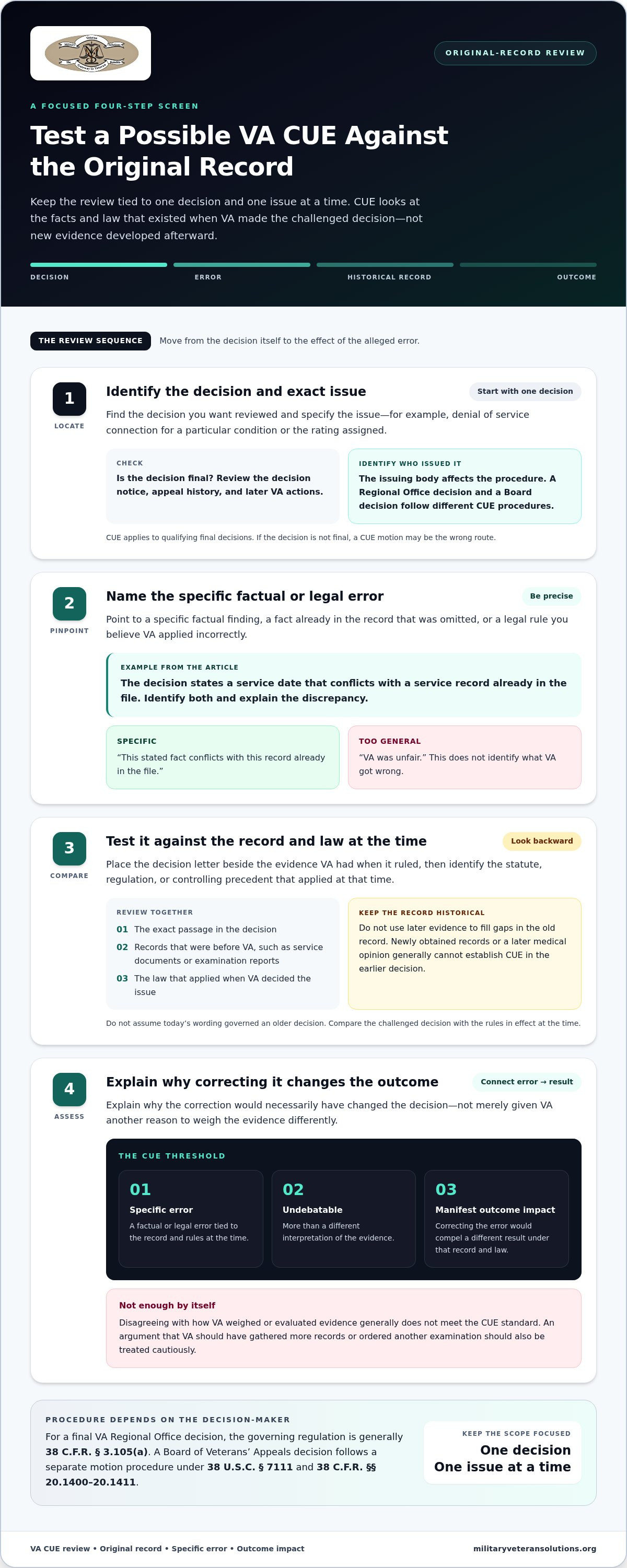
Start with the documents VA had, not with what you know now. A practical screen can turn a general sense that the decision was wrong into a specific, testable argument. Keep your review tied to one decision and one issue at a time.
- Locate the decision. Identify the final decision and the exact issue you want reviewed, such as the denial of service connection for a particular condition or the assigned rating.
- Identify the alleged error. Point to a specific factual finding, an omitted fact already in the record, or a legal rule you believe VA applied incorrectly. “VA was unfair” doesn’t identify what VA got wrong.
- Test the historical record. Compare the challenged part of the decision with the evidence VA had when it ruled and the law then in effect. Don’t use later evidence to fill gaps in the old record.
- Assess the outcome impact. Explain how correcting that specific error would necessarily have changed the result, rather than simply giving VA another reason to weigh the evidence differently.
Compare the decision with the evidence and law at that time
Place the decision letter beside the records that were before VA, such as service documents or examination reports. Mark the exact passage that supports your point. For example, if the decision states a service date that conflicts with a service record already in the file, identify both documents and explain why the discrepancy mattered to the issue decided. Then identify the statute, regulation, or controlling precedent that applied at the time. Don’t assume today’s wording governed an older decision.
The Board’s rule describes CUE as an error that, had it not been made, would have manifestly changed the outcome. In plain language: the error must be undebatable, and correcting it must compel a different result under the record and law that existed when VA decided the issue. The federal regulation on Board CUE sets out that standard and examples of what generally does not qualify.
Screen out arguments that do not meet the CUE threshold
Newly obtained records or a later medical opinion may support a different review route, but they generally can’t establish CUE in the earlier decision. CUE review isn’t a fresh weighing of the claim with new evidence added.
Be cautious about arguing that VA should have gathered more records or ordered another examination. A failure to assist is generally not CUE because it doesn’t establish that the decision was undebatably wrong based on the record VA had. The precise rule can depend on the decision and procedure, so verify the governing standard before filing. Ask yourself: if VA corrected the exact error I’ve identified, would the evidence and law at that time require a different outcome? If reasonable reviewers could still disagree, the argument may not meet the threshold.
A focused review of your decision letter and the records VA considered can help clarify the issue before you act. Military Veteran Solutions, LLC provides VA decision-letter analysis to help you assess the decision and organize your next steps.
CUE Claim vs. VA Appeal or Supplemental Claim: Which Route Fits?
The right review route depends on what you’re challenging, what information you have, and whether the decision is still within its review period. A VA clear and unmistakable error (CUE) claim targets a specific, qualifying error in a final decision. It isn’t a general request for VA to take another look or reconsider evidence with the benefit of hindsight.
| Review route | Purpose | Evidence basis | Decision status and action |
|---|---|---|---|
| CUE request or motion | Seek revision for a specific, outcome-changing error of fact or law. | Generally limited to the record and law when VA made the challenged decision. | For a qualifying final decision. Identify the error precisely and follow the procedure for the body that issued it. |
| Supplemental Claim | Ask VA to review the issue with new and relevant evidence. | New and relevant evidence is central to this route. | Use the process and filing requirements that apply to the decision and claim. |
| Other timely review option | Challenge a decision through an available review lane, such as Higher-Level Review or a Board appeal. | Depends on the chosen review option and its rules. | Review the decision notice and act within the applicable time limit. |
These routes aren’t interchangeable, and filing one doesn’t automatically preserve access to another. Check the decision notice and applicable procedures before choosing, especially if a review deadline may still be open. The VA appeals guide explains broader appeal considerations and how to approach a denial strategically.
When CUE may fit better than an evidence-based review
Consider a hypothetical decision that states a service record showed one discharge date, although the correct date appears plainly in a document already before VA, and that date controlled the result under the rule then in effect. That could point to a specific historical factual error. By contrast, a medical opinion created years later doesn’t itself show that the original decision was clearly wrong based on the record VA had. The Board’s CUE regulation, Cornell Law School’s interpretation of 38 CFR § 20.1403, describes the Board standard and examples of arguments that generally fall short. Keep the analysis focused on one decision and one issue, rather than the full history of your claim.
When another VA review route may fit better
If you now have new and relevant evidence, a Supplemental Claim may be a more suitable way to ask VA to consider it. If you disagree with a recent decision, check the notice for available review choices and deadlines. Waiting to pursue CUE could put a timely option at risk. The decision’s written rationale can help clarify what VA decided and why. Reviewing a VA decision letter with an advocate can help you understand that rationale before organizing your next step.
How to Prepare and File a VA CUE Request
A focused request gives VA a specific decision to review and a clear explanation of the alleged error. Before drafting, gather the decision letter and the records that were before VA at the time. Keep the request centered on the historical record and applicable law, not evidence created later or a broad account of every difficulty in your claim history.
Prepare a specific, issue-by-issue argument
Begin by identifying the decision date, the issuing body, the issue you’re challenging, and why you believe the decision is final. If the decision addressed several issues, specify which one your request concerns. A VA clear and unmistakable error (CUE) claim should distinguish the alleged error on that issue from disagreements with other parts of the decision.
Then set out the argument in a direct sequence:
- What VA decided: Quote or summarize the relevant finding or conclusion.
- What was wrong: Identify the specific factual mistake or legal rule that VA misapplied.
- What the record or rule showed then: Cite the contemporaneous document or the authority in effect when VA made its decision.
- Why it mattered: Explain how correcting the error would have compelled a different outcome under that historical record and law.
Be precise. Saying VA “ignored the evidence” doesn’t explain which evidence, how it was misused, or why the outcome necessarily would have changed. New records or later medical opinions may be relevant to another review route, but they don’t establish what VA had before it when it issued the challenged decision.
Follow the procedure for the decision being challenged
A Regional Office request and a Board of Veterans’ Appeals motion follow distinct procedures. Regional Office decisions are generally addressed under 38 C.F.R. § 3.105(a); Board CUE motions are governed by 38 U.S.C. § 7111 and 38 C.F.R. §§ 20.1400-20.1411. Read the decision notice and current VA instructions to identify the correct submission method, destination, and any content requirements. Don’t assume a form or filing route for an ordinary appeal also applies to CUE.
Before submitting, check whether the rules limit repeated requests involving the same issue. A CUE challenge is generally a one-time opportunity on a specific issue, so avoid sending a vague or incomplete argument. Keep a copy of the request, supporting citations, and proof of submission. Retain VA’s response and decision as well.
Protect other review deadlines
Don’t assume that preparing or filing a CUE request pauses a deadline to pursue another review option. If the decision notice gives you a current review period, confirm the deadline and available route before relying on CUE. Reviewing the decision letter can help clarify the issue and organize the relevant records. Military Veteran Solutions, LLC offers VA decision review with an advocate to help you assess your next steps.
What Happens After a CUE Claim, and How Advocacy Can Help
After VA reviews a CUE request or motion, it may revise the challenged decision, deny the request, or issue a decision that requires you to consider what review rights remain. The result depends on the specific allegation, the decision being challenged, and the procedure that applies. Read the written decision closely before deciding what to do next.
Understand a CUE decision and its possible consequences
Start with VA’s reasons and findings. Does the decision address the precise error you raised? Does it explain why VA considers the error undebatable or not outcome-changing? Note any instructions about available review options and deadlines. If something remains unclear, compare the response with your original request and the documents you cited.
A favorable revision corrects the challenged decision, but it doesn’t automatically grant every benefit you sought or establish the effective date you believe should apply. The effective date and any resulting payment depend on what VA changes and the laws governing that decision. For example, a revision on one issue doesn’t necessarily change a separate rating or resolve a different claim. Review the revised findings, effective-date explanation, and payment information together, and consider how the applicable rules affect your circumstances.
If VA denies the request, don’t assume that no further option exists or that a particular option is automatically available. The decision notice and applicable procedure determine whether and how you may seek further review. Preserve the notice and note any stated deadlines while assessing the next step. A CUE denial can raise specific procedural questions, so don’t rely on a general deadline or process that may apply to a different kind of VA decision.
Get focused support for reviewing your VA decision
A careful decision-letter analysis can help organize VA’s explanation alongside the error you alleged, the issue involved, and the outcome you requested. A military-record review can help identify and arrange relevant service documents, especially when the disagreement concerns what information was in the record at the time of the original decision. These reviews can clarify the case and help you consider next steps, but they can’t guarantee that VA will revise its decision.
Military Veteran Solutions, LLC was founded by a disabled veteran who served ten years in the U.S. Army. The firm provides veteran claims representation, military-record reviews, VA decision-letter analysis, and virtual consultations to help veterans assess VA decisions and supporting records. For broader information about available support and resources, explore the VA claim assistance resource guide.
A VA clear and unmistakable error (CUE) claim turns on a demanding, decision-specific standard. If you want help reviewing the written decision, organizing the relevant records, and considering your next steps, discuss your VA decision with Military Veteran Solutions, LLC through a virtual consultation. No outcome is guaranteed, but a focused review can help you understand your options.
Choose Your Next Step With Care
A difficult VA decision can leave you feeling stuck between challenging the past and protecting the options still available to you. Before acting, write down the decision or issue you want to address and what you need clarified. A calm, focused plan can make a complex process feel more manageable.
If you’re considering a VA clear and unmistakable error (CUE) claim, don’t let urgency push you into filing an argument that hasn’t been carefully assessed. The right next move depends on the decision, its status, and the facts specific to your situation. Support that takes those details seriously can help you understand the path ahead without promising a particular result.
Explore support for your VA claim next steps with Military Veteran Solutions, LLC. A focused conversation can help you approach the decision with greater clarity. Take the next step when you’re ready.
Frequently Asked Questions
Is there a time limit to file a VA CUE claim?
Generally, there’s no time limit for requesting revision based on CUE in a final VA decision. A veteran may raise a qualifying error years after the decision, but the passage of time doesn’t make an argument meet the strict CUE standard. Identify the exact decision and issue, and check whether another review deadline is currently open before deciding how to proceed.
Does filing a CUE claim pause the deadline to appeal a VA decision?
No. Don’t assume a CUE request pauses, extends, or preserves the deadline for another review option. If you’ve received a recent decision, use the notice to identify available review choices and their deadlines, then confirm the current VA instructions for the option you’re considering. For example, a CUE request about an older decision shouldn’t be treated as protection for a separate, recent denial.
What happens if the VA denies a CUE request?
VA will explain its decision in writing, and any further review depends on whether the challenged decision came from a Regional Office or the Board and which procedure applies. Read the denial for its reasoning, instructions, and any stated deadlines. Compare its explanation with the specific error you raised. Don’t assume the same review route applies to every CUE denial or that another filing is automatically available.
Can a surviving spouse request CUE in a veteran's VA decision?
Sometimes, but eligibility depends on the survivor’s legal standing, the type of benefit at issue, and the decision being challenged. A surviving spouse seeking benefits connected to a veteran’s claim may face different requirements from the veteran who filed the original claim. Before submitting anything, identify the benefit sought and review the applicable CUE procedure and survivor-benefit rules. Don’t assume that a survivor can pursue every issue the veteran could have raised.
Can someone file more than one CUE request about the same VA decision?
Repeated requests about the same specific issue are generally restricted after VA has decided a CUE challenge, so treat the first submission as consequential. A decision that covers several issues may raise separate questions, but that doesn’t mean repeat filings on one issue are allowed. Before submitting, distinguish the issues carefully and verify the procedure that applies to the issuing body, especially if VA has already ruled on an earlier request.
Does a successful CUE claim automatically result in back pay?
No. A favorable revision doesn’t automatically establish entitlement to every benefit or payment you sought. VA must apply the corrected decision and governing effective-date rules to determine what benefits, if any, are due and for what period. Review the revised decision’s findings, effective date, and payment explanation separately. If those details don’t appear to match the correction, preserve the notice and determine what review options and deadlines apply.


