
A 0% VA rating is not a denial, but it may still fail to reflect how your service-connected condition affects you. The distinction matters: a 0% rating means the VA recognized the connection to your service but assigned no monthly compensation for that condition. If you believe the evaluation does not fit the evidence or rating criteria, appealing a 0 percent VA rating may be an option. It is understandable to feel unsure about challenging the decision, especially when the letter’s reasoning and your review choices are unclear.
This guide explains what the decision says, how to compare a Supplemental Claim, Higher-Level Review, and Board Appeal, and what evidence each path allows. It also explains why the date on your decision letter matters. Generally, filing a review request within one year can preserve the original effective date for potential back pay. If your condition worsened after the decision, requesting an increased rating may be a different next step. Start with the VA’s explanation, then match your evidence and concerns to the appropriate review option. A focused review of the decision letter and record can help you choose your next step with greater confidence.
Key Takeaways
- A 0% rating recognizes a service-connected condition, but the percentage is a separate decision about compensation.
- Compare the VA’s explanation with the condition-specific rating criteria to understand what may have led to the noncompensable evaluation.
- When appealing a 0 percent VA rating, match the review option to the issue and the evidence you can submit.
- Check the decision notice for the applicable deadline and filing requirements to protect your options.
- A focused review of your decision letter and records can help clarify what to challenge and how to prepare your next step.
What Appealing a 0 Percent VA Rating Can, and Cannot, Change
A 0% VA disability rating is a noncompensable evaluation. It means the VA recognized a condition as service-connected but assigned a percentage that does not provide monthly disability compensation for that condition. The decision has two distinct parts: whether the condition is connected to service, and how seriously it affects you under the applicable rating criteria.
A 0% service-connected rating is not a denial of the claim; it is a finding of service connection without a compensable evaluation. That distinction can guide your next step. If you disagree with the percentage, focus on the evaluation and the evidence behind it. If the VA denied service connection, you are challenging a different finding: whether the condition is connected to service.
Does a 0% VA rating mean the condition is not service-connected?
No. A noncompensable rating recognizes the condition as service-connected, even though the assigned evaluation is 0%. Recognition and compensation are separate questions. The first concerns the relationship to service; the second concerns the condition’s severity under the VA’s criteria. Find the specific condition and its assigned evaluation in your decision notice. A 0% rating does not guarantee that the VA will grant compensation later. Any future change depends on the applicable rules and evidence.
When might challenging the evaluation make sense?
Consider a challenge if you believe the assigned percentage does not reflect the evidence the VA reviewed, such as examination findings or records describing the condition’s effects. For example, if the decision assigns 0% but you believe documented symptoms meet the criteria for a higher evaluation, identify the gap between the findings and the VA’s reasoning. If the VA recognized the condition but you dispute whether it is connected to service, you are challenging a different part of the decision.
Be precise about what you want reviewed. Appealing a 0 percent VA rating means challenging the evaluation for the condition at issue. It does not automatically reopen every condition or change every rating in your file. Make clear which condition and decision your review request addresses. Do not assume that appealing one issue will cause the VA to reassess unrelated conditions.
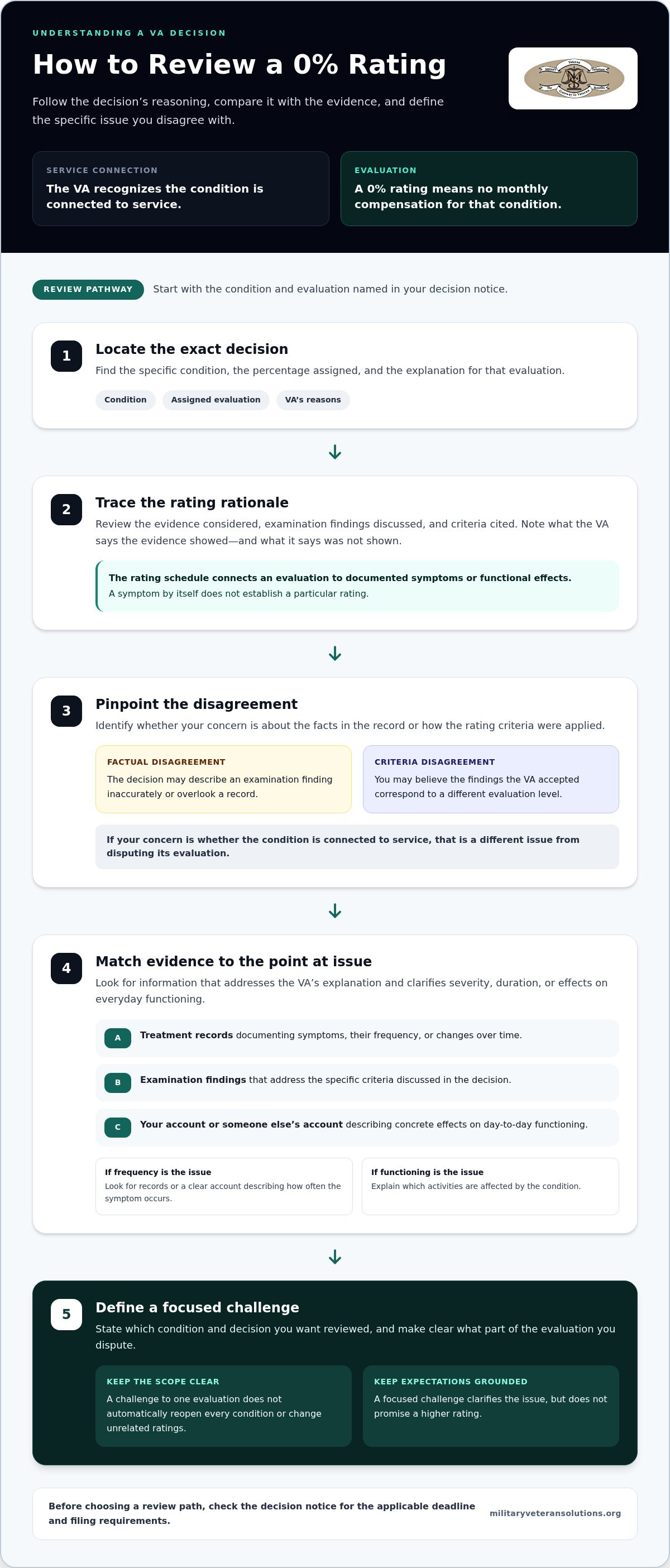
Start with the decision notice. Locate the condition, the percentage assigned, and the explanation for that evaluation. Then compare the VA’s reasoning with the evidence you believe it should have considered or interpreted differently. If your disagreement is about service connection, recognize that distinction before choosing how to proceed. The VA’s broader VA appeals filing guidance can help put the review process in context.
A focused challenge gives the VA a clear issue to review, but it does not promise a higher rating. To prepare, understand how the VA evaluates conditions and what the decision’s cited criteria say about your evidence.
How the VA Decides Whether a Condition Qualifies for Compensation
The VA evaluates disabilities using condition-specific criteria in the VA Schedule for Rating Disabilities. The criteria describe symptoms or functional effects associated with different evaluation levels. The VA compares the record for your condition with the relevant criteria to determine the percentage, so a symptom by itself does not establish a particular rating.
The rating schedule connects an evaluation to the evidence by comparing the documented effects of a condition with the criteria for each percentage level. For a 0% evaluation, the decision’s reasoning should help explain why the VA found that the evidence did not meet the criteria for a higher, compensable level.
Where the 0% rationale appears in the decision
Start with the section identifying the condition and its evaluation. Then review the evidence considered and the explanation for the outcome. Headings and layouts vary, but look for the VA’s reasons, any examination findings it discusses, and the criteria it cites. Note what the decision says the evidence showed, what it says was not shown, and which finding appears to support the 0% evaluation.
Next, distinguish a factual disagreement from a disagreement about how the criteria apply. A factual disagreement might be that the decision describes an examination finding inaccurately or overlooks a record. A criteria question might be whether the findings the VA accepted correspond to a different evaluation level. This distinction helps you identify what needs clarification or support. The VA’s decision reviews and appeals process explains the available review paths if you disagree with a decision.
What medical and lay evidence may clarify severity?
Evidence is most useful when it addresses a specific point in the VA’s explanation. Review the record for material that can clarify the condition’s severity, duration, or effect on everyday functioning. Depending on the condition and the VA’s reasoning, relevant evidence may include:
- Treatment records documenting symptoms, their frequency, or changes over time.
- Examination findings that address the specific criteria discussed in the decision.
- Your account, or an account from someone familiar with your day-to-day experience, describing concrete functional effects.
For example, if the VA’s reasoning turns on how often a symptom occurs, records or a clear account describing its frequency may address that point. If the decision discusses functional limitations, explain which activities are affected and how, rather than relying only on a general statement that the condition is severe. Connect each piece of evidence to the finding you believe needs another look.
No single type of evidence automatically outweighs another. The issue is how the full record relates to the criteria and the VA’s stated reasoning. Before appealing a 0 percent VA rating, organize the decision’s key findings alongside the evidence that supports your disagreement. A careful review of your decision letter and evidence through VA decision-letter analysis and claims representation can help you understand the rationale and prepare a focused next step.
Supplemental Claim, Higher-Level Review, or Board Appeal?
The right review lane depends on what you believe went wrong and whether you have additional evidence. A Supplemental Claim is generally suited to relevant new evidence. A Higher-Level Review asks for another look at the existing record. A Board Appeal places the issue before a Veterans Law Judge. Each route has its own procedures, so choose based on the disputed point and the evidence you can submit, not simply on which option sounds fastest.
Use this comparison as a starting point. VA forms and procedures can change, so review current instructions before filing. The VA’s disability rating explanation provides context for how ratings relate to compensation, while your decision notice helps identify the issue you want reviewed.
| Review lane | What it generally allows | Evidence considered |
|---|---|---|
| Supplemental Claim | Asks the VA to review the issue again | New and relevant evidence, under current VA rules |
| Higher-Level Review | Requests review of the prior decision by a more senior reviewer | The existing record; generally, no new evidence |
| Board Appeal | Requests review by a Veterans Law Judge | Depends on the selected docket and its rules |
When does a Supplemental Claim fit a 0% rating dispute?
A Supplemental Claim may fit when you have new and relevant evidence addressing a reason the VA gave for assigning 0%. This might include treatment records that were not previously available or other documentation related to the disputed evaluation. The evidence should speak to the VA’s stated reasoning, not simply repeat that the condition affects you. New evidence can support reconsideration, but it does not guarantee a different percentage.
How do Higher-Level Review and Board Appeal differ?
Choose Higher-Level Review when you believe the VA made an error based on the record it already had and you are not submitting new evidence. A reviewer may identify an error, but a review request does not ensure it will be corrected. A Board Appeal asks a Veterans Law Judge to review the issue. The available docket choices determine whether and how additional evidence or a hearing may be part of the process.
Current VA forms include Form 20-0995 for a Supplemental Claim, Form 20-0996 for Higher-Level Review, and Form 10182 for a Board Appeal. Board docket options and evidence-submission rules matter, so review the VA’s current instructions before selecting one. When appealing a 0 percent VA rating, match the lane to your evidence and the specific error or gap you want reviewed. Confirm the correct form and submission requirements for that lane before filing.
How to Prepare and File a Challenge to a 0% Rating
A focused filing starts with the VA’s explanation, not a stack of records. Follow these steps to identify the issue, choose a suitable review route, and connect your evidence to the reason for the noncompensable evaluation.
- Read the decision notice. Find the condition, assigned evaluation, evidence considered, and explanation for the decision. Mark the specific finding you believe does not reflect the record.
- Identify the disputed issue. State whether you disagree with the evaluation, the VA’s interpretation of evidence, or another part of the decision. Keep the challenge specific to the issue you want reviewed.
- Select a review lane. Match the route to your circumstances. A Supplemental Claim may fit when you have new and relevant evidence; a Higher-Level Review generally uses the existing record. Review current VA instructions before choosing.
- Assemble focused support. Gather records or statements that address the VA’s stated reason for assigning 0%. Organize the evidence so it is clear which finding each item relates to.
- Submit the correct request. Use the current form and filing method for your selected lane. Keep a copy of what you submit and any confirmation of receipt.
Build an evidence plan around the VA’s stated reasons
Before filing, turn the decision’s explanation into a simple issue-to-evidence plan. Review relevant VA and private treatment records, examination reports, and service records, then note what each document may clarify. A focused personal statement can describe symptoms and their effects on daily activities, but it does not replace medical evidence or guarantee a particular evaluation. For related documentation guidance, explore VA claim assistance resources.
| VA finding to review | Evidence to consider |
|---|---|
| The decision says a symptom or finding was not documented | Relevant treatment records or examination reports |
| The decision describes effects on functioning | Records or a specific account explaining activities affected and how |
| The decision relies on a particular examination result | The report and any relevant records that add context to that finding |
Make the connection clear: identify the VA’s stated reason, then explain how the evidence relates to it. Avoid sending documents without explaining why they matter to the disputed evaluation.
Protect the deadline and submit the correct review request
Check the date on your decision notice and read its review instructions promptly. In general, filing a decision-review request within one year can preserve the original effective date for potential back pay, but deadline and effective-date consequences depend on your circumstances and applicable VA rules. Verify the deadline, current forms, and filing methods through official VA sources rather than relying on a general guide alone.
If you want support connecting the decision’s reasoning with your records and filing steps, request VA appeal assistance from Military Veteran Solutions, LLC. A careful plan can make appealing a 0 percent VA rating more focused, though no review guarantees a higher evaluation.
When VA Appeal Representation Can Help With a 0% Rating
A 0% decision can leave you with a specific question: does the VA’s explanation match the record and the criteria it applied? A structured review can help connect those pieces. Rather than treating the decision, service records, medical documentation, and examination findings as separate documents, review them together to understand what the VA relied on and what may need clarification.
What a careful decision and record review should clarify
A focused review should identify the finding or rating criterion behind the 0% evaluation, then compare the VA’s explanation with relevant service, medical, and examination records. It can also help surface unanswered questions and possible evidence gaps. The purpose is to clarify the basis for your next step, not to promise a higher rating or predict the VA’s decision.
- Which finding or criterion does the decision say supports the evaluation?
- Do your records address that point, or is there an apparent gap?
- What facts or functional effects would you want to explain more clearly?
These questions help keep the review focused. For example, if the decision refers to an examination finding, consider whether the report and other relevant records present a consistent picture. If the VA’s explanation leaves you unsure which evidence mattered, note that uncertainty. It can help shape a more informed discussion about review options.
Discuss your next step with an advocacy team
Military Veteran Solutions, LLC provides VA decision-letter analysis and veteran claims representation. Its review can help you understand the decision’s rationale and consider how service records and medical documentation relate to the issue you want reviewed. A virtual consultation gives you an opportunity to discuss your decision and possible next steps, including questions that remain and records that may be relevant.
The organization was founded by a disabled veteran who served ten years in the U.S. Army. That background informs its veteran-focused approach, but it does not predict the outcome of an appeal. Representation can help you assess the record and navigate appeal steps; the VA makes the decision, and no particular rating outcome is assured.
Before a conversation, gather the decision notice and records you believe relate to the 0% evaluation. Write down the VA’s stated reason for the rating, what you believe the record shows, and any deadline listed in the notice. A concise outline makes it easier to discuss your concern and identify what needs closer review.
If you are considering appealing a 0 percent VA rating and want to discuss the decision with a veteran-focused advocacy team, discuss your VA rating decision with Military Veteran Solutions, LLC.
Make Your Next Move With a Clear Plan
The next step does not have to be rushed. Identify the question you still need answered, whether it is what the VA relied on, which review route fits, or how to organize the record. A deliberate plan can help you move forward with purpose while keeping the focus on the issue that matters to you.
If appealing a 0 percent VA rating feels difficult to manage alone, Military Veteran Solutions, LLC can help you examine the decision and consider your options. Founded by a disabled veteran who served ten years in the U.S. Army, the organization provides VA decision-letter analysis, claims representation, and virtual consultations. No review can promise a particular outcome, but informed preparation can help you approach the process with greater confidence.
Explore your VA appeal next steps with Military Veteran Solutions, LLC for support reviewing your decision and preparing your next move.
Frequently Asked Questions
Can I appeal a 0% VA disability rating?
Yes. You can request review if you disagree with the evaluation. Start by pinpointing what you believe is wrong. Check whether the notice says service connection was granted, then identify the explanation for the percentage. For instance, you may believe an examination finding was not accurately reflected. Your request should clearly name the condition and issue you want reviewed.
Does a 0% VA rating mean my condition is not service-connected?
No. A 0% evaluation generally means the VA recognized the condition as connected to service but assigned no compensable percentage under the applicable criteria. Review the decision for that specific condition rather than relying only on the overall outcome. If several conditions are listed, one may be granted at 0% while another is denied or receives a different evaluation. A later increase is not automatic.
How long do I have to appeal a 0% VA rating?
For many VA decision-review options, the general period is one year from the date of the decision notice, but your deadline and the consequences of filing depend on the decision and your circumstances. Use the date and review instructions on your notice as your starting point. Do not estimate from the day you opened or received the letter. Confirm the current deadline and filing rules through official VA guidance before acting.
Which VA appeal option should I choose for a 0% rating?
Choose based on the issue you are raising and the evidence available. If you have additional relevant records that were not considered, a Supplemental Claim may fit. If you believe the decision contains an error based on the existing record, consider whether Higher-Level Review is appropriate. A Board Appeal follows a separate process with docket choices. Before deciding, write down your main disagreement and review the current rules for each route.
Can new medical evidence change a 0% VA rating?
It may support a different evaluation if it addresses the reason the VA assigned 0%, but the evidence must be allowed in the review lane you select. For example, a newly obtained treatment note may add information about a symptom discussed in the decision. A Supplemental Claim generally considers new and relevant evidence; Higher-Level Review generally uses the record already before the VA. Evidence is considered under the criteria for the condition, not in isolation.
Can I appeal only one condition in my VA decision?
Generally, you can request review of a specific issue rather than challenging every condition in the decision. Identify the condition and evaluation clearly on the request, and follow the current form instructions for that review lane. If you disagree with more than one condition, keep the supporting records and explanation for each issue distinct. This helps show which evidence relates to each dispute and can prevent confusion in the filing.
Should I get help appealing a 0% VA rating?
Support may help if you are unsure how the VA’s reasoning relates to the record or which review route fits your concern. Military Veteran Solutions, LLC provides decision-letter analysis and veteran claims representation, including review of relevant service and medical documentation. A virtual consultation gives you an opportunity to discuss the decision and possible next steps. Representation can help organize and address your appeal, but no one can guarantee a particular VA outcome.


