
What if your recent va hearing loss claim denied letter isn't the final word, but actually a roadmap to your eventual approval? It's incredibly frustrating to spend years around jet engines or heavy artillery only to be told your impairment isn't service-connected because of a flawed Duty MOS Noise Exposure Listing. You know the ringing is real and the silence is growing, yet the system treats your struggle like a math problem that doesn't add up. We understand that feeling of being ignored by the very institution meant to support you.
You deserve a representative who sees the person behind the audiogram. This guide will show you how to transform that denial into a winning strategy by identifying exactly where the VA's logic failed. You'll learn how to uncover hidden evidence in your military records, decode complex test results, and choose the right appeal path to secure the disability rating you earned through your service. Your journey doesn't end with a "no"; it starts with a better plan and the right evidence to prove your case.
Key Takeaways
- Learn how the "Caluza Triangle" identifies the specific missing link in your evidence and why the VA’s mechanical rating system often leads to non-compensable 0% ratings.
- Discover how to challenge the "Duty MOS Noise Exposure Listing" and defend against VA claims that your hearing loss is simply a result of aging or post-service activities.
- Master the strategy of auditing your C-File for overlooked military audiograms and securing a Nexus Letter that uses the specific medical language required for approval.
- Determine the best path forward after a va hearing loss claim denied decision, including why a Supplemental Claim is frequently the most effective way to introduce new evidence.
- Understand how a professional Decision Letter Analysis can pinpoint the exact administrative flaws needed to overturn a denial and secure the disability rating you earned.
Understanding Why Your VA Hearing Loss Claim Was Denied
Receiving word that your va hearing loss claim denied can feel like a punch to the gut. You spent years in high-noise environments, yet the paperwork says you don't qualify. It's frustrating to feel invisible after your service. But here's the reality: a denial isn't a permanent "no." It's a technical statement from the Veterans Benefits Administration (VBA) that a specific piece of evidence is missing. This letter is actually a diagnostic tool. It tells us exactly where the breakdown happened so we can fix it. Many veterans walk away at this stage. We want you to keep moving forward. A denial is just the first step in a more detailed conversation about your service.
The Three Pillars of a Successful Claim (The Caluza Triangle)
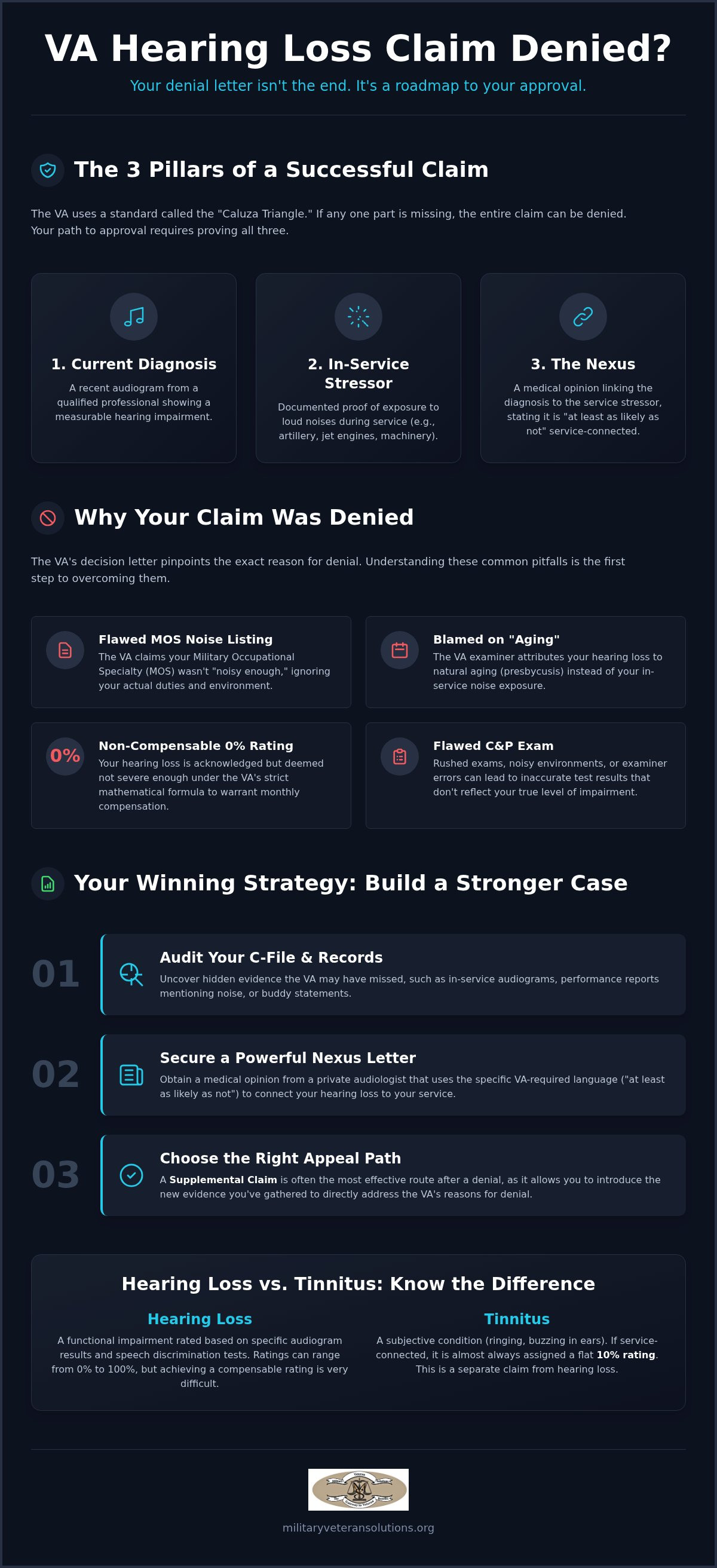
The VA uses a legal standard often called the Caluza Triangle. If one side is missing, the whole claim collapses. To win, you must satisfy three specific requirements:
- Current Diagnosis: You need a recent audiogram showing hearing loss. Sometimes, a private audiologist finds impairment while a VA examiner doesn't. We help resolve these discrepancies.
- In-Service Stressor: You must document the specific loud noises you encountered. This could be flight line noise, artillery fire, or engine room vibrations.
- The Nexus: This is the medical link. A doctor must state that your current hearing loss is "at least as likely as not" caused by your military service. Without this bridge, the VA will deny the connection.
Decoding Your VA Decision Letter
Don't throw that letter away in anger. Look closely at the "Reasons for Decision" section. This is where the VA reveals its cards. We look for "Favorable Findings" first. These are facts the VA already concedes, like your service dates or the existence of a noise-heavy job. Then, we identify the "Legal Basis" for the denial. Did they say there's no service connection? Or did they claim your hearing loss isn't severe enough to be compensable? After a va hearing loss claim denied notification, identifying these flaws is the core of our VA Decision Letter Analysis. Military Veteran Solutions, LLC uses this analysis to pinpoint the exact administrative error or missing evidence needed to build a targeted appeal. You've fought for your country; now let us fight for your benefits. Our Military Record Reviews often uncover the very evidence the VA claims is missing.
The VA Hearing Loss Rating Schedule: Strict Rules and High Bars
The VA rating schedule for hearing loss is notoriously rigid. It doesn't account for your subjective experience or the social isolation you feel. Instead, it relies on a cold, mathematical formula. This mechanical approach is the primary reason why many veterans find their va hearing loss claim denied or rated at 0% despite clear impairment. While you might feel like you're struggling to follow a conversation in a crowded room, the VA only looks at the numbers on a grid. Understanding these metrics is vital before you learn how to file a VA disability claim or appeal a previous decision.
It's also important to distinguish between hearing loss and tinnitus. Tinnitus is the subjective ringing in your ears, which is usually a flat 10% rating. Hearing loss is functional and much harder to prove at a compensable level. You can be legally "deaf" in one ear, but if your other ear tests well, the VA's formula may still result in no monthly compensation. This feels unfair, but it's the system we have to navigate.
The Maryland CNC Test and Pure Tone Audiometry
The VA uses two specific tests to determine your rating. First, Pure Tone Audiometry measures the quietest sounds you can hear at frequencies between 1000 and 4000 Hz. The VA averages these results to create a "pure tone threshold." Second, the Maryland CNC test measures speech recognition. This test is often the "make or break" factor. You might hear the sound of a voice, but if you can't distinguish the specific words, your speech discrimination score will drop.
Errors in the C&P exam are common. Rushed examiners or noisy testing environments can lead to inaccurate results that don't reflect your true level of impairment. If your test results don't match your daily reality, it's a sign that something went wrong during the evaluation. We often see cases where a va hearing loss claim denied letter is based on a single flawed exam. Our team can help you identify these discrepancies through a thorough military record review to ensure your evidence is accurate.
The 0% Rating Trap: Why It’s Still a Victory
Many veterans feel defeated when they receive a 0% non-compensable rating. It feels like the VA is acknowledging your injury but refusing to pay for it. However, a 0% rating is actually a massive legal victory. It means the VA has officially conceded that your hearing loss is service-connected. This establishes a "service connection" that can never be taken away.
Winning a 0% rating provides immediate benefits. You gain access to VA healthcare and hearing aids for that specific condition. Most importantly, it creates a foundation. If your hearing worsens over time, you don't have to prove the service connection again; you simply file for an increase. It also opens the door for secondary claims. Conditions like depression, anxiety, or social withdrawal often stem from hearing loss. Securing that 0% rating is the first step toward a comprehensive disability package.
Common Reasons for Denial: From MOS Noise Levels to 'Aging'
The VA often relies on a rigid spreadsheet called the Duty MOS Noise Exposure Listing to decide if your military job was loud enough to cause damage. If your MOS is categorized as "low" or "moderate" risk, your claim faces an uphill battle from the start. This categorization is a primary factor in a va hearing loss claim denied notification. Beyond the job list, the VA frequently points to post-service noise or hobbies like hunting to shift the blame away from your service. They might also cite Presbycusis, which is simply the medical term for age-related hearing loss. However, the Presumption of Soundness means the VA must prove your hearing was already damaged before you enlisted, or they must concede that your service contributed to the decline. Understanding where you stand in the VA claim process is the first step in dismantling these generic excuses.
Challenging the MOS Noise Exposure List
Don't let a low risk designation stop your appeal. The official list is a guideline, not a law. Lay statements from you and your peers can legally override the official MOS list by providing specific details about your actual environment. If you were an office worker stationed next to a generator or a supply clerk on a firing range, the VA's chart won't reflect that reality. Buddy statements from shipmates or squad members who witnessed the noise levels are powerful pieces of evidence. They provide the boots on the ground context that a spreadsheet lacks. We help you gather these testimonies to prove the environment was far louder than the VA assumes.
The 'Gap in Treatment' Myth
A 15-year gap between your discharge and your first hearing test is a favorite target for VA raters. They assume that if you didn't see a doctor, you didn't have a problem. We counter this by establishing a continuity of symptomatology. You didn't wake up with hearing loss yesterday; the struggle has been constant. Personal narratives describing how you've compensated for years, like lip-reading or turning up the volume, help bridge the timeline. Family statements are equally vital here. Your spouse or children can testify to the decades they spent repeating themselves, proving the impairment has been present since you left uniform. This evidence fills the void that medical records alone cannot cover.
Evidence Strategies to Overturn a Hearing Loss Denial
Winning an appeal requires more than just a second opinion. It requires a targeted strike against the specific reasons listed in your va hearing loss claim denied letter. The most powerful tool in your arsenal is your C-File (Claims File). This document contains every medical record, examiner note, and audiogram the VA used to deny you. Many veterans don't realize that the VA often misses "threshold shifts" documented in entrance and exit exams. By auditing these records, we can often find the exact moment your hearing began to fail, even if a formal diagnosis wasn't made at the time. If you're unsure where to start, you can request a forensic review of your military records to find the evidence the VA ignored.
You should also consider the broader impact of your impairment. Hearing loss rarely exists in a vacuum. It often leads to secondary conditions like depression, anxiety, or social isolation. When the VA denies a primary claim, they also shut the door on these related struggles. Proving a "Nexus" is about more than just ears; it's about connecting your entire health profile to your service through a medical opinion that uses the VA's own language.
Finding the 'Smoking Gun' in Your Military Records
A "threshold shift" is a significant change in your hearing ability that's often recorded during routine military physicals. These shifts are the "smoking gun" of noise-induced hearing loss. Even if your exit exam didn't explicitly state you were "deaf," a drop in specific frequencies proves that damage occurred on active duty. Military Veteran Solutions, LLC performs deep-dive Military Record Reviews to find these hidden entries. We look for mentions of "acoustic trauma" or "tinnitus" in old sick call slips that the VA adjudicators frequently skip. These small details often provide the legal link needed to overturn a denial.
Drafting Effective Lay Evidence
Medical records tell the "what," but lay evidence tells the "how." Use VA Form 21-4138 to describe the daily reality of your hearing loss. Don't just say "I can't hear." Use the "Show, Don't Just Tell" method. Describe how you missed your daughter's wedding vows or why you stopped attending family dinners because the background noise is overwhelming. Use VA Form 21-10210 to gather statements from friends and family who can testify to your social withdrawal. The "at least as likely as not" standard is the legal threshold where a medical professional determines there's a 50% or greater probability that your military service caused your current hearing impairment. Combined with strong personal narratives, this medical standard becomes nearly impossible for the VA to ignore.
Navigating the Appeal: How Military Veteran Solutions, LLC Wins Entitlements
Navigating the bureaucracy after your va hearing loss claim denied notification is a daunting task. You don't have to face it alone. Choosing the correct appeal lane is a strategic decision that determines how quickly you receive your benefits. At Military Veteran Solutions, LLC, we specialize in removing the administrative burden from your shoulders. We handle the paperwork, the complex deadlines, and the technical communication with the VA. We analyze your situation to decide between a Supplemental Claim, a Higher-Level Review (HLR), or a Board Appeal. Our goal is to find the path of least resistance to your successful rating.
Supplemental Claims vs. Higher-Level Review
A Higher-Level Review is effective when a VA rater made a clear and unmistakable error using the evidence already in your file. It's a closed-record review, which means no new evidence is allowed. However, for most hearing loss cases, a Supplemental Claim is the superior choice. This lane allows us to introduce the "New and Relevant Evidence" we've discussed, such as specific threshold shifts or detailed lay statements that were previously missing. We don't guess which lane is best. We use our expertise in VA Decision Letter Analysis to pinpoint exactly why the previous claim failed. Then, we provide the missing link to win.
The Military Veteran Solutions, LLC Advantage
The sting of a va hearing loss claim denied letter is real, but it's not the end of the road. Military Veteran Solutions, LLC was founded by a disabled veteran with a decade of Army service. We bring over 25 years of advocacy experience to every case. We aren't just another service; we are your allies in a complex system. Our virtual consultations allow us to serve veterans across the United States, providing expert representation regardless of where you live. We perform forensic record reviews to identify service connections that the VA overlooked. This no-nonsense approach ensures your best interests are always the priority. We understand the technicalities of the system but remain independent to better serve you. Ready to fight your denial? Schedule your virtual consultation with Military Veteran Solutions, LLC today.
Secure the Disability Rating You Earned
A va hearing loss claim denied letter is a setback, not a stop sign. It marks the beginning of a more focused fight to prove the connection between your service and your impairment. By auditing your C-File for hidden threshold shifts and leveraging strong lay evidence, you can dismantle the VA's generic excuses about aging or MOS noise levels. You've already done the hard work of serving your country. Now, let us handle the technical burden of navigating the appeals process.
Military Veteran Solutions, LLC was founded by a disabled veteran with 10 years of Army service and brings over 25 years of advocacy experience to your case. We offer nationwide virtual consultations to ensure every veteran has access to expert representation. Don't let a flawed decision stand. Get a Professional VA Decision Letter Analysis from Military Veteran Solutions, LLC today. We'll identify the administrative flaws in your denial and build a clear path to the entitlements you deserve. You fought for us; now we're ready to fight for you.
Frequently Asked Questions
What is the most common reason for a VA hearing loss denial?
The most common reason for a denial is a lack of medical nexus connecting your current impairment to your military service. Even if you worked in a loud environment, the VA often claims your hearing loss is due to aging or post-service noise. Many veterans find their va hearing loss claim denied because their test results fall just short of the VA's rigid mathematical requirements for a compensable rating.
Can I appeal a hearing loss denial if I've been out of the military for 30 years?
You can absolutely appeal a denial regardless of how long you've been out of uniform. The key is establishing "continuity of symptomatology" by showing you've struggled with hearing since your discharge. We use lay statements and family testimony to bridge that 30-year gap. This evidence proves the damage started during your service, even if you didn't seek formal medical treatment for decades.
What does 'at least as likely as not' mean in a VA claim?
This phrase represents the VA's legal burden of proof and means there's at least a 50% chance that your service caused your condition. It's a veteran-friendly standard designed to give you the benefit of the doubt. When a doctor uses this specific language in a medical opinion, it tells the VA that your military noise exposure is just as likely to be the cause as any other factor.
How much does the VA pay for hearing loss in 2026?
For 2026, the VA disability compensation for a single veteran with a 10% rating is $180.42 per month. If your hearing loss is severe enough to reach a 100% rating, the monthly payment is $3,930.96. These rates include the 2.8% COLA that took effect on December 1, 2025. Most veterans receive a 10% or 0% rating due to the VA's strict evaluation formula.
Can I get a VA rating for tinnitus if my hearing loss claim was denied?
Yes, you can receive a 10% rating for tinnitus even if your hearing loss claim was denied. Tinnitus is the most commonly claimed disability and is evaluated separately from functional hearing loss. As of early 2026, the VA still treats tinnitus as a standalone condition. This provides a critical 10% foundation for your overall disability compensation while you appeal the hearing loss decision.
What is a 'Nexus Letter' and do I really need one for hearing loss?
A Nexus Letter is a formal medical opinion from a healthcare provider that connects your current hearing loss to your military service. While not strictly required, it's often the deciding factor in a successful appeal. Without this expert link, the VA will likely conclude that your impairment is age-related. A strong letter provides the clinical evidence needed to overturn a va hearing loss claim denied decision.
How long does a VA hearing loss appeal take in 2026?
The timeline for an appeal depends on which lane you choose, but you have exactly one year from your decision letter to start the process. Supplemental Claims and Higher-Level Reviews typically take several months to resolve. Board Appeals involve a Veterans Law Judge and can take significantly longer, often years. We help you choose the fastest path based on the specific evidence missing from your file.
What should I do if my C&P exam for hearing loss felt rushed or inaccurate?
You should immediately submit a statement to your C-File detailing why the exam was inadequate. Describe specific issues, such as a noisy testing room or an examiner who ignored your symptoms. This creates a legal paper trail that allows us to challenge the results. Don't wait for the denial; proactive steps can force the VA to schedule a new, more thorough evaluation.


