
What if the most important document in your VA claim isn't the one you're missing, but the one you haven't properly explained? You've likely spent hours digging through dusty boxes for old service records or staring at a nexus requirement that feels like it's written in a foreign language. It's exhausting to feel like your earned benefits depend on medical codes you don't understand. This frustration is real, especially when you're worried that a single missing record will trigger a denial. This guide clarifies exactly what is credible evidence for a VA claim so you can stop guessing and start building a case that demands respect.
We'll show you how the VA evaluates credible evidence in 2026, moving beyond simple paperwork to focus on the medical logic that connects your condition to your service. You'll learn how to make a personal statement carry weight and how professional record reviews can bridge the gap in your history. We're providing a clear roadmap for a successful appeal, ensuring you have the tools to navigate the system with confidence. With the average claim taking 78.6 days to process as of May 2026, you can't afford to submit anything less than an airtight package. Let's get your benefits secured.
Key Takeaways
- Master the VA standard for "plausible" documentation and understand exactly what is credible evidence for a VA claim to avoid common filing errors.
- Learn how to leverage both Service Treatment Records and private medical files to build a continuous, undeniable history of your condition.
- Discover how to use VA Form 21-10210 and personal statements to provide the human context that medical codes won't capture.
- Identify the three critical components of a medical nexus to prove your disability is directly or secondarily related to your time in service.
- Gain a clear roadmap for navigating denials by choosing the right appeal path after a professional analysis of your decision letter.
What Is Credible Evidence? Understanding the VA Standard
The U.S. Department of Veterans Affairs (VA) doesn't just look for paperwork; it looks for truth. When you ask what is credible evidence for a VA claim, you're asking about a specific legal standard. Credibility means your evidence is plausible and capable of being believed. It's not about the quantity of pages in your file. It's about the reliability of the information inside them. If a statement is inconsistent with the known facts of your service or medical history, a rater will likely dismiss it. Trust is the currency of the claims process.
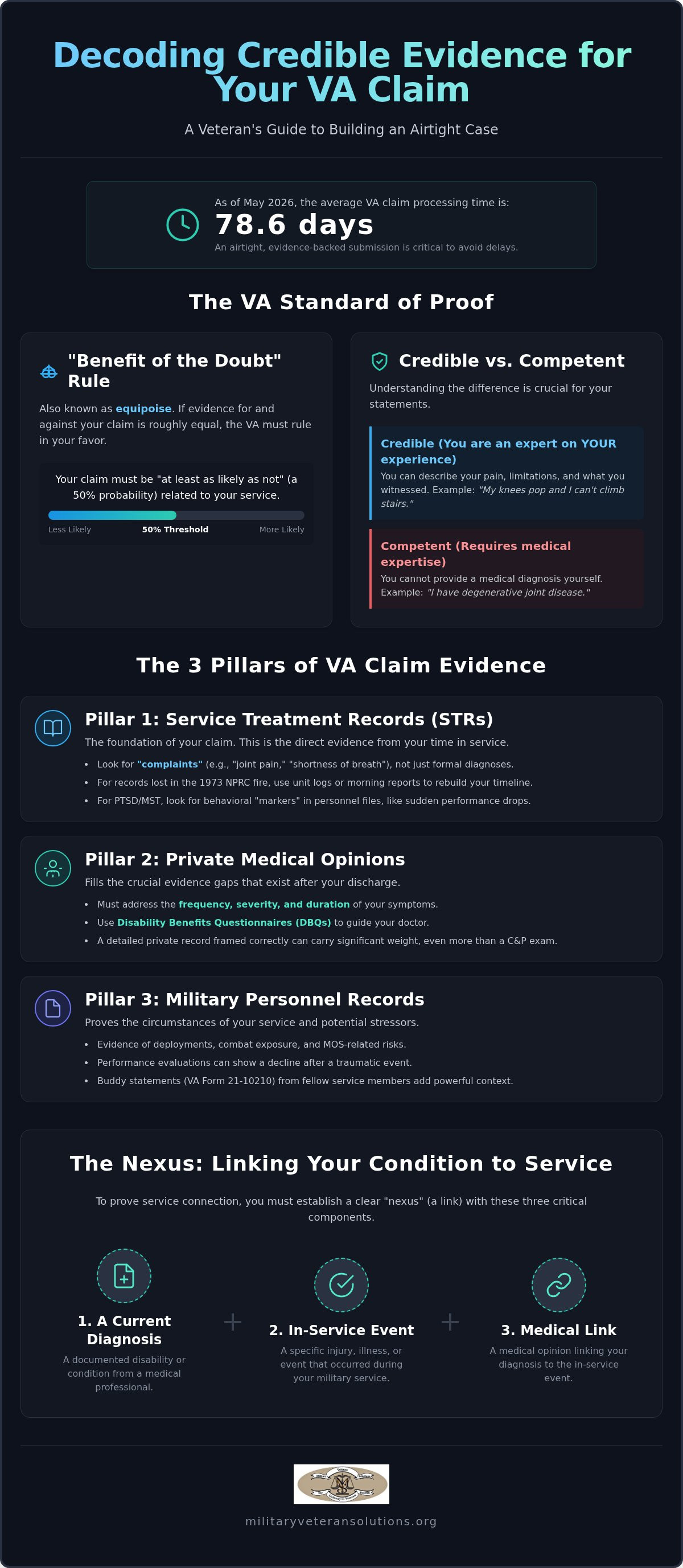
One of the most powerful tools in your arsenal is the "Benefit of the Doubt" rule. In legal terms, this is often called equipoise. If the evidence for and against your claim is roughly equal, the law requires the VA to rule in your favor. You don't need to prove your case beyond a shadow of a doubt. You only need to show that your condition is "at least as likely as not" related to your service. However, this rule only triggers when the evidence is truly balanced. If your records are contradictory or lack medical logic, the rater won't have the "equipoise" needed to grant the benefit.
The Legal Weight of Your Evidence
To win your claim, you must meet the 50% threshold. This means your evidence must prove your claim is "at least as likely as not" true. While the VA often relies heavily on Compensation and Pension (C&P) exams, private medical opinions can carry significant weight if they are supported by sound medical reasoning. In 2026, the preponderance of evidence standard is defined as evidence that has better searching power and is more convincing than the evidence offered in opposition to it. We see many veterans lose ground because they assume the VA will find the evidence for them. You must take the lead in presenting a consistent narrative.
Competent Lay Evidence
There's a critical difference between being credible and being competent. You are a credible witness to your own life. You can describe your pain, your limitations, and your "functional loss" with authority. However, you are generally not "competent" to provide a medical diagnosis unless you have a medical license. A veteran can state, "My knees pop and I can't climb stairs," but they cannot legally state, "I have degenerative joint disease." Competent lay evidence relies on first-hand knowledge. When a spouse or fellow service member writes a buddy statement, they should stick to what they saw and heard. These observations bridge the gap between clinical records and the reality of your daily struggle.
The Pillars of VA Claim Evidence Analysis
Building a winning case requires more than just a stack of papers. It requires a strategic audit of your history. When determining what is credible evidence for a VA claim, the rater looks for a clear, unbroken line connecting your current health to your time in uniform. This path is built on three specific pillars: your service treatment records, your private medical history, and your military personnel files. Simply gathering these documents isn't enough; you must analyze them to ensure they speak the VA's language.
Your Service Treatment Records (STRs) are the foundation of any service connection. Don't just look for a formal diagnosis in these old files. Instead, search for "complaints." Many veterans were never formally diagnosed while on active duty, but their records show frequent visits for "joint pain" or "shortness of breath." These entries are vital. If your records were part of the 1973 NPRC fire gap, you'll need to rebuild that timeline using unit logs or morning reports. For those dealing with PTSD or MST, we look for "markers" in personnel files, such as sudden performance drops or unauthorized absences, which can signal an underlying trauma even if a medical report is missing.
Leveraging Private Medical Opinions
Private medical records fill the critical gaps that exist after your discharge. However, a civilian doctor's note often lacks the specific terminology the VA requires. To be considered credible, these records should address the "frequency, severity, and duration" of your symptoms. Utilizing Disability Benefits Questionnaires (DBQs) is a highly effective way to ensure your doctor provides the exact data points a rater needs to assign a percentage. This documentation is a core part of the Evidence Needed For Your Disability Claim. Without this specific framing, even the most detailed private record can be dismissed as "non-probative."
Military Personnel Records prove your stressors, deployments, and MOS-related risks. For example, a veteran with a high-noise MOS has an inherent credibility advantage for hearing loss claims because the risk is documented in their job description. Uncovering these links often requires a professional military record review to find evidence that isn't obvious on the surface. This exhaustive analysis ensures that every potential service connection is identified before you file, protecting you from unnecessary denials based on "missing" records that were actually there all along.
Buddy Statements and Lay Evidence: Building Credibility
Lay evidence is often the deciding factor in a complex case. It acts as the connective tissue between your service records and your current medical diagnosis. When the VA evaluates what is credible evidence for a VA claim, they aren't just looking for a doctor's signature; they're looking for a consistent, believable narrative of your daily life. Buddy statements and your own personal testimony provide the vital context that clinical notes often miss. These documents build a timeline of symptoms that proves your condition has persisted from your time in uniform until today.
Consistency is your greatest asset. If your buddy statement describes a back injury in 2012, but your medical records show no treatment until 2024, the rater may question the credibility of the testimony. To avoid this, your lay evidence must align with the "markers" found in your personnel files or the complaints in your service treatment records. These statements are particularly crucial when preparing for a VA claim exam (C&P exam), as they provide the examiner with a roadmap of your functional limitations before you even walk into the room.
Writing an Effective Buddy Statement
The VA uses Form 21-10210 to collect official statements from those who knew you during or after service. An effective statement avoids medical jargon and focuses entirely on observable behavior. A fellow soldier might describe how you could no longer finish a ruck march, or a spouse might detail how your sleep apnea affects your ability to stay awake during the day. Lay witnesses are legally restricted to reporting what they have personally seen or heard, as they cannot provide medical opinions. This first-hand knowledge requirement is what gives the statement its legal weight.
The Veteran’s Personal Statement
Your personal statement on VA Form 21-4138 is your opportunity to bridge the gap between service and your current disability. Doctors often see you for only fifteen minutes on a "good day," which means they might miss the reality of your worst flare-ups. Use your statement to describe the frequency and severity of these episodes. This is also the best place to prove "secondary" service connections. For example, you can explain how a service-connected knee injury has forced you to change your gait, leading to the chronic back pain you're now claiming. By telling your story clearly, you turn a sterile medical file into a compelling case for benefits.
The Nexus: The Final Piece of Evidence Analysis
The nexus is the final, essential bridge that turns a collection of medical records into a granted claim. Even with the best service treatment records, your case will fail without a clear medical link. When determining what is credible evidence for a VA claim, the rater looks for three specific components: a current clinical diagnosis, a documented in-service event or injury, and a professional medical opinion that connects them. This nexus must be established with a logic that's medically sound and legally sufficient.
Direct service connection is the most common path, but secondary service connection is equally powerful. This occurs when a service-connected disability causes or aggravates a new condition. For example, the medication used to treat your service-connected PTSD might cause chronic gastrointestinal issues. In these cases, the evidence analysis must focus on the causal relationship between the two conditions. Understanding these nuances is why we offer a VA decision letter analysis to pinpoint exactly where the VA believes your evidence falls short.
How to Establish a Medical Nexus
Establishing a nexus requires a methodical three-step approach. First, you must obtain a definitive diagnosis from a competent medical authority. A vague description of symptoms isn't enough to satisfy the rater. Second, you must identify the specific in-service event or aggravation that triggered the issue. Finally, your doctor must provide a rationalized medical opinion. This means they must explain the science behind the link using VA-standard language like "at least as likely as not." If the doctor simply says "maybe," the VA will often deem the evidence non-credible.
Proving Presumptive Connections in 2026
In 2026, the PACT Act has significantly expanded the list of presumptive conditions, with over 20 new conditions added for toxic exposure. For these claims, the nexus is legally assumed. You don't have to prove your service caused the cancer or respiratory issue; you only have to prove you served in a specific location during a specific time. Personnel records are the primary evidence here. Despite this, the VA still denied thousands of PACT Act claims in early 2026 due to simple errors in service dates. If you're fighting a denial for a condition that should be presumptive, the focus of your appeal should be on correcting the record of your deployments and toxic exposure markers.
Navigating Denials with Professional Advocacy
A denial letter isn't the end of the road; it's a diagnostic tool. Even if you've submitted what is credible evidence for a VA claim, administrative errors or misinterpretations by a rater can lead to a "denied" status. These mistakes happen frequently in a system that processed over 2 million disability benefit claims by June 1, 2026. You need to understand the specific path forward to correct these errors. A Supplemental Claim allows you to submit new and relevant evidence to bridge a gap, while a Higher-Level Review (HLR) asks a senior rater to look at the existing evidence for legal errors. Choosing the wrong lane can cost you months of back pay.
Through virtual consultations, we provide national access to expert advocacy. This ensures you aren't limited by local resources when fighting for your earned benefits. Military Veteran Solutions, LLC, founded by a 10-year Army veteran, brings over 25 years of advocacy experience to your case. We act as a seasoned guide to ensure your voice is heard and your records are analyzed with a level of detail the VA often overlooks.
Analyzing Your VA Decision Letter
Your decision letter contains a roadmap for your appeal. Look closely at the "favorable findings" section. This area lists what the VA already accepts as true, such as your diagnosis or your service dates. By identifying these, you can narrow your focus to the specific piece of evidence the VA found "not credible" or missing. Perhaps the rater ignored a buddy statement or misunderstood a private medical opinion. Once the gap is identified, we develop a targeted evidence strategy to address it directly before the one-year appeal deadline passes.
The Value of Expert Representation
Professional advocacy makes a measurable difference in complex appeals. We perform exhaustive military record reviews to uncover evidence that veterans often miss, such as obscure duty logs or specific markers for PTSD. In 2026, meeting the evolving legal standards for toxic exposure and secondary service connection requires a precise touch. We craft persuasive arguments that force the VA to acknowledge the weight of your evidence. Don't leave your future to chance. Get a professional analysis of your VA decision letter today.
Take Control of Your VA Claim Journey
Success in the VA disability system depends on your ability to move beyond simply collecting documents. You now understand that what is credible evidence for a VA claim is defined by plausibility, medical logic, and an unwavering consistency across your entire history. By mastering the three-part nexus test and leveraging lay evidence correctly, you turn a confusing stack of records into a powerful narrative for service connection. You don't have to navigate this overwhelming administrative maze alone.
Military Veteran Solutions, LLC was founded by a disabled 10-year Army veteran who understands the weight of this struggle first-hand. With over 25 years of advocacy experience, we specialize in providing expert analysis of VA decision letters to find the exact gaps preventing your approval. It's time to stop guessing and start using a proven roadmap. Whether you need a virtual consultation or an exhaustive record review, we're here to ensure your earned benefits are finally secured. Secure your benefits with a professional VA claim evidence analysis. You've served your country with honor; now let's work together to make sure the system honors its commitment to you.
Frequently Asked Questions
What is the most important piece of evidence for a VA claim?
A current, formal diagnosis from a qualified medical professional is the most critical element of your file. Without a clinical diagnosis, the VA has no disability to rate or compensate. Once this is established, you must focus on the medical link to your service. This diagnosis serves as the anchor for what is credible evidence for a VA claim, as it provides the legal basis for your entire request.
Can the VA deny my claim even if I have a nexus letter?
Yes, the VA can dismiss a nexus letter if the rater finds the medical provider's reasoning flawed or non-probative. If your doctor didn't review your complete military file or used speculative language like "possibly," the letter loses its weight. A successful nexus must be rationalized. The doctor must explain the specific medical science that connects your current health condition to your time in the military.
How do I prove a disability is service-connected if it started years after discharge?
You must establish a continuity of symptomatology or prove a secondary service connection. This involves showing that your symptoms persisted since your time in uniform, even if you didn't seek constant medical treatment. Private medical records and buddy statements are vital in these cases. They bridge the chronological gap by documenting the steady progression and severity of your health issues over the intervening years.
Is a buddy statement considered credible evidence by the VA?
Buddy statements are legally recognized as competent lay evidence and carry significant weight when they describe observable events. While a friend or family member cannot provide a medical diagnosis, they can testify to seeing you struggle with physical tasks or hearing you gasp for air. These statements provide the human context that clinical notes often miss, helping the rater understand the daily reality of your disability.
What happens if my military medical records are missing or destroyed?
You can rebuild your case timeline using alternative evidence like unit logs, morning reports, and buddy statements. If your records were lost in the 1973 NPRC fire, the VA has a specific duty to help you locate other sources of proof. We often use military personnel files to find markers of trauma or injury that serve as a credible substitute for missing medical treatment entries.
How does the PACT Act change the evidence needed for my claim?
The PACT Act removes the requirement to prove a medical nexus for over 20 presumptive conditions related to toxic exposure. Instead of proving your service caused the illness, you only need to prove you served in a covered location during specific dates. This shifts the focus from medical opinions to personnel records, simplifying the process of establishing what is credible evidence for a VA claim.
Can I submit new evidence during a Higher-Level Review (HLR)?
No, you cannot submit new evidence during a Higher-Level Review. An HLR is a closed-record review where a senior rater looks for legal or factual errors in the existing evidence. If you have uncovered new medical records or obtained a new nexus letter, you must file a Supplemental Claim instead. Selecting the correct appeal lane is essential to avoiding long delays and protecting your effective date.
What is the "Benefit of the Doubt" rule in VA claims?
This rule applies when the evidence for and against your claim is in equipoise, meaning it's roughly equal. In these situations, the VA is legally required to resolve the doubt in your favor. It's a standard that acknowledges the difficulty of proving service connection years after discharge. However, your evidence must still be credible and persuasive enough to reach that 50 percent balance before the rule triggers.


