
The VA's "pre-existing condition" label isn't a final verdict on your claim; it's actually the starting line for a sophisticated strategy to establish service connection by aggravation. You know your body. You know the rigors of service changed your health forever. It's incredibly frustrating when the VA uses your entrance physical to deny benefits, claiming your current struggle is simply the natural progression of an old injury. You deserve an ally who recognizes the toll your service took, regardless of where your health started.
This guide provides the forensic evidence strategies and legal frameworks you need to prove your claim in 2026. We'll show you how to navigate the "but for" standard of causation implemented in May 2026. You'll identify the specific nexus evidence required to secure the benefits you earned. We'll help you distinguish clinical worsening from natural aging and outline the exact steps to build a thorough supplemental claim that supports a higher disability rating.
Key Takeaways
- Master the "Presumption of Soundness" to ensure the VA carries the burden of proof when challenging your pre-service health records.
- Learn how to establish service connection by aggravation for both pre-existing conditions and secondary disabilities worsened by your primary service-connected injuries.
- Identify the specific clinical evidence, such as functional loss and flare-up frequency, required to defeat the common "natural progression" denial.
- Execute a forensic audit of your military records to build a clear medical baseline that connects your entry physical to your current diagnosis.
- Understand the critical differences between Higher-Level Reviews and Supplemental Claims to choose the most effective path for your appeal.
What is Service Connection by Aggravation and the Presumption of Soundness?
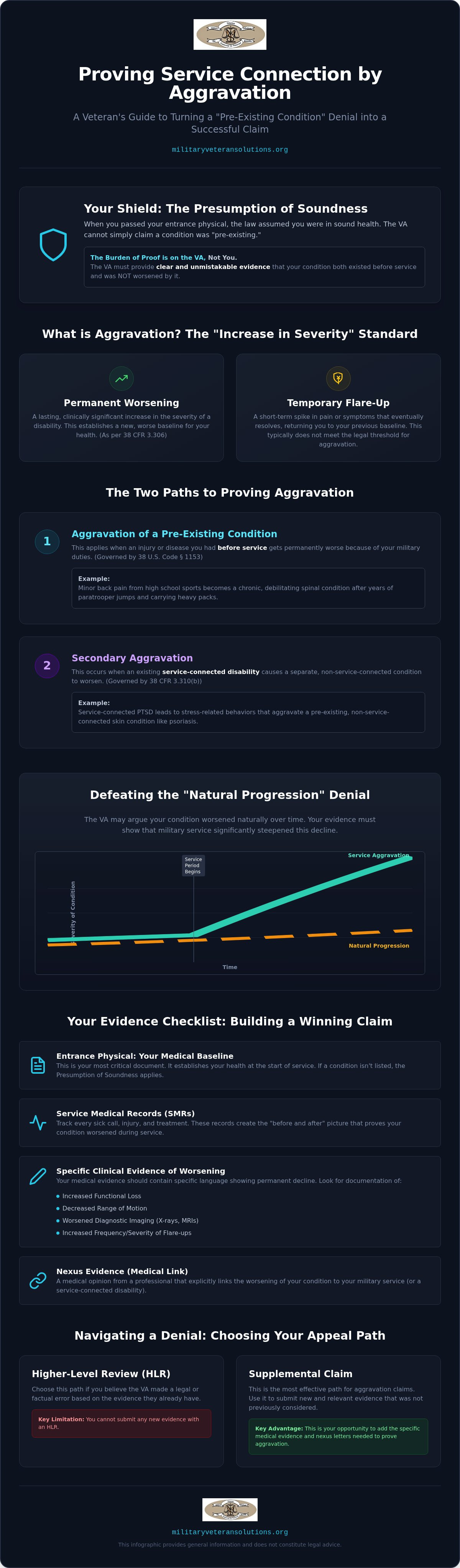
Aggravation isn't just a medical term; it's a legal gateway to the benefits you've earned. Under 38 CFR 3.306, the VA defines aggravation as a permanent increase in the severity of a pre-existing disability. This means that if you entered the military with a minor back issue and left with a chronic, debilitating condition, you may be eligible for service connection by aggravation. It's not enough for a condition to simply hurt more on a cold morning. The change must be clinically significant and lasting.
The Veterans Benefits Administration (VBA) operates under a powerful legal concept known as the "Presumption of Soundness." When you took that oath and passed your entrance physical, the law assumed you were in sound health, except for any conditions specifically noted on your records. If the VA wants to deny your claim by saying your condition was "pre-existing," the burden of proof is on them, not you. They must provide clear and unmistakable evidence that the condition existed before service and that it was not worsened by your time in uniform.
The Legal Framework of 38 CFR 3.306
The VA looks for a permanent worsening of symptoms rather than temporary spikes in pain. A simple flare-up that resolves after a few days of light duty usually won't meet the legal threshold. To win, your medical records should reflect a shift in your baseline health. We look for specific language in your clinical notes, such as "increased functional loss," "decreased range of motion," or "worsened diagnostic imaging," to verify this permanent change. The goal is to show the system that your service left you in a worse state than when you arrived.
Why the Entrance Physical is Your Most Important Document
Your entrance physical is the benchmark for your entire claim. If a condition isn't listed there, the VA must treat it as if it didn't exist when you joined. This creates a high hurdle for the government to clear. If the DoD lost your entrance physical paperwork, don't panic. In these cases, the Presumption of Soundness typically remains intact because the VA cannot prove the condition was pre-existing without that baseline record. The Presumption of Soundness acts as your primary shield, forcing the VA to prove you were "un-sound" rather than making you prove you were healthy.
Service Connection: Pre-Service vs Secondary Aggravation
Establishing service connection by aggravation requires a clear understanding of which legal path applies to your specific situation. The VA treats a condition you had before your first day of boot camp differently than a condition that developed later as a result of your service-connected injuries. Both paths lead to the same goal: securing the compensation you deserve for the health you lost. However, the evidence required to bridge the gap between your military service and your current diagnosis varies significantly between pre-service and secondary claims.
The core of any aggravation claim is the nexus. This is the medical link that proves your military service, or a condition caused by that service, is the reason your health declined. You aren't asking the VA to take responsibility for the entire condition. Instead, you're seeking recognition for the "aggravated portion." The VA calculates this by subtracting the severity of the condition before the aggravation occurred from its current state. If you don't define that baseline clearly, you risk a denial based on "natural progression."
Aggravation of Pre-Existing (Pre-Service) Conditions
This path is governed by 38 U.S. Code § 1153. It applies when a veteran enters the military with a known injury or disease that worsens beyond what would normally be expected. Consider a recruit with minor chronic back pain from high school sports. If that recruit later endures years of paratrooper jumps and heavy rucking, the resulting spinal degradation isn't just "aging." It's a direct result of service. Your Service Medical Records (SMRs) are vital here to show the "before and after" state. When records are sparse, "Statements in Support of Claim" from those who served with you can provide the necessary context to prove your functional decline.
Secondary Aggravation: When One Disability Worsens Another
Secondary aggravation falls under 38 CFR 3.310(b). This occurs when an existing service-connected disability causes a non-service-connected condition to worsen. A common example involves service-connected PTSD aggravating a non-service-connected heart condition. The chronic physiological stress of PTSD can directly impact cardiovascular health, leading to increased severity of heart disease. To win this claim, you must prove "proximate cause." You need a medical expert to explain the biological link and show how the first condition directly impacted the second. Identifying these complex links often requires professional military record reviews to ensure no evidence is overlooked during the filing process.
How the VA Measures Aggravation: The 'Increase in Severity' Standard
The VA doesn't grant benefits simply because a condition exists. They measure the gap between your health at entry and your health today. This "Increase in Severity" standard is the yardstick for service connection by aggravation. To secure a rating, you must demonstrate that the worsening is more than just a temporary spike in pain. It must be a permanent shift in your baseline functional capacity. The VA typically uses the General Rating Formula to evaluate this change, comparing your current symptoms against the diagnostic criteria for that specific condition. If your symptoms now meet a higher percentage threshold than they did at enlistment, you've established the foundation for a successful claim.
The C&P (Compensation and Pension) exam is the primary tool the VA uses for this measurement. It's often the only time a VA-contracted doctor sees you, making it a high-stakes encounter. If the examiner fails to ask about your flare-ups or doesn't use a goniometer to measure your range of motion, the resulting report will be flawed. You must be prepared to describe your "worst day," not just how you feel at the moment of the exam. When the VA measures the aggravated portion of your claim, they are looking for a clear clinical trail that starts with your entrance physical and ends with your current diagnosis.
Natural Progression vs. Service Aggravation
The most common reason for a denial is the "Natural Progression" defense. The VA often argues that your condition would have worsened regardless of your military service. They might claim you're simply "getting older" or point to "intervening causes," such as a post-service injury, to sever the link. This is where clinical precision becomes vital. A specialist's medical opinion can debunk the 'natural progression' argument by citing specific clinical markers that exceed normal age-related decline. This distinction is backed by research, such as the National Academies report on aggravation, which highlights how environmental stressors in the military accelerate physical decline beyond civilian norms.
Documenting Flare-Ups and Functional Loss
Your daily struggle is evidence. The VA is legally required to consider "functional loss" under the DeLuca Criteria. This means they must look beyond a simple range-of-motion test and account for how pain, fatigue, and lack of endurance limit your ability to work. You can't rely solely on a one-time exam to capture this. Use lay evidence to document the increased frequency and intensity of your symptoms. A "Headache Log" or "Pain Journal" provides a chronological record that proves your condition has worsened over time. These documents turn vague complaints into hard data that the VA cannot easily dismiss during the evaluation process.
Addressing the physical limitations caused by functional loss often requires more than just medical care; it may also involve making your home safer and more accessible. To help manage these changes, you can learn more about HomeSafe Living Solutions and their expertise in professional ADA remodels and aging-in-place modifications.
How to Prove Service Connection by Aggravation: A Step-by-Step Strategy
Winning a claim for service connection by aggravation is a forensic exercise. It requires more than just showing you're hurt. You must build a medical bridge between your past health and your present disability. This process is methodical. It demands a level of detail that many veterans overlook when filing on their own. By following a structured strategy, you can transform a denied claim into a successful appeal.
- Step 1: Conduct a forensic audit. Don't just glance at your records. You must scour your Military Service Records and C-File for every mention of your condition.
- Step 2: Establish a baseline. You need to define exactly how severe the condition was before it worsened. This baseline is the starting point for measuring the "aggravated portion."
- Step 3: Secure a high-quality Nexus Letter. This document must contain specific legal language that connects the worsening of your health directly to your service.
- Step 4: Analyze your VA Decision Letter. Identify the exact reason the VA gave for any prior denials. Was it a lack of evidence or a disagreement on "natural progression"?
- Step 5: Submit a Supplemental Claim. Use "New and Relevant" evidence to address the VA's specific concerns rather than just refiling the same paperwork.
Auditing Your Records for Hidden 'Nexus' Evidence
Evidence often hides in plain sight. Search for "sick call" entries that mention a flare-up or a worsening of an old injury. Look for performance reviews or "profiles" that limited your duty because of your physical condition. These documents prove that your condition wasn't static; it was actively interfering with your ability to serve. If you feel overwhelmed by the sheer volume of paperwork, a professional Military Record Review can help uncover the critical links you need to win.
The Anatomy of a Winning Nexus Letter for Aggravation
A weak Nexus Letter is a common cause of denial. To be effective, the letter must use the gold-standard phrase: "at least as likely as not" caused or aggravated by service. Your doctor must explicitly state that they reviewed both your pre-service and post-service medical records. The most important part is the doctor's "rationale." This is where they explain the biological "why" behind the worsening. Without a clear rationale, the VA rater may dismiss the medical opinion as speculative. You need a document that connects the dots so clearly that the rater has no choice but to grant the claim.
Your journey to a fair rating starts with an exhaustive analysis of your history. If you're tired of boilerplate denials, it's time to take a more aggressive, evidence-based approach. We recommend scheduling a virtual consultation to analyze your decision letter and identify the fastest path to a successful appeal.
Navigating Denials: Why Professional Advocacy is Critical for Appeals
Receiving a denial for service connection by aggravation often feels like a door slamming shut. It's not. Most initial denials rely on "boiler-plate" language that ignores the specific nuances of your military history. The VA might claim your condition is simply following its natural course or that there's no evidence of a permanent increase in severity. These are often administrative shortcuts rather than medical realities. You know your body, and you know the toll your service took. Professional advocacy ensures your voice isn't lost in a pile of standardized forms.
The VA has a legal "duty to assist" you in gathering the evidence needed to support your claim. If the rater failed to obtain your private medical records or overlooked specific entries in your C-file, they haven't met their obligation. This failure is a common ground for appeal. It's easy to get stuck in the "hamster wheel" of repeated denials and refilings. Professional representation helps you identify these procedural gaps and forces the system to do its job. Military Veteran Solutions, LLC has spent over 25 years helping veterans break this cycle by identifying the evidence the VA missed.
Analyzing the VA Decision Letter for Errors
Your appeal begins with a surgical review of your denial. You must look for instances where the rater ignored the Presumption of Soundness or dismissed your lay evidence without cause. In many cases, C&P exams are inadequate because the doctor didn't address the specific requirements for service connection by aggravation. If the examiner didn't discuss functional loss or the frequency of your flare-ups, their opinion is legally incomplete. A professional VA Decision Letter Analysis serves as the diagnostic tool you need to pinpoint these errors and build a stronger case.
Building a Comprehensive Appeal Strategy
Choosing the right lane for your appeal is a strategic decision. A Higher-Level Review (HLR) is effective when the evidence is already in your file but the rater made a legal mistake. If you need to introduce a new Nexus Letter that specifically addresses the May 2026 "but for" standard, a Supplemental Claim is the better path. As of June 2026, the average claim processing time is 71.3 days. You don't want to waste those months in the wrong appeal lane. A virtual consultation provides the clarity needed to assess the strength of your evidence before you refile. You deserve an ally who understands the technicalities of the system and remains fiercely committed to your best interests.
Contact Military Veteran Solutions, LLC for a professional record review and advocacy.
Secure the Rating Your Service Deserves
Proving service connection by aggravation is about holding the system accountable to the legal standards designed to protect you. By leveraging the Presumption of Soundness and focusing on clinical evidence of worsening, you can overcome "natural progression" denials. Your military history contains the forensic evidence needed to bridge the gap between your entrance physical and your current diagnosis. You don't have to navigate this administrative maze alone.
Military Veteran Solutions, LLC was founded by a 10-year Army veteran to provide the dedicated advocacy you deserve. With over 25 years of experience, we specialize in identifying the hidden "Nexus" evidence that turns a denial into an approval. We offer nationwide virtual representation to ensure every veteran has access to expert record reviews and decision letter analysis. It's time to stop fighting the system and start winning the benefits you earned through your service.
Schedule your virtual consultation with a veteran advocate today. You've already done the hard work of serving your country. Let us handle the heavy lifting of your appeal.
Frequently Asked Questions
Can I get VA disability for a condition I had before I joined the military?
Yes, you can receive compensation for conditions that existed prior to your enlistment. This process is known as service connection by aggravation. If your military duties caused a permanent increase in the severity of a pre-existing condition, the VA is legally required to compensate you for that worsening. You must establish a clear baseline from your entrance physical to show the extent of the change.
What does 'aggravated by service' mean in VA terms?
Aggravated by service means a condition has undergone a permanent increase in disability severity beyond what is expected from natural progression. It isn't enough for symptoms to temporarily flare up during a deployment or training exercise. The change must be a lasting shift in your clinical baseline that can be measured through functional loss, increased frequency of symptoms, or diagnostic testing.
How do I prove my service-connected PTSD made my other condition worse?
You must establish a "but for" standard of causation to link your conditions. This involves providing medical evidence that your secondary condition would not have reached its current severity "but for" the impact of your service-connected PTSD. A medical professional must explain the biological link, such as how chronic stress hormones from PTSD worsened a cardiovascular issue or interfered with necessary treatments.
What is the 'Presumption of Soundness' and how does it help my claim?
The Presumption of Soundness is a legal assumption that you were in sound health when you entered the military. Unless a condition was specifically noted on your entrance physical, the VA must treat you as having been healthy. To deny your claim, the VA carries the heavy burden of providing clear and unmistakable evidence that your condition was not aggravated by your military service.
What if the VA says my condition is just 'natural progression'?
You must rebut the "natural progression" argument with a specific medical opinion from a specialist. This expert should identify clinical markers that prove your condition worsened faster or more severely than expected for a civilian of the same age. This evidence shifts the focus from simple aging to the specific environmental stressors and physical rigors you encountered during your time in uniform.
Do I need a Nexus Letter to prove service connection by aggravation?
A Nexus Letter is highly recommended for these complex claims. It provides the essential medical rationale that links the worsening of your health directly to your time in uniform. While lay evidence like buddy statements is helpful for documenting symptoms, a doctor's opinion using the "at least as likely as not" standard is often the evidence that secures a claim approval.
How much does the VA pay for an aggravated service-connected disability?
Compensation rates depend on your total disability rating. Effective December 1, 2025, monthly rates for a veteran with no dependents range from $180.42 for a 10% rating to $3,938.58 for a 100% rating. For pre-service conditions, the VA calculates your payment by determining the current severity of the disability and then subtracting the degree of disability that existed at the time of enlistment.
What is the difference between direct service connection and service connection by aggravation?
Direct service connection applies to injuries or illnesses that began while you were on active duty. In contrast, service connection by aggravation applies to conditions that existed before you joined or were worsened by an existing service-connected disability. The key difference lies in the evidentiary requirement to show a permanent increase in severity rather than just an initial occurrence during your service.


