

A current GERD diagnosis may not be enough to establish a VA claim. If you’re trying to understand how to service connect GERD, the central question is whether the evidence links your condition to military service or to an already service-connected disability. That connection can be difficult to show when symptoms began gradually, weren’t documented during service, or may relate to medication or another condition.
Medical records can establish that you have GERD, but your claim also needs evidence supporting the connection you’re asserting. This guide explains the difference between direct and secondary service connection and how records, treatment history, and personal statements can help clarify when symptoms began and why they developed.
You’ll also learn how to organize evidence from your service and medical history, what to examine if VA denies the claim or overlooks key information, and how a review of your records and decision letter can help you identify next steps.
Key Takeaways
- Understand why a GERD diagnosis alone may not establish the required connection to military service.
- Compare direct and secondary service connection to identify which theory may fit your claim.
- See how service records, treatment history, and a clear symptom timeline can support your account of how to service connect GERD.
- Organize evidence and keep your claim narrative consistent with your records.
- If VA denies your claim, review the decision to see whether it addressed your diagnosis, service history, and evidence linking the two.
How GERD Service Connection Works in a VA Disability Claim
GERD service connection means VA recognizes that a veteran’s current GERD is related to qualifying military service. A diagnosis can establish that you have the condition, but it doesn’t, by itself, show why it developed or connect it to service. Your claim needs relevant evidence that supports the relationship you’re asserting.
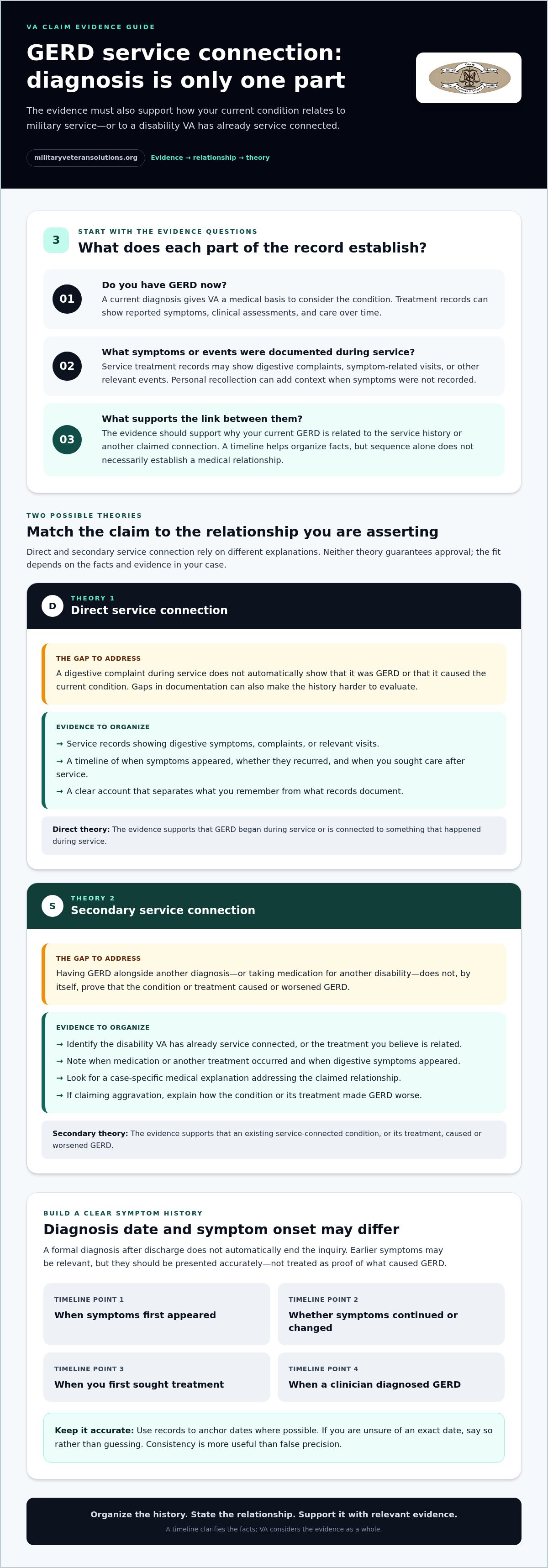
Think of the evidence as answering three questions: Do you have GERD now? What symptoms or events were documented during service? And what supports a link between your current condition and that service history? Separating these questions can help you identify what your records establish and where your explanation may need support.
This video on types of VA service connections explains the basic framework:
What a GERD service-connection claim needs to show
A current diagnosis gives VA a medical basis to consider the condition. Treatment records can also show how GERD has been documented over time, including reported symptoms, clinical assessments, and care received. For general background on the condition, see this Gastroesophageal Reflux Disease (GERD) Overview.
Next, review your service history. Service treatment records may document digestive complaints, symptom-related visits, or other relevant events. Not every symptom will appear in a medical record, so a careful account of what you remember can provide context. Include approximate timing and whether you sought care, and distinguish what you recall from what the records document.
The remaining question is the connection. Evidence should support why your current GERD is related to the service history you describe. A timeline can organize the facts, but a sequence of events alone doesn’t necessarily establish a medical relationship. VA considers the evidence as a whole.
Why a diagnosis after discharge does not automatically end the inquiry
The date of diagnosis and the beginning of symptoms are not always the same. You may have received a formal diagnosis after leaving service but recall earlier symptoms. That history may be relevant, but it should be presented accurately rather than treated as proof of what caused GERD.
Build a straightforward timeline. Note when symptoms first appeared, whether they continued or changed, when you first sought treatment, and when a clinician diagnosed GERD. Use records to anchor dates where possible. If you’re unsure of an exact date, say so instead of guessing. Consistency is more useful than false precision.
A delayed diagnosis does not automatically qualify a claim for service connection. The key question is whether the evidence supports the claimed relationship, not simply whether symptoms appeared before a diagnosis. Understanding how to service connect GERD starts with identifying what each piece of evidence can establish and what it cannot.
Direct or Secondary GERD Service Connection: Which Theory Fits?
Direct service connection links GERD to an event, circumstance, or symptoms during military service. Secondary service connection links it to a disability VA has already service connected or to treatment for that disability. Neither theory guarantees approval. The right fit depends on the facts and evidence in your case.
Use this comparison to identify what your claim needs to explain:
- Direct theory: The evidence supports that GERD began during service or is connected to something that happened during service. Relevant records may include in-service complaints or treatment, along with a timeline connecting symptoms during service to the later diagnosis.
- Secondary theory: The evidence supports that an existing service-connected condition, or its treatment, caused or worsened GERD. The connection needs support specific to your medical history, not just the fact that both conditions are present.
When a direct GERD claim may fit
A direct theory may be worth examining if service records document digestive symptoms or medical visits during active service. Line up those records with your timeline: when symptoms appeared, whether they recurred, and when you sought care after service. This can help identify a possible connection for VA to evaluate, but an in-service complaint does not automatically establish that it caused a later diagnosis.
Gaps in documentation don’t automatically settle the question, but they make a clear, consistent account especially useful. Note what you remember and distinguish personal recollection from details supported by records. For example, a record of a visit for digestive discomfort can establish that you sought care at that time. On its own, it may not show that the symptoms were GERD or caused your current condition. The full record matters.
When to consider GERD secondary to a service-connected condition
Consider a secondary theory if you already have a service-connected condition and believe it, or treatment for it, contributed to your GERD. For example, you might take medication for another disability and notice digestive symptoms during that treatment. The timing can help frame the question, but medication use alone doesn’t prove causation. A case-specific medical explanation can address whether the treatment or primary condition is connected to GERD.
The same care applies when considering another diagnosed condition, including PTSD, anxiety, or asthma. Having another diagnosis alongside GERD doesn’t automatically show that one caused or worsened the other. Identify the precise relationship you’re claiming, then look for records and medical reasoning that address it. If the claim concerns aggravation, the evidence should support how the service-connected condition or its treatment made GERD worse, rather than simply showing that both conditions exist.
To determine which theory best matches your history, compare the dates of symptoms, diagnosis, treatment, and the primary condition’s service-connection history. A focused review of service records and medical documentation can help clarify which theory the evidence supports and where the explanation may need strengthening. That’s a practical starting point for deciding how to service connect GERD without treating any single detail as proof on its own.
Evidence That Can Help Connect GERD to Military Service
Build your evidence around what it can establish, not simply how many documents you can collect. A useful GERD claim connects three parts: medical records showing the current condition, service records and credible recollections describing relevant history, and evidence supporting the specific relationship you’re claiming. For a direct theory, that means a connection to service. For a secondary theory, it means a connection to an already service-connected condition or its treatment.
These records can work together. A service note might document digestive complaints, later treatment records may show continuing symptoms, and a medical opinion may explain whether the history supports a relationship. Each item has limits on its own. Read them as a timeline, and note what each one does and does not show.
- Current condition: A diagnosis, treatment notes, medication history, and relevant diagnostic results can document how GERD has been identified and managed.
- Service history: Service treatment records and other military records may show symptoms, medical visits, exposures, or circumstances relevant to the theory you’re pursuing.
- Medical relationship: A reasoned medical opinion may help explain how the documented history relates to current GERD, particularly when the relationship isn’t self-evident.
Medical and service records to review
Gather post-service records that identify GERD, describe symptoms, or document treatment over time. Include medication history if your theory involves treatment for another service-connected disability. Then review service records for related complaints or visits, even if they don’t use the diagnosis you received later. The absence of an entry doesn’t decide the claim by itself, but it makes the remaining evidence and explanation important to review carefully.
Diagnostic tests may be relevant when they appear in your medical history, but no single test should be treated as a universal requirement for every claim. Focus on obtaining records that help explain your condition and the chronology of care.
Symptom statements and medical opinions
Your statement can add context that clinical notes may not capture: approximate onset, recurring patterns, changes over time, and when you sought care. Keep it consistent with known dates and records. If you don’t remember an exact date, describe the timing honestly rather than guessing. A symptom timeline can clarify the history, but it doesn’t independently establish medical causation.
When the link between GERD and service, a primary condition, or its treatment isn’t obvious, a medical opinion may help address that question. A useful opinion should engage with the relevant history and explain its reasoning, rather than merely repeat that the conditions exist. Match the evidence to the theory: service-era symptoms and later continuity may inform a direct claim, while records about a service-connected condition, its treatment, and GERD may inform a secondary claim.
Records can be overlooked or difficult to interpret in isolation. A professional military record review service can help identify potentially relevant details and place them alongside medical documentation. This organized approach can make it easier to assess how to service connect GERD based on the evidence your particular claim needs.
How to Prepare and Submit a GERD Service-Connection Claim
A clear claim gives VA a focused explanation to evaluate. Before submitting, decide which service-connection theory fits your history, gather records that support it, and check that your written account matches the dates and details in those records. An organized file can make the relationship you’re claiming easier to understand, though no particular format or set of documents guarantees an outcome.
Build a clear claim narrative from your records
Start with the theory. For a direct claim, explain how your evidence connects GERD to symptoms, events, or circumstances during service. For a secondary claim, identify the service-connected condition or its treatment and explain the relationship you’re asking VA to consider. Then assemble a dated timeline covering relevant service events, symptom history, diagnosis, and treatment.
Use the timeline to check consistency across your claim narrative, medical records, and supporting statements. If a record gives a different date or leaves a gap, address it honestly rather than changing your account to make the history appear seamless. Distinguish what the records document from what you recall. Clear, accurate context is more useful than overstating what any one record proves.
Before filing, review the packet as a whole. Ask whether each piece supports the theory you selected and whether your claim explains why that evidence matters. This preparation can help you present how to service connect GERD as a specific, evidence-based claim rather than a collection of disconnected documents.
Prepare for VA review and an examination
VA may review your records, request additional information, arrange an examination, or take more than one of these steps. Follow the instructions in any VA notice carefully, including directions about providing information or attending an examination. Filing and examination procedures can change, so use current official VA guidance for the requirements that apply to your claim.
If you attend an examination, describe your history accurately. Be prepared to discuss when symptoms began, how they have changed, what treatment you’ve received, and how the condition affects your daily activities. Don’t guess at dates or minimize symptoms, but don’t exaggerate them either. If you’re uncertain about a detail, say so. Your answers should align with the records while still reflecting your experience.
After submitting, keep copies of what you sent and any VA notices or decisions you receive. If VA says the claim needs further review or you disagree with the outcome, identify the specific issue and follow current VA instructions for the next step. If an appeal is appropriate, this VA appeals filing guide can help you understand the process.
Military Veteran Solutions, LLC reviews service records and medical documentation to help veterans organize evidence around their claim theory. A careful review can help clarify what your materials show and what questions may still need attention. Learn more about a review of your GERD claim evidence.
GERD Claim Denied? How Advocacy Can Help
A denial can feel like a final answer, but it’s also a decision you can examine. Start with the reason VA gives and the evidence it discusses. The explanation may point to a missing current diagnosis, insufficient information about service, or a gap in the claimed medical relationship. Each issue calls for a different next question, so review the decision letter before concluding why VA denied the claim.
Read the decision for the actual reason VA gave
Separate VA’s findings from your own interpretation. Check whether the decision recognizes your GERD diagnosis, addresses the relevant service history, and discusses the direct or secondary relationship you claimed. Note which records VA considered and whether it explains why particular evidence did or didn’t support the claim.
Look for a specific gap. If the decision accepts that you have GERD but finds no link to service, the issue may differ from a decision that questions the diagnosis itself. If VA doesn’t appear to address a key record or the theory you raised, note that carefully. Don’t choose a review option based only on a general description of appeal routes. Available options, requirements, and deadlines depend on current VA rules and your decision, so verify them promptly using official VA guidance.
Get focused support reviewing records and the decision
A careful review puts the decision alongside your military records, medical documentation, and claim narrative. That comparison can help clarify whether VA identified a missing diagnosis, overlooked relevant service evidence, or found the medical explanation insufficient. It can also show whether the decision addressed the theory you claimed, rather than a different relationship.
Keep the decision letter and the records VA relied on together. Mark each stated reason for denial, then connect it to relevant evidence or identify what question remains unanswered. This makes the next step more focused, whether you’re gathering additional evidence or considering a review or appeal. For broader information on available claim support, consult this VA claim assistance resource guide.
Understanding how to service connect GERD also means knowing how to respond when VA’s explanation doesn’t match your evidence. Military Veteran Solutions reviews VA decisions, service records, and medical documentation to help veterans assess what the decision says and what may need attention. A review can clarify the issues, but it can’t guarantee a particular result.
For individualized guidance, request a virtual consultation to discuss your GERD claim and decision letter. Bring the decision and relevant records so the discussion can focus on the reasons VA gave and the questions you need answered.
Take the Next Step With a Clear Plan
Uncertainty can make a VA claim feel harder to move forward. You don’t have to resolve every question at once. Focus on the next one: what does your evidence establish, and what still needs clarification? An evidence-led approach can help you make informed decisions about how to service connect GERD without overstating what your records prove.
Military Veteran Solutions, LLC was founded by a disabled veteran who served ten years in the U.S. Army. To discuss your next steps, request a virtual consultation about your VA claim. Bring your decision letter and relevant records so the conversation can focus on your claim and the evidence that supports it.
Frequently Asked Questions
Is GERD a presumptive condition for veterans?
Don’t assume GERD qualifies for presumptive service connection based only on a diagnosis or where you served. Presumptive eligibility depends on current VA rules and your circumstances, so verify any potentially applicable category through official VA sources. If no presumption applies, that doesn’t necessarily end the inquiry. VA may still consider a direct or secondary claim when the evidence supports the claimed relationship.
Can I service connect GERD if it was diagnosed after I left the military?
Yes. A post-discharge diagnosis doesn’t by itself disqualify a claim, but it also doesn’t prove service connection. For example, a later diagnosis may follow earlier treatment notes describing digestive complaints without naming GERD. Those records can help explain the history, while a qualified medical opinion may address whether the evidence supports the claimed link. VA evaluates the full record rather than relying on diagnosis timing alone.
Do I need an endoscopy to file a VA claim for GERD?
No single diagnostic test, including an endoscopy, should be assumed necessary for every GERD claim. The records and testing relevant to your case depend on your medical history and the evidence available. A treating clinician decides what evaluation is appropriate for your health. For claim-specific documentation requirements, consult current official VA guidance. An article about benefits isn’t a substitute for medical advice or individualized care.
Can medication for another service-connected condition cause GERD?
Medication effects may be relevant to a secondary claim, but taking a medication doesn’t establish that it caused GERD. The evidence needs to address the relationship in your individual case, potentially through treatment records and a reasoned medical opinion. Don’t stop, change, or skip prescribed medication based on a possible claim connection. Discuss concerns about side effects or treatment with your clinician, who can advise you about your care.
What if my service records do not mention heartburn or reflux?
A missing in-service notation doesn’t automatically decide the outcome of your claim. Be precise about what your records show and what you remember, and avoid presenting recollection as a documented medical visit. For example, a personal statement may describe when symptoms occurred, while later treatment notes may show when you first sought care. VA considers the evidence as a whole, but no single type of evidence guarantees that a gap will be overcome.
What should I do if VA denied my GERD service-connection claim?
Start by identifying the reason in the decision letter and checking which records VA considered. Note whether the stated concern involves the diagnosis, service history, or evidence of a medical relationship. The next step depends on the decision and current VA review rules, including applicable deadlines. Verify options through official VA guidance before acting. A focused review of the decision and records can help clarify what issue needs attention.


