
What if a confusing VA decision letter is only one piece of the picture? Unfamiliar reasoning, scattered service records, and medical documents can make it hard to see what supports your claim and what still needs attention. A professional VA claim review brings those pieces together so you can better understand the evidence and your options.
It’s reasonable to want clarity before filing or responding to a decision. A careful review examines your military service records, VA decision details, and medical documentation, then identifies what the file supports, where details may be unclear, and which questions deserve attention. It can’t guarantee a particular result, but it can give you a more informed basis for deciding what to do next.
In this article, you’ll learn which records and decision details matter, how a review can help at different stages of a claim, and what next steps to consider. Military Veteran Solutions connects those records through veteran claims representation and VA decision letter analysis, with virtual consultations available nationally. The goal is a clearer picture of your file, not false certainty.
Key Takeaways
- A professional VA claim review connects service records, VA decisions, and medical documentation to assess the claim as a whole.
- A structured review can help you spot inconsistencies, missing context, and evidence that may need closer attention.
- Separate documented observations from questions that require additional evidence or qualified input before deciding what to do next.
- Your next-step considerations depend on whether you’re preparing a claim, responding to a decision, or considering further review.
- Connected records analysis can inform claims or appeals advocacy, but it cannot guarantee a particular outcome.
What does a professional VA claim review examine?
A professional VA claim review is a structured examination of military service records, VA decisions, and relevant medical documentation. Instead of treating each document in isolation, the reviewer considers how they relate: what the records say about service, how the VA explained its decision, and what the medical documents describe about the claimed condition. This helps clarify what the file currently shows and what questions remain.
The United States Department of Veterans Affairs administers disability compensation among other benefits. A review focuses on the evidence and reasoning connected to an individual claim, rather than predicting what the VA will decide. To see how claims consulting is discussed, watch this video:
The purpose is evidence analysis, not online claim tracking. A professional VA claim review can help you understand the documents in your file, identify potential gaps or inconsistencies, and frame questions for the next step. It can inform decisions before filing, after receiving a decision, or while considering an appeal-related option. It cannot guarantee approval or a particular disability rating.
How a claim review differs from checking VA claim status
VA.gov status information is a process-tracking resource. It can show where a claim or decision review is in the process and may display some evidence filed with it. That’s useful for following progress, but it doesn’t explain whether the evidence supports the claim or how the VA’s reasoning relates to the records.
Claim tracking shows where a case stands; professional evidence analysis examines what the records and decision say. For example, a status tool might show that a review is underway, while a records review compares the decision’s explanation with the service and medical documents available.
When veterans may seek a professional review
Before submitting a claim, you may be unsure which records are relevant or whether the available documentation addresses the issue you’re claiming. After a decision, unfamiliar terms or reasoning can raise questions about what the VA considered and what may need attention. In either situation, a review can organize the information without treating a possible evidence gap as a prediction of the outcome.
To prepare, gather the decision letter, relevant service records, and medical documentation. Note the specific questions you want answered, such as which records relate to a finding in the decision or what part of its reasoning is unclear. A reviewer can use those materials to distinguish what appears documented from where context may be missing and which issues call for closer examination. If you’re weighing appeal-related options, the VA appeals guide offers broader guidance to consider alongside a review of your own records.
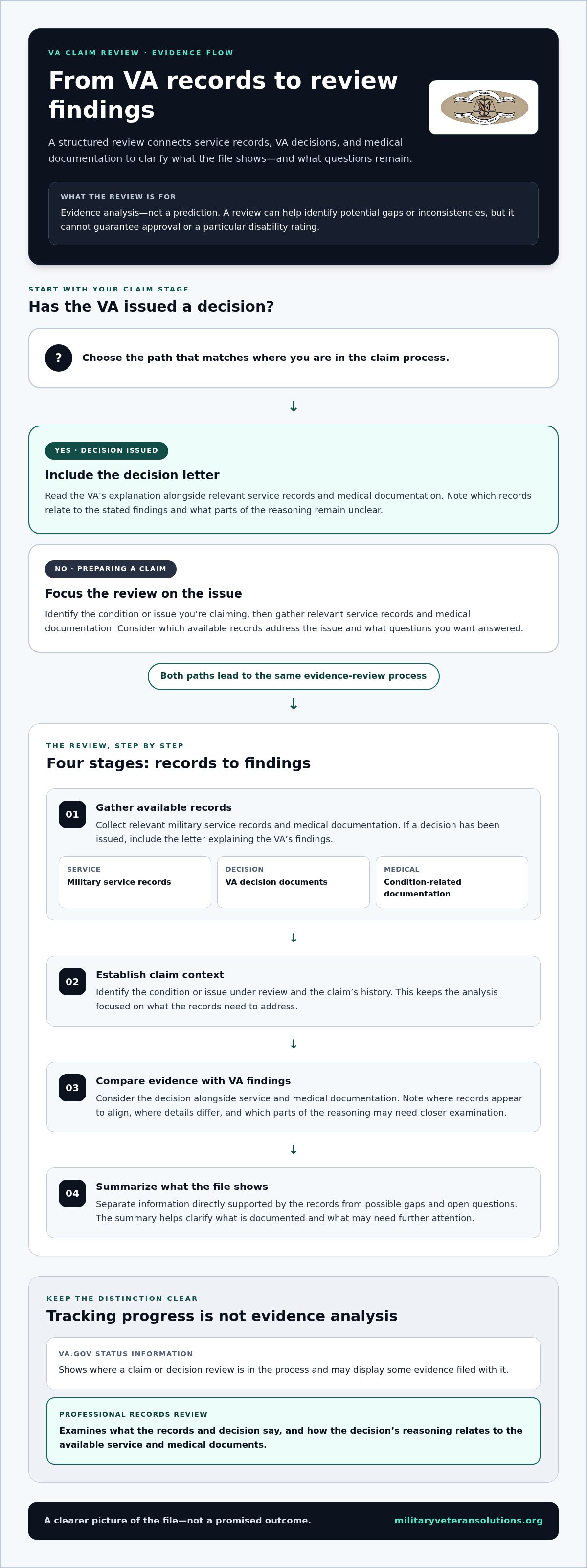
How a professional VA claim review works, from records to findings
A professional VA claim review turns a set of documents into an organized picture of the claim. The work is not simply reading each record separately. It involves identifying the claim issue and history, comparing relevant records with the VA’s stated reasoning, and distinguishing what the file documents from what still needs clarification.
A claim review gathers the relevant records, sets them in context, compares them with the VA’s findings, and summarizes documented strengths, gaps, and open questions. The materials and focus depend on the claimed condition and where the claim stands. The aim is a clearer basis for considering next steps, not a promised result.
- Gather available records. Collect relevant military service records, VA decision documents, and medical documentation. If a decision has been issued, include the letter explaining the VA’s findings.
- Establish claim context. Identify the condition or issue under review and the claim’s history. This keeps the analysis focused on what the records need to address.
- Compare the evidence. Read the decision alongside service and medical documentation. Note where the documents appear to align, where details differ, and which parts of the reasoning may need closer examination.
- Summarize findings. Separate information directly supported by the file from possible gaps or questions. A clear summary helps you understand what is known and what may require further attention.
Which documents inform the review?
Relevant materials may include military service records, VA decision documents, and medical documentation connected to the claimed condition. A decision letter shows the VA’s explanation; service records provide context about military service; and medical documents may describe a condition or its history. No single record is automatically required or sufficient in every case. The useful documents depend on the claim and its history. The VA’s VA Disability Benefits page provides official information about applying for and managing disability compensation.
How reviewers connect evidence to VA findings
A reviewer compares what the decision says with what the available documents show. For instance, if a decision discusses a particular issue, the review can identify records that appear relevant to that explanation and flag details that seem unclear or absent from the file. That observation does not, by itself, establish that the VA made an error. It helps distinguish documented facts from matters that may call for further consideration.
As you gather records, keep notes that identify each document and, if known, its date or subject. Add the question it raises, such as how a record relates to a particular finding. This makes it easier to discuss the file and avoids treating an unanswered question as a settled conclusion. For a closer look at service documentation, the professional military record review guide explores how those records can inform a claim.
If you want support organizing military records, VA decisions, and medical documents into a connected review, Military Veteran Solutions’ claim review support can help you discuss the records and questions that matter to your situation.
What a VA claim review can reveal and what it cannot promise
A careful review can make the contents of a claim easier to understand. It may identify relevant records already in the file, differences between documents, missing context, or questions that deserve further investigation. These are useful findings, but they are not proof that every requirement for a benefit has been met.
For example, a medical record may document a condition while other questions about the claim remain unresolved. A review can point out what that record says and how it relates to other documents. It should distinguish that observation from a conclusion that requires additional evidence or qualified input.
Evidence strengths and gaps are not the same as a guaranteed outcome
A document can be relevant without establishing every point at issue. Its meaning may depend on the claim history, other evidence, and the VA’s assessment. The VA makes the official benefits determination; a reviewer can analyze the file and explain observations, but cannot decide the claim on the VA’s behalf. The official How to File a VA Disability Claim page describes the VA’s process for reviewing claims and making decisions.
Evidence analysis can inform advocacy by identifying documented support and unresolved questions, but it cannot guarantee approval, a rating, or any other particular decision. Keep that distinction in view, especially when a review identifies a potentially important record. Finding evidence is not the same as knowing how the VA will weigh it.
| Area | What it means |
|---|---|
| Review findings | Observations about records, inconsistencies, missing context, or questions that may warrant follow-up. |
| VA determinations | The VA’s official decisions about benefits, based on its evaluation of the claim. |
| Outcomes outside a reviewer’s control | Whether the VA grants a claim, assigns a particular rating, or reaches another result. |
How to understand review findings responsibly
Read a review summary in two categories: what the records show and what remains uncertain. A date or statement quoted from a document is a record detail. A question about whether the file fully addresses an issue is a prompt for further attention, not a confirmed defect or a prediction.
Next steps depend on the decision, the evidence available, and the VA process that applies to your circumstances. A review may help you organize questions, understand the reasoning in a decision, or consider whether further action warrants exploration. Don’t treat an identified strength as a promise of success, or a possible gap as proof that a claim cannot succeed. A professional VA claim review is most useful when it gives you a clear, grounded understanding of the file while being candid about what remains undecided.
How to use review findings for your next VA claim step
Review findings are most useful when you connect them to where you are in the process. A claim that hasn’t been filed raises different questions from a claim with a decision or one where you’re considering another review. Start with the decision letter, if you have one, and the evidence available. Note what the VA said, which documents appear relevant to each point, and what remains unclear.
| Your situation | Questions to consider | Possible focus |
|---|---|---|
| Claim not yet filed | What records relate to the claimed condition? What questions remain about the available documentation? | Organize relevant evidence and identify issues to clarify before filing. |
| Decision received | What reasons does the decision give? Which documents address those points? | Understand the VA’s explanation and identify questions for further consideration. |
| Further review under consideration | What does the decision and claim history show? What evidence or review process may be relevant? | Discuss the circumstances and applicable process before choosing a next step. |
Questions to resolve before choosing a next step
Separate requests for clarification from decisions about filing or pursuing review. Write down the decision’s stated reasoning in your own words, then list the documents that appear to address each point. Mark anything uncertain as a question, not a proven error. This creates a more focused basis for discussion without assuming what the VA should decide.
A professional VA claim review can help organize those questions, but the appropriate next step depends on your specific decision, evidence, and claim history. Avoid relying on a hypothetical example as a personal recommendation. Also pay attention to any applicable time limits and use official VA information when confirming process requirements.
How review relates to VA decision-review options
For eligible decisions, the available options may include a Higher-Level Review, a Supplemental Claim, or an appeal to the Board of Veterans’ Appeals. These are distinct paths, and the evidence available and circumstances of the decision can affect which one may fit. A review can help clarify relevant facts and questions, but it doesn’t select an option for every veteran or guarantee a result. The VA appeal representation guide covers the process in greater detail.
Bring your decision letter, relevant records, and a short list of questions to a discussion about next steps. Military Veteran Solutions reviews VA decisions alongside military records and medical documentation to support informed claims or appeals advocacy. Discuss your VA claim review needs through a virtual consultation.
How Military Veteran Solutions supports a professional VA claim review
Military Veteran Solutions brings military service records, VA decisions, and medical documentation into one connected review. The process considers the available records in context, the VA’s stated reasoning when a decision has been issued, what the file documents, and which questions remain. This review can inform a claim or appeal strategy, but it cannot guarantee approval, a particular rating, or another specific outcome.
A veteran-founded perspective grounded in claim advocacy
Military Veteran Solutions was founded by a disabled veteran who served ten years in the U.S. Army. That background informs a respectful approach to reviewing service and benefits records. VA paperwork can feel difficult to interpret, especially when you’re already managing questions about a claim. The focus is on listening to your concerns and examining the records carefully, without overstating what the evidence can establish.
A professional VA claim review can be useful at different points, whether you’re organizing information before filing or trying to understand an existing decision. Military Veteran Solutions reviews the documents together rather than treating a service record, medical document, or decision letter as the whole story. Findings can help shape informed claims or appeals advocacy, including identifying questions that may need attention. The VA remains responsible for making the official decision.
To make a discussion more focused, gather the materials you have and note what you want clarified. You might prepare:
- Military service records that relate to the claim.
- Any VA decision letter or other decision documents you’re reviewing.
- Medical documentation relevant to the claimed condition.
- A short list of questions, including details in the decision or records that you don’t understand.
You don’t need to resolve every uncertainty before discussing the file. Gathering these items makes the claim’s context easier to understand and helps focus the conversation on the questions that matter to you. If a document is unavailable or a finding raises a new question, note that clearly rather than assuming what the missing information would show.
Taking a clear next step with professional support
Military Veteran Solutions offers virtual consultations to veterans across the United States. This gives you a practical way to discuss your records and claim circumstances from wherever you are. Bring the documents you can access and your questions. A connected review can clarify what is documented, what needs further consideration, and how findings may inform representation or appeal support. No review can remove uncertainty about a future VA decision, but understanding the file can help you approach the next step with better-informed questions.
If you’re ready to discuss your claim circumstances and explore representation, explore VA claim review and representation.
Move Forward With a Clearer Plan
You don’t have to resolve every question about your claim before taking a next step. Start by naming what you need clarified, then use that focus to guide a conversation about your options. A professional VA claim review can help turn uncertainty into specific questions to consider, while leaving the official decision where it belongs: with the VA.
Military Veteran Solutions offers a way to discuss your claim circumstances and explore representation without treating any outcome as certain. Bring the records and decision details you have, along with the questions you want answered. A focused discussion can help you approach what comes next with greater understanding and purpose.
Explore VA claim review and representation, and take the next step with a clearer sense of direction. You deserve support that treats your claim and your questions with care.
Frequently Asked Questions
Is a professional VA claim review the same as checking claim status?
No. A professional VA claim review examines the substance of claim documents, while a status check helps track where a submission is in the process. For example, a status update may show that evidence was received; it won’t explain how a particular record relates to the VA’s reasoning. Use status information to follow progress, and evidence analysis to understand what the documents may show.
Can a professional VA claim review guarantee approval?
No. A review can help you understand the records and identify questions to consider, but the VA makes the official benefits decision. The reviewer can’t control how the VA evaluates the evidence or what decision it reaches. Be cautious of anyone presenting a review as a promise of approval, a particular rating, or another specific result. Its value is clearer information, not certainty about the outcome.
What should I have ready for a VA claim review?
Bring the documents you have that relate to the claim, such as a VA decision letter, relevant service records, and medical documentation. If you’ve filed before, include prior claim or review decisions that help explain the history. Write down the questions you want answered, such as which part of a decision you don’t understand. If a record is missing, note that too; you can still discuss the available information.
Can I seek a professional VA claim review before filing?
Yes. You can discuss a potential claim before submitting it, even if you’re still organizing documents or deciding what questions to ask. A review may help you understand how the records you already have relate to your concerns and identify matters that need clarification. It doesn’t determine that a claim is complete or predict how the VA will decide it. Use the discussion to make informed preparations.
Does a professional VA claim review include medical treatment?
No. A claim review examines documentation for benefits advocacy; it isn’t medical care, diagnosis, or treatment. If you have questions about symptoms, diagnosis, or care, raise those with a healthcare professional. Medical documentation may be considered as part of the claim file, but reviewing it for claim purposes doesn’t replace clinical evaluation. Keep medical care decisions separate from questions about how records relate to a VA claim.
Can a review help if my military records are incomplete?
Yes. A review can examine the records that are available and help identify which details appear documented and where information is missing or unclear. It can also help you form specific questions about the gaps, such as a date or service event you’re trying to clarify. A review can’t recreate missing records or guarantee that other evidence will resolve an issue, but incomplete files can still be assessed.
What is the difference between a Higher-Level Review and a Supplemental Claim?
A Higher-Level Review asks for another review of the decision based on the evidence already considered, while a Supplemental Claim is used to submit or identify new and relevant evidence for consideration. They serve different purposes, so the decision details and evidence available matter. This is a general distinction, not a recommendation for your circumstances. Review the decision and applicable VA instructions before selecting an option.


