
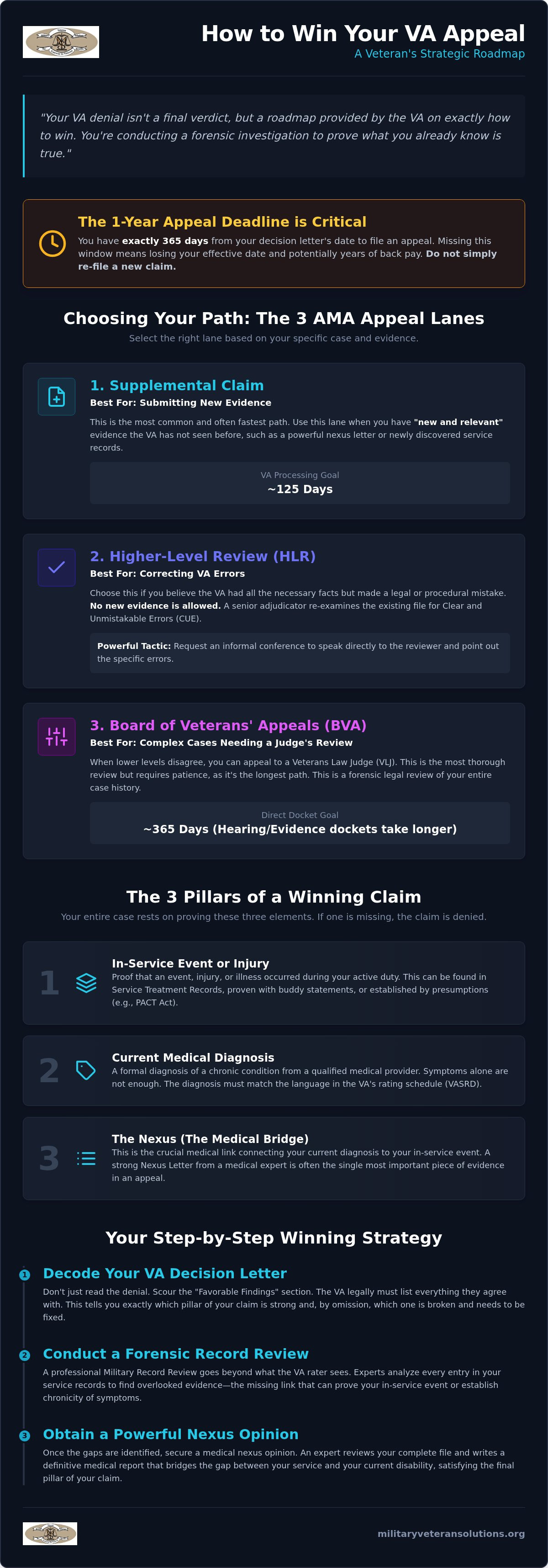
What if your VA denial wasn't a final verdict, but actually a roadmap provided by the VA on exactly how to win? Most veterans see a denial letter and feel defeated by the weight of complex jargon and the prospect of even longer wait times. However, understanding how to win a VA appeal in 2026 requires a shift in perspective. You aren't just fighting a bureaucracy. You're conducting a forensic investigation into your own history to prove what you already know is true.
It's exhausting when the system ignores the connection between your current pain and the events of your service. We understand that feeling of being overlooked by the very institution meant to support you. This guide provides a veteran-led strategy for overturning denials and securing your earned disability benefits through precise advocacy. You'll learn which of the three AMA appeal lanes fits your specific case and how a professional Military Record Review acts as a secret weapon to validate your claims. We're providing the roadmap to a 100% rating so you can finally move forward with the security and relief you deserve.
Key Takeaways
- Navigate the Appeals Modernization Act (AMA) framework and meet critical deadlines to preserve your effective date and potential back pay.
- Master the three pillars of the "Caluza Triangle" to ensure your claim meets every requirement for a successful service connection.
- Use the "Favorable Findings" in your VA decision letter as a tactical guide to pinpoint and fix the specific gaps in your previous evidence.
- Learn the specific steps for how to win a VA appeal by conducting a forensic military record review and obtaining powerful nexus opinions.
- Shift from simply filing forms to building a strategic case through expert advocacy that bridges the gap between your service and your current disability.
Understanding the VA Decision Review Process in 2026
Winning a VA appeal isn't about asking for a second chance. It's about correcting a record that is currently incomplete or inaccurate. Since the implementation of the Appeals Modernization Act (AMA), veterans have three distinct paths to challenge a denial. The most critical rule is the one-year deadline. You have exactly 365 days from the date on your decision letter to file an appeal. If you miss this window, your effective date disappears, and you could lose years of back pay. Many veterans make the mistake of simply re-filing a brand new claim. Don't do this. Re-filing creates a new effective date, essentially forfeiting the money the VA owes you from your original filing. Learning how to win a VA appeal starts with choosing the right lane for your specific situation.
The Supplemental Claim Lane: When You Have New Evidence
This is the most common path for veterans who have discovered a missing link in their evidence. To win here, you must provide new and relevant evidence. This isn't just any document; it's information the VA hasn't seen before that directly addresses the reason for your denial. In 2026, the VA targets a 125-day turnaround for these decisions. It's often the fastest way to secure a grant if you can produce a solid nexus letter or previously unreviewed military medical records. We use this lane when a Military Record Review reveals service entries that the original rater overlooked.
Higher-Level Review (HLR): Correcting VA Errors
If you believe the VA had all the facts but simply made a mistake, the Higher-Level Review (HLR) is your tool. You can't submit new evidence here. It's a closed record review by a senior claims adjudicator. You're looking for Clear and Unmistakable Errors (CUE). Requesting an informal conference allows your representative to point out these errors directly to the reviewer. This is a powerful tactic for reversing technical denials where the rater ignored existing evidence already in your file.
Board of Veterans’ Appeals: The Judge’s Review
When the local office won't budge, you take it to the Board of Veterans' Appeals. This lane involves a Veterans Law Judge (VLJ) reviewing your file. While the direct docket has a 365-day goal, the hearing and evidence dockets often take much longer. This is a forensic review of your case. It's the most thorough option available, but it requires a patient, long-term strategy. Understanding how to win a VA appeal at this level requires mapping your service records directly to the legal requirements of the 38 CFR, ensuring every service-connected condition is backed by undeniable proof.
The Three Pillars of a Successful Service Connection
You cannot win a case without a solid foundation. The VA relies on a legal framework known as the Caluza Triangle to evaluate every disability claim. If any side of this triangle is missing, the rater will issue an automatic denial. This is the most common hurdle veterans face when they try to navigate the system alone. Mastering these three pillars is the first real step in learning how to win a VA appeal. While you navigate the VA Decision Review Process, remember that your evidence must satisfy these specific requirements to succeed.
Pillar 1: The In-Service Event or Injury
Your claim begins with a documented event, injury, or illness that occurred during active duty. For many veterans in 2026, the PACT Act has simplified this by creating presumptions for toxic exposures, which removes the need to prove a specific event. For other conditions, we must find proof in your Service Treatment Records (STRs). If your records are silent, we utilize buddy statements or lay evidence to fill the gaps. The "Presumption of Soundness" is also a powerful tool. It assumes you were in good health when you entered service unless the military documented otherwise at your entrance physical.
Pillar 2: The Current Medical Diagnosis
You must have a current, formal diagnosis from a qualified medical provider. A "working diagnosis" or a list of symptoms is not enough to secure a rating. Your diagnosis needs to match the language used in the VA Schedule for Rating Disabilities (VASRD). We also look for evidence of chronicity. This means showing the VA that your condition has required ongoing care rather than being a one-time occurrence. Continuous treatment records are vital for proving that your pain is a permanent part of your life and warrants compensation.
Pillar 3: The Nexus (The Bridge)
The Nexus is the most difficult pillar to establish. It serves as the medical bridge between your time in uniform and your current diagnosis. The VA requires a medical opinion stating your condition is "at least as likely as not" related to your service. This is a 50% or greater probability. A Nexus is the medical link between service and current disability. Identifying this link often requires a professional military record review to find the service connection the VA rater overlooked. This forensic analysis is the secret to how to win a VA appeal when the system claims your condition is unrelated to your service.
Decoding Your VA Decision Letter for Hidden Winning Gaps
Your denial letter is a tactical asset. It's often painful to read, but it contains the keys to your eventual victory. By analyzing the "Reasons for Decision" section, you can pinpoint exactly which of the three pillars we discussed earlier is missing. If the VA states they found no evidence of an in-service event, you know you need to focus on Pillar 1. If they admit you were injured but claim there's no current diagnosis, you need to revisit Pillar 2. This clarity is essential for anyone trying to figure out how to win a VA appeal. Understanding the VA's Modernized Decision Review Process allows you to use the VA's own logic to build a stronger case for your next move. You can then decide if a Higher-Level Review is enough to fix a technical error or if a Supplemental Claim is needed to bridge an evidentiary gap.
Identifying Favorable Findings
Scan your letter for the "Favorable Findings" section. This is where the VA admits certain facts are true. If the VA admits you have a current diagnosis, that's half the battle won. You no longer need to prove you're sick; you only need to prove the link to your service. For many veterans in 2026, the VA may concede toxic exposure under the PACT Act but still deny the claim based on a lack of a medical nexus. We look for these concessions to turn a partial win into a 100% rating. Conceded stressors for combat veterans or verified deployments are powerful building blocks. By focusing only on the missing link, your appeal becomes a laser-focused strike rather than a broad, ineffective argument.
Spotting VA Duty to Assist Failures
The VA has a legal obligation to help you develop your claim. This is known as the Duty to Assist. If your decision letter shows they made a choice without scheduling a required C&P exam or requesting the records you identified, they've failed their duty. You can use a Higher-Level Review to call out these procedural errors. An informal conference during an HLR is the perfect time to explain why the rater's failure to gather evidence led to an incorrect denial. Spotting these gaps is a primary strategy in how to win a VA appeal. When the VA fails to follow its own rules, the "benefit of the doubt" rule should protect you, but you have to be the one to point out the mistake. Our VA Decision Letter Analysis service is designed to find these specific openings that the average person might miss.
Step-by-Step Strategy to Overturn a Denial
Overturning a VA denial requires more than just persistence; it requires a tactical shift in how you present your history. You must begin by auditing your military service records for overlooked medical entries. Often, a single note from a corpsman or a brief visit to a clinic decades ago provides the evidence needed to establish a service connection. If your primary condition is already service-connected, consider filing secondary claims for conditions it has caused. For example, chronic back pain often leads to depression or radiculopathy. Mapping these connections is a primary component of how to win a VA appeal in 2026.
The Power of the Nexus Letter
A negative C&P exam is not the end of the road. You can counter it with a private medical opinion, commonly known as a Nexus Letter. To be effective, this letter must use the VA’s specific legal language, stating your condition is "at least as likely as not" related to your service. This signifies a 50% or greater probability. Your treating physician’s opinion often carries more weight than a one-time C&P examiner because they understand your long-term medical history. This is especially true when connecting complex secondary conditions, such as sleep apnea secondary to PTSD. Our Military Record Reviews provide the forensic data your doctor needs to write a bulletproof nexus.
Crafting Effective Lay Evidence
Lay evidence provides the human context that medical records sometimes miss. Use VA Form 21-10210 to draft high-impact statements that describe your daily limitations. Don't just focus on pain levels; focus on functional loss. Explain how your condition prevents you from standing at a grocery store or playing with your children. Buddy statements from fellow service members can fill gaps where military medical records are missing. Additionally, family members can document the progression of your symptoms over time, providing a clear picture of how your disability has worsened since you left the service.
Preparing for the C&P Exam (Round Two)
If your appeal triggers a new C&P exam, you must go in prepared. Review the Disability Benefits Questionnaire (DBQ) for your condition before the appointment. This ensures you know exactly what the examiner is looking for. When you speak to the examiner, talk about your "worst days," not your "good days." If you're having a relatively pain-free morning, it doesn't represent your true disability level. If the examiner is dismissive or the exam is inadequate, report it immediately to the VA. Documenting misconduct or a rushed exam is a vital step in learning how to win a VA appeal when the initial system fails you.
Why Professional Advocacy Is the Key to Winning Complex Appeals
The difference between a successful claim and a denial often comes down to the difference between filing forms and building a strategic case. Many veterans feel like they're just shouting into a void when they submit evidence. You need an advocate who understands the nuances of the system. Professional representation moves beyond the surface level to find the "hidden evidence" buried in your service record. This is how to win a VA appeal when the initial facts seem stacked against you. We don't just submit documents; we analyze every decision letter to find the tactical openings the VA left behind. We provide the strategic clarity you need on how to win a VA appeal through meticulous record analysis and dedicated support.
Virtual Consultations: Expert Help Anywhere
There is an emotional benefit to working with a peer who has walked in your boots. Military Veteran Solutions, LLC was founded by a 10-year Army veteran. We bring over 25 years of experience in veteran advocacy to every case we handle. This isn't just a job for us; it’s a commitment to our community. We speak the language of the VA and the language of the veteran. This dual perspective is a secret weapon. It allows us to bridge the gap between your service experiences and the VA’s rigid requirements. We manage the bureaucratic burden so you can focus on your health and your family. If you're ready to take the next step, Schedule your virtual consultation with Military Veteran Solutions today. Let us help you navigate the path to the benefits you've earned through your service and sacrifice.
Take Control of Your Disability Rating Today
Securing the benefits you earned through your service is often a marathon, not a sprint. You now have the strategic framework for how to win a VA appeal by identifying evidentiary gaps and choosing the correct AMA lane. Your denial letter isn't a dead end; it's a blueprint for your next move. By focusing on the Caluza Triangle and utilizing forensic record reviews, you can transform a rejection into a successful grant. You don't have to navigate this daunting bureaucracy alone. As a veteran-owned firm with over 25 years of advocacy experience, we understand the technicalities of the system and the weight of your sacrifice. We offer virtual consultations nationwide to ensure every veteran has access to expert representation.
Don't let a complicated decision letter stand between you and the security you deserve. Get a Professional Analysis of Your VA Decision Letter today to uncover the hidden evidence that could change your outcome. You've fought for this country; now let us fight for you. Your service caused your condition, and it's time the VA validated that truth. Stay persistent and keep moving forward on the roadmap to your 100% rating.
Frequently Asked Questions
How long does a VA appeal take in 2026?
In 2026, the VA targets a decision timeline of 125 days for both Supplemental Claims and Higher-Level Reviews. If you choose the Board of Veterans' Appeals direct docket, the goal is 365 days. However, hearing and evidence dockets at the Board often take significantly longer. These timelines depend on the complexity of your file and the current backlog. We focus on streamlining your evidence to help you meet these goals without unnecessary delays.
Can I submit new evidence during a Higher-Level Review?
No, you cannot submit new evidence during a Higher-Level Review. This lane is strictly for a senior reviewer to examine the evidence already in your file at the time of the initial decision. If you've discovered new medical records or obtained a nexus letter after your denial, you must use the Supplemental Claim lane instead. Choosing the right lane is a critical part of how to win a VA appeal effectively.
What is the "benefit of the doubt" rule in VA appeals?
The "benefit of the doubt" rule, also known as the Equipose Rule, applies when the evidence for and against your claim is roughly equal. If the positive and negative evidence have nearly equal weight, the VA is legally required to resolve the issue in your favor. This rule is a powerful protection for veterans. It ensures that you aren't unfairly denied simply because a medical opinion isn't 100% certain in its findings.
Do I need a lawyer to win my VA disability appeal?
You don't need a lawyer to win your appeal. Many veterans find success by working with professional advocates who specialize in military record reviews and decision letter analysis. While some choose legal representation, veteran-led advocacy firms provide a peer-to-peer perspective that bridges the gap between your service and the VA's requirements. Expert representation focuses on building a strategic case through forensic record analysis rather than just filing basic paperwork.
What happens if my Supplemental Claim is denied again?
If your Supplemental Claim is denied, you still have options to continue your appeal. You can file another Supplemental Claim if you have additional new and relevant evidence; otherwise, you can move to a Higher-Level Review or a Board Appeal. As long as you take action within one year of the new denial, you protect your original effective date. This allows for a continuous pursuit of the benefits you earned during your service.
Can the VA lower my rating if I file an appeal?
While it's rare, the VA technically has the authority to review your entire file when you file an appeal. If they find evidence that a condition has significantly improved, they could propose a rating reduction. However, specific protections exist for ratings held for five years or more. We conduct a thorough evaluation of your current medical evidence before filing to ensure your strategy protects your existing benefits while pursuing the increase you deserve.
What is a "Nexus Letter" and why is it important for my appeal?
A Nexus Letter is a formal medical document that connects your current disability to an event or injury during your service. It's often the missing piece in a denied claim. To be effective, it must use specific language like "at least as likely as not" to establish service connection. This letter provides the medical bridge the VA rater needs to grant your claim. It's a cornerstone of how to win a VA appeal.
How far back will the VA pay me if I win my appeal?
If you win your appeal, the VA typically pays back pay to your original effective date. This is usually the date you first filed the claim, provided you've kept the appeal active by meeting every one-year deadline. If you miss a deadline, your effective date resets to the date of your newest filing. This makes timely action and strategic lane selection vital for maximizing the retroactive compensation you receive for your service-connected conditions. To make the most of this financial recovery, you may want to explore Retirement Income Planning to protect your future.


