
What if that "denied" stamp on your VA decision letter wasn't a final verdict, but a detailed roadmap showing you exactly how to win? You've likely spent months gathering records and attending C&P exams, only to be told there's "no service connection." It's incredibly frustrating to feel like the VA ignored your medical evidence or simply overlooked the reality of your service. You deserve a system that recognizes your sacrifice, yet these complex administrative hurdles often make you feel like just another number in a crowded system.
We understand the weight of this setback, but a denial is often just the beginning of a more focused strategy. This article will help you decode the technical reasons for VA claim denial and identify the specific evidentiary gaps needed to overturn their decision. You'll discover how to find the "missing link" in your medical records that bridges the gap between your service and your current diagnosis. We will also break down the critical differences between a Supplemental Claim and a Higher-Level Review, ensuring you choose the right path to secure the benefits you've earned in 2026.
Key Takeaways
- Learn how to pinpoint the "Reasons for Decision" in your VA letter to uncover the specific technicality that triggered your denial.
- Identify the three primary reasons for VA claim denial and which evidentiary pillar you must strengthen to win your appeal.
- Discover how to audit your evidence list to verify if the VA actually reviewed all the medical records and statements you submitted.
- Understand the impact of negative C&P exams and how a professional military record review can help counter unfavorable medical opinions.
- Determine whether a Supplemental Claim or a Higher-Level Review is the right tactical move to preserve your effective date and back pay.
Decoding Your VA Decision Letter: Why Denials Happen
Opening that thick envelope and seeing the word "Denied" feels like a punch to the gut. It is more than an administrative setback; it feels like the VA is questioning your integrity or the reality of the sacrifices you made. You served your country with honor, and receiving a rejection can feel like a betrayal of the promise made to those who wore the uniform. However, you must understand that a denial is rarely a final verdict on your character or your service. Instead, it is a signal that your claim did not meet a specific regulatory threshold. You need to stop viewing this letter as a dead end and start seeing it as a technical blueprint for your next move.
The most critical part of that document is the "Reasons for Decision" section. This is where the VA is forced to show its hand. It details exactly which reasons for VA claim denial applied to your specific case, whether the rater missed a piece of evidence or you lacked a clear medical link. Think of this letter as a request for more specific information. The VA isn't necessarily saying your condition isn't real. They are saying you haven't yet proven it according to their strict legal framework. When you approach the letter with this mindset, you can identify the gaps and build a stronger case for your appeal.
The Emotional Impact of a VA Denial
Receiving a denial often triggers a sense of betrayal. It is easy to feel defeated and simply "file and forget" the letter in a desk drawer, letting the one-year appeal deadline slip away. This is exactly what the bureaucracy expects. You must shift into a mission-first mindset. Analyze the denial with the same precision you used during your service. The VA is a massive system that operates on logic and evidence, not emotion. If you treat this as a tactical challenge rather than a personal insult, you can identify the actionable errors and move forward with confidence.
The Three Pillars: Diagnosis, Event, and Nexus
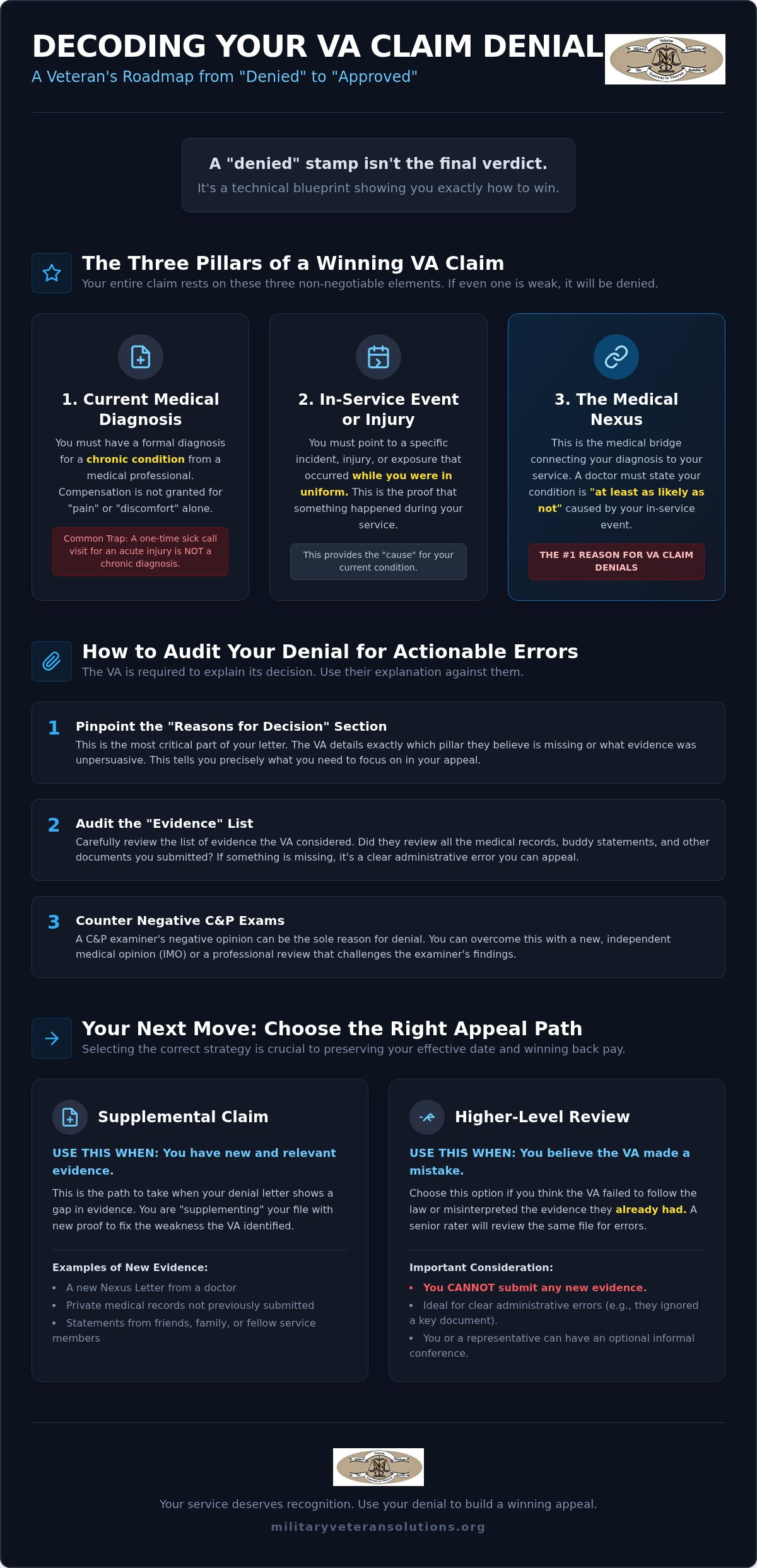
Every successful claim rests on three non-negotiable pillars. If even one of these is missing or weak, the claim will fail. Understanding these is the first step to identifying the reasons for VA claim denial in your specific letter.
- Current Medical Diagnosis: You must have a formal diagnosis for a chronic condition. The VA does not grant compensation for "pain" or "discomfort" alone. You need a specific medical name for the disability that affects your life today.
- In-Service Event: You must point to a specific incident, injury, or exposure that occurred during your military service. This is the evidence that something happened while you were in uniform that could have caused your current health issues.
- The Nexus: This is the most common point of failure. The nexus is the medical bridge that connects your current diagnosis to your in-service event. You generally need a medical professional to state that your condition is "at least as likely as not" caused by your military service to secure this link.
The 'Big Three' Reasons for VA Claim Denial
The VA disability system functions like a rigid, three-legged stool. If any one of those legs is missing, the entire stool collapses, resulting in an immediate rejection of your benefits. Most veterans focus heavily on the severity of their current pain, but the VA rater is looking for a very specific trifecta of evidence. These "Big Three" requirements are the primary filters through which every application passes. Understanding these reasons for VA claim denial is the only way to build an appeal that actually addresses the rater's technical objections.
Failing even one of these three pillars leads to an automatic denial, regardless of how much you are suffering. The rater isn't necessarily calling you a liar. They are stating that your evidence folder is incomplete according to the law. To win, you must identify which leg of the stool is broken and provide the specific documentation needed to repair it.
Missing Diagnosis: The "Not Chronic" Trap
Many veterans assume that because they went to sick call for a back injury during a training exercise, they have a "diagnosis." They don't. A one-time clinic visit for an acute injury is not a diagnosis of a chronic condition. To the VA, an acute injury is something that heals and disappears over time. You must prove that your condition is persistent and currently affects your life. Under 38 CFR, a chronic disability is defined as a condition characterized by lasting or recurring symptoms that demonstrate a permanent or long-term impairment of health. If you haven't seen a doctor for your condition in the last year, the VA will likely conclude that the injury resolved itself years ago.
The Nexus Gap: The #1 Reason for Denial
This is the most frequent hurdle in the entire system. The VA often agrees that you are sick today and that you served honorably, but they deny the claim because there is no "nexus" or medical bridge. The rater needs to see that your current health issue is "at least as likely as not" caused by your military service. This 50% or greater probability is the legal standard of proof required for service connection. If your denial letter contains phrases like "no medical evidence linking the condition to service" or "not shown in service records," you have a nexus problem.
Identifying which of these pillars failed is the first step in any successful appeal. If you're struggling to translate the VA's technical jargon, a professional VA Decision Letter Analysis can provide the clarity needed to pinpoint exactly where your evidence fell short. Don't guess at what the VA wants; use their own logic to prove your case and secure the rating you deserve.
Common Evidentiary Gaps and Administrative Errors
Even if you have the three pillars of a successful claim in place, your case can still fail due to technical oversights or systemic failures. The VA has a legal "Duty to Assist" veterans in gathering evidence, but this often translates to a superficial search of available records. If the VA rater doesn't find a specific document immediately, they frequently move straight to a denial rather than performing the deep dive your service history requires. These administrative oversights are among the most common reasons for VA claim denial, leaving you to perform the investigative work the VA should have handled from the start.
Sometimes the error is even more direct. A "Clear and Unmistakable Error" (CUE) occurs when a rater misinterprets a regulation or completely overlooks a piece of evidence already residing in your file. These are high-stakes mistakes that can lead to years of missed benefits and mounting frustration. Identifying these gaps requires a methodical, line-by-line approach to your decision letter and your underlying military personnel file to see what the rater missed.
The C&P Exam: When the Examiner Disagrees
It's a frequent point of contention: a 15-minute Compensation and Pension (C&P) exam often carries more weight in the VA's eyes than decades of private medical records. You might have a specialist who has treated you for years, yet the VA rater may choose to follow the opinion of a general practitioner who saw you for only a few minutes. If the examiner's report states your condition is "not service-connected" without acknowledging your full medical history, that exam was likely inadequate. You have the right to challenge these findings, especially if the examiner failed to address specific evidence or ignored the functional limitations you described during the appointment.
Lost in Translation: Missing Military Records
Paperwork disappears. Whether it was the 1973 fire at the National Personnel Records Center that destroyed millions of files or a simple misfiling at a local clinic, missing records sink thousands of claims every year. The VA rater might claim an event never happened simply because it isn't in your "official" digital folder. This is where a comprehensive Military Record Review becomes vital to your success. A professional audit can uncover entries, such as duty logs, performance reports, or secondary medical notes, that a VA rater might miss during their standard, high-volume processing. These hidden details often provide the undeniable proof of service connection needed to turn a technical denial into a winning approval.
How to Audit Your VA Denial for Actionable Errors
You cannot fix what you do not understand. Your denial letter is not just a rejection; it is a technical assessment that requires a methodical, line-by-line audit. To move forward, you must approach the document with the mindset of an investigator. The VA is required to explain its logic, and within that explanation lies the key to overturning the decision. By following a structured audit, you can strip away the administrative jargon and reveal the specific reasons for VA claim denial that are standing between you and your benefits.
Start by locating the "Evidence" section, which is usually found near the beginning of the decision. This is the VA's official inventory of everything they considered before making their ruling. If you sent 200 pages of private medical records but only your military personnel file is listed, you have identified a major procedural error. Once you verify the evidence list, cross-reference the rater's logic against the "Big Three" pillars discussed earlier. Did they deny you because of a missing diagnosis, a lack of an in-service event, or a weak nexus? Pinpointing the exact pillar that failed allows you to stop guessing and start gathering the specific proof required for a successful appeal.
Finding Your "Favorable Findings"
Hidden toward the end of the decision letter is a section labeled "Favorable Findings." These are the facts the VA has already conceded in your favor. For example, the rater might agree that you have a current diagnosis of PTSD but deny the claim because they don't see a nexus to your service. These findings are your foundation. You don't need to re-prove these points in your appeal. Instead, you should protect these concessions and focus 100% of your energy on the missing link. Never restart a claim from scratch if you have favorable findings to build upon, as doing so often results in a loss of back pay and effective dates.
Choosing the Right Appeal Lane
Selecting the correct "lane" is a tactical decision that depends entirely on your audit results. If the evidence was already in your file but the rater simply missed it or applied the law incorrectly, a Higher-Level Review (HLR) is often the fastest path. In an HLR, a more senior reviewer looks at the exact same evidence without any new input. However, if your audit reveals a missing nexus or a lack of medical evidence, you must file a Supplemental Claim. This lane allows you to submit "new and relevant" evidence, such as a private medical opinion or additional buddy statements. The Board of Veterans’ Appeals is a third option, but it is typically reserved for complex legal disputes and can take years to resolve.
If you find yourself staring at a confusing decision letter and aren't sure which lane to choose, we can help. Our team specializes in VA Decision Letter Analysis to identify the hidden errors and evidentiary gaps that the VA rater may have overlooked. We provide the professional clarity you need to turn a confusing denial into a winning strategy.
Overcoming a Denial with Professional VA Claims Representation
Analyzing a stack of technical paperwork while managing a chronic disability is a heavy burden. You have already done the hard work of serving your country; you shouldn't have to spend your civilian life fighting a confusing bureaucracy alone. Military Veteran Solutions, LLC (MVS) exists to be your dedicated ally in this process. We specialize in transforming a frustrating rejection into a winning strategy by performing the deep, investigative work that the VA often rushes through. Our team doesn't just look at the surface. We dig into the technicalities of your case to find exactly where the system failed you.
The first step in any successful appeal is a professional VA Decision Letter Analysis. We take that document and strip away the administrative jargon to reveal the specific reasons for VA claim denial that are holding you back. This analysis saves you months of stress and prevents you from filing the wrong type of appeal. By identifying the exact evidentiary gap early, we ensure your next move is a calculated one that protects your original effective date and your right to back pay.
The Advantage of Veteran-Led Advocacy
Experience matters when you're dealing with military records. Our firm was founded by a 10-year Army veteran, and we bring over 25 years of experience to every case we handle. We understand the "Army way" or "Navy way" of record-keeping, which is often a foreign language to civilian raters. This specialized knowledge allows us to conduct a comprehensive Military Record Review that identifies service connections the VA missed. We know where the "lost" proof often hides within duty logs and performance reports. Our no-nonsense approach to institutional hurdles ensures that your best interests remain the priority throughout the entire evaluation process.
Your Next Step Toward the Benefits You Earned
Time is your most valuable asset after a denial. You generally have exactly one year from the date of your decision letter to file an appeal and preserve your back pay. Don't let the clock run out while you're still trying to figure out the VA's logic. We offer Virtual Consultations nationwide, providing you with expert guidance from the comfort of your home. During this session, we'll discuss your history, review your current status, and outline a clear path forward. You'll leave the conversation knowing exactly what evidence is missing and how we can help you find it. Your service was real, and your benefits should be too. Schedule your VA Decision Letter Analysis with Military Veteran Solutions today and take the first step toward the rating you deserve.
Secure the Benefits You've Earned
A VA denial letter is a dense, technical document, but it's also the key to your eventual success. By auditing your decision letter and identifying which of the "Big Three" pillars is missing, you can stop guessing and start building a precise appeal. Whether the VA overlooked a critical medical record or failed to establish a clear nexus, understanding the specific reasons for VA claim denial is the only way to move forward with confidence. You don't have to navigate this complex administrative maze alone.
Military Veteran Solutions, LLC was founded by a 10-year Army veteran who understands the weight of your sacrifice. With over 25 years of advocacy experience, we specialize in identifying rater errors and finding the "missing link" in your service records. We offer nationwide virtual consultations to ensure every veteran has access to expert support, regardless of their location. It's time to take control of your claim and secure the rating you deserve. Get a Professional VA Decision Letter Analysis Today and let us help you finish the mission. You served with honor; now it's time to get the support you've earned.
Frequently Asked Questions
Can the VA deny my claim even if I have a doctor’s note?
Yes, the VA can and often does deny claims despite a doctor's note if that note fails to establish a chronic diagnosis or a clear service connection. A simple letter stating you have pain is not enough for a rater. You need a formal medical opinion that uses specific language, such as "at least as likely as not," to bridge the gap between your current health and your military service.
How long do I have to appeal a VA claim denial in 2026?
You have exactly one year from the date printed on your VA decision letter to file an appeal. Missing this deadline causes the decision to become final, which means you could lose years of retroactive back pay. In 2026, the VA continues to follow this strict timeline, so it's vital to act quickly once you receive your notification to preserve your effective date.
What is a "Nexus Letter" and do I really need one?
A Nexus Letter is a formal medical document written by a healthcare professional that links your current disability to an event, injury, or exposure from your service. You likely need one if the primary reasons for VA claim denial in your letter involve a lack of service connection. This letter acts as the "missing link" that provides the clinical evidence a VA rater needs to approve your benefits.
Can I file a new claim for the same condition after a denial?
You should not file a brand-new claim for a condition that has already been denied. Instead, you must use one of the three appeal lanes, such as a Supplemental Claim, to keep your case active. Filing a new claim for the same issue often leads to an immediate administrative rejection or resets your effective date, potentially costing you thousands in back pay.
What happens if the VA says my condition is "not service-connected"?
This ruling means the VA rater agrees you are currently ill but does not believe your condition started or was aggravated by your time in uniform. To overturn this, you must identify the specific reasons for VA claim denial found in your letter and provide evidence of an in-service occurrence. This is the moment to audit your military records for any missed sick call entries or performance reports that prove the injury happened during service.
Is it better to file a Supplemental Claim or a Higher-Level Review?
The best choice depends entirely on whether you have more evidence to provide. If you have new medical records or a Nexus Letter to add, the Supplemental Claim is your best path. If you believe the evidence already in your file is sufficient and the rater simply made a mistake, a Higher-Level Review allows a senior official to re-examine the case without adding new documents.
Does a negative C&P exam mean my claim is officially over?
A negative C&P exam is a significant hurdle, but it is not the end of the road. You can challenge an inadequate exam by filing a Supplemental Claim with a private medical opinion that counters the examiner's findings. Many veterans successfully overturn these negative opinions by pointing out specific medical facts or service records that the C&P examiner ignored during their brief evaluation.
How much does it cost to have a professional review my VA denial?
The cost of a professional review varies depending on the depth of the analysis and the complexity of your service records. While some individuals attempt to navigate the appeal process alone, an expert review is an investment in identifying the technical errors that lead to denials. Getting professional help can save you years of frustration and ensure your appeal is built on a foundation of solid evidence.


