
If you think a VA accreditation badge is a guarantee of victory, you might be setting your appeal up for a quiet denial. Accreditation is simply the legal minimum required to sit at the table; the real value of a representative lies in their ability to perform a forensic audit of your military records. You've already spent years serving your country, and it's frustrating to feel like you're now fighting a system that's designed to overlook your sacrifices.
It's natural to feel overwhelmed by the complexity of VA decision letters or fear wasting your hard-earned back pay on incompetent representation. You need to know that your advocate has a specific, winning strategy for your unique case. We're going to arm you with the exact 21 critical questions to ask a VA claims agent so you can distinguish a true ally from a generic service provider. This checklist provides a clear framework to interview potential representatives, giving you the confidence that your chosen advocate can secure the service connection and maximized disability rating you've earned. By the end of this guide, you'll have the tools to vet any agent with the scrutiny your claim deserves.
Key Takeaways
- Verify legal standing immediately by asking for an OGC accreditation number to ensure your representative is authorized by the VA to handle your appeal.
- Learn the essential questions to ask a VA claims agent to confirm they will perform a forensic, line-by-line audit of your military and medical records rather than a surface-level review.
- Protect your back pay by understanding legal fee structures and avoiding agents who demand upfront payments or access to your private VA.gov credentials.
- Identify dangerous red flags, such as "guaranteed" disability ratings, which signal predatory practices rather than professional, evidence-based advocacy.
- Build a clear framework for interviewing potential representatives to ensure they have a dedicated strategy for winning your service connection and maximizing your rating.
The Foundation: Questions to Verify VA Accreditation and Legal Standing
Accreditation isn't a suggestion; it's a federal mandate designed to safeguard your rights. When you begin your search, your primary objective is confirming that your representative has the legal authority to stand between you and the Veterans Benefits Administration. Without this accreditation, an individual cannot legally represent you during an appeal, and they certainly cannot charge you a fee for doing so. You're trusting this person with your medical history and your financial future, so start with the hard questions.
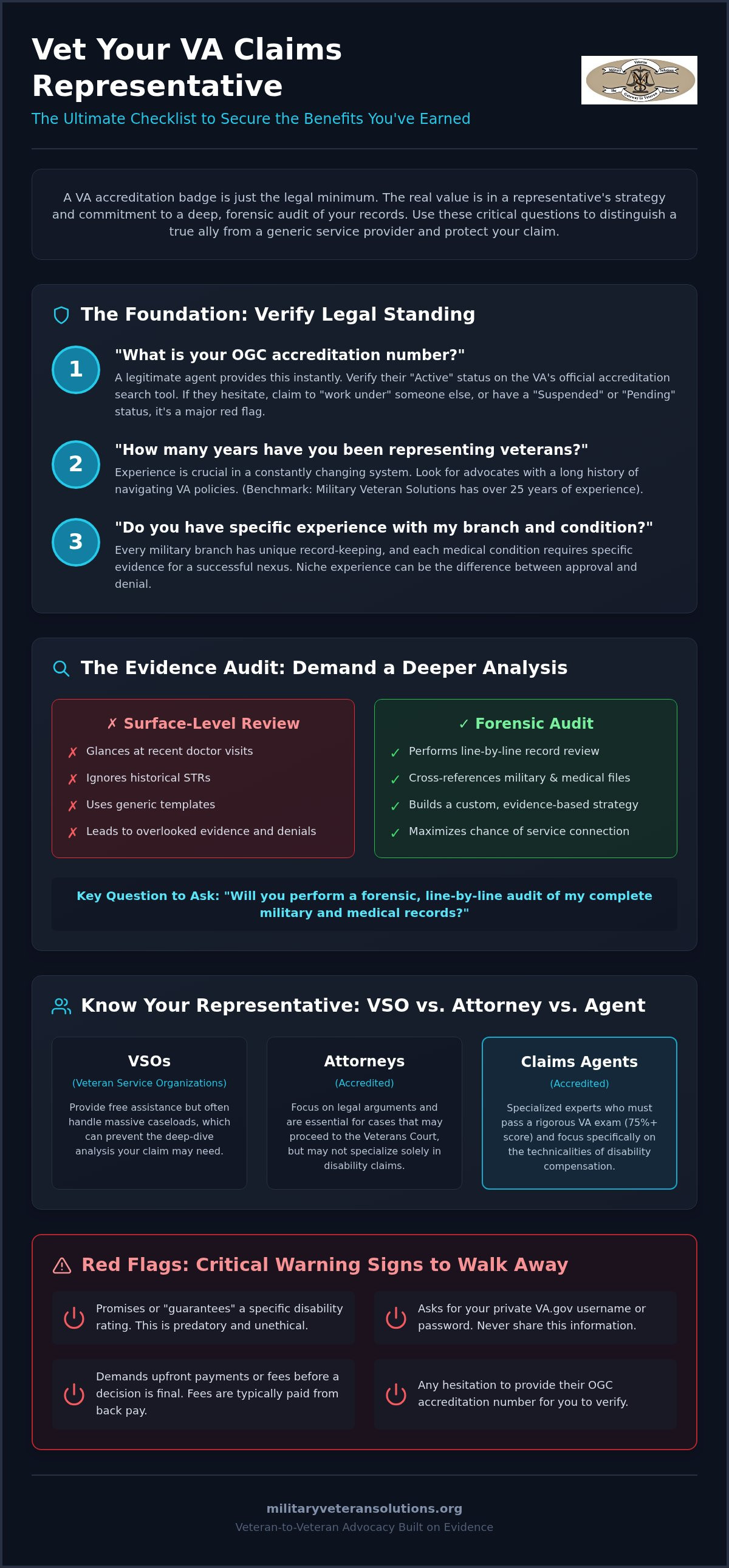
Question 1: "What is your OGC accreditation number and can I verify it right now?" A legitimate agent will provide this without hesitation. This number is your proof that the Office of General Counsel has vetted their character, fitness, and knowledge of VA law. If they hesitate or claim they "work under" someone else's number, walk away. Your representation must be direct and transparent. When you prepare your list of questions to ask a VA claims agent, this is the non-negotiable starting point.
Question 2: "How many years have you been representing veterans before the VA?" Experience matters because the system is constantly shifting. Military Veteran Solutions, LLC brings over 25 years of experience to the table. You need an advocate who's seen how the VA's internal policies have evolved and knows how to pivot when a strategy needs adjustment. Question 3: "Do you have experience specifically with [Your Branch] and [Your Condition]?" Every branch has different record-keeping quirks, and every condition requires a specific type of medical nexus. If they've never handled a claim for your specific injury, they might miss the subtle evidence needed to win.
Understanding the difference between representatives is also vital. Veteran Service Organizations (VSOs) provide free assistance but often carry massive caseloads that prevent deep-dive analysis. Accredited attorneys focus on legal arguments and may take cases to the Veterans Court. Accredited claims agents, however, are specialized experts who must pass a rigorous written exam with a score of 75 percent or higher. They focus specifically on the technicalities of disability compensation, offering a level of dedicated advocacy that larger organizations often struggle to match.
Verifying Accreditation via the OGC Database
Don't take an agent's word for it. Visit the VA's official accreditation search tool and enter their name. Look specifically for an "Active" status. If you see "Suspended" or "Cancelled," it means the VA has revoked their authority due to ethical or professional failures. "Pending" status means they aren't authorized to represent you yet. Unaccredited consultants, often called "claims sharks," are a massive risk. They operate outside federal law, often demanding illegal portions of your back pay while offering zero legal protection if your claim is mishandled.
Defining the Role of a Professional Claims Agent
Professional agents are held to high standards. Beyond the initial exam, they must complete three hours of continuing legal education within their first year and maintain ongoing training every two years. This ensures they're up to date on the latest 2026 disability rates and procedural changes. Working with an independent firm like Military Veteran Solutions, LLC provides a "Veteran-to-Veteran" approach. Founded by a 10-year Army veteran, we prioritize a thorough military record review over high-volume processing, ensuring your appeal is built on a foundation of evidence that generic providers often overlook.
The Evidence Audit: Questions About Their Case Analysis Strategy
A surface-level review of your records is the primary reason for claim denials. Many representatives simply glance at your most recent doctor's visit and hope for the best. This approach fails because it ignores the deep history contained within your Service Treatment Records (STRs) and personnel files. When vetting a representative, your questions to ask a VA claims agent must focus on their willingness to do the heavy lifting. You need a forensic investigator, not a paper pusher. If you're tired of surface-level skims, consider a comprehensive military record review to find the evidence the VA missed.
Question 4: "Will you perform a line-by-line audit of my military service and medical records?" If the answer is anything less than a resounding "yes," keep looking. A true advocate looks for the small details, like a single clinic visit in 1994 that proves your condition started on active duty. Question 5: "How do you identify 'missing' evidence that the VA might have overlooked?" Professional agents know how to hunt for missing records or use lay statements from your fellow soldiers to fill the gaps. A Nexus is the essential link between your current disability and your time in military service. Without it, your claim has no foundation.
Question 6: "What is your process for analyzing a VA Decision Letter to find legal or factual errors?" The VA makes mistakes. A professional analysis looks for "Clear and Unmistakable Errors" (CUE) or instances where the rater ignored your evidence. They should also be looking for secondary conditions. For example, if your service-connected knee injury has caused back pain over the years, that back pain is a secondary condition you deserve compensation for. Identifying these links is a specialized skill that sets high-tier advocates apart from the rest.
The Power of a Comprehensive Military Record Review
At Military Veteran Solutions, LLC, we prioritize record reviews as the first step because evidence is the only thing that wins appeals. We don't just look at your current diagnosis; we scour your STRs, personnel files, and performance evaluations. These documents often contain the "hidden" proof of an injury or event that the VA rater overlooked during their initial review. While you can verify an agent's standing through the VA Accreditation Program, their ability to find this evidence is what actually secures your rating.
Decoding the VA Decision Letter
The "Reasons for Decision" section is the roadmap to your appeal. It tells us exactly why they said no, which allows us to build a targeted counter-argument. You should ask your agent about their experience with Higher-Level Reviews (HLR) versus Supplemental Claims. An HLR is best when the evidence is already there but the rater made a mistake. A Supplemental Claim is necessary when we need to introduce new and relevant evidence found during our audit. Understanding which path to take requires a deep familiarity with the 2026 appeal regulations.
Logistics and Communication: Questions on Representation and Fees
Understanding the financial side of representation is about protecting your back pay. Federal law is incredibly strict regarding how and when an agent can charge for their services. It is illegal for anyone to charge you a fee for assisting with an initial claim. Fees only become a factor once the VA has issued an initial decision and you're moving into the appeals process. When you're narrowing down your list of questions to ask a VA claims agent, the financial details must be transparent and documented in writing.
Question 7: "Do you work on a contingency basis, and what is your percentage?" Most accredited agents work on a contingency model. This means they only receive a fee if they successfully win your appeal and secure retroactive benefits. While the VA allows for various fee structures, a 20 percent fee taken from your back pay is generally considered reasonable and is often paid directly by the VA to the agent. Question 8: "Are there any upfront costs or hidden administrative fees?" You shouldn't ever be asked for a retainer or consultation fee to start an appeal. If an agent demands money before they've even reviewed your decision letter, they aren't following standard practices.
Question 9: "How often will I receive updates on the status of my claim?" The VA system is notoriously slow. As of 2026, a Board Appeal with a direct review can take approximately 12 months, while hearings can stretch beyond two years. You need an advocate who won't leave you in the dark during these long windows of silence. To formalize the relationship, you'll need to sign VA Form 21-22a. This document is the Appointment of Individual as Accredited Representative. It officially grants your agent the power of attorney to view your records and act on your behalf before the VA.
Navigating the Representation Agreement
Your legal fee agreement must be a clear, standalone document. It should outline exactly what percentage the agent will receive and specify that this fee only applies to retroactive benefits. A major red flag is any agent who asks for a portion of your future monthly disability checks. Those benefits belong entirely to you. Before signing, use the VA's official accreditation search tool one last time to ensure the name on the contract matches the individual registered with the Office of General Counsel.
Expectations for Communication and Timelines
Distance shouldn't ever be a barrier to high-quality advocacy. Military Veteran Solutions, LLC utilizes virtual consultations to provide national reach, ensuring that a veteran in California receives the same dedicated service as one in Florida. During your initial interview, ask: "Who will be my primary point of contact throughout this process?" You deserve to know if you'll be speaking with the agent directly or if your case will be handed off to an assistant. Clear communication is the only way to maintain confidence during a process that can take months or even years to resolve.
Red Flags and Warning Signs: When to Walk Away
The path to a successful appeal is often paved with predatory promises from individuals looking to profit from your service. You've fought for your country; you shouldn't have to fight your own representative. Recognizing red flags early saves you from lost back pay and compromised personal data. When you're preparing your questions to ask a VA claims agent, listen closely to their answers. If they sound more like a used car salesman than a professional advocate, it's time to walk away.
The most dangerous red flag is the "Guaranteed Rating." No accredited agent can promise a specific outcome. The VA appeals process involves subjective medical evaluations and complex legal interpretations that no one can control with 100 percent certainty. If someone claims they can "guarantee" a specific rating, they are lying to you. Another major warning sign is a request for your VA.gov or DS Logon credentials. Your login information is private. Legitimate representatives use official channels to access your records. They don't need to impersonate you online.
You should also be wary of firms that discourage you from speaking with the VA directly or those that operate as "Nexus Letter Mills." A legitimate medical evidence review involves a deep dive into your history, not a paid signature from a doctor who has never seen your records. Only OGC-accredited individuals are legally authorized to prepare, present, or prosecute VA claims. If an agent isn't willing to sign the official representation forms, they aren't legally representing you. They are likely a "claim shark" operating in the shadows of the law.
Identifying 'Claims Sharks' and Unaccredited Consultants
Predatory consultants often use high-pressure marketing tactics, promising fast results that the VA simply doesn't provide. Many of these unaccredited individuals charge "membership fees" or demand a portion of your monthly benefits indefinitely. This is illegal. Under federal law, unaccredited people cannot represent you during an appeal. They lack the oversight of the Office of General Counsel and have no accountability if they mishandle your case. If you want a transparent, veteran-led approach to your appeal, contact Military Veteran Solutions today for a professional consultation.
Protecting Your Back Pay and Personal Data
Data security is a critical part of the claims process. Your military and medical records contain sensitive information that must be handled with the highest level of care. Military Veteran Solutions maintains a transparent process where you are always in control of your information. We believe in empowering veterans through education and honest advocacy. By avoiding the shortcuts offered by unaccredited consultants, you protect your retroactive benefits and ensure that your appeal is handled with the professional integrity you deserve.
Why Military Veteran Solutions is the Right Choice for Your Appeal
You have done the research. You have prepared the questions to ask a VA claims agent to ensure your future is in capable hands. At Military Veteran Solutions, we don't just meet the legal minimums; we exceed the standards set by the industry. Our firm was founded by a 10-year Army veteran who understands the physical and mental toll of service. We combine that personal empathy with over 25 years of professional experience to provide a level of advocacy that high-volume firms simply cannot match. You aren't just another case file to us; you are a fellow veteran who deserves the benefits you earned.
Our "Evidence-First" approach is designed to counter the most common reason for denials: a lack of specific, service-connected proof. We perform a comprehensive review of your military service records to identify "hidden" evidence that the VA rater likely overlooked. This forensic audit is the foundation of a winning appeal. Whether it's a forgotten clinic visit or a specific personnel file, we hunt for the details that establish your service connection. Our nationwide virtual consultations mean you have access to this expertise regardless of your current location. We check every box on your vetting checklist, from OGC accreditation to a proven track record of successful VA decision letter analysis.
The Veteran-to-Veteran Advocacy Difference
A shared service background isn't just a point of pride; it's a strategic advantage. We understand how military medical documentation is structured because we've lived it. This deeper understanding allows us to translate your service history into a compelling argument for the entitlements you earned. We aren't just filing paperwork. We are fighting to ensure you receive the maximized disability rating you deserve. If your decision letter was a "no," our analysis will find the path to a "yes." We speak the same language, and we know exactly what it takes to win.
Getting Started with Your Claim Review
Initiating your appeal doesn't have to be a daunting task. Our process is streamlined to respect your time and provide immediate clarity. To begin, you only need to have your DD-214 and your recent VA Decision Letters ready. These documents allow us to perform the initial analysis needed to build your strategy. Don't let another deadline pass or leave your back pay to chance. Your path to a successful service connection starts with a single conversation. Schedule your virtual consultation with Military Veteran Solutions today and take the first step toward the rating you've earned.
Take Command of Your VA Appeal Strategy
You now have a powerful framework to evaluate potential representatives and protect your financial future. Remember that accreditation is just the beginning; the real victory is found in the details of your military records. By using these specific questions to ask a VA claims agent, you can ensure your advocate is prepared to perform a forensic audit rather than a surface-level scan. Don't settle for representation that ignores the "hidden" evidence within your service history or fails to provide a transparent fee structure.
Military Veteran Solutions was founded by a 10-year Army veteran with over 25 years of advocacy experience. We are dedicated to winning the entitlements you earned. We specialize in comprehensive military record audits and detailed decision letter analysis to build the strongest possible case for your appeal. You've served your country with honor, and you deserve an ally who will fight for you with that same level of commitment. Secure the benefits you earned; schedule your expert VA claim analysis now. You have the tools and the checklist to move forward with absolute confidence.
Frequently Asked Questions
What is the difference between a VA claims agent and a VSO?
Veteran Service Organizations (VSOs) provide free assistance and are typically part of large, non-profit groups. While they offer vital support, they often manage high caseloads that limit the time they can spend on individual record audits. Accredited claims agents are specialized professionals who often provide more intensive, one-on-one advocacy. They focus specifically on the technicalities of appeals and forensic evidence reviews to win complex cases.
Can a VA claims agent charge me for an initial claim?
No, it's illegal for anyone to charge a fee for assisting with the filing of an initial claim. Federal law is very clear on this point to protect veterans from predatory practices. Fees are only permitted for representation after the VA has made an initial decision on your claim. If someone asks for money to help you file your very first application, you should report them immediately.
How do I verify if a VA claims agent is actually accredited?
You can verify accreditation by using the VA Office of General Counsel (OGC) online search tool. Entering the individual's name will show their current status and accreditation number. This is one of the most vital questions to ask a VA claims agent during your initial interview. Always ensure their status is listed as "Active" before sharing any of your personal military or medical records.
What happens if my VA claims agent doesn't win my appeal?
If your agent doesn't win your appeal, you typically won't owe them a representation fee. Most accredited agents work on a contingency basis, meaning their payment is tied directly to your success and the recovery of retroactive benefits. You should always review your specific fee agreement to understand if there are any minor administrative costs for which you might be responsible, such as fees for obtaining external medical records.
Do I have to live in the same state as my VA claims agent?
No, you don't need to live in the same state as your representative. VA accreditation is a federal authorization that allows an agent to represent veterans across the entire country. Virtual consultations have made it possible for veterans to access high-level advocacy regardless of their physical location. This ensures you can choose the best advocate for your specific condition rather than being limited by your local geography.
What is a VA Form 21-22a and why is it important?
VA Form 21-22a is the "Appointment of Individual as Accredited Representative." This legal document officially grants your agent the power of attorney to act on your behalf before the VA. It's essential because it allows your representative to view your electronic records and receive copies of all correspondence from the VA. Without this signed form, the VA won't recognize your agent's authority to prosecute your claim or appeal.
Can a VA claims agent help with a Higher-Level Review (HLR)?
Yes, accredited agents are experts at navigating the Higher-Level Review process. During an HLR, a senior rater reviews your existing evidence to find legal or factual errors without considering new information. An agent's expertise in VA law is critical here, as they can point out exactly where the original rater failed to follow procedure. They help determine if an HLR or a Supplemental Claim is the better path for your specific appeal.
How much of my back pay will a claims agent take?
The VA generally considers a fee of 20 percent of your retroactive benefits to be reasonable. This fee is typically paid directly from your back pay by the VA once your appeal is successful. While some agents may charge a higher percentage, the 20 percent mark is the standard for many professional advocates. It's important to clarify the exact percentage and how it's calculated before you sign your representation agreement.


