
The key threshold is qualifying service during a specific exposure period. According to the U.S. Department of Veterans Affairs, Veterans, Reservists, and National Guard members may qualify for Camp Lejeune water contamination disability benefits if they served at Camp Lejeune or MCAS New River for at least 30 days between August 1, 1953, and December 31, 1987, and later developed a covered condition.
If you’re unsure whether your service dates or diagnosis qualify, that uncertainty is understandable. Your exposure history, medical records, and diagnosed condition all matter when you assess a Camp Lejeune water contamination disability benefits claim.
This article explains who may qualify, which conditions the VA presumes are connected to Camp Lejeune service, and what records can help establish your service and diagnosis. It also explains how the exposure period affects eligibility, so you can understand the rules before deciding what to do next.
Key Takeaways
- Qualifying service at Camp Lejeune or MCAS New River generally requires at least 30 days during the covered period, so compare your service history with the eligibility dates.
- The VA recognizes eight presumptive conditions, including several cancers and Parkinson’s disease; identifying whether your diagnosis is on the list can clarify what evidence your claim needs.
- Keep military records that show where and when you served, alongside medical records documenting your diagnosis and treatment.
- VA disability compensation and claims under the PACT Act or Camp Lejeune Justice Act are distinct pathways, so understand which benefit or claim you’re pursuing.
- If the VA denied your claim, a review of the decision and supporting records can help identify issues to address in an appeal.
Who Qualifies for Camp Lejeune Water Contamination Disability Benefits?
Eligibility depends on qualifying service or residence during the exposure period and on the benefit you’re seeking. VA disability compensation for veterans has different criteria from health care reimbursement available to some family members.
Exposure Eligibility Periods and Duration
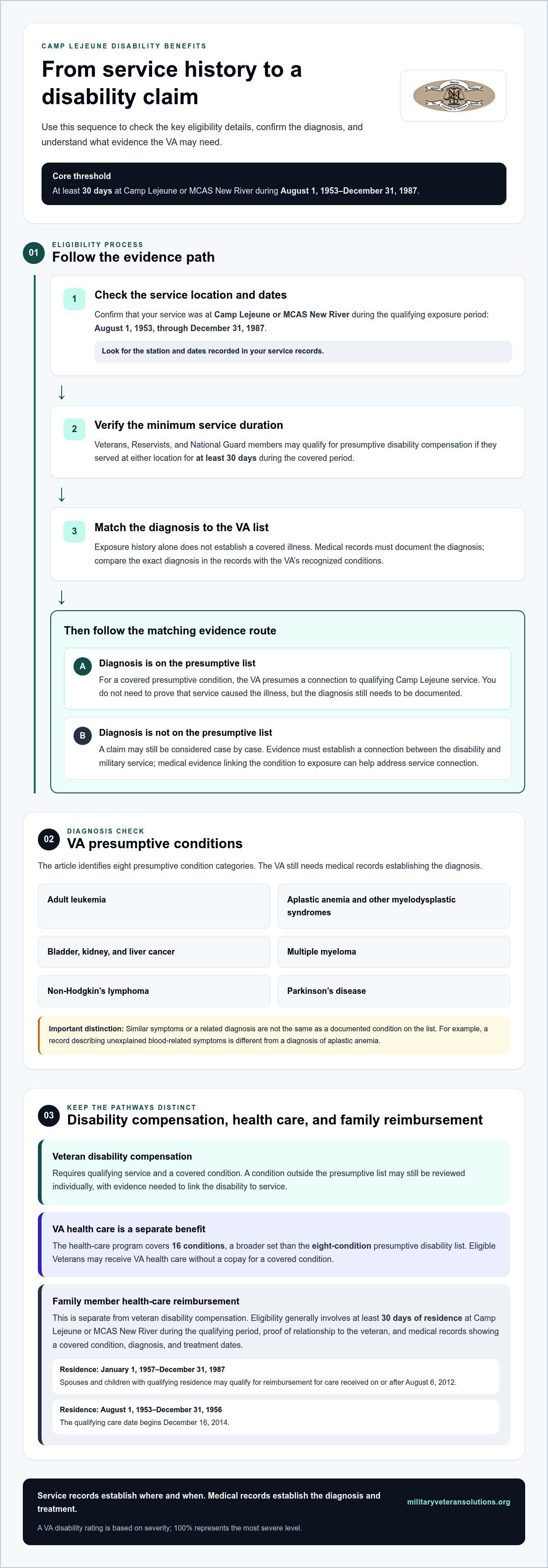
The qualifying period for veteran disability compensation runs from August 1, 1953, through December 31, 1987. According to the U.S. Department of Veterans Affairs, Veterans, Reservists, and National Guard members may qualify for presumptive disability compensation if they served at Camp Lejeune or MCAS New River for at least 30 days during that period. The location and length of service matter because they help establish qualifying exposure. Check service records for the station and dates recorded.
Veteran Eligibility for VA Benefits
Veterans who meet the service and exposure criteria may qualify for VA benefits if they later develop a covered condition. The presumptive list includes adult leukemia, bladder cancer, kidney cancer, liver cancer, multiple myeloma, non-Hodgkin’s lymphoma, Parkinson’s disease, aplastic anemia, and other myelodysplastic syndromes. Exposure history alone does not establish a covered illness: your medical records must document the diagnosis. Compare the exact diagnosis in your records with the VA’s recognized conditions.
Veteran Eligibility for Disability Compensation
Disability compensation is for an eligible veteran whose service and medical condition meet VA requirements. For a covered presumptive condition, the VA presumes a connection to qualifying Camp Lejeune service, so you do not need to prove that service caused the illness. You may still file a claim for a condition outside the presumptive list. In that case, the VA reviews the evidence individually, including medical evidence linking the disability to service.
Family Member Eligibility
Family members may qualify for reimbursement of certain health care costs, which is separate from veteran disability compensation. Eligibility generally involves at least 30 days of residence at Camp Lejeune or MCAS New River during the qualifying period, proof of relationship to the veteran, and medical records showing a covered condition, diagnosis, and treatment dates. Spouses and children with qualifying residence from January 1, 1957, through December 31, 1987, may qualify for reimbursement for care received on or after August 6, 2012. For residence from August 1, 1953, through December 31, 1956, the qualifying care date begins December 16, 2014. These dates help families identify the applicable reimbursement rules.
VA presumptive conditions for disability compensation
The VA’s presumptive list identifies conditions linked to qualifying Camp Lejeune exposure. Presumptive status affects what evidence you need to establish service connection.
The VA assigns a disability rating based on severity, with 100% representing the most severe level.
Presumptive Conditions for Camp Lejeune Exposure
According to the U.S. Department of Veterans Affairs, the presumptive list covers eight conditions: adult leukemia; aplastic anemia and other myelodysplastic syndromes; bladder, kidney, and liver cancer; multiple myeloma; non-Hodgkin’s lymphoma; and Parkinson’s disease. If your diagnosis matches a listed condition, the presumptive rule means you don’t need to prove military service caused it. Your medical records must still establish the diagnosis.
Compare the exact diagnosis in your records with the VA’s condition names. Similar symptoms or a related diagnosis aren’t the same as a documented condition on the list. For example, a record that says “aplastic anemia” is different from one describing unexplained blood-related symptoms without a diagnosis.
Case-by-Case Claims for Other Conditions
A condition outside the presumptive list may still support a disability claim, but the VA evaluates it individually. The evidence must establish a connection between the disability and military service. Medical records can document the diagnosis, symptoms, and treatment. Medical evidence linking the condition to exposure can help address service connection.
Oral cancer, for example, isn’t on the VA’s Camp Lejeune presumptive list. That doesn’t automatically rule out a claim, but you’ll need evidence supporting the connection. Clearly identify the diagnosed condition and include records relevant to the claimed service connection.
If you’ve read about proposals to expand the presumptive list, distinguish proposed changes from conditions the VA currently recognizes. For a claim now, compare your diagnosis with the existing list. Don’t treat a proposed addition as an approved presumptive condition, because presumptive status affects the evidence the VA requires to establish service connection.
Disability compensation and VA health care are separate benefits. Eligible Veterans may receive VA health care without a copay for a covered condition. The health-care program covers 16 conditions, a broader set than the eight conditions on the presumptive disability list. A veteran may therefore qualify for care related to a covered condition without that condition appearing on the disability-compensation presumptive list.
If a VA decision overlooks a diagnosis or supporting evidence, veteran claims representation can help you understand the decision and consider an appeal.
PACT Act claims related to Camp Lejeune water exposure
The Camp Lejeune Justice Act of 2022 allows eligible people to pursue compensation through a legal claim, separate from VA benefits. VA disability compensation follows a different process and does not require filing a lawsuit under that Act.
Appeals of Denied VA Claims
A VA denial can be challenged through the applicable review process. Start by reading the decision letter carefully. It explains the reasons for the outcome and identifies the evidence the VA considered. Compare those reasons with your service and medical records. If the decision overlooked relevant evidence or misunderstood a key fact, that may help identify an issue to address. A VA appeal challenges the VA decision; it is separate from a Justice Act claim.
Evidence and Records for VA Claims
A VA claim should identify the Camp Lejeune condition and include records showing qualifying military service and a medical diagnosis. Service documents can show that you were stationed at Camp Lejeune or Marine Corps Air Station New River, while medical records document the illness. You can apply through VA.gov or work with a qualified representative. Organize these records together to show how your service history and condition relate to the benefit you’re seeking.
Effective Dates for Disability Claims
An effective date determines when VA disability compensation begins. For claims filed before March 13, 2018, the effective date could be retroactive to March 14, 2017, or the claim date, whichever was earlier. That rule concerns claims filed before the stated cutoff; it should not be assumed to apply to a later claim. Keep the original claim date and VA correspondence with your records, since both help clarify the timeline.
Justice Act Claims and VA Benefits
The Justice Act and VA benefits are separate routes, with different purposes and procedures. The Justice Act allows eligible people to pursue compensation through a legal claim, while a VA claim seeks disability benefits based on service-connected conditions. Lawsuits under the Justice Act had to be filed before August 11, 2024. A court award may be reduced by related VA benefits, though that offset doesn’t apply to claims settled through the Navy’s elective option process.
The Navy’s Camp Lejeune Elective Option sorts qualifying conditions into Tier 1 and Tier 2 categories. Its maximum possible offer is $550,000; claims involving a condition that resulted in death are offered an additional $100,000. People accepting an offer can expect payment within 60 days or less. Accepting a Navy offer waives the claimant’s right to file a lawsuit, so the settlement route and its consequences matter.
The PACT Act, signed into law on August 8, 2022, addresses toxic-exposure benefits, and Section 804 addresses people who lived at Camp Lejeune. It also expands and extends VA health care eligibility for veterans affected by toxic exposures and requires toxic-exposure screening for veterans receiving VA health care. These provisions do not make the Justice Act and VA disability claims interchangeable. Keep the claim type clear when reviewing forms, records, and VA decisions.
Evidence needed to establish service connection
A well-organized Camp Lejeune claim connects three points: qualifying military service, a diagnosed condition, and the benefit you’re seeking. Your records should make clear where you served and which illness the claim addresses.
Evidence of Illness and Service
Evidence of illness and service means medical records documenting the diagnosis alongside military records showing qualifying duty. Both matter because a diagnosis alone doesn’t establish where you served, while service records don’t establish a medical condition. Luis Martinez Jr., for example, served four years in the Marine Corps and was stationed at Camp Lejeune from 1984 to 1987. His example shows why both timelines matter.
For a Camp Lejeune claim, identify the specific condition and include medical records documenting its diagnosis. Then connect those records with military documents showing the relevant station and service dates. Veterans, Reservists, and National Guard members may qualify for presumptive compensation after at least 30 days at Camp Lejeune or MCAS New River during the covered period, according to the U.S. Department of Veterans Affairs.
Organize evidence by what it establishes. Service records support your military history, while medical records support the diagnosis. If your condition isn’t presumptive, medical evidence must also support a connection to service. Since the VA reviews claims individually, make clear how each document relates to the claimed condition.
Proof of Service and Diagnosis
Proof of service and diagnosis means documenting both qualifying duty and the illness. Before filing, confirm that your service records identify Camp Lejeune or MCAS New River and that your medical records identify the claimed condition. This helps the VA assess your service period and diagnosis together, without leaving either point unclear.
A Veterans Service Officer can help you prepare a VA claim and organize relevant evidence. Bring available military records and medical documentation, including records that clarify your station or diagnosis. A VSO can help identify what the claim needs to establish, while you remain responsible for ensuring the submission accurately reflects your history.
Keep copies of submitted records and VA correspondence together. If a VA decision later questions your service dates, diagnosis, or the connection between them, the copies make it easier to find relevant evidence. A lawsuit under the Camp Lejeune Justice Act is separate from a VA disability claim, so evidence assembled for one should not automatically be treated as a complete VA submission.
Before submitting, compare the claim’s stated condition with the diagnosis in the medical records, then compare the service dates with the military history. For example, a record showing a Camp Lejeune station from 1984 to 1987 can help document service, while a separate medical record must establish the diagnosed illness. Clear records make the basis of the claim easier to follow.
Camp Lejeune water contamination and exposure period
The dates matter because the VA service window and the history of contaminated water aren’t identical. People living or working at Marine Corps Base Camp Lejeune and Marine Corps Air Station New River may have encountered contaminated drinking water between 1953 and 1987.
For VA disability compensation, the qualifying service period runs from August 1, 1953, through December 31, 1987. Veterans generally need at least 30 days of qualifying service at Camp Lejeune or MCAS New River. The critical comparison is between your documented station dates and that eligibility window. A service record showing a different installation, or dates outside the period, raises a different eligibility question.
The contamination involved chemicals in drinking water, including trichloroethylene and perchloroethylene. Reported maximum levels reached 1,400 parts per billion for trichloroethylene at Hadnot Point and 215 parts per billion for perchloroethylene at Tarawa Terrace in 1985. These figures describe reported contamination levels, not an individual’s personal dose. A person’s service or residence records establish their own connection to the location and period.
The estimated contamination period also differs from the VA eligibility window. Contaminants were estimated to have entered the water supply from the mid-1950s until February 1985, while the VA service period extends through December 31, 1987. According to the U.S. Marine Corps, Camp Lejeune water has been found free of contaminants since March 1987. These dates describe separate facts: estimated contamination history, reported water status, and the period used for qualifying service.
Family members should distinguish the veteran’s service window from the residence and health-care reimbursement rules. Eligible spouses and children who lived at Camp Lejeune from January 1, 1957, through December 31, 1987, may qualify for reimbursement for covered care received on or after August 6, 2012. For residence between August 1, 1953, and December 31, 1956, the corresponding care date is December 16, 2014. A dependent’s residence dates and treatment records therefore matter separately from a veteran’s station history.
Exposure records can also matter under a different route. The Camp Lejeune Justice Act of 2022 concerns financial claims, while VA disability compensation is a separate benefit. The Act’s eligibility may involve people who lived, worked, or were otherwise exposed at Camp Lejeune for at least 30 days during the specified period. A person whose mother was exposed while pregnant may also qualify to file a financial claim when the exposure meets that duration and date requirement.
If a VA decision misreads your service dates or exposure evidence, get support with filing a VA appeal.
Military Veteran Solutions: Filing VA appeals
Military Veteran Solutions, LLC helps veterans review VA decisions and pursue appeals when a Camp Lejeune claim is denied or rated incorrectly. Its Veteran Claims Representation includes analysis of decision letters and military records to identify issues affecting a claim. If the VA’s reasoning does not address important service or medical evidence, a focused review can help clarify potential appeal issues.
You can turn to the firm for VA Decision Letter Analysis, Military Record Reviews, or help filing a VA appeal. These services support claim review and representation, not medical treatment or a civil lawsuit. The next step is to discuss your VA decision and relevant records with the team. Contact Military Veteran Solutions, LLC to talk about your claim.
Take the Next Step With a Clear Claim Strategy
Understanding eligibility is only the first step. Next, decide what action fits your situation and make sure your records support it. If you’re considering Camp Lejeune water contamination disability benefits, an organized review can help you focus on the evidence and questions raised by a VA decision.
Military Veteran Solutions provides Veteran Claims Representation, Military Record Reviews, and Filing VA Appeals. These services can help you assess your military records, understand a VA decision, and consider how to respond to a denial. You don’t have to navigate a complicated VA process alone. Bring your questions and relevant records to a focused conversation about your options.
Contact Military Veteran Solutions for help with your VA claim. A thoughtful next step can make the path forward clearer and help you move ahead with greater confidence.
Frequently Asked Questions
Am I eligible for VA disability compensation?
You may qualify if you served at Camp Lejeune or MCAS New River for at least 30 days between August 1, 1953, and December 31, 1987, and developed a covered condition. The U.S. Department of Veterans Affairs recognizes qualifying service by Veterans, Reservists, and National Guard members. If your diagnosis isn’t on the presumptive list, you can still submit a claim, but the VA evaluates the connection to service case by case.
What does it mean to have a presumptive condition?
A presumptive condition is one the VA recognizes as connected to qualifying Camp Lejeune service. The list includes adult leukemia; aplastic anemia and other myelodysplastic syndromes; bladder, kidney, and liver cancer; multiple myeloma; non-Hodgkin’s lymphoma; and Parkinson’s disease. If your diagnosis matches a listed condition, you don’t need to prove that service caused it. Your medical records must still establish the diagnosis.
Can I also get health care benefits?
Yes. Eligible veterans may receive VA health care for covered conditions without a copay. This benefit is separate from disability compensation, so eligibility for care doesn’t automatically qualify you for monthly compensation. Eligible family members may also seek reimbursement for certain out-of-pocket care costs. For family members, residence dates, relationship evidence, and records of the covered condition and care help determine whether the reimbursement program applies.
What Does This Mean for Veterans and their Families?
Veterans and family members may have different benefit options, even if they share the same exposure history. A veteran’s disability compensation claim depends on qualifying service and a diagnosed condition. Family members may instead seek reimbursement for eligible health care expenses and need evidence of their relationship and residence. For example, a spouse’s care records support a reimbursement request, while a veteran’s military records support a service-based disability claim.
What Types of Compensation Are Available for Veterans?
VA disability compensation is a tax-free benefit for eligible Veterans with service-connected disabilities, paid according to the VA’s disability rating. The Camp Lejeune Justice Act of 2022 provides a separate route to pursue compensation through a legal claim. It isn’t a VA benefit, and accepting a Navy offer under its elective option waives the claimant’s right to file a lawsuit. Consider which process matches the relief you’re seeking.
What is the PACT Act of 2022 for veterans?
The PACT Act of 2022 expands and extends VA health care eligibility for Veterans affected by toxic exposures. It also requires toxic-exposure screening for Veterans receiving VA health care. Section 804 addresses people who lived at Camp Lejeune. The Act doesn’t make every exposure-related illness presumptive for disability compensation, so Veterans still need to understand how the condition claimed and the evidence relate to the specific benefit sought.
What type of evidence can I submit with my application?
Submit military records identifying your service at Camp Lejeune or MCAS New River, along with medical records documenting the claimed diagnosis. Keep records that clarify your station and service dates together with those identifying the condition. If the diagnosis isn’t presumptive, medical evidence linking it to service is especially relevant. For a family member’s reimbursement request, relationship, residence, diagnosis, and treatment records each address a different part of eligibility.
Why Is Presumptive Service Connection Important?
Presumptive service connection can remove the need to prove that qualifying Camp Lejeune service caused a listed condition. A claim for a condition outside the presumptive list requires evidence connecting the disability to service. For example, a veteran with a listed diagnosis focuses on documenting service and diagnosis; a veteran with a different condition also needs supporting medical evidence for the service connection.