
Hypertension may qualify for presumptive VA service connection if you meet the service requirements for presumed Agent Orange exposure. The PACT Act made hypertension presumptive for veterans covered by that presumption, so a VA claim for hypertension may not require you to prove that military service directly caused the condition.
If you’re unsure whether your service qualifies for a VA claim for hypertension presumptive service connection, that uncertainty is understandable. Eligibility depends on where and when you served, and the rules can be difficult to apply to your records. This guide explains who may qualify, what evidence can support a claim, and how the VA evaluates hypertension ratings.
You’ll also learn how to file a claim, what can affect its effective date and potential back pay, and what options may be available after a denial. The goal is to help you understand the process and the details that matter before deciding what to do next.
Key Takeaways
- Presumptive eligibility depends on whether your service meets the VA’s exposure rules, so connect your medical claim to records documenting where and when you served.
- Build a clear picture of your blood pressure history with diagnosis records and readings across different days.
- Medication history can matter to the rating, but taking blood-pressure medication alone doesn’t determine the outcome.
- Effective dates and potential back pay depend on filing dates and applicable requirements, not automatically on when hypertension was diagnosed.
- VA Form 21-526EZ is used to apply for disability compensation; the evidence you submit can help explain both service connection and the severity of your condition.
What Is the VA Rating for Hypertension?
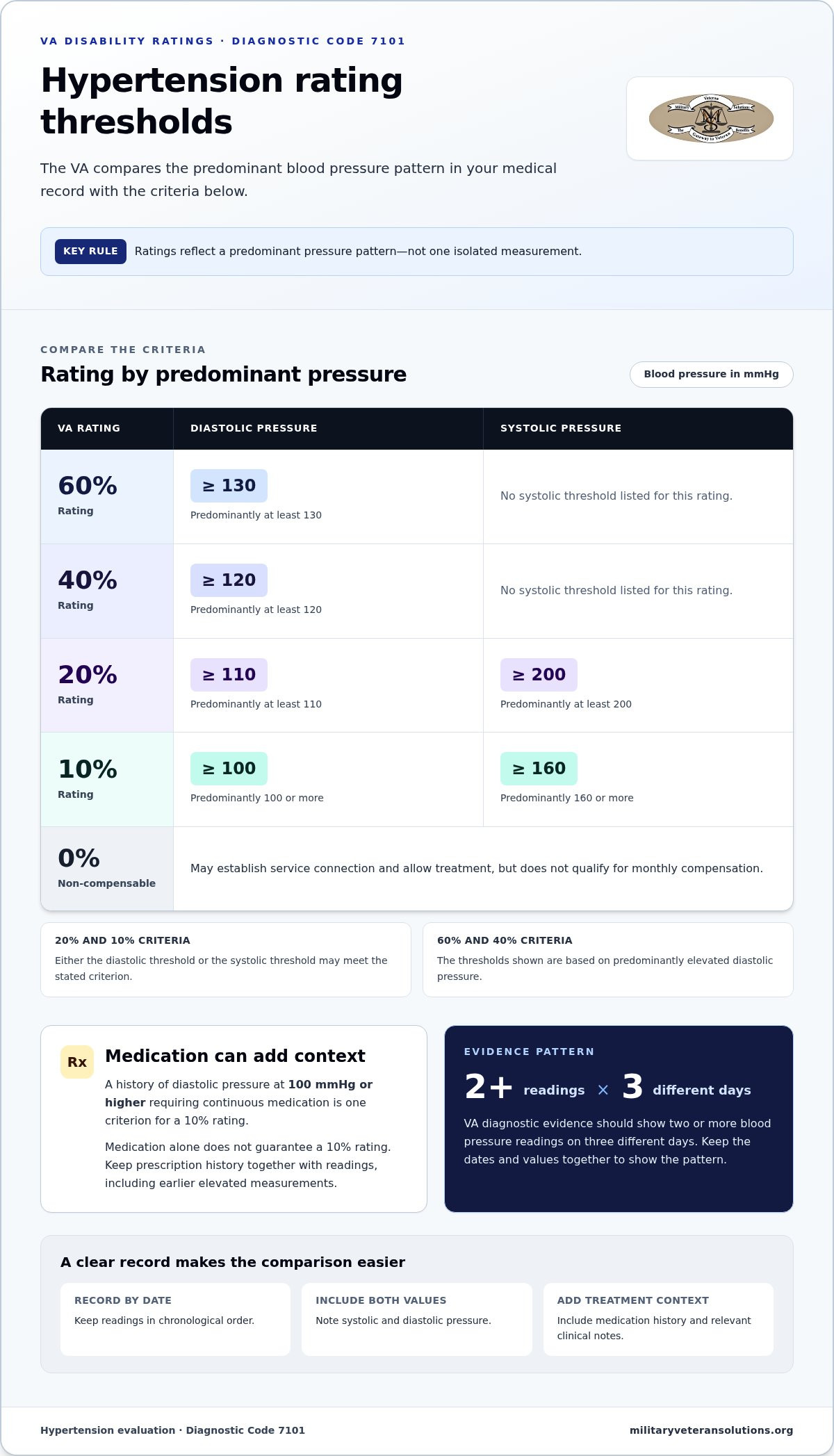
The VA evaluates service-connected hypertension using blood pressure readings and Diagnostic Code 7101. The rating reflects the pressure pattern documented in your medical record, not a single isolated measurement.
Hypertension Rating Thresholds
Rating thresholds compare predominantly elevated diastolic or systolic pressure against Diagnostic Code 7101 criteria. According to the U.S. Department of Veterans Affairs, a 60% rating applies when diastolic pressure is predominantly at least 130. A 40% rating applies when it is predominantly at least 120. A 20% rating applies when diastolic pressure is predominantly at least 110 or systolic pressure is predominantly at least 200. These distinctions help you compare documented readings with the assigned evaluation.
Lower thresholds matter, too. According to the U.S. Department of Veterans Affairs, a 10% rating applies when diastolic pressure is predominantly 100 or more, or systolic pressure is predominantly 160 or more. The VA rating schedule identifies Diagnostic Code 7101 as the code for hypertensive vascular disease, including hypertension and isolated systolic hypertension. The code gives the VA a consistent framework for evaluating blood pressure evidence.
A 0% rating is non-compensable, but still establishes service connection and allows treatment. That outcome differs from a denial: service connection may be recognized even when the assigned rating does not qualify for monthly compensation. Review the decision’s stated evaluation alongside the blood pressure evidence it discusses.
Continuous Medication and Rating Eligibility
Continuous medication means prescribed treatment is ongoing, but medication alone doesn’t guarantee a 10% rating. A history of diastolic pressure at 100 mmHg or higher requiring continuous medication is one criterion for a 10% hypertension rating. This matters when current readings are lower during treatment, because the historical pressure pattern and medication history can help explain the record.
Keep your prescription history together with your blood pressure readings. For example, records showing medication use alongside earlier elevated measurements may provide context that a recent, controlled reading cannot show on its own. The VA applies the relevant rating criteria; taking medication alone does not determine a rating. Make sure the evidence reflects both your treatment history and documented blood pressure patterns.
If the VA denies service connection or assigns a rating you believe does not reflect the evidence, start with the decision letter. Identify the reason given, then compare it with your diagnosis, pressure readings, medication records, and military documentation. A mismatch between the stated threshold and the cited readings may indicate that the evidence needs closer review. For example, if the decision overlooks a documented pattern that meets a higher threshold, organize those records by date and address that finding through an available review option. A clear comparison keeps your response focused on the issue in dispute.
How Can a Veteran Prove That Their Hypertension Is Service Connected?
Build your claim around two questions: do medical records establish hypertension, and do they connect it to military service? For a presumptive claim, qualifying service can establish the service connection without requiring you to prove that service directly caused the condition. For a direct claim, records should explain the relationship between your current diagnosis and an in-service event or condition.
Diagnosis and Blood Pressure Readings
VA diagnostic evidence should show two or more blood pressure readings on three different days. This pattern helps distinguish persistent hypertension from an isolated high reading. Keep the dates and values together instead of submitting separate measurements without context.
Normal blood pressure is below 120/80 mmHg. A reading of 130/80 mmHg or above usually indicates hypertension, while VA purposes define hypertension by diastolic pressure predominantly at least 90 mm or systolic pressure predominantly at least 160 mm. These are different reference points: a reading that suggests hypertension does not, by itself, establish the VA definition or service connection.
Service medical records documenting readings of at least 140/90 mmHg may support a claim. For example, an entry showing an elevated measurement during service can help establish when the issue appeared. Pair it with later diagnosis records and treatment notes so the evidence shows a timeline, not just a single moment.
Measurement Records and Monitoring
Organize readings by date, systolic value, diastolic value, and whether the record notes medication. Include relevant clinical notes explaining the measurement or diagnosis. A clear chronology helps show whether elevated pressure continued across separate days and how the condition developed after military service.
Home monitoring can add context, but keep the original log and bring it to medical appointments. Ask your treating clinician to document readings in your medical record when appropriate. A handwritten list may help explain your history, while clinical records provide a documented account of your diagnosis and care.
For direct service connection, the evidence needs to address the link between current hypertension and military service. Service records, post-service diagnosis records, and medical opinions can all contribute. If records show elevated pressure during service but a later diagnosis, a clinician’s explanation may clarify the significance of that gap.
For presumptive service connection, the key evidence is whether your service meets the applicable exposure requirements. You don't need to prove that service caused the condition when the presumption applies, but you still need evidence of hypertension. A focused review of military and medical records can help organize the service timeline and diagnosis evidence into a coherent claim.
Does taking blood-pressure medication guarantee a 10% rating?
No. Continuous medication alone doesn’t guarantee a 10% VA disability rating. A relevant criterion is a history of diastolic blood pressure at 100 mmHg or higher that requires continuous medication. The rating review considers the documented pressure history and treatment, so prescription records should be read alongside earlier measurements.
Medication can lower current readings without erasing the history that led to treatment. Gather records showing when medication began, what treatment was prescribed, and your blood pressure readings before and during treatment. For example, if your pressure improved after treatment, earlier clinic measurements can help show the pattern that prompted ongoing care. Don’t rely on a prescription list alone. Connect it to medical records documenting your diagnosis and treatment over time.
An emergency-room reading may also become relevant evidence. In an appeal involving a compensable hypertension rating, VA treatment records included an emergency-room blood pressure reading of 164/105. One measurement does not establish a continuing pattern by itself, but it can add context when considered with other dated readings, clinical notes, and medication history.
For a secondary claim, the question is whether a service-connected condition or its treatment caused or aggravated your hypertension. A medical nexus opinion can explain the relationship using your diagnosis, treatment history, and relevant records. The opinion is more useful when it addresses your specific history and explains how the evidence supports its conclusion, rather than simply noting that both conditions exist.
Can hypertension be claimed as secondary to another service-connected condition or medication? Yes. Include evidence connecting the condition or medication to hypertension, such as a medical opinion discussing causation or aggravation alongside your treatment timeline.
Arrange the evidence in a clear timeline: diagnosis, blood pressure readings, medication changes, and records for the service-connected condition. This helps show what happened before treatment and what changed afterward. If your claim involves Agent Orange exposure, service records may establish eligibility for the relevant presumption; medical evidence must still establish the hypertension diagnosis.
Before filing or responding to a VA decision, compare the decision’s reasoning with the actual records. If it overlooks a documented history of diastolic readings at 100 mmHg or higher, or leaves out medication evidence, identify the missing records and explain their relevance. A focused evidence packet lets the reviewer assess the treatment history, the pressure pattern, and any claimed medical connection together.
Effective dates and potential back pay
An effective date marks when VA compensation begins for an approved hypertension claim. That date, the assigned rating, and applicable requirements shape potential back pay.
Effective Dates
VA generally bases the start of compensation on filing dates and other legal requirements, not automatically on the diagnosis date. For example, a diagnosis recorded before you filed a claim does not, by itself, set the compensation start date. Keep the filing record and decision notice together to see which date VA used and how it explained its decision.
The PACT Act became law on August 10, 2022, and VA implemented the hypertension presumption before its October 1, 2026, phase-in date. If exposure rules support presumptive service connection, the claim still needs to be evaluated under applicable effective-date requirements. A prior denial can also matter: veterans with a previously denied hypertension claim can seek review as a supplemental claim under the new PACT Act rules.
Check the decision for the effective date and the basis for service connection. Compare that date with your filing history, including any earlier hypertension claim and later review submissions. Comparing the records can clarify whether the decision addressed the relevant claim history, exposure evidence, and connection to service.
Potential Back Pay
Back pay is compensation for a period covered by the effective date of an approved claim. The amount depends on the applicable monthly compensation and the period recognized in the decision. The rating matters: VA evaluates hypertension using documented blood pressure patterns, including diastolic readings, rather than the diagnosis date alone.
To understand the calculation, read the effective date and rating in the decision together. Compare them with your claim timeline and the VA’s explanation of service connection. For a presumptive claim, organize records establishing qualifying exposure separately from those confirming the hypertension diagnosis. For a secondary claim, focus on evidence connecting hypertension to the service-connected condition or its treatment.
If a denial came before a later award, examine the review history and the reason for the denial. A supplemental claim under the PACT Act rules can affect how the VA reviews a previously denied hypertension claim, but the decision still states the effective date used. Keep copies of each notice, filing confirmation, and supporting record. These documents help you track the period covered by the decision and whether the monthly compensation reflects the assigned rating.
Filing a hypertension disability claim
Filing starts with VA Form 21-526EZ, the application for disability compensation. A strong claim makes the path clear: current hypertension, the basis for service connection, and records supporting both. Presumptive eligibility, direct service connection, and secondary service connection rely on different evidence, so identify the route that matches your circumstances. A VA claim for hypertension presumptive service connection should also make the qualifying service basis easy to identify.
For a presumptive claim involving Agent Orange, connect your diagnosis to records showing qualifying service. Service in the Republic of Vietnam between January 9, 1962, and May 7, 1975, is among the qualifying periods. DD-214s, personnel records, and other military documents can help establish where and when you served. If you served elsewhere, compare your service location and dates with the VA’s applicable exposure rules.
For direct service connection, assemble evidence explaining the relationship between hypertension and military service. Service medical records, post-service diagnosis records, and relevant medical opinions can help establish the condition’s history and connection to service. If your claim is based on a secondary condition, include evidence addressing how that service-connected condition or its treatment relates to hypertension.
Organize your application materials so the reviewer can follow the evidence clearly. Include:
- Medical records documenting the hypertension diagnosis and blood pressure readings.
- Service records supporting the exposure location and service period for a presumptive claim.
- Relevant treatment history and medical opinions for direct or secondary service connection.
- Prior VA decision letters if the condition was previously denied.
Keep a copy of the submitted form and supporting records. Check that dates and identifying details remain consistent across the application, service documents, and medical evidence. For example, a personnel record may help explain a location that does not appear clearly on a DD-214. A well-organized submission helps connect that detail to the claimed disease and the requested disability benefits. For a VA claim for hypertension presumptive eligibility, clear service documentation can help show why the exposure rules apply.
If VA denied an earlier hypertension claim, the PACT Act rules allow veterans to seek review through a supplemental claim. Veterans generally use VA Form 20-0995 for that review. Higher-Level Review generally must be requested within one year of the decision notice. Read the decision letter carefully, identify the reason for denial, and match new or overlooked evidence to that specific issue.
Filing the claim is only one part of the process. The records must support the route to service connection and the claimed disability. If a denial or rating decision leaves key evidence unresolved, request help with a VA claim or appeal to assess the decision and organize the next filing.
Military Veteran Solutions: Filing VA appeals
Military Veteran Solutions, LLC helps veterans assess VA decisions and pursue next steps when a hypertension claim is denied or rated incorrectly. Its VA Decision Letter Analysis and Military Record Reviews can help identify issues in the decision or gaps in service documentation. When an appeal is appropriate, the firm provides Veteran Claims Representation and files VA appeals based on a review of the claim and supporting records.
If you’re weighing a denial, a rating, or evidence tied to qualifying service, focused support can help clarify the issues to address. Contact Military Veteran Solutions, LLC to discuss your VA claim.
Take the Next Step With a Clear Claim Strategy
Your next step is to make the record tell a coherent story: what you’re claiming, why you believe it connects to service, and which evidence supports your position. For a VA claim for hypertension presumptive service connection, keep your service timeline and claim documents organized so the basis for eligibility remains clear as your case progresses.
If a VA decision leaves you unsure what to do next, Military Veteran Solutions, LLC can provide Veteran Claims Representation, review your military records, and file VA appeals. For a VA claim for hypertension presumptive eligibility, the firm can review your decision and supporting documents, then identify a path forward that fits your claim. You don’t have to work through a difficult decision alone.
Contact Military Veteran Solutions, LLC for help with your VA claim or appeal. Take the next step with a clearer understanding of your options and the evidence behind them.
Frequently Asked Questions
Is Hypertension a Presumptive Condition?
Yes, hypertension is presumptive for veterans who meet the VA’s Agent Orange exposure requirements. The PACT Act of 2022 added hypertension to the conditions covered by this presumption. For a VA claim for hypertension presumptive service connection, establish a current diagnosis and document qualifying service. The presumption can address the connection to service, but the VA separately evaluates the disability rating.
Can I qualify if hypertension developed years after service?
Yes. A later diagnosis can still qualify if your service meets the applicable Agent Orange exposure rules. The delay between service and diagnosis does not, by itself, prevent a presumptive claim. Keep records showing when hypertension was diagnosed and how it has been treated. If the presumption does not fit your service history, evidence connecting the condition directly or secondarily to service may support another claim pathway.
How Does VA Rate Hypertension?
The VA evaluates hypertension under Diagnostic Code 7101, based on the documented pattern of blood pressure readings. The schedule ranges from 0% to 60%, with thresholds tied mainly to diastolic pressure and, for some evaluations, systolic pressure. A 0% evaluation is non-compensable but still recognizes service connection. Read the decision’s explanation to see which medical evidence supports the assigned level.
Is it hard to get VA disability for hypertension?
The evidence you need depends on how you establish service connection. A presumptive claim relies on qualifying service and a current diagnosis, while a direct claim needs evidence linking hypertension to service. Missing records or unclear service dates can make a claim harder to assess. Organize medical and personnel documents by date, and make sure they support the specific pathway you’re claiming.
Is hypertension a presumptive condition for VA disability compensation?
Yes. Hypertension may qualify for presumptive service connection and VA disability compensation if you meet the applicable exposure requirements. Presumptive eligibility addresses service connection; it does not automatically determine the compensation level. The VA evaluates the condition’s severity separately. When preparing a VA claim for hypertension presumptive eligibility, keep evidence of qualifying service distinct from medical records supporting diagnosis and rating.
Which veterans qualify for presumptive VA service connection for hypertension?
Veterans who meet VA Agent Orange exposure rules may qualify, including eligible Vietnam veterans and certain Blue Water Navy veterans. The rules also cover specified service in other locations and periods, and former prisoners of war may qualify under a separate presumption for hypertensive vascular disease. Your service records should identify where and when you served so the relevant eligibility rule can be applied to your history.
Which locations and service periods qualify for presumptive hypertension due to herbicide exposure?
Listed periods include Vietnam from January 9, 1962, to May 7, 1975; Thailand bases from January 9, 1962, to June 30, 1976; Laos from December 1, 1965, to September 30, 1969; Guam or American Samoa from January 9, 1962, to July 30, 1980; Johnston Atoll from January 1, 1972, to September 30, 1977; and the Korean DMZ from September 1, 1967, through August 31, 1971. Qualifying Cambodia service included Mimot or Krek, April 16 through April 30, 1969.
What evidence and documents are needed to file a VA hypertension claim?
Gather medical records showing your diagnosis, treatment, and dated blood pressure readings, plus service documents supporting the claimed connection. A DD-214, personnel records, or other military records can help establish location and service dates for an exposure-based claim. For a direct or secondary claim, include relevant treatment records and medical evidence addressing the relationship. If the VA previously denied the claim, include the decision letter and records relevant to its stated reason.