
The next step after a service-connection denial depends on what the record needs: a Supplemental Claim can add new and relevant evidence, while a Higher-Level Review is limited to the evidence VA already considered. If the Board of Veterans’ Appeals denied your claim, you generally have 120 days from the date of its final decision to appeal to the U.S. Court of Appeals for Veterans Claims, according to that court. Understanding how to appeal a VA denial for no service connection starts with identifying which part of the link between your condition and service the decision found lacking.
A denial can feel final, especially when you know your condition affects your life and believe it began during or was worsened by service. The VA decision letter is the place to start: it explains the reasons for denial, which can show what evidence or review option may address the gap. This article explains the review options, what evidence each allows, and which disability and service records may support a connection. It also covers what to consider if the Board has already ruled on your claim.
Key Takeaways
- Read the denial notice closely and identify the specific link between your condition and service that VA found missing.
- Match your review option to the issue: a new, relevant record may support a different path than an error in the existing file.
- For a Supplemental Claim, focus new evidence on the reason VA denied the claim rather than resubmitting records already in the file.
- Organize records to show a current condition, an event or exposure during service, and evidence connecting the two.
- Consider a review of your decision and military records when you need help identifying gaps and preparing an appeal.
Choosing among a Supplemental Claim, Higher-Level Review, and Board Appeal
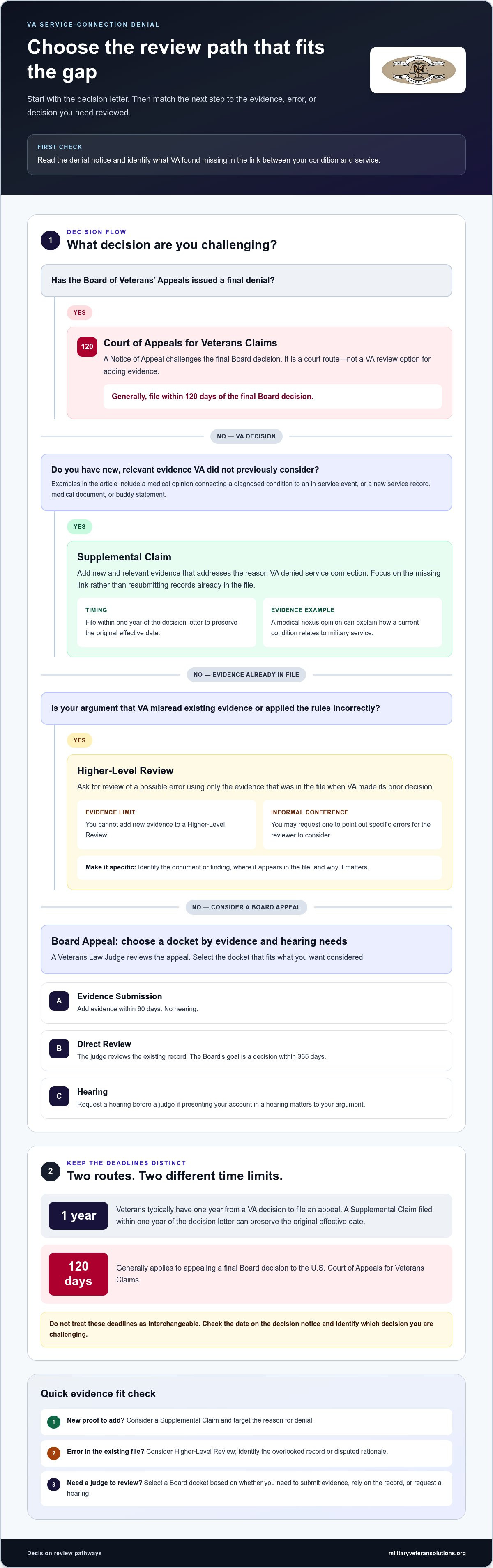
The U.S. Department of Veterans Affairs says veterans typically have one year from the date of a VA decision to file an appeal. For a final Board decision, a different deadline applies: the U.S. Court of Appeals for Veterans Claims says a veteran generally has 120 days from the decision date to file a Notice of Appeal.
- Mark the deadline and identify the decision. Find the date on the VA decision notice, then note the review deadline that applies. The one-year period generally concerns review of a VA decision; the 120-day period applies when appealing a final Board of Veterans’ Appeals decision to the Court of Appeals for Veterans Claims. Don’t treat those deadlines as interchangeable.
- Choose a Supplemental Claim if you have new, relevant evidence. Use this path when evidence not previously considered addresses the reason VA denied service connection. For example, a medical opinion connecting a diagnosed condition to an in-service event may address a missing link. File within one year of the decision letter to preserve the original effective date.
- Choose Higher-Level Review to challenge an error in the existing record. This option fits when you believe VA misread evidence already in the file or applied the rules incorrectly. You can’t add new evidence to a Higher-Level Review. Request an informal conference if you want to identify specific errors for the reviewer to consider.
- Select a Board docket based on your evidence and hearing needs. A Veterans Law Judge reviews Board appeals. On the Evidence Submission docket, appellants may add evidence within 90 days without a hearing, according to the Board of Veterans’ Appeals. The Direct Review docket uses the existing record; the Board’s goal for a Direct Review decision is within 365 days. A hearing docket lets you request a hearing before a judge.
- Prepare the Board appeal to match the issue. Explain whether the dispute concerns evidence, a legal error, or both, and select the docket that fits. A hearing can let you present your account to a Veterans Law Judge, while Direct Review relies on the record. Avoid choosing a docket without considering whether additional evidence or testimony matters to your service-connection argument.
- If the Board has issued a final denial, assess court review promptly. A Notice of Appeal to the Court of Appeals for Veterans Claims challenges the final Board decision, rather than adding evidence through another VA review option. The court route has its own 120-day deadline, so identify the decision date and act within that period.
Higher-Level Review evidence limits and informal conferences
Before requesting Higher-Level Review, separate evidence VA already had from records you gathered afterward. Under 38 C.F.R. § 3.2601, the reviewer considers the evidence in the file when VA made its prior decision. That limit shapes both your argument and your choice of review path.
- Check what was in the record on decision day. Compare the denial notice with the service and medical records VA considered. Note missing pages, overlooked entries, or a medical opinion the decision failed to address. A Higher-Level Review can examine whether VA made an error based on that existing file, but it cannot add later evidence to fill a gap.
- Frame the request around a specific error. Use VA Form 20-0996 and identify the finding you challenge. For example, point to a service treatment entry that the decision overlooked, or explain why the stated rationale conflicts with a medical opinion already submitted. A focused explanation helps direct review toward the disputed issue rather than repeating the entire claim.
- Use an informal conference to clarify the argument. If you request one, prepare concise points tied to the existing record. Identify the document, its location in the file, and why it matters to service connection. Treat the conference as a chance to explain a potential error, not as a hearing to introduce new facts or submit new medical records.
- Reserve new evidence for a path that accepts it. A medical nexus opinion can explain how a current condition relates to military service. A useful opinion states that the relationship is “at least as likely as not” and explains its medical reasoning. If you obtain that opinion after VA’s decision, a Higher-Level Review cannot consider it as new evidence; a Supplemental Claim may be a better fit.
- Organize lay statements around firsthand observations. A buddy statement can describe an event witnessed during service, changes noticed afterward, or symptoms observed over time. Ask the writer to give concrete details, such as what they personally saw and when, rather than offering a medical diagnosis. Your own account can explain what happened and how symptoms continued, while medical evidence addresses diagnosis and clinical connection.
- Avoid duplicating records without a purpose. Resubmitting documents already held by the Department of Veterans Affairs can slow the process. Instead, list the records you believe were overlooked and explain their relevance. If the missing proof is a new service record, medical document, or buddy statement, organize it for a supplemental filing rather than relying on an evidence-limited review. A military record review can help identify which service documents may support the argument.
What Decisions Can be Appealed?
Read the decision letter’s reasons and bases, then identify which part of service connection VA found unsupported. For example, VA may accept that you have a current diagnosis but find insufficient evidence of an in-service event or a link between the condition and your service.
To request Higher-Level Review, file VA Form 20-0996 and identify the decision and disputed issue. You may request an informal conference on the form to explain specific errors in the existing record.
- Identify whether the decision is reviewable. A claimant may appeal adverse decisions on VA-administered benefits, including compensation benefits, under 38 U.S.C. § 7104. Locate the benefit and issue in the notice, such as a denied compensation claim for a mental health condition. Then separate that decision from any other issues VA decided.
- Read the denial rationale before choosing a review. Find the stated findings, evidence VA considered, and explanation for denying service connection. Note whether VA disputes the current condition, an in-service event, or the connection between them. For instance, if VA acknowledges a diagnosis but discounts an existing medical opinion, identify the opinion and the reason given.
- Compare the rationale with the evidence in the file. Review the VA claims file, often called the C-file, to see which service records, medical records, and statements were considered. Request access to the file through VA’s records process if you need to examine it. Make a short list matching each disputed finding to relevant evidence already in the record.
- Use Higher-Level Review for an alleged error in that record. This path asks a more senior reviewer to reassess the prior decision using evidence VA had at the time. State the specific error rather than repeating the full claim. For example, point to a service record the decision overlooked or explain how an existing medical opinion addresses the stated reason for denial.
- Prepare for an informal conference with focused points. On VA Form 20-0996, request the conference and identify the issues you want to discuss. Before it, organize the decision’s finding, the record location, and your explanation of the error. A conference helps clarify the argument, but it does not allow you to add new evidence or replace a missing opinion.
- Choose another review route if the record needs new proof. If your argument depends on a medical opinion or service document that was not in VA’s file, an evidence-accepting option may fit better than Higher-Level Review. Keep the distinction clear: an existing-record error supports review of the prior decision, while new relevant evidence supports a different filing strategy.
Supplemental claims
To file a Supplemental Claim, submit VA Form 20-0995 and new, relevant evidence tied to the reason VA denied service connection. If you miss the deadline for appealing a final Board decision, you may ask the VA Regional Office to reopen the claim with new, relevant evidence.
- Match the new evidence to the denial. Under 38 C.F.R. § 3.2501, evidence must relate to the reason VA denied the prior claim. If VA accepted your diagnosis but found no connection to service, a medical opinion explaining that connection may address the gap. A record that does not speak to the denial rationale may add little to the appeal.
- Gather records VA did not previously consider. Look for relevant service records, medical documentation, or statements from people with firsthand knowledge. For example, a newly located duty record may document an event, while a buddy statement may describe what a fellow service member observed. Explain how each item relates to the specific condition and missing service-connection element.
- Complete VA Form 20-0995 with a focused explanation. Identify the prior decision and the condition you want reviewed. Describe the new evidence and why it matters, then submit the supporting records with the form. Keep copies of the form and evidence together so you can track exactly what you sent during the appeals process.
- Use the Supplemental Claim route after a missed deadline when appropriate. A claimant who misses the deadline to appeal a final Board of Veterans’ Appeals decision may reopen the claim at the Regional Office by submitting new and relevant evidence. This is a VA claim route, not an appeal to the court. Reopening does not preserve the original claim’s effective date or retroactive compensation that a timely appeal could have preserved.
- Keep VA’s role in evidence gathering in view. Filing a Supplemental Claim triggers VA’s duty to assist in gathering federal records connected to the new evidence, under 38 C.F.R. § 3.2501. Identify the federal records relevant to your argument, such as service or VA medical records, and explain their connection to the denied issue.
- Distinguish a VA claim from court review. The Court of Appeals for Veterans Claims has exclusive jurisdiction over appeals from Board of Veterans’ Appeals decisions. A Veterans Law Judge reviews a Board appeal; the court reviews a Board decision. A Supplemental Claim instead returns new, relevant evidence to VA for consideration at the Regional Office.
- Organize your submission around the missing link. Label each document by source and date, and briefly state what it supports. VA’s stated average processing goal for a Supplemental Claim is about 125 days. Strong organization helps show how the evidence addresses the denial, rather than simply repeating information VA already considered.
Documenting disability and service connection
- Break the claim into its key evidence links. If you’re deciding how to appeal a VA denial for no service connection, first identify which link VA found unsupported. Under 38 C.F.R. § 3.303, a service-connection claim generally needs a current diagnosis, an in-service event, injury, or exposure, and a medical nexus connecting them. For example, if VA accepted your diagnosis but questioned its relationship to service, focus on evidence addressing that connection.
- Document the current disability with medical records. Gather records identifying the diagnosed condition, its symptoms, and relevant treatment history. For a mental or physical condition, make sure the records clearly concern the disability named in the VA decision. This evidence establishes the present condition; it doesn’t, by itself, show that military service caused or worsened it.
- Build a record of the in-service event. Collect service records that may document an injury, illness, exposure, or relevant symptoms. Add a clear account of when and where the event occurred, what happened, and how it affected you. A claim may involve active duty, active duty for training, or inactive duty training, alongside a current illness or injury affecting the mind or body.
- Connect the diagnosis to service with medical reasoning. A nexus opinion should explain how the current condition relates to the documented event, injury, or exposure. For a disability claim, the opinion should state that the connection is “at least as likely as not” and explain its medical reasoning. A conclusion without an explanation may not address why VA found the service connection unsupported.
- Describe firsthand events and symptoms in your own words. Use VA Form 21-4138, Statement in Support of Claim, to explain what happened during service and how the condition affects you. Keep the account specific: describe observed symptoms, when they began, and how they continued. A fellow service member’s statement can add firsthand observations, but shouldn’t be presented as a medical diagnosis.
- Check whether a presumptive route may apply. VA presumes service connection for certain qualifying chronic diseases that manifest within the one-year period after discharge. Presumptions also apply to certain illnesses caused by toxic chemical or hazardous-material exposure and illnesses connected to time spent as a prisoner of war. Organize records showing the condition and the facts relevant to the applicable category.
- Use a Supplemental Claim when new evidence fills the identified gap. For veterans weighing how to appeal a VA denial for no service connection, tie each new document to the reason VA denied compensation, rather than sending unrelated records. If you need help aligning disability records with the service-connection issue, get support with your veteran claim.
Military Veteran Solutions: Filing VA appeals
Military Veteran Solutions, LLC helps veterans pursue VA appeals by reviewing decision letters, military records, and claim documentation. Its Veteran Claims Representation can help you understand how the denial rationale, service records, and disability evidence fit together.
A review can clarify whether your appeal should address an error in the existing record or provide new supporting evidence. Military Record Reviews and VA Decision Letter Analysis can help identify relevant records and the specific findings that need a response. When you’re ready to organize your case and move forward, Military Veteran Solutions, LLC provides representation and advocacy for filing VA appeals.
Contact Military Veteran Solutions, LLC or visit militaryveteransolutions.org to discuss your VA appeal.
Make Your Next Move With a Clear Record
If you’re deciding how to appeal a VA denial for no service connection, build a clear, evidence-based account of your claim. Describe the service event, the condition that followed, and the records supporting each part. This keeps your filing focused on the reason for the denial rather than unrelated details.
Keep copies of the decision, your evidence, and everything you submit. Recording what you sent and why can help you stay organized as your appeal moves forward. A clear account of your service and disability history helps present your claim.
For support with your next step, contact Military Veteran Solutions. Your experience matters, and a focused appeal can help make your evidence easier to understand.
Frequently Asked Questions
What evidence is needed to establish service connection for a VA disability claim?
Generally, the claim needs evidence of a current condition, an in-service event or exposure, and a connection between them. Under 38 C.F.R. § 3.303, a diagnosis alone may not establish that service caused or worsened the condition. For example, pair treatment records confirming a diagnosis with service documents describing an injury and a medical opinion explaining their relationship. Each piece should support a specific part of the claim.
What are the differences between a Supplemental Claim, Higher-Level Review, and Board Appeal?
A Supplemental Claim lets you submit new and relevant evidence addressing the denial. A Higher-Level Review asks VA to reconsider the decision based on the existing record, so you can’t add evidence. A Board Appeal asks a Veterans Law Judge to review the decision under a selected docket. The key distinction is whether you need to provide new evidence, point to an error in the existing record, or seek Board review.
How do you appeal a VA decision to the Board using VA Form 10182, and what are the docket options?
Use VA Form 10182 to identify the decision you’re appealing and select a Board docket. Direct Review asks a Veterans Law Judge to consider the existing record. Evidence Submission allows additional evidence without a hearing; the Board of Veterans’ Appeals permits submissions within 90 days. The Hearing docket includes a hearing before a Veterans Law Judge. Choose based on whether your argument needs new evidence, testimony, or review of the current file.
Can new medical evidence, a nexus letter, or a C&P exam help overturn a service-connection denial?
New medical evidence can strengthen a claim when it addresses the specific reason for the denial. A nexus letter is most useful when it explains the medical basis for linking your diagnosed condition to service, rather than offering only a conclusion. A C&P exam may also provide relevant findings. Because Higher-Level Review is limited to the existing record, submit new evidence through a review option that accepts it.
Can a veterans service officer or accredited VA attorney help appeal a service-connection denial, and what do they charge?
A Veterans Service Officer or VA-accredited attorney can help request a decision review; attorneys must be VA-accredited to represent veterans before the agency. Fee arrangements vary by representative and service. Military Veteran Solutions offers Veteran Claims Representation, and its initial consultation is free. Any other fee depends on the case and is provided after a quote request, so consider the proposed work and terms before proceeding.