
A remand isn’t an approval or a final denial. It means the Board of Veterans’ Appeals has sent your appeal back to VA for additional evidence or another required action. Understanding what happens after a BVA remand can help you prepare for the next stage: the process may take several months to 1 to 2 years, depending on the work needed.
The wait can feel like another setback, especially after you’ve already spent time pursuing your claim. But a remand doesn’t restart the case from zero. This guide explains why the Board may remand an appeal, what the VA may do next, when you might need to respond, and how the case can move toward another decision. You’ll also see why timelines vary and what to look for in the remand instructions, so you can better understand where your appeal stands.
Key Takeaways
- A Board remand means more development or action is needed before a decision, not that your claim has been approved or finally denied.
- The post-remand process may take several months to 1 to 2 years, depending on the work required.
- VA may seek records, arrange a new C&P examination, or request information to address the remand instructions.
- Read VA notices carefully and respond to requests, since your timely input may help move the appeal’s development forward.
- After the instructions are completed, the claim may receive a decision or return to the Board, depending on the type of appeal.
VA Remand Timeline 2026: How Long Does a Board Remand Take?
After a Board remand, the next stage may take several months to 1 to 2 years, depending on the work required. The VA had no official statistic for the exact average wait after a Board remand as of April 2026. The timeline can include regional office review, evidence development, and a decision after the remand instructions are addressed. Initial review by regional office staff can add weeks before development begins.
The next steps depend on the instructions in your remand order. VA may need to obtain missing records, arrange a medical opinion, or request information from you. Its duty to assist applies to remanded claims and includes helping gather evidence needed to develop the claim. The process can involve both VA action and documents you submit. A records or forms request can affect how quickly VA gets the information it needs.
Watch for letters and respond to requests for information. If VA needs you to take a step to continue claim development, it will notify you by mail. A veteran with a VA TDIU claim may be asked to submit VA Form 21-8940, according to the U.S. Department of Veterans Affairs. Read each notice closely, note its requested action, and send the relevant information through the stated process.
Evidence development can include obtaining medical records or arranging a new medical opinion. When the appeal reaches a VA Regional Office, it should remain there for at least 30 days to allow new evidence to be submitted. That period gives you an opportunity to provide focused material relevant to the remand, such as a record addressing the specific gap identified by the Board. Unrelated documents can make it harder to identify the evidence that answers the remand issue.
Can I request an advancement on the docket or expedited processing for a remanded appeal? A remand does not automatically mean expedited handling. The Board generally works appeals in docket order, subject to exceptions in its docket priority rules. Any request for priority must be considered under those rules.
Keep a copy of each form and record you submit, along with the date sent. If a VA notice asks for a specific document, provide it rather than assuming VA already has it. For example, a request for treatment records calls for records relevant to the condition or period identified. Responding directly helps keep the evidence development focused.
Once the regional office completes the additional evidence gathering, the appeal typically returns to the Board for a decision. The total wait depends on the tasks required, the records involved, and how long each step takes.
Meaning of a Board of Veterans’ Appeals remand
A remand sends a veterans’ appeal back for additional action before the Board decides it. The instructions determine what VA must address next and where the appeal goes afterward.
Effect of a Board Remand
A Board remand is an order for more work, not an approval or final denial of the claim. The Board has not upheld the initial denial and has identified an issue requiring further action. What happens to a VA claim after the BVA remands it? VA must carry out the instructions before the appeal can move toward its next decision. A remand may address a missing record, a procedural step, or another unresolved matter.
The Board may grant, deny, or remand a claim, and one decision can combine those outcomes for different issues. A judge may remand the same case more than once, with no stated limit on the number of remands. The key is to read which issues were sent back and what evidence or action each instruction requires.
Handling the Remanded Appeal
The VA Regional Office handles the development directed by the Board’s remand. The Board sends the appeal back to VA, where the regional office addresses ordered tasks, such as obtaining records or considering evidence. Which VA office or agency handles a remanded BVA appeal? The VA Regional Office generally carries out the remand work. Where applicable, the Board resumes its role when the appeal returns for further review.
This distinction helps you understand notices and decisions that arrive during the process. VA may send a letter requesting records or another action while the case is with the regional office. Keep the letter with your remand order so you can connect the request to the issue the Board identified.
Compliance With Remand Instructions
To comply, VA must complete the actions ordered by the Board and address the specific issue identified in the remand. What steps must the VA take to comply with a BVA remand? It must follow each instruction, which may require gathering information, obtaining evidence, or applying relevant procedures. Compare the remand order with later VA notices to see which actions are underway.
If VA fails to address an instruction, identify the exact direction and the action that appears to be missing. Raise the concern with VA in writing and keep a copy with the remand order and related notices. This creates a clear record of the unaddressed task instead of a general objection to the outcome.
Readjudication and Return to the Board
Readjudication means VA reviews the claim again after completing the ordered development. The regional office may grant the claim or continue the denial. What happens next depends partly on the appeal type: after gathering requested information in a legacy appeal, VA returns it to the Board for a final decision. In a modernized appeal, VA makes a final decision after completing the remand work, and the appeal does not return to the Board.
If the Board later denies a claim, a veteran may appeal to the Court of Appeals for Veterans Claims or file a Supplemental Claim with additional evidence. These are different paths, so the decision and the evidence available matter. If another appeal is needed, filing a VA appeal can be a practical next step to address the decision.
Additional C&P examinations and medical records
A Board remand may direct VA to schedule a new Compensation and Pension (C&P) examination, obtain records, or consider new evidence. These tasks address specific gaps affecting the appeal. For example, if the file lacks a medical opinion on an issue, the remand may ask VA to obtain one. The regional office develops the evidence before the claim moves toward another decision.
A C&P examination gives VA additional medical information to evaluate the remanded issue. The Board’s instructions guide what VA needs to address, so the examination relates to the question identified in the remand. A new exam may be needed when the appeal requires a medical assessment that the existing record does not provide. Check the remand order and examination notice to identify the issue under review.
Records gathering can involve locating missing medical documentation relevant to the claim. VA may obtain records as part of evidence development, while the remand may also direct it to consider evidence already submitted. For example, if a record cited in the appeal is missing from the file, obtaining it may help complete the evidence under review. The focus is on the evidence needed to address the Board’s instructions.
VA may also check whether earlier evidence is accurate and complete. That review can identify a missing document or the need for a new medical opinion. These are distinct tasks: gathering records adds documentation, while an examination or opinion provides a medical assessment. The remand order identifies the required work, so comparing each development step with its wording helps clarify what VA is completing.
When you receive a notice requesting information or describing a scheduled examination, read it alongside the remand instructions. Identify the condition or issue named in both documents. If you submit evidence, make its connection to that issue clear. A focused record or explanation helps VA understand how the material relates to the question the Board sent back.
Keep the remand order, VA notices, submitted records, and examination-related correspondence together. This gives you a practical record of what evidence was requested or provided. If the remand calls for records from a particular period or concerning a specific condition, use those details to organize relevant material. Don’t assume a document is in the file simply because you submitted it earlier.
The development process may involve several actions, not just an examination. VA might gather medical records, arrange a C&P examination, and review prior evidence for accuracy before completing the remand work. Each action addresses a different evidence need. Your remand instructions show which steps apply and what information they are intended to address.
Estimated post-remand timeline
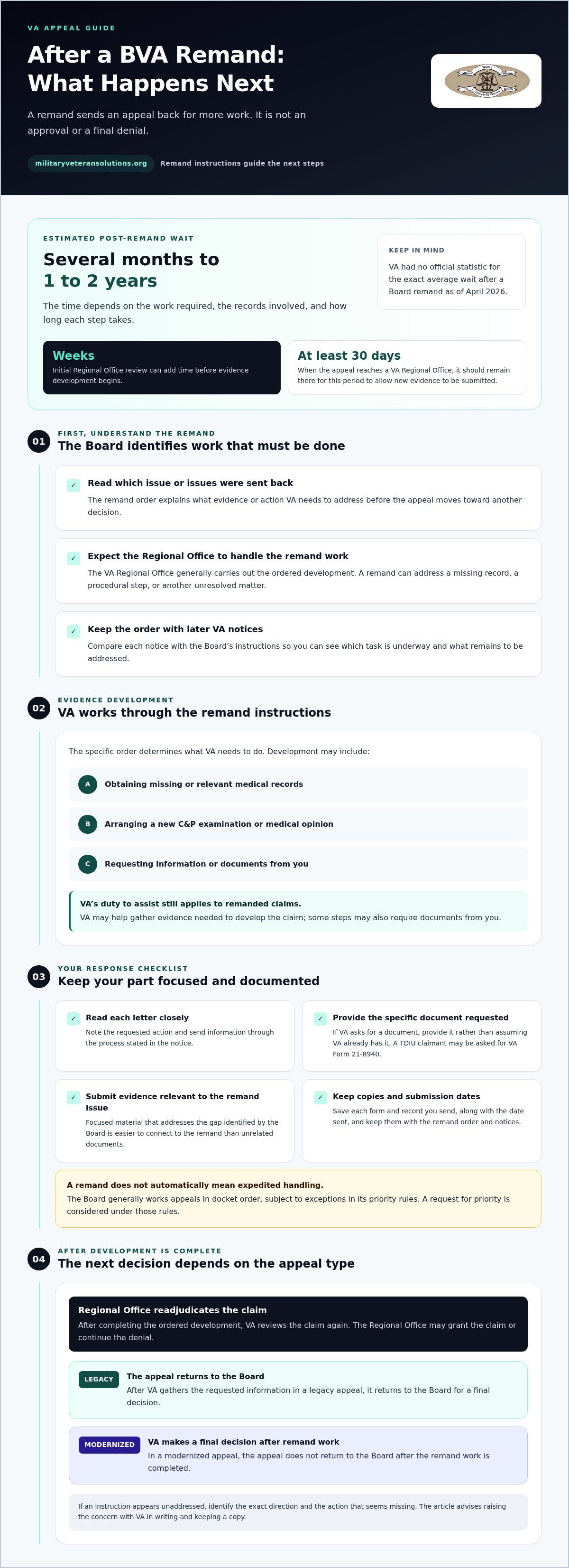
A post-remand wait may range from several months to 1 to 2 years, depending on the work required. As of April 2026, VA had no official statistic for the exact average wait after a Board remand. For veterans asking what happens after a BVA remand, the timeline depends on the tasks in the order, not a fixed schedule. A file needing a single review may move differently from one requiring records, an examination, and further evaluation.
The regional office’s initial file review can add weeks before the ordered development begins. Staff must identify the Board’s instructions and determine which tasks remain outstanding. For example, an order to obtain medical records creates a different workload from one requiring a new medical opinion. The type and availability of evidence, along with any response needed from you, shape the next steps and their sequence.
Evidence development is another major factor. A remand may require VA to gather missing medical records, arrange an examination, or obtain an opinion. Each task has stages: VA makes requests, receives evidence or completes an examination, and reviews the results against the remand instructions. If a required step remains incomplete, the regional office cannot finish that part of its review. Tracking VA requests helps you see what stage the appeal has reached.
After development, the regional office reviews the claim and decides whether to grant it or continue the denial. If the appeal returns to the Board, another wait follows before a decision. The Board generally works appeals in docket order, subject to exceptions in its docket priority rules. Understanding what happens after a BVA remand means accounting for both the regional office’s completed work and the appeal’s place in the applicable review process.
A Court of Appeals for Veterans Claims (CAVC) remand follows a different timeline from a Board remand. The estimated period for a BVA decision after a CAVC remand is three to nine months, while the full CAVC remand process may take 12 to 26 months or longer. These estimates apply to court-remanded cases, not every appeal returned by the Board. Distinguishing the type of remand helps set a more relevant expectation.
To understand how the appeal is progressing, match each VA notice to the task it addresses. A records request, examination notice, or regional-office decision marks a different stage. Keep correspondence and submitted evidence together, with dates. This record can help you identify whether VA is still developing the claim or has completed its review and moved toward readjudication.
Following the remand instructions
The remand order sets out the work VA must complete before moving the claim forward. Read each instruction separately and note the evidence, review, or procedure it identifies. For example, an order may require VA to obtain a record or reconsider an issue using additional evidence. These directions guide the next stage, so a general update may not show whether every requested task is complete.
VA’s next steps depend on the specific remand. The regional office may gather information, arrange an examination, or review evidence already in the file. Match each notice to the instruction it addresses. If VA requests a document, provide the requested information through the stated process and keep a copy. This makes it easier to track what you have submitted and what remains outstanding.
After completing the ordered work, the regional office reviews the claim again. It may grant the claim or continue the denial. A grant means VA has changed its decision on that issue; a continued denial means it remains unresolved. Read the decision closely to see which claims or issues it covers, rather than assuming it addresses every part of the appeal.
The appeal path after readjudication depends on its type. A VA claim decided on or after February 19, 2019, is considered a modernized appeal. After VA gathers the requested information for a modernized remand, it makes a final decision, and the appeal does not return to the Board. A claim decided before February 19, 2019, is considered a legacy appeal. After gathering the requested information, VA returns that appeal to the Board for a final decision.
A second Board remand means the process starts again. The new order identifies the remaining work, which may differ from the earlier instructions. Compare both orders to understand what VA has addressed and what the Board now requires. A repeated remand may therefore involve new evidence development or further review of an issue that remains unresolved.
A remand from the Court of Appeals for Veterans Claims follows court instructions directed to the Board. Those instructions may require the Board to reevaluate evidence, gather information, or apply the correct legal standards. The Board must address the court’s order before issuing its next decision. This process differs from a Board remand sent to a regional office.
Keep the remand orders, VA notices, submitted documents, and decisions together. Use them to track each instruction and the response that follows. If you need help evaluating the appeal record and its next steps, review your VA appeal options.
Military Veteran Solutions: Filing VA appeals
Military Veteran Solutions, LLC helps veterans pursue VA benefits through filing VA appeals and Veteran Claims Representation. If a remand order or later decision leaves you unsure how to proceed, VA Decision Letter Analysis can clarify what the decision says and which issues remain. Military Record Reviews can also help identify service-record details relevant to a claim.
Consider support when you need help understanding the decision, organizing the record, or pursuing an appeal after VA completes its remand review. The next step is to discuss your claim and the documents connected to it. You’re welcome to contact Military Veteran Solutions, LLC to talk about your VA appeal.
Keep Your Appeal Moving With a Clear Record
Use the period after a remand to keep your appeal file organized and ready for the next decision. Save VA letters, copies of submitted documents, and notes about actions you’ve taken together. When a new notice arrives, compare it with your records to understand what has changed and what still needs attention. A clear file makes it easier to explain your position and respond thoughtfully as the appeal progresses.
Knowing what happens after a BVA remand is useful, but understanding how each decision affects your claim is the next step. If you want support evaluating your VA appeal and deciding how to proceed, contact Military Veteran Solutions for a free initial consultation.
Discuss your VA appeal with Military Veteran Solutions. Move forward with a clearer understanding of your options and the record before you.
Frequently Asked Questions
What’s a remand?
A remand returns an appeal for additional action before the claim receives a final decision. It keeps the affected issue in the review process rather than resolving it in your favor or against you. Read the remand order to see which issue it addresses. For example, an order may call for a missing record before VA can evaluate that issue further.
What Happens After VA Completes the Remand Instructions?
After VA completes the ordered work, the next step depends on whether your appeal is legacy or modernized. A legacy appeal generally returns to the Board for a decision after evidence gathering. For a modernized appeal, VA makes a final decision and it doesn’t return to the Board. Check the decision notice for the outcome and the issues it covers; separate issues may have different outcomes.
What does a Board of Veterans’ Appeals (BVA) remand mean?
A BVA remand means the Board has ordered more work before deciding the affected appeal issue. It doesn’t mean the Board has granted the claim, and it isn’t a final denial. Identify the Board’s specific instructions, then match later VA notices to them. A request for a record, for instance, signals an evidence task rather than a final ruling.
Can I submit new evidence or arguments after a BVA remand?
Yes. During remand development, you can submit relevant evidence and arguments for VA to consider. Make clear which appealed issue the material addresses and how it relates to the Board’s instructions. For example, if the remand concerns a particular condition, identify that condition when sending supporting records. Keep a copy of what you submit and any related VA notice for your file.
How long does a BVA remand usually take, and can I check its status?
The post-remand process may take several months to 1 to 2 years, depending on the work required; VA had no official exact average as of April 2026. To follow progress, review VA correspondence and any claim-status information available to you. Note whether the latest update concerns records, an examination, or a decision, and keep its date with your appeal documents.
What happens if the VA grants or denies the claim after remand?
If VA grants the claim, read the decision to identify which issue it resolved and what it says about that issue. If VA continues the denial, the claim remains unresolved at that stage, and the next route depends on your appeal type. A decision can address multiple issues differently, so review each separately instead of treating the entire appeal as one outcome.
Can I appeal or challenge a new VA decision after a BVA remand?
Yes. If the Board denies your claim, you may appeal to the Court of Appeals for Veterans Claims or file a Supplemental Claim with additional evidence. These options address different needs: the Court reviews Board decisions for legal or procedural errors, while a Supplemental Claim gives VA additional evidence to consider. Read the decision carefully to identify the denial and the issues involved.