
A statement in support of a claim for PTSD is commonly submitted on VA Form 21-0781, titled “Statement in Support of Claimed Mental Health Disorder(s) Due to an In-Service Traumatic Event(s).” According to the U.S. Department of Veterans Affairs, veterans seeking service connection for a mental health condition related to an in-service traumatic event are asked to use the form to give details about the event. Your account can help explain what happened and how it affected you.
Putting traumatic experiences into words can be difficult, especially when dates or details are hard to recall. You don’t need polished language; a clear, honest account matters. This guide explains how to describe stressors, symptoms, changes in behavior, and supporting records, and how to certify and submit your statement with a VA claim. You’ll also learn how to organize multiple events and use concrete examples to show how they affect daily life.
Key Takeaways
- Describe each traumatic event clearly, including approximate dates, locations, and details you can recall.
- Connect symptoms to specific examples of how they affect your everyday life.
- Use records and observations from people who know you to help show changes in your behavior.
- Organize your supporting information and follow the form’s instructions for completing and submitting it with your claim.
- Review certification and signature fields carefully before sending your statement.
What is a Stressor Statement?
A stressor statement describes an in-service traumatic event and its effects. Use it to give the VA a clear, accurate account, even when some details are difficult to recall.
-
Identify the Traumatic Events
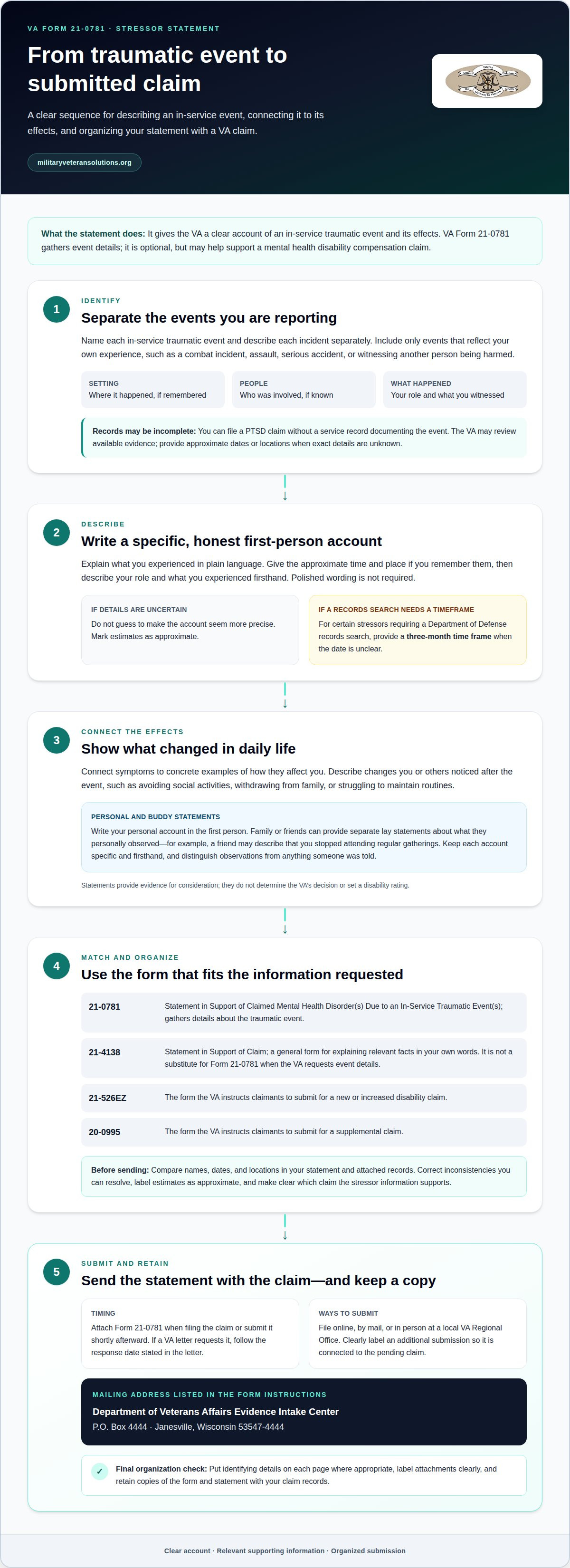
Name each event you’re reporting and distinguish separate incidents. Veterans seeking VA service connection for a mental health condition caused by an in-service traumatic event are asked to submit VA Form 21-0781, which helps the VA gather details about the event, according to the U.S. Department of Veterans Affairs. The form is titled “Statement in Support of Claimed Mental Health Disorder(s) Due to an In-Service Traumatic Event(s).”
You can file a PTSD claim without a service record documenting the event. The VA may review available evidence, and you can provide approximate dates or locations when exact details aren’t known.
For each event, note what you remember about the setting, the people involved, and what happened. If several events contributed to your claim, describe each one separately.
-
Describe In-Service Events
Explain what happened during service in plain, specific language. A statement in support of claim for PTSD should identify the event and describe what you experienced firsthand. Traumatic events may include combat incidents, assault, serious accidents, or witnessing another person being harmed. Include only events that reflect your own experience.
Give the approximate time and place if you remember them, then describe your role and what you witnessed. If the date is unclear and a Department of Defense records search is needed for certain stressors, provide a three-month time frame. Don’t guess to make your account seem more precise.
VA Form 21-4138 is titled “Statement in Support of Claim” and can be used for a general claim statement. The phrase “statement in support of claim for PTSD” describes the purpose of your account, while VA Form 21-0781 gathers details about an in-service traumatic event.
-
Include Personal and Buddy Statements
Write your personal account in the first person, describing what you experienced and how it affected your life. Family members or friends can provide separate lay statements about what they personally observed. For example, a friend might explain that you stopped attending regular gatherings, while distinguishing that observation from anything you told them.
Keep each account specific and firsthand. A personal statement or buddy statement can add context, but neither should claim to determine the VA’s decision. Personal statements provide evidence for consideration; they don’t set a disability rating. Describe your experience honestly rather than trying to predict how the VA will evaluate it.
Submitting a statement with a VA claim
Plan how the stressor statement will accompany your claim, then check that the form and supporting material are clearly connected. VA Form 21-0781 is optional, but it may help support a disability compensation claim for a mental health condition.
- Choose when to submit it. Attach the completed VA Form 21-0781 to your claim when filing, or submit it shortly afterward. A separate form may be useful if you filed online but skipped the mental health questions, used a downloaded PDF claim form, or received a VA letter requesting it. If you already filed, label the additional submission clearly so its relationship to the pending claim is apparent.
There is no separate timing rule listed here for the statement. Submit it with the claim or shortly after filing. If the VA requests it in a letter, follow the response date stated there. Don’t leave an attachment unsubmitted on the assumption that the original application includes it.
- Complete the relevant form carefully. VA Form 21-4138 is a general form for a statement in support of a claim. Use it to explain relevant facts in your own words, identify the condition or claim the statement concerns, and organize details so they are easy to follow. For a PTSD claim, keep the account focused on the event, its effects, and information that supports your account. Don’t use the form as a substitute for VA Form 21-0781 when the VA requests details about an in-service traumatic event.
Before submitting, compare names, dates, and locations in your statement and attached records. Correct inconsistencies you can resolve, and mark estimates as approximate rather than presenting uncertain details as exact.
- Select a submission method. You may file VA Form 21-0781 online, by mail, or in person at a local VA Regional Office. If mailing a completed form, its instructions direct claimants to send it to the Department of Veterans Affairs Evidence Intake Center, P.O. Box 4444, Janesville, Wisconsin, ZIP code 53547-4444. Keep a copy of the form and statement with your claim records.
For a new or increased disability claim, the U.S. Department of Veterans Affairs instructs claimants to submit VA Form 21-526EZ. For a supplemental claim, it instructs claimants to submit VA Form 20-0995. Attach or submit the stressor information in a way that identifies the related claim.
- Keep the submission organized. Put the veteran’s identifying details on each page where appropriate, use clear labels for attachments, and retain copies of what you send. If you need help aligning the paperwork and claim, Veteran Claims Representation can help you review the claim materials.
Behavioral changes and related records
Describe changes you noticed after the event, then connect them to records or observations that provide context. Organize each example so the VA can understand what changed and when.
-
Document Behavioral Changes
List specific changes you or others noticed, such as avoiding social activities, withdrawing from family, or struggling to maintain routines. For example, you might describe avoiding travel or canceling plans like a Tanzania safari and Zanzibar package because large groups or unfamiliar surroundings trigger stress. If you can do so accurately, compare a concrete example from before the event with what happened afterward. Don’t present another person’s interpretation as your own observation.
Identify who observed each change and when they noticed it. A family member might describe you leaving gatherings early, while a coworker might recall a change in communication. Ask them to stick to firsthand observations and distinguish those from details they heard from you.
Keep the account factual. Describe the behavior and its effect rather than labeling it or guessing at its cause. For example, explain that you stopped attending a regular activity and how that affected your routine. If records or recollections place the change at different times, explain the difference instead of forcing them to match.
-
Gather Supporting Evidence
Collect records and statements that help explain the event, symptoms, or changes over time. Relevant material may include service records, treatment records, and observations from people who know you. The U.S. Department of Veterans Affairs says it uses information on VA Form 21-0781 to help identify records and other evidence supporting a claim.
What evidence is needed to support a VA claim for PTSD? Organize information that helps show the in-service event, the condition, and its effects, including relevant records and firsthand observations. A personal account should not be treated as a substitute for the other evidence available in your case.
Sort documents by what they help explain. A service record may provide context about an event; a treatment record may document care; a family member’s statement may describe an observed change. Briefly label each item to make its connection to your account clear. Don’t alter records or ask anyone to state something they didn’t witness.
If you want VA to obtain records from a private provider or VA Vet Center, the U.S. Department of Veterans Affairs says you must provide consent using VA Forms 21-4142 and 21-4142a. Identify the provider and include the required consent forms with your claim materials. Keep your own copies of submitted records and statements, and note which evidence relates to each event or change.
Certification and signatures
Before submitting your account, review the certification and signature fields on the exact VA form you completed. Treat signing as a final accuracy check, not a substitute for clear supporting details.
- Read the certification text before signing. Review the statement beside the signature field on your copy of VA Form 21-0781. Confirm that the information reflects what you know and remember, including any estimates you identify as approximate. Don’t sign a draft that still contains unanswered questions, conflicting dates, or wording you haven’t reviewed.
Check the form’s current revision and its printed instructions. The revision date shown for VA Form 21-0781 is March 2024. Use the signature and date fields presented on the version you are submitting, rather than copying a layout from an older saved form.
- Complete the fields that apply to you. VA Form 21-0781 is optional, and claimants don’t have to complete every section. Review each item and answer the parts relevant to your circumstances. If a question doesn’t apply, follow the form’s instructions for that field instead of adding unrelated details.
If you report more than one event, keep the descriptions and related information distinct. Before signing, compare those entries with your personal statement and attachments. Correct a name or date you can verify, and clearly label any estimate.
- Check who is making each statement. Sign your own account only after reviewing its contents. Keep a family member’s or friend’s separate observations distinct from your account. They should review their own words and identify what they personally observed, rather than signing language attributed to you.
Keep authorship clear throughout the packet. A statement describing your symptoms belongs to the person who experienced them; an observer’s account should describe that observer’s knowledge. This distinction helps the VA understand whose perspective each signed page represents.
- Make a final submission copy. Complete the signature and date fields wherever the form requests them, then save or copy the signed pages. Check that attachments are readable and belong with the signed statement. If you revise the account after signing, review the changed version again before submitting it.
Keep the submitted copy with your claim records. A clear file lets you identify which version you sent and compare it with later correspondence. The OMB control number printed on VA Form 21-0781 is 2900-0659; use the form itself to guide your final review.
Describing symptoms with specific examples
Describe symptoms in clear, everyday language and explain how they affect daily life.
- Name the experience, then show it in context. Describe the symptom in ordinary language, then give a specific example of when it affected you. A technical term alone may not help the reader understand your experience. For example, explain what happens when a reminder of an event interrupts a conversation or routine. Keep the example accurate and focused on what you experienced.
Separate what you felt from what someone else observed. You might describe feeling tense in a crowded place, then explain how you responded, such as leaving early. Don’t add details because they sound more persuasive. A straightforward account gives the VA a clearer picture than broad claims without examples.
- Explain the effect on ordinary tasks. Connect the symptom to a real activity, such as sleep, household responsibilities, social plans, or concentration during a task. Instead of writing “I have trouble concentrating,” describe losing track of instructions while completing a routine assignment. Explain what happened next and whether you needed to stop, start over, or ask for help.
Choose examples that show practical impact without overstating it. If a symptom affects one task but not another, describe the difference. Specific contrasts help avoid making your account sound absolute when your experience varies by setting or circumstance.
- Make each example easy to follow. Organize the description around the situation, your response, and the consequence. For instance, identify the setting, explain what you experienced, and state whether it disrupted an appointment or caused you to leave. Follow the sequence you remember; don’t fill gaps with assumptions.
Add a time reference only when you remember one, such as “after returning home” or “during a later appointment.” If the timing is uncertain, say so plainly. Consistent wording across your statement and records makes it easier to see how the account fits together.
- Review for clarity before submitting. Read each symptom description and ask whether someone unfamiliar with your experience could picture what happened. Replace vague phrases like “it affects everything” with one clear example. Keep sensitive details relevant to explaining the symptom and its impact; you control how you describe your experience.
Specific examples can help the reader understand your experience better than technical terms alone. Use your own words, and avoid trying to predict how a particular phrase will affect a rating. If you need support organizing your claim materials, get help reviewing your VA claim.
Headings distinguish multiple in-service traumatic events; veterans or observers may add lay statements on events or life effects. Section VI, VA Form 21-0781, permits consent to share information with the Veterans Health Administration for care; at the time described, only for military sexual trauma.
Military Veteran Solutions: Filing VA appeals
Military Veteran Solutions, LLC helps veterans pursue VA appeals through Veteran Claims Representation, Military Record Reviews, and VA Decision Letter Analysis. If a VA decision doesn’t reflect the evidence you submitted, a focused review can help identify issues in the decision and records that may matter to an appeal.
Consider this support when you need help understanding a VA decision or organizing next steps after an unfavorable outcome. Reviewing your military records and decision letter can clarify how your claim materials relate to the result. Military Veteran Solutions, LLC also files VA appeals.
Visit militaryveteransolutions.org to learn more about support for your VA appeal.
Take the Next Step With a Clear Plan
Your account should reflect your experience, not an attempt to guess what the VA wants to hear. Before moving forward, consider whether your claim materials tell a consistent story and whether you still have questions about the VA’s decision. A statement in support of a claim for PTSD can explain your experience in your own words, while a careful review can help you decide what to address next.
Military Veteran Solutions, LLC offers Veteran Claims Representation, Military Record Reviews, and VA appeals filing support for veterans considering their next steps. If you’re preparing an appeal or want help understanding how your records relate to a VA decision, this support can help you approach the process with greater clarity.
Contact Military Veteran Solutions, LLC to discuss your claim. Your service and experiences deserve to be presented with care, and taking a thoughtful next step can help you move forward with confidence.
Frequently Asked Questions
Need Assistance with Your PTSD Claim or Appeal?
Military Veteran Solutions can help you review a VA decision and consider your next steps. If your claim was denied, gather the decision letter and records connected to the issue. The letter’s explanation can help focus a review on what the VA considered and what may need further attention. Military Veteran Solutions offers VA Decision Letter Analysis and Veteran Claims Representation for veterans working through claims or appeals.
What Happened in Service?
Explain what you personally experienced during service, in the order you remember it. Separate what you witnessed from what someone later told you, and don’t present secondhand information as firsthand knowledge. For example, clarify whether you saw an incident directly or learned about it afterward. If your recollection has gaps, identify them honestly. Distinguishing what you remember from what you learned from others makes your account easier to understand.
What Is VA Form 21-0781?
VA Form 21-0781 is the form used to provide information about a claimed mental health condition related to an in-service traumatic event. The form has ten sections and provides space to describe six stressors. If you experienced more events, organize the account so each incident remains identifiable. Use the form version you intend to submit, and keep a copy alongside your claim records.
How do you describe a PTSD stressor in a VA disability claim?
Describe the incident in concrete terms, then give the best time frame and location you can recall. If you don’t know the exact date, a three-month window can help with a Department of Defense records search for certain stressors. Avoid guessing. For multiple incidents, use separate labels or headings so the VA can distinguish each event and connect information to the right account.
Where do you submit a statement supporting a VA PTSD claim?
You can submit VA Form 21-0781 online, by mail, or in person at a local VA Regional Office. If you’re sending the statement after filing, identify the claim it supports and include the related identifying information. When mailing, follow the instructions on the form for the destination. Keep a copy of the submitted statement and note how you sent it for your records.