
A nexus letter can use the right probability language and still leave important questions unanswered. To understand how to get a strong nexus letter, focus on whether a medical professional explains how your current condition connects to an event, injury, illness, or exposure during service. For a VA disability opinion, “at least as likely as not” means there is a 50% or greater probability of that connection.
It’s understandable to look for wording that will strengthen your claim. But the wording matters only when the letter’s reasoning supports it and fits the medical and service evidence in your file. A well-supported opinion identifies what the provider reviewed, addresses relevant facts, and explains the medical rationale instead of relying on a conclusion alone.
This article explains how to assess a nexus letter’s reasoning, consistency with your claim evidence, and probability language. You’ll also learn what a nexus letter does, when it may support a claim, and how to spot gaps that could make an opinion less persuasive.
Key Takeaways
- Assess whether the medical opinion connects your current diagnosis to a specific service event, injury, illness, or exposure with clear reasoning.
- Look for an explanation of the records reviewed and how the evidence supports the provider’s conclusion.
- Compare the letter with your service records, medical history, symptom account, and examination statements to spot inconsistencies.
- Read the probability language alongside the rationale; a persuasive conclusion should be supported by the facts and medical explanation in the letter.
- If a claim is denied because the service connection is unclear, identify what the decision says is missing before deciding what evidence to address next.
1. What Is a Nexus Letter?
A VA nexus letter is a medical professional’s written opinion connecting a veteran’s current condition with military service. It addresses the medical link between a diagnosed disability and an in-service event, injury, illness, or exposure. For example, a provider might explain how documented repetitive lifting relates to a diagnosed back condition. The letter supports the nexus element; it does not replace evidence of the current diagnosis or service event.
A useful opinion does more than state that service caused a condition. It identifies the provider’s credentials, reviews relevant records, states the probability of service connection, and explains the medical rationale. For a VA disability opinion, “at least as likely as not” means a 50% or greater probability that the condition relates to service. The provider should connect that conclusion to the veteran’s history and evidence, rather than leaving the reader to infer the link.
Treating providers and independent medical professionals may both write nexus letters. A treating clinician may know the veteran’s symptoms and treatment history firsthand, while an independent professional may offer an opinion after reviewing claim records. The author should have relevant medical expertise and identify their credentials and experience. Their role is to give an honest opinion based on evidence, not simply support a preferred outcome.
Are private nexus letters stronger than VA C&P exam opinions? Not automatically. The value of either opinion depends on its medical reasoning, relevant expertise, evidence review, and consistency with the record, not simply whether the author works privately or for the VA. VA doctors aren’t prohibited from writing nexus letters, although the VA generally discourages them from offering opinions in disability cases.
Medical history gives the provider the facts needed to assess the connection. Share the DD214 details about service dates and roles, relevant service records, diagnosis, treatment history, and a clear account of symptoms. If records omit an event, lay statements or alternative evidence can help explain what happened and how the available facts fit together. A provider may also cite medical literature when it helps explain the connection between the condition and service.
Can a veteran write their own nexus letter or use a template? A veteran can prepare a personal statement describing events and symptoms, but a medical nexus opinion must come from a medical professional. A template may help organize information, but it can’t replace the provider’s individualized review, clinical judgment, or signed conclusion.
A practical starting point for how to get a strong nexus letter is to choose a licensed medical professional whose expertise fits the diagnosed condition. Provide organized records and ask the provider to identify the sources reviewed, explain the medical reasoning, and state the opinion clearly. These steps make the letter easier to compare with your claim evidence.
2. Reasoning that connects service events to current conditions
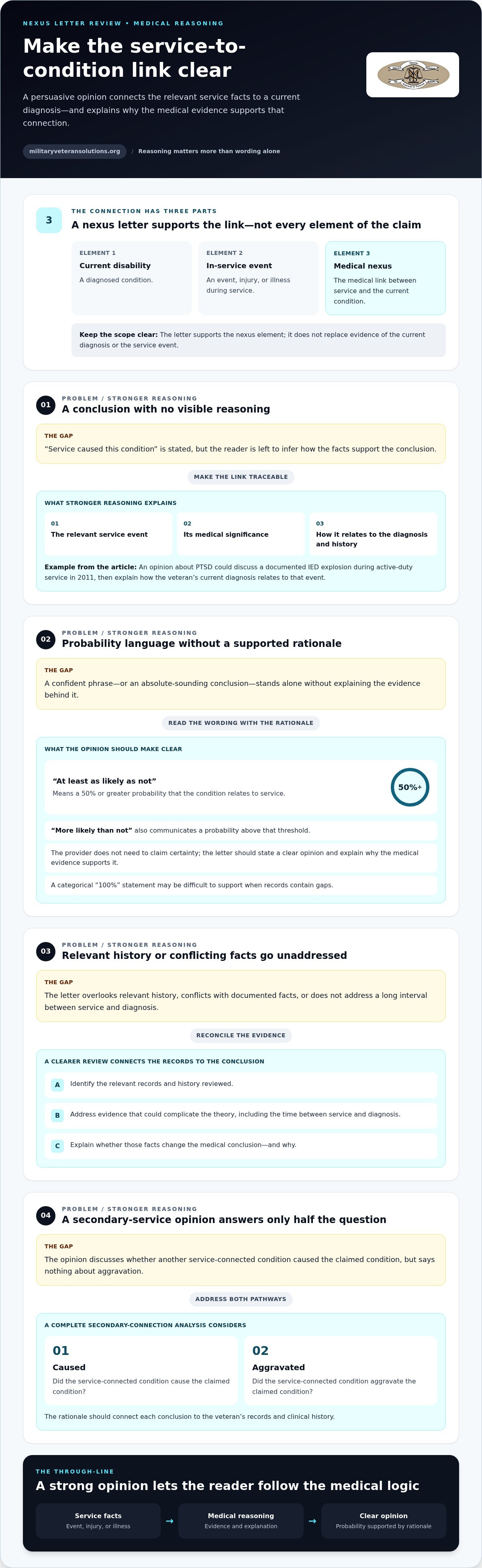
A nexus opinion should explain the medical connection between a current diagnosed disability and military service. VA service connection generally involves three elements: a current disability, an in-service event, injury, or illness, and a nexus linking them. The provider should show how the evidence supports that link, not simply state that the condition followed service.
Look for a traceable line of reasoning. The provider should identify the relevant service event, explain its medical significance, and relate it to the veteran’s diagnosis and history. For example, an opinion about PTSD might discuss a documented IED explosion during active-duty service in 2011, then explain how the veteran’s current diagnosis relates to that event. A conclusion without those steps leaves the central connection unclear.
The probability threshold matters. In a VA disability opinion, “at least as likely as not” means a 50% or greater probability that the condition is related to service. “More likely than not” also communicates a probability above that threshold. The provider doesn’t need to claim certainty; the letter should state a clear opinion and explain why the medical evidence supports it.
Read the reasoning alongside the records it cites. Does the provider acknowledge evidence that could complicate the theory, such as a long interval between service and diagnosis? Does the opinion explain why that interval does or doesn’t change the medical conclusion? If the letter overlooks relevant history or conflicts with documented facts, its reasoning may be harder to reconcile with the claim.
Secondary service connection requires focused analysis of another service-connected condition. The provider should address both possible pathways: whether that condition caused the claimed condition and whether it aggravated it. An opinion that discusses causation but ignores aggravation leaves part of the medical question unanswered. The rationale should connect each conclusion to the veteran’s records and clinical history.
Check that probability language matches the reasoning. A categorical statement that service caused a condition “100%” may be difficult to support when records contain gaps. A careful opinion states the degree of medical certainty and explains the evidence behind it, rather than using absolute wording to sound persuasive.
If the VA denied a claim because the service connection was unclear, focus on the missing link identified in the decision. Repeating the same records without addressing that gap may not strengthen the medical argument. A targeted review of service documentation can help clarify which events and records the opinion should address; Military Record Reviews can support that evidence review.
3. Why a nexus letter may support a VA disability claim
A nexus letter can help explain the medical link a VA disability claim relies on, especially when the relationship isn’t obvious from diagnosis records alone. A current diagnosis establishes the condition, while service records can document an event or exposure. The provider’s opinion explains how those facts relate. This can be especially relevant for delayed-onset conditions, secondary conditions, and mental health conditions such as PTSD.
Medical reasoning can add context that forms and treatment notes don’t provide. For example, a veteran’s treatment history might document a diagnosis years after military service. A provider can explain whether the recorded service event and medical history support a connection despite the delay. For a secondary condition, the opinion can address its relationship to an existing service-connected disability. The value lies in connecting evidence, not simply adding another document to the file.
A nexus letter isn’t required to submit a disability claim. A veteran can include one with the initial application, provide it while the VA develops the claim, or submit it after an adverse C&P exam. Timing can depend on the evidence gap: an opinion included with the application can address the connection early, while a later letter can respond to issues raised during claim development.
Submitting a nexus letter doesn’t prevent the VA from scheduling a C&P exam. The examiner’s assessment and the private medical opinion can both become part of the evidence considered. Before submitting a letter, compare its diagnosis, service-event details, and medical explanation with the rest of the claim. If the documents describe different histories, the discrepancy can distract from the opinion’s reasoning.
After an adverse C&P exam, identify what the examination says about the condition and its relationship to service. Then assess whether a medical opinion addresses that specific issue with a clear explanation. A general letter that repeats a conclusion without engaging with relevant facts does less to clarify the record. Focus on the gap: the diagnosis, the service event, or the medical reasoning linking them.
Think of the nexus letter as one part of a thorough VA disability claim, not a substitute for the rest of the evidence. Organize supporting records so the opinion’s factual basis is easy to follow, and make sure the letter addresses the claimed condition. The provider’s conclusion should be consistent with the medical history and other claim documents. This focused review helps you decide when an opinion adds useful evidence and when the file needs attention elsewhere.
4. Consistency across claims evidence and examinations
A nexus letter is easier to assess when its facts match the rest of your claim. Compare service dates, described events, diagnosis, and symptom history across the letter, application, treatment notes, buddy statements, and examination account. A date discrepancy may seem important even if the underlying event is the same. Note each difference and determine whether the documents explain it.
Start with a simple evidence comparison. Put the provider’s factual statements beside the records they refer to. If the letter says an injury occurred during a particular duty, look for that account in service records or supporting statements. If service records don’t document the incident, the opinion should explain the gap and its reasoning based on available evidence, rather than describing the incident as documented.
Before a nexus-letter examination, organize service records, earlier medical documents, and a detailed symptom history. Give the medical professional a clear timeline: when symptoms began, how they changed, and what treatment followed. For example, if a treatment note records symptoms beginning after separation but your claim describes earlier symptoms, explain the difference accurately. Don’t alter dates to make documents appear consistent.
The provider’s rationale should identify which records informed the opinion and what evidence supports the connection between service and diagnosis. A useful review asks whether the letter discusses relevant evidence, rather than merely listing files. For a delayed diagnosis, the provider can explain how the documented history supports the opinion despite the interval. If the records contain conflicting accounts, the letter should address any conflict that affects its conclusion.
Toxic-exposure claims call for a clear connection between the claimed disability and exposure during military service. The nexus opinion should state that the disability is as likely as not related to the toxic exposure, then explain the medical reasoning and identify the evidence reviewed. A physician licensed in the United States may write a nexus letter for a VA toxic-exposure claim. The conclusion should still align with the veteran’s documented history and diagnosis.
How does the VA evaluate nexus letters and conflicting medical opinions? An opinion’s strength depends on its explanation and the evidence it addresses, not just its conclusion. Compare whether each opinion identifies relevant records, discusses the veteran’s history, and explains its medical reasoning.
Keep supporting documents organized by topic, such as service events, diagnosis, treatment, and symptom timeline. This makes it easier to see whether the nexus letter accurately reflects the record. If a statement conflicts with a document, resolve the factual explanation before relying on the opinion. Consistency doesn’t mean every account uses identical wording; it means the key facts fit together or their differences are clearly explained.
5. Reviewing a nexus letter’s probability language
Read the probability statement and the medical opinion together. “At least as likely as not” means a 50% or greater probability that the medical condition relates to military service. “More likely than not” expresses a higher probability. Neither phrase carries persuasive weight by itself; the doctor’s explanation must show how the evidence supports the stated link between service and the condition.
Check whether the doctor answers the specific question at issue. A letter about direct service connection should address whether an in-service event, injury, illness, or exposure relates to the current diagnosis. For a secondary claim, look for separate discussion of whether a service-connected condition caused or aggravated the claimed condition. A general statement that two conditions are “related” may not clarify which connection the opinion supports.
Next, compare the certainty of the wording with the rationale. If a doctor states “at least as likely as not,” the letter should explain the records, medical history, and clinical reasoning behind that assessment. A phrase such as “could be related” may describe a possibility without clearly stating the probability opinion. Look for a direct conclusion followed by specific supporting reasoning.
Absolute wording deserves careful review. A statement that a condition was “100% caused” by service can overstate what the available record supports, particularly when evidence has gaps. The doctor needn’t be completely certain to provide an opinion using the VA probability threshold. A measured conclusion supported by the veteran’s records is more useful than emphatic wording without analysis.
Credentials also matter when assessing the opinion. Confirm that the letter identifies the doctor’s qualifications and experience relevant to the condition. Then check whether the provider states what information informed the conclusion. A clear opinion should distinguish documented facts from the veteran’s reported history and explain how both affect the medical reasoning.
Common mistakes include vague probability language, omitting the medical rationale, overlooking relevant records, and making unsupported absolute claims. Another weakness is a conclusion that doesn’t match the letter’s own evidence, such as stating that a condition is service-connected while discussing no relevant event or medical history.
For a final review, underline the probability phrase, identify the condition and service event it addresses, and trace each reason back to evidence. Then compare that conclusion with the VA decision’s stated concerns. If the decision identifies a gap in the evidence or questions the medical rationale, use VA decision letter analysis to focus your review on those specific points.
Military Veteran Solutions: Filing VA appeals
Military Veteran Solutions, LLC helps veterans pursue VA appeals when a decision doesn’t clearly address their evidence or medical opinion. A focused review of the decision can help identify the reasons for denial and the issues an appeal needs to address.
If a nexus letter is part of your claim, compare its reasoning with the VA’s stated concerns before deciding what evidence to develop next. Military Veteran Solutions, LLC offers VA Decision Letter Analysis, Military Record Reviews, and Veteran Claims Representation to support this review and the appeal process. Turn to these services when you need help understanding a decision or organizing the next steps in a VA claim.
Contact Military Veteran Solutions, LLC to discuss your VA appeal.
Take the Next Step With a Clear Evidence Plan
If you’re working out how to get a strong nexus letter, make the next step specific: identify the exact issue your evidence needs to address. Set the letter beside the VA decision or claim record, mark unanswered questions, and organize the documents that relate to those points. This gives you a focused basis for deciding what to clarify, rather than adding material without a clear purpose.
A claim can feel personal and complicated at the same time. You don’t have to sort through every document at once. Start with the issue that matters most, then consider whether a closer review of your records or support with an appeal would help you move forward. Military Veteran Solutions, LLC works with veterans pursuing VA claims and appeals, including military record reviews.
Contact Military Veteran Solutions, LLC today to discuss a clear next step for your claim. A careful, organized approach can help you move ahead with greater confidence.
Frequently Asked Questions
What Is a Nexus Letter?
A nexus letter is a medical professional’s written opinion about whether a veteran’s diagnosed condition is connected to military service. It provides the medical perspective on that relationship, rather than serving as the veteran’s own account of events. For instance, a veteran may describe an in-service injury in a personal statement, while the clinician explains whether the injury is medically related to the current diagnosis.
Can My Private Physician Write My Letter?
Yes, your private physician can write a nexus letter if their medical expertise is relevant to your condition. To help them assess the connection, organize your diagnosis and treatment records alongside service documents and a clear symptom timeline. For example, if your physician treated recurring knee pain, include records describing its progression and the service history relevant to your claim. The physician’s opinion should reflect their independent medical judgment.
Can a VA Doctor Write a Letter on My Behalf?
Yes, VA doctors aren’t prohibited from writing nexus letters, though the VA generally discourages them from offering medical opinions in disability cases. You don’t have to rely on a VA doctor for a nexus opinion. If you discuss the request with a treating clinician, focus on an honest assessment of your medical history and records, not on obtaining a particular conclusion. The clinician should state their reasoning clearly.
Why is a Nexus So Important?
A nexus addresses the medical relationship between a diagnosed disability and military service, a link that may not be obvious from treatment records alone. Consider a veteran diagnosed after leaving service: records may establish the diagnosis but not explain its relationship to an earlier event. A medical opinion can provide that explanation. Its usefulness depends on whether the reasoning engages with the veteran’s actual history and relevant evidence.
What is a nexus letter for a VA disability claim?
For a VA disability claim, a nexus letter is a clinician’s opinion on whether a veteran’s medical condition is related to service. It can accompany an initial application or be added while the VA develops the claim. For example, a veteran may submit a letter to address a medical connection that isn’t clear from existing records. The letter becomes part of the evidence, not a substitute for the claim itself.
What should a strong VA nexus letter include?
A strong letter should identify the doctor’s credentials, relevant records reviewed, probability opinion, and medical rationale. Check practical details: does it name the condition being assessed, identify the records considered, and explain how those facts support the conclusion? A letter that lists medical documents without showing how they informed the opinion gives you less insight into the clinician’s reasoning.
Who is qualified to write a VA nexus letter?
An appropriate author is a licensed medical professional with expertise relevant to the veteran’s diagnosed condition. For example, a provider assessing a joint condition should have medical expertise related to it. Review the letter for the provider’s credentials and experience, then consider whether the opinion addresses the medical question in your claim. Familiarity with your treatment history can inform the review, but the opinion must remain the provider’s own.
How should a doctor explain that a condition is at least as likely as not related to service?
The doctor should state the opinion clearly, then explain the medical reasoning that supports it. “At least as likely as not” means a 50% or greater probability of a relationship to service. The explanation should connect the relevant medical history and evidence to the conclusion. The doctor doesn’t need to claim complete certainty, but the letter should show why its probability assessment follows from the facts reviewed.