

An effective date can determine how far back VA disability compensation reaches, so an incorrect date can leave retroactive benefits uncounted. In general, the effective date is tied to when VA received the claim and when entitlement arose; according to the U.S. Department of Veterans Affairs, a veteran who files within one year after discharge generally receives an effective date of the day after discharge. Knowing how to appeal a VA effective date starts with understanding the rule behind the date VA assigned.
It’s frustrating when VA grants a claim but the decision assigns an effective date later than the period you believe should qualify. The date is a separate part of the decision, and appealing it means identifying why it may be wrong and choosing a review path that fits. This article explains what an effective date means, how it affects retroactive benefits, and the main ways to challenge it, including the deadlines that can shape your options. The claim history, evidence, and wording in the VA decision all matter when assessing whether an earlier date is supported.
Key Takeaways
- An effective date can affect how much retroactive compensation is payable, so it matters independently of the disability rating and service-connection decision.
- Medical records and examination evidence can help explain when a condition began or worsened, but the date evidence was created is not automatically the effective date.
- For most VA benefits, the U.S. Department of Veterans Affairs says you have 1 year from the decision-letter date to request a Higher-Level Review or a Board Appeal.
- The right review option depends on the decision history and whether you need to submit additional evidence or challenge an error in the existing record.
- A close review of the VA decision and claim history can help identify whether an earlier date may be supportable and which appeal path fits.
Why Does an Earlier Effective Date Matter?
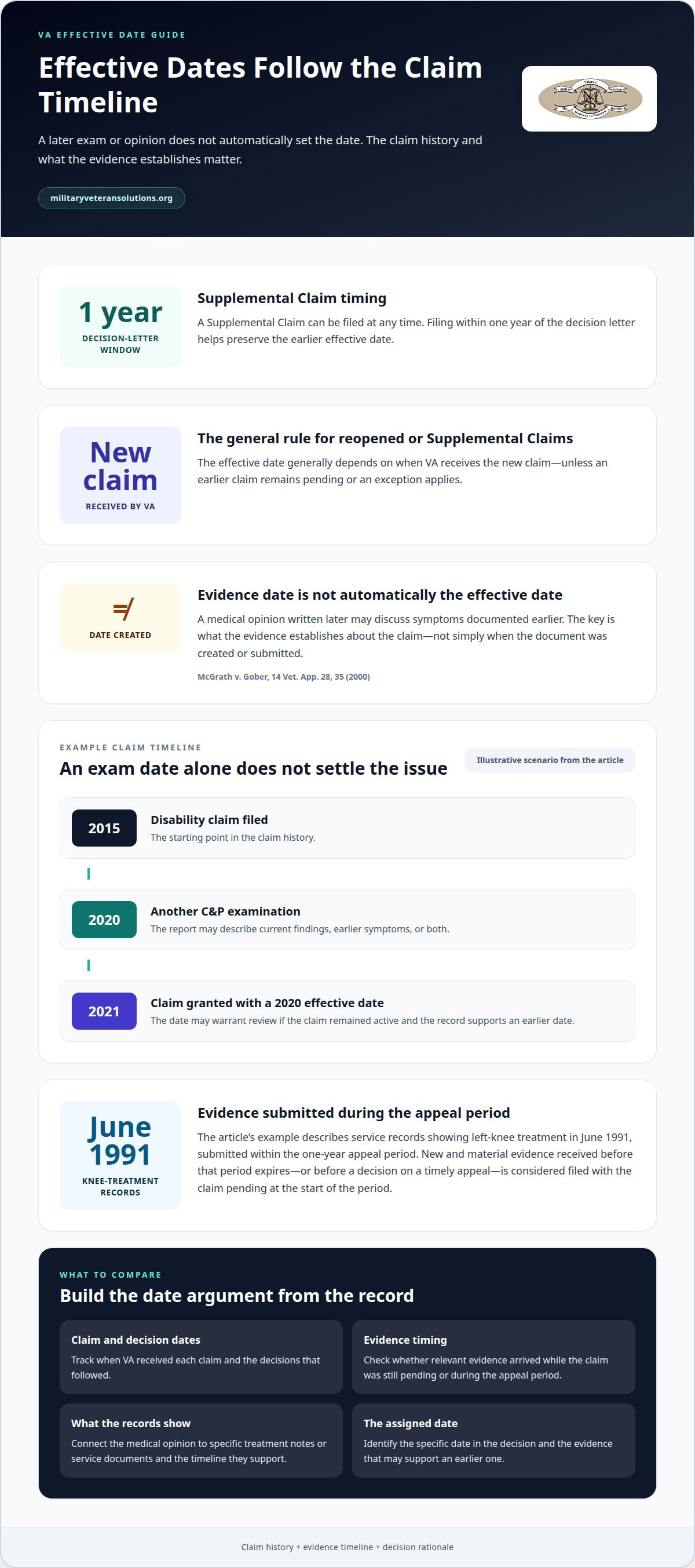
An earlier effective date can connect a VA award to an earlier claim period, changing how much retroactive compensation the decision covers. For reopened or supplemental claims, the date generally depends on when VA receives the new claim, unless an earlier claim remains pending or an exception applies. A Supplemental Claim can be filed at any time, but filing within one year of the decision letter helps preserve the earlier effective date.
Evidence can show why the assigned date deserves review. A medical opinion may explain when a condition first appeared, how symptoms developed, or whether later records describe an earlier period. It is most useful when it addresses the relevant timeline and connects its conclusions to specific records, such as treatment notes or service documents. A diagnosis date alone may not establish when entitlement began.
That distinction matters under McGrath v. Gober, 14 Vet. App. 28, 35 (2000). The decision held that the date evidence was submitted or created does not determine a disability claim’s effective date. For example, a doctor may write an opinion years after treatment, yet discuss symptoms documented earlier. The key question is what the evidence establishes about the claim, not simply when someone produced it.
Evidence received during an appeal period can also affect whether a claim remains connected to its earlier filing. According to the Electronic Code of Federal Regulations, new and material evidence received before the appeal period expires, or before a decision on a timely appeal, is considered filed with the claim pending at the start of that period. For example, service records showing left-knee treatment in June 1991 were submitted within the one-year appeal period.
When veterans obtain relevant records or medical opinions, submitting them promptly can matter. Make the document’s connection to the pending claim clear, rather than leaving VA to infer how it affects the timeline. A rating decision, prior submissions, and appeal history can show whether evidence arrived before the claim became final. The submission date and the document’s description can therefore become important parts of the record.
For an earlier-date argument, focus on the timeline and what each record establishes. Compare the claim date, decision dates, evidence received during the appeal period, and the date the condition or entitlement arose. Then identify the specific evidence supporting an earlier date. This helps distinguish a medical opinion created later but describing earlier facts from evidence that establishes only a later change in the condition.
Effective date errors involving medical examinations
A compensation and pension examination can shape VA’s view of a condition, but its appointment date isn’t automatically the correct effective date. The report may describe symptoms observed that day, review earlier medical records, or address when a condition became connected to service. These are different points. An effective-date dispute examines whether the rating decision used the claim history and medical evidence to select the proper date.
Consider a veteran who filed a disability claim in 2015, attended another C&P examination in 2020, and received a grant in 2021 with an effective date in 2020. That date may warrant review if the claim remained active and the record supports an earlier date. The examination could document a worsening condition, but the date of the examination alone doesn’t settle when entitlement began. The initial claim, intervening decisions, and medical evidence all matter.
Read the examination report closely. Does it discuss symptoms from before the appointment? Does it refer to earlier treatment notes or explain when limitations began? Does another medical record show a different timeline? These details help distinguish evidence of a condition’s earlier history from evidence of a change first observed during the examination. A medical opinion can support an argument, but its reasoning and connection to the record matter.
Read the rating decision issue by issue. VA decisions address service connection, the disability rating, and the effective date separately. You might agree with the rating but dispute the date, or accept service connection while challenging both the rating and its start date. The Board of Veterans’ Appeals may review an effective-date challenge, but the argument should identify the specific date error and the records supporting a correction.
When reviewing a decision based on an examination, build a clear timeline from the initial claim through the examination and award. Note when VA received each claim, which records the examiner considered, and whether the decision explains its chosen date. If the examination describes earlier symptoms but the decision focuses only on the appointment date, that difference may form part of the appeal argument. If the report documents a new increase instead, the record may support a later date for that change.
A focused review of medical findings and the claim sequence can clarify whether an examination date was treated as more decisive than the full record supports. Veteran Claims Representation can help assess the decision and frame an appeal around the evidence relevant to the assigned date.
Finality of VA regional office decisions
A VA regional office decision can become final when the appeal period ends without a valid review request. Finality matters because it can limit the ordinary ways to challenge an effective date. Start with the decision-letter date and identify the issue you dispute. A disability claim can involve separate questions, including service connection, rating, and effective date. Pinpointing the date issue helps determine whether a review option remains open.
For most VA benefits, a veteran has 1 year from the decision-letter date to request a Higher-Level Review or a Board Appeal, according to the U.S. Department of Veterans Affairs. The deadline runs from the letter date, so the date the letter was opened does not replace it. A Higher-Level Review examines the existing record, while a Board Appeal asks the Board of Veterans’ Appeals to review the decision. The request must challenge the effective date, not merely express general disagreement.
Decision timing also matters. VA’s modernized decision review system applies to claims decided on or after February 19, 2019. Decisions before that date follow the legacy appeals process. For a decision under the modernized system, the review options include a Supplemental Claim, Higher-Level Review, or Board Appeal. A Supplemental Claim involves new and relevant evidence; a Higher-Level Review evaluates the existing record. The choice should match the error being raised and the evidence available.
Favorable findings can affect whether a regional office decision is final. For an AMA regional office decision issued after February 19, 2019, failure to provide proper notice of favorable findings may mean the decision lacks finality. This argument concerns regional office decisions, not Board decisions. Review the notice and decision for findings VA accepted, such as a diagnosed condition or an established event. Those findings generally bind later adjudicators unless clear and convincing evidence shows otherwise.
If the ordinary appeal period has passed, reopening a disability claim does not automatically restore the original effective date. A Supplemental Claim may still be filed, but VA recommends filing within 1 year of the decision letter to preserve the date. Once a decision is final, a clear and unmistakable error claim may provide a route to challenge a specific past error. It requires identifying the error in the prior decision and explaining why correcting it changes the outcome.
Before choosing a route, map the decision letters, appeal requests, and evidence submissions in date order. For example, a timely appeal followed by a later regional office decision may leave a different review path than an unchallenged denial. A consultation can help clarify whether the effective-date decision became final, whether favorable-findings notice matters, and which review request fits the claim’s procedural history.
Retroactive disability benefits
Retroactive benefits cover compensation owed for the period between an effective date and the start of payments after an award. For VA disability compensation, the effective date is generally the later of the date VA received the claim and the date entitlement arose. That comparison is central to determining whether the assigned date is correct. Moving the date earlier can extend the period covered, while the disability rating affects the monthly compensation amount.
A claim filed soon after military service can follow a different date rule. According to the U.S. Department of Veterans Affairs, a veteran who files a VA disability claim within one year after discharge generally receives an effective date of the day after discharge. For example, a claim filed within that period may reach back to the day after separation rather than the later claim-receipt date. The claim must still result in an award for the condition.
The date can also turn on how a claim remained active. A claim with an effective date of May 1, 2015, granted one year later covers the intervening year for compensation purposes. If a decision was appealed in time, later evidence and decisions may belong to the same continuing claim history. By contrast, a final denial followed by a later application can change which date controls. The letters and filings establish the sequence.
Some service-record situations have a specific route to an earlier date. Under 38 CFR 3.156(c), qualifying service department records later associated with the file may support an earlier effective date when they substantiate the original service-connection claim. Special Nehmer rules can also provide more favorable dates in certain Agent Orange cases. In both situations, the records and prior claim history help determine whether the special rule applies.
Changes in law can affect the calculation, too. If a veteran files within one year after a change in VA law allows benefits for a condition, the effective date is the date the law changed. A claim filed more than one year after that change generally receives the date VA gets it. Presumptive claims also depend on timing: a claim filed within one year after discharge uses when the illness or injury first occurred; a later claim uses the claim-receipt date or onset date.
The amount of retroactive disability benefits depends on the covered period and the rating assigned for that period. A 30% rating and a 50% rating can produce different compensation amounts, so a date correction alone doesn’t establish the final payment. The useful review is to connect each period, rating, and effective date to the VA decision and claim record.
Appealing an assigned VA effective date
An effective-date appeal disputes when VA began recognizing a disability award, not necessarily the award itself. Knowing how to appeal a VA effective date means matching your disagreement to the review option and evidence available.
Appeal Deadlines
The deadline is the period after a VA decision when you can request review through an available appeal option. For most VA benefits, the U.S. Department of Veterans Affairs says a veteran has 1 year from the decision-letter date to request a Higher-Level Review or Board Appeal. That date matters because missing it can change which routes remain open. Note the letter date and identify the effective-date issue promptly.
Appeals After the Deadline
After the ordinary appeal period, a final effective-date decision can generally be challenged through a clear and unmistakable error claim. A Supplemental Claim can be filed at any time, but VA recommends filing within 1 year of the decision letter to preserve the effective date. Reopening a denied disability claim doesn’t automatically restore its original date. Distinguish a new claim from an alleged error in the earlier decision.
Appeal Timing and Representation
Appeal timing depends on the review path and the record involved; no single duration applies to every case. An attorney or accredited representative can help organize decision history, identify the disputed date, and assess whether the record supports the argument. This can be useful when multiple decisions or evidence submissions complicate the timeline. Understanding how to appeal a VA effective date also means explaining why the selected date conflicts with the claim history.
Start with the decision letter that assigned the date, then connect your disagreement to a review option. A Higher-Level Review considers the existing record without additional evidence. A Supplemental Claim requires new and relevant evidence, while a Board Appeal asks the Board of Veterans’ Appeals to review the issue. Choose the option that fits why you believe VA selected the wrong date.
For a Higher-Level Review, use VA Form 20-0996 and explain the date assigned, the date you believe the record supports, and the error in the decision. A Supplemental Claim should identify or submit evidence that could change the outcome. For a Board Appeal, specify the effective-date issue and choose a review path that fits how you want the Board to consider the record.
If more than 1 year has passed, determine whether the decision became final before treating a later filing as part of the original appeal. A clear and unmistakable error argument must identify a specific error in the earlier decision and explain how correcting it changes the outcome. If you need help assessing the decision history or preparing an appeal, review your effective-date appeal options.
Military Veteran Solutions: Filing VA appeals
Military Veteran Solutions, LLC reviews VA decision letters and represents veterans challenging effective dates through VA appeal filings. If the decision date doesn’t match the claim history or evidence, a focused review can clarify the issue and the appeal argument to pursue.
The firm’s Veteran Claims Representation supports veterans through the appeal process, and its Military Record Reviews examine service records relevant to a claim. The review focuses on the decision, claim timeline, and supporting documents so the effective-date question is addressed directly.
For support assessing a VA effective-date decision or preparing an appeal, contact Military Veteran Solutions, LLC for a free initial consultation.
Take the Next Step With Confidence
Deciding how to appeal a VA effective date is a practical next step when the assigned date doesn’t reflect the claim history you believe supports your benefits. Before moving forward, consider the outcome you’re seeking and whether you need help developing the argument from your decision and records. A clear, focused review can help you approach the appeal with purpose.
Military Veteran Solutions, LLC provides VA appeal filing, Veteran Claims Representation, and Military Record Reviews. If you’re ready to discuss support for your effective-date challenge, contact Military Veteran Solutions, LLC today. Bring your questions and the decision you want reviewed, and take the next step with an advocate focused on your VA claim.
Frequently Asked Questions
What is the Effective Date for a Veterans Affairs Claim?
The effective date is the date VA uses to determine when an awarded benefit begins. It can affect the period covered by retroactive compensation, even when the disability rating stays the same. For example, two decisions granting the same rating may cover different periods because their effective dates differ. The date applies to a specific benefit issue, so a decision may show different outcomes for separate conditions or claims.
What are the 3 decision review options, and which is best for me?
The three options are a Supplemental Claim, Higher-Level Review, and Board Appeal. A Supplemental Claim fits when you can submit or identify new and relevant evidence. Higher-Level Review examines the existing record, while a Board Appeal asks the Board of Veterans’ Appeals to review the issue. The right fit depends on what the record contains, what you want reviewed, and whether additional evidence is central to your argument.
How do I appeal the effective date of a VA disability claim?
Identify the specific benefit issue and explain why the date in the decision doesn’t match the claim record or evidence. For example, point to an earlier filing, a pending review, or records relevant to when entitlement arose. Then choose a review option suited to that argument. A focused explanation distinguishes a date disagreement from a challenge to service connection or the disability rating.
Which VA review option should I choose for an effective date dispute: Supplemental Claim, Higher-Level Review, or Board Appeal?
Choose based on your argument and the evidence you need considered. If relevant evidence is already in the record and you’re identifying an error in how VA assessed it, Higher-Level Review may fit. If new and relevant evidence could change the date decision, consider a Supplemental Claim. A Board Appeal puts the dispute before the Board of Veterans’ Appeals, with options that differ in how evidence is handled.
How do I file a Higher-Level Review or Board Appeal for a VA effective date?
Use the review request that matches your selected option and identify the effective-date issue clearly. A Higher-Level Review request uses VA Form 20-0996; explain the date assigned and the error you believe the existing record shows. For a Board Appeal, select the Board review path and state which issue you want reviewed. Keep a copy of the request and related decision documents for your records.
What evidence can support an earlier VA disability effective date?
Evidence that clarifies the claim timeline can help, including dated claim correspondence, VA notices, medical records, or service department records connected to an earlier claim. A medical opinion may explain what earlier records show about a condition’s onset or progression. Organize documents by date and note what each demonstrates. This makes it easier to connect the evidence to the specific effective date in dispute.
How does the VA determine the effective date for an initial claim or increased rating?
For an initial disability claim, the effective date generally depends on the claim-received date and when entitlement arose. An increased-rating dispute requires attention to evidence showing when the disability became more severe, alongside the claim history. For instance, a treatment record documenting worsening symptoms may help establish a timeline, but it must be considered with the relevant claim and decision records.
Can a VA effective date be based on an intent to file or an earlier informal claim?
An intent to file or earlier informal claim may matter if VA’s records and applicable filing rules connect it to the later claim. Look for dated confirmation, correspondence, and records identifying the benefit or condition involved. An earlier contact alone doesn’t establish the effective date. The key is whether the filing qualifies under the rules that applied and whether the later claim followed the required process.