
A denial doesn’t always close the door to supporting your VA claim with additional evidence. A Supplemental Claim lets you submit evidence that wasn’t previously part of the record and tends to prove or disprove an issue in your claim, the standard set out in 38 C.F.R. § 3.2501. Understanding what qualifies is central to submitting new and relevant evidence to the VA.
If you’re unsure whether a new medical record, personal statement, or other document can help, the key question is whether it addresses an issue in your claim. Your review option depends in part on whether you want to add evidence or have VA review its decision using the existing record.
This article explains when and how to submit evidence, what may support a Supplemental Claim, and how evidence fits the Board of Veterans’ Appeals options. You’ll also learn what can make a statement or record relevant and when another review path may fit your situation.
Key Takeaways
- Learn what makes evidence both new to your VA record and relevant to the issue under review.
- See when a Supplemental Claim may let you add evidence, and which records could support it.
- Understand how buddy statements and other lay evidence can help describe experiences and symptoms.
- Explore how the Board of Veterans’ Appeals options differ when you want to present additional evidence.
- Find out which forms and submission routes may apply to your claim.
When Can I Submit New and Relevant Evidence?
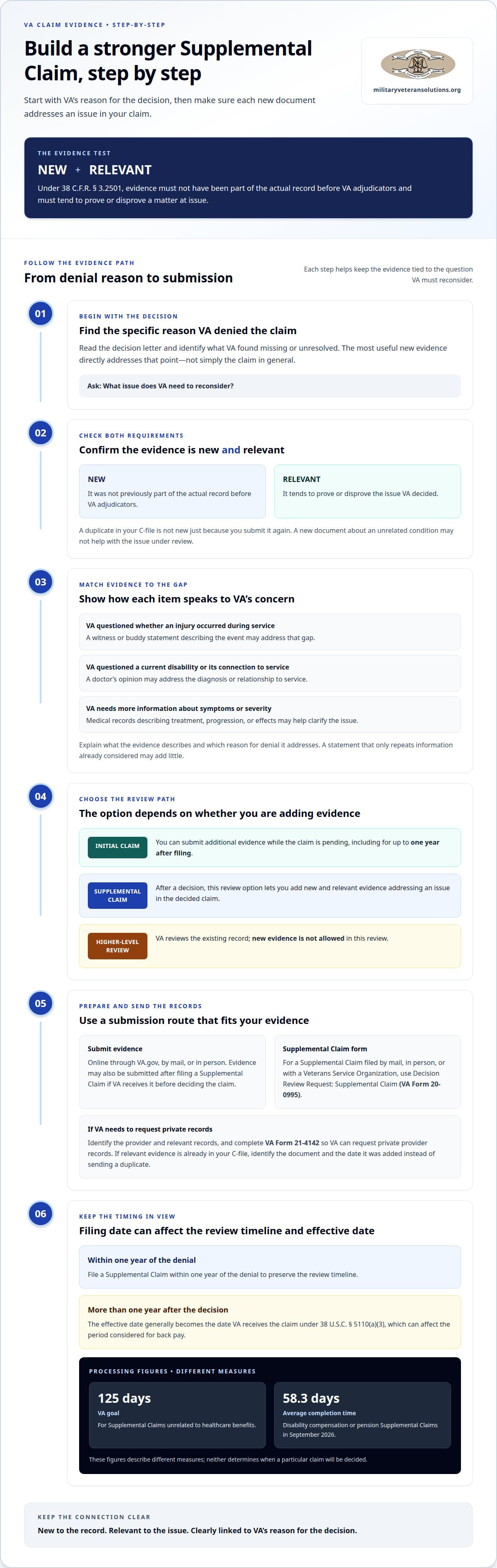
You can submit evidence while an initial VA claim is pending or file a Supplemental Claim after a decision. For a Supplemental Claim, the evidence must be new and relevant to an issue in your disability claim.
What Makes Evidence New and Relevant
Under 38 C.F.R. § 3.2501, evidence is new if it wasn’t previously part of the actual record before VA adjudicators, and relevant if it tends to prove or disprove a matter at issue. Both conditions matter: a duplicate document already in your C-file doesn’t become new simply because you submit it again. A record can be new yet unhelpful if it doesn’t address the disability or issue VA decided.
For example, a medical record about an unrelated condition may not help establish the connection or severity at issue. A new doctor’s opinion or buddy statement may qualify if it addresses a disputed point. The key is whether the material adds to the record and bears on VA’s reason for its decision.
Matching Evidence to the Denial Reason
New evidence is most useful when it addresses the specific reason VA denied a claim. Read the decision letter, identify what VA found missing, then connect each document or statement to that point. If VA questioned whether an injury occurred during service, a witness account describing the event may address that gap. If the dispute concerns a current disability or its connection to service, a doctor’s opinion may speak to that issue.
A doctor’s opinion or buddy statement may count as new and relevant evidence if it wasn’t previously in the record and bears on an issue VA decided. A statement that simply repeats information already considered may add little. Make the connection clear by explaining what the evidence describes and which reason for denial it addresses.
Evidence During Pending Claims and Reviews
While an initial VA disability claim is pending, submit additional evidence as soon as possible. You may add evidence for up to one year after filing an initial claim. By contrast, a Higher-Level Review considers the existing record and doesn’t allow new evidence. A Supplemental Claim is the review option for adding new and relevant evidence after a decision.
If VA denies a Higher-Level Review, the evidence window for a later Supplemental Claim is measured from the original claim decision. Don’t assume the Higher-Level Review pauses or resets the timeline. You can also file a Supplemental Claim after an initial decision or a Board denial, but it must include evidence addressing the decided claim.
Ways to Submit Evidence
You can submit evidence online through VA.gov, by mail, or in person. For a Supplemental Claim filed by mail, in person, or with a Veterans Service Organization, the U.S. Department of Veterans Affairs requires Decision Review Request: Supplemental Claim (VA Form 20-0995). Keep the documents tied to the claimed disability and the issue VA must reconsider.
You may also submit evidence after filing a Supplemental Claim, as long as VA receives it before deciding the claim. If relevant evidence is already in your C-file, identify the document and the date it was added instead of sending a duplicate. This helps direct attention to the existing record.
Processing figures describe different measures. The U.S. Department of Veterans Affairs’ goal for completing Supplemental Claims unrelated to healthcare benefits is 125 days. The average time to complete a Supplemental Claim for disability compensation or pension benefits was 58.3 days in September 2026. Neither figure determines when a particular claim will be decided.
Timing can also affect back pay and the effective date. File a Supplemental Claim within one year of the denial to preserve the review timeline. For a claim filed more than one year after the decision, the effective date generally becomes the date VA receives the claim under 38 U.S.C. § 5110(a)(3), which can affect the period considered for back pay.
Is a Supplemental Claim an option for me?
A Supplemental Claim may fit when VA has decided your claim and you can provide evidence addressing an issue in that decision. Medical records and opinions can clarify a diagnosis, symptoms, or how a disability relates to service.
VA and Private Medical Records
VA treatment records and private medical records can document a condition’s diagnosis, treatment, and progression. Their value depends on how they relate to the disability and the question VA decided. A record absent from your C-file may be new even if it’s decades old; for example, a 40-year-old record can qualify if it wasn’t previously in the file.
Relevant records may come from VA facilities or private hospitals and clinicians. You can identify records for VA to obtain through its duty to assist, which applies to initial and Supplemental Claims. For private provider records, complete VA Form 21-4142 so VA can request them. Identify the provider and records that relate to the claimed condition.
Medical and Expert Opinions
A medical opinion can explain a diagnosis, describe a condition’s severity, or address its relationship to military service. A new doctor’s opinion may qualify as new and relevant evidence even if the doctor reviews records already in your C-file. What matters is whether the opinion adds evidence bearing on an issue in your claim.
Consider how an opinion responds to VA’s stated reason for its decision. If VA questioned the connection between service and a current disability, an opinion addressing that relationship may be pertinent. If VA considered the condition but lacked information about its severity, medical documentation describing its effects may address that gap.
Private records and medical opinions can provide useful evidence even if they come from a provider you’ve seen before. The key is whether the material is new to the record and relates to the issue at hand. A document about an unrelated condition, for example, may not help resolve a disability compensation claim.
If VA already has relevant records, identify them rather than sending duplicate copies. If records remain with a private provider, VA Form 21-4142 supports a request for those records. For a condition covered by a change in law, medical evidence showing the diagnosis and severity may still matter, even when the law changes how service connection is considered.
When the issue involves missing or incomplete military documentation, military record reviews can help assess the service records alongside the medical evidence supporting a claim.
Buddy and lay statements
A lay statement is a written account of what someone personally observed or experienced. In a VA claim, a buddy statement can add firsthand details about an in-service event, changes in symptoms, or how a disability affects daily life. It may help address a denied issue if it relates directly to the question VA considered.
Veterans and witnesses can submit a lay or witness statement, also called a buddy statement, on VA Form 21-10210. A witness might be a service member who saw an injury happen, or a family member who observed ongoing symptoms after service. The statement’s value comes from clear, relevant details, not from the writer’s title or relationship to the veteran.
Keep each account focused on what the writer personally knows. Someone who witnessed an injury during service can describe the event and what they saw afterward. A spouse who observes difficulty sleeping can describe changes in the veteran’s routine. Neither needs to offer a medical diagnosis; each can describe observations in their own words.
- Identify the event, symptoms, or daily-life effects the account describes.
- Explain how the writer knows about those details, such as witnessing the event or living with the veteran.
- Connect the account to the issue VA denied, rather than unrelated events.
Specific examples give VA more context than broad conclusions. “I saw him leave work early because his back pain worsened” describes an observation. “His condition is service-connected” states a conclusion the witness may not be qualified to make. A statement can describe when and where an event happened, who was present, and what changed afterward, using details the writer remembers accurately.
A veteran can also submit a personal lay statement describing current symptoms and their effect on daily life. For example, the veteran might explain how pain affects standing, household tasks, or sleep. A clear account can add context to medical records, especially when they don’t capture every impact outside an appointment.
Keep each witness’s account in their own voice. A buddy statement should reflect the witness’s direct knowledge, not a shared script or assumptions about what VA wants to hear. If an advocate helps organize a claim, the statement should still accurately describe what the witness personally remembers. Don’t add details to make an account sound stronger.
Before filing, connect each statement to the relevant claim issue and include VA Form 21-10210 for a lay or witness account. A statement about an event may address what happened during service; an account of ongoing symptoms may describe their impact now. This focus helps VA understand why the testimony matters to the denied claim.
Examples of supporting evidence
Supporting evidence should address the condition or issue involved in a VA denial. The most useful additions aren’t simply more documents; they give VA relevant information to consider. Match each item to the point in dispute, such as diagnosis, severity, service connection, or the effect of a disability on employment.
A personal explanation can accompany other evidence. VA Form 21-4138 is a Statement in Support of Claim. For example, if the decision identifies an unanswered question about symptoms, the statement can direct attention to records or observations that address that question.
For PTSD and other mental health claims, VA Form 21-0781 is the Statement in Support of Claimed Mental Health Disorder(s) Due to an In-Service Traumatic Event(s). It provides a way to submit information about the claimed mental health condition and traumatic event. Tie the information to the issue VA considered, rather than adding details that don’t help explain the claim.
- Medical evidence: Records showing diagnosis or severity can relate to a claimed condition.
- Personal claim statement: VA Form 21-4138 can explain how evidence relates to the issue.
- Mental health statement: VA Form 21-0781 addresses a claimed disorder due to an in-service traumatic event.
- Employment evidence: VA Form 21-4192 is completed by the last employer for an Individual Unemployability claim.
For Individual Unemployability, the VA lists VA Form 21-4192, Request for Employment Information in Connection with Claim for Disability Benefits, for completion by the last employer. Employment information can be relevant when the claim concerns how a service-connected disability affects work. Connect the form to that issue instead of treating it as general background.
A change in law can also affect what evidence matters. The PACT Act added more than 20 presumptive conditions related to burn pits, Agent Orange, and other toxic exposures. For a presumptive condition, qualifying service can satisfy the service-connection presumption, but the claimant still needs to meet its service requirements. Medical evidence showing diagnosis and severity remains relevant to a disability compensation claim.
Evidence about a VA examination may matter if the examiner’s qualifications are challenged. If a veteran raises concerns about an examiner’s credibility or qualifications, VA must obtain those qualifications under the duty to assist. The examiner’s qualifications can count as new and relevant evidence for a Supplemental Claim. Use evidence that bears on the disputed issue and clearly explain its connection to the denial.
Board of Veterans’ Appeals evidence options
If VA denies a Supplemental Claim, you can consider another review option, including an appeal to the Board of Veterans’ Appeals. The Board offers three appeal options, two of which allow veterans to present new evidence. Your choice depends on whether you need to add material or want the Board to review the existing evidence.
Start with the reasons in VA’s latest decision. Identify whether the dispute concerns a diagnosis, the connection between a disability and service, or the condition’s severity. Then consider whether you have evidence addressing that issue. New treatment records, a medical opinion, or relevant witness information may affect which Board option fits.
- Direct Review: The Board reviews the existing record without new evidence.
- Evidence Submission: You can provide additional evidence for the Board to consider.
- Hearing: You can request a hearing and submit evidence as part of that option.
The Evidence Submission option may suit veterans who have relevant material but don’t want a hearing. The evidence should relate to the disability claim and the question VA decided. For example, a new medical opinion addressing a disputed connection to service may be more useful than records about an unrelated condition. Explain how each item relates to the denial.
A hearing option gives you an opportunity to present your case to the Board and submit supporting evidence. If you ask the Board of Veterans’ Appeals for a hearing, new and relevant evidence must be submitted within 90 days of the hearing date. Keep that window in view when planning to add treatment records, a diagnosis, or other material.
If VA denies your Supplemental Claim after reviewing new evidence, read the reasons and identify what remains unresolved. You may consider a Board appeal or another Supplemental Claim supported by additional new and relevant evidence. Filing within one year of the decision matters for preserving the review timeline.
Choose based on the record, not just the name of an appeal option. If the existing evidence already addresses the denial and you have nothing new to add, Direct Review keeps the Board’s review focused on that record. If treatment records or other material could address a missing point, an evidence option may fit better.
Board appeals require careful alignment between the decision, the evidence, and the review path. If you need help evaluating a VA denial and preparing an appeal, get support with a VA appeal.
Military Veteran Solutions, LLC
Military Veteran Solutions, LLC helps veterans assess VA decisions and plan next steps when evidence has been overlooked or a claim denied. VA Decision Letter Analysis and Military Record Reviews can help identify issues in a decision and relevant service documentation. When an appeal is appropriate, the firm also provides Veteran Claims Representation and files VA appeals.
Consider this support if you’re unsure whether new records address VA’s stated reason or which review option fits your case. A focused review can bring the decision, military records, and appeal strategy together, keeping attention on the issue VA must reconsider.
Contact Military Veteran Solutions, LLC to discuss your VA claim and the next step.
Move Forward With a Clear Evidence Strategy
Your next step is to connect each piece of evidence to the specific issue you want VA to reconsider. A focused evidence strategy can keep your claim coherent, especially when medical records, personal accounts, and service documents address different parts of your case.
Before choosing a review path, consider what question remains unanswered and what evidence addresses it. Submitting new and relevant evidence to VA is most effective when each item has a clear purpose, rather than simply adding paperwork. If you need help assessing a decision or preparing an appeal, Military Veteran Solutions provides representation and advocacy to help you approach the process with structure.
Discuss your VA claim options with Military Veteran Solutions and take a considered step toward your next decision.
Frequently Asked Questions
What documents will I need to support my claim?
The documents you need depend on the issue VA must decide. A claim might include service records, medical documentation, or statements describing an event or symptoms. For example, if VA needs evidence of a current diagnosis, relevant treatment records may help. If the question concerns an in-service event, military records or a witness account may add context. Organize materials by the issue each one addresses, rather than submitting unrelated paperwork.
When Can You Reopen a VA Claim?
After VA decides a claim, you can generally seek another review by filing a Supplemental Claim with new and relevant evidence. A change in law may also provide a basis for a Supplemental Claim without new medical evidence. For example, a legal change may affect whether a condition is considered presumptive. Review the decision and identify what has changed or what additional material supports reconsideration.
What counts as new and relevant evidence for a VA claim?
Evidence is new if it wasn’t previously in the record before VA adjudicators, and relevant if it tends to prove or disprove an issue. For example, a newly prepared medical opinion may address a disputed connection to service, even if it reviews existing records. When submitting new and relevant evidence to VA, connect each item to a specific question in the decision, such as diagnosis, severity, or service connection.
What forms are needed to submit evidence for a VA supplemental claim?
For a Supplemental Claim filed by mail, in person, or with a Veterans Service Organization, the U.S. Department of Veterans Affairs requires Decision Review Request: Supplemental Claim, VA Form 20-0995. Other forms depend on the evidence or claim type. VA Form 21-4142 authorizes requests for private medical records, while VA Form 21-10210 is for lay or witness statements. Use forms that match the records or claim issue involved.
What is the deadline for submitting new evidence to the VA?
For an initial disability claim, you may submit additional evidence for up to one year after filing, and should send it as soon as possible while the claim is pending. For a Supplemental Claim, evidence can be submitted after filing if VA receives it before deciding the claim. A separate deadline applies to Board hearings: submit new and relevant evidence within 90 days of the hearing date.
Can I submit new evidence after filing a VA claim?
Yes. While an initial claim is pending, send additional evidence promptly so VA can consider it during review. After filing a Supplemental Claim, you can also submit evidence if VA receives it before deciding the claim. For example, if a private provider sends a relevant record after you file, submit it promptly and identify the disability and issue it addresses. Higher-Level Reviews don’t accept new evidence.
What happens after I submit new and relevant evidence to the VA?
VA reviews the Supplemental Claim and readjudicates the issue when new and relevant evidence is presented or secured. The review may involve considering submitted records and requesting further information. After filing, respond to VA’s requests and attend any examination VA schedules. For example, if VA asks for clarification or arranges an examination about the claimed condition, responding helps keep the review moving.
What are examples of evidence that can support a VA disability claim?
Examples include a new diagnosis or treatment record, a medical opinion addressing service connection, and a witness account describing an event or observable symptoms. Employment information may support an Individual Unemployability claim; VA Form 21-4192 is completed by the last employer. For a mental health claim tied to an in-service traumatic event, VA Form 21-0781 provides a specific statement form. Choose evidence that addresses the claim’s unresolved issue.