
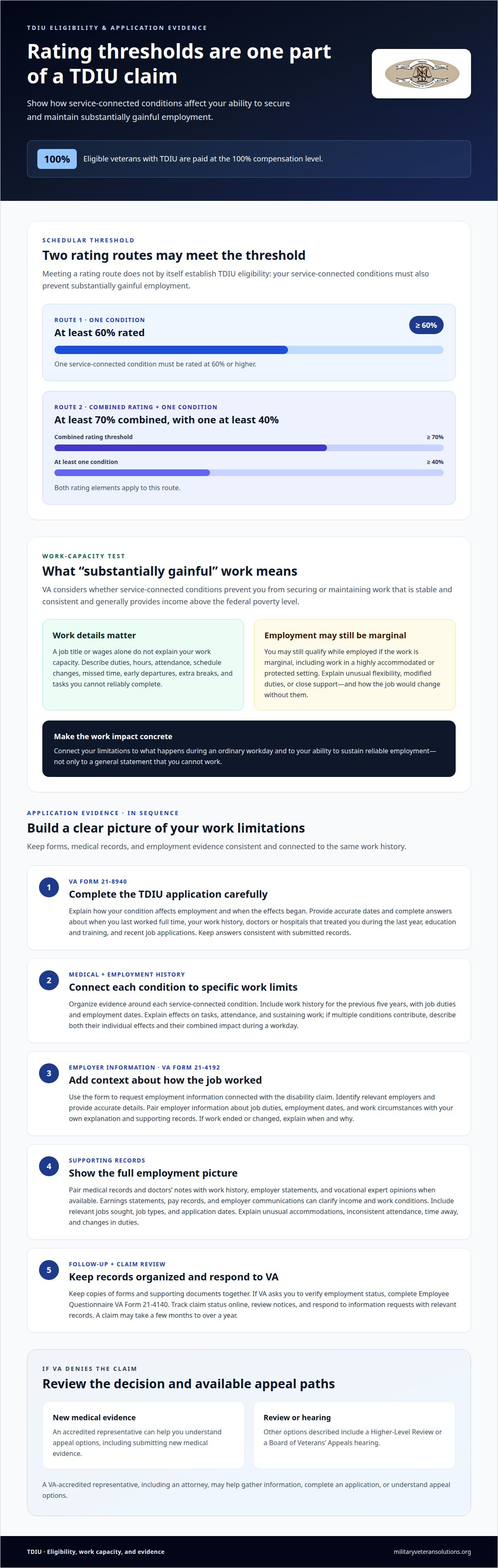
A disability rating below 100% doesn’t automatically rule out TDIU. According to the U.S. Department of Veterans Affairs, you may meet the schedular threshold with one service-connected condition rated at least 60%, or a combined rating of at least 70% with one condition rated at least 40%; TDIU pays eligible veterans at the 100% compensation level. Knowing how to apply for TDIU benefits means showing not only that you meet the applicable rating criteria, but that your service-connected conditions keep you from maintaining substantially gainful employment.
Applying for TDIU can feel demanding because VA needs a clear picture of how your health affects your ability to work. A strong application connects the required forms with medical records, work history, and other evidence explaining your limitations. This guide covers eligibility, application steps, and the medical and employment evidence that can make your case clearer. It also explains what to consider if VA denies your claim.
Key Takeaways
- Understand how VA evaluates whether your work is substantially gainful, including how accommodations or a protected work setting may matter.
- Build a clearer application by connecting medical records and work history to the specific ways your conditions affect employment.
- Learn how rating thresholds relate to TDIU eligibility and why qualifying may depend on more than your combined rating alone.
- Show how service-connected conditions affect your ability to secure and maintain work, using evidence that presents the full picture.
- Find out how Military Veteran Solutions’ claims representation and decision analysis may help when you need support with a VA claim or appeal.
What Does “Substantially Gainful Employment” Mean?
- Assess the work itself, not just whether you currently have a job. Substantially gainful employment generally provides income above the federal poverty level and is stable and consistent. VA considers whether service-connected conditions prevent you from securing or maintaining that kind of work. You may still qualify for TDIU while employed if the work is marginal, including work in a highly accommodated or protected environment. For example, an employer might allow unusually flexible duties or provide close support because of a service-connected disability. Describe those conditions clearly. A job title or wages alone do not show whether your work is substantially gainful.
- Explain how your employment works in practice. List your duties, hours, attendance, schedule changes, and support from supervisors or coworkers. Identify tasks you cannot complete reliably, including duties modified because of your disability. If you miss work, leave early, or need extra breaks, connect those circumstances to your limitations and explain how they affect consistency. If you complete some tasks only with substantial accommodations, describe them and explain how the job would change without them. Be factual: explain what happens during an ordinary workday instead of relying only on a general statement that you cannot work.
- Use VA Form 21-4192 to document the employer’s account. According to the U.S. Department of Veterans Affairs, veterans applying for TDIU submit VA Form 21-4192 to request employment information connected with a disability benefits claim. The form can help establish job duties, dates of employment, and work-related information. Identify relevant employers and provide accurate details so the employment information can be connected to your claim. If your work ended or changed, explain the timing alongside the medical or workplace circumstances. An employer’s response adds context; it should be considered with your own explanation and supporting records, not treated as the full account of your work capacity.
- Organize employment and financial evidence alongside your work history. Gather available earnings statements, pay records, and employer communications that clarify your income and work conditions. Arrange them with a chronological account of jobs, changes in duties, time away from work, and attempts to continue working. Explain any mismatch between reported earnings and your actual work capacity, such as wages earned with unusual accommodations or inconsistent attendance. The goal is to show how your service-connected disability affects reliable, sustained employment, not simply that you have income or left a job. This evidence gives VA a fuller picture of your work history and circumstances.
What Evidence Is Needed for a TDIU Claim?
Veterans apply for Individual Unemployability disability benefits using VA Form 21-8940, according to the U.S. Department of Veterans Affairs. A TDIU claim may take a few months to over a year; you can follow its progress through VA’s online claim-status service and respond to requests for information.
-
Complete VA Form 21-8940 Carefully
Use the form to explain how your condition affects employment and when those effects began. It asks when you last worked full time, which doctors or hospitals treated you during the last year, and about your work history. Provide accurate dates and complete answers. The form also asks for your highest completed education level, other schooling or training, and recent job applications. Keep your responses consistent with the records you submit.
-
Document Conditions and Work History
Organize records around each service-connected condition that contributes to your inability to work. VA reviews work and education history alongside medical evidence, so explain how your experience, training, and limitations relate to the jobs you have held. Include your work history for the previous five years, with job duties and employment dates. Avoid broad statements alone. Explain how each condition affects specific tasks, attendance, or your ability to sustain work.
-
Assemble Evidence for Multiple Conditions
If your claim is based on multiple conditions, gather medical evidence for each and explain both its individual effects and its combined impact. For example, records may document separate limitations, while a clear written account shows how they interact during a workday. Connect symptoms and treatment information to practical barriers at work. A list of diagnoses alone does not demonstrate how they affect your ability to maintain gainful employment.
-
Include Employment and Supporting Records
Pair medical records and doctors’ notes with employment history, employer statements, or vocational expert opinions when available. Each item should help explain why your service-connected condition prevents steady employment. Include information about jobs sought, job types, and application dates when relevant to your work history. If VA asks you to verify employment status, complete Employee Questionnaire VA Form 21-4140. Keep a copy of submitted forms and supporting documents together.
-
Use Accredited Help and Track the Claim
A VA-accredited representative, including an attorney, can help gather information or complete the application. If VA denies your claim, an accredited representative can also help you understand appeal options, such as submitting new medical evidence or requesting a Higher-Level Review or Board of Veterans’ Appeals hearing. Track your claim through VA’s online status service, review notices promptly, and respond to requests with relevant records. Organized documents make it easier to address missing information.
What Are the Eligibility Requirements for TDIU Benefits?
Review the rating pathways, work limitations, and payment rules together. TDIU considers whether service-connected disabilities prevent substantially gainful employment.
- Check which schedular rating pathway applies to your service-connected conditions. A single condition rated at least 60% may meet the threshold. With multiple conditions, the general threshold is a combined rating of at least 70%, including one condition rated at least 40%. Meeting a rating threshold alone doesn’t establish unemployability. The evidence must also show how service-connected limitations affect your ability to secure or maintain substantially gainful employment.
- Consider whether your circumstances may support TDIU even if you do not meet the standard rating thresholds. Can you qualify for TDIU without meeting the schedular rating requirements? Yes. VA may grant extraschedular TDIU when service-connected disabilities prevent work despite ratings below the standard thresholds. Work-related evidence remains central: explain how your conditions affect your ability to perform and sustain employment. A lower rating alone does not determine whether you qualify.
- Understand what TDIU changes before assessing the compensation. According to the U.S. Department of Veterans Affairs, eligible veterans receive compensation at the same level as a 100% VA disability rating. TDIU doesn’t change the underlying disability rating, though it changes the monthly compensation payment. The amount can depend on factors that affect VA compensation, including eligible dependents.
- Use the payment rule to answer how much VA pays and whether it matches the 100% rate. TDIU pays at the 100% compensation level, not necessarily as a 100% schedular disability rating. That figure is a basic monthly rate, so it doesn’t describe every veteran’s payment. Check the applicable award information for the amount VA assigned to your circumstances.
- Respond carefully to VA employment verification requests. Can TDIU benefits be reduced or discontinued, and what reporting rules apply? VA may ask you to verify employment status using Employee Questionnaire VA Form 21-4140; complete it if requested. TDIU doesn’t alter your underlying disability rating, but the compensation paid under TDIU differs from compensation at a lower rating. Keep employment information accurate and respond to VA notices so the agency can assess your circumstances.
Medical evidence and service connection
Organize medical records to show both the connection to service and the employment effects of your disabilities. Use evidence that clearly links your conditions, their documented limitations, and your ability to work.
-
Gather Medical and Vocational Evidence
Collect treatment records, doctors’ notes, and medical opinions describing your service-connected conditions and their effects. A vocational expert report can assess how your combined service-connected conditions affect your ability to maintain employment. Use vocational evidence to explain practical work limits, such as difficulty sustaining tasks or meeting job demands. Check that each document identifies the condition it discusses and connects its effects to workplace function.
-
Check Evidence Before Submission
Review every record for missing pages, unclear dates, and inconsistent descriptions of your limitations. Avoid submitting a diagnosis without evidence explaining how it affects work or connects to service. For example, a treatment note describing symptoms may not explain why they interfere with job duties. Arrange records so VA can follow the link between your service, the condition, and your employment limits.
- Build a clear service-connection timeline. Arrange relevant medical records, VA disability decisions, and medical opinions by date. Identify when symptoms began, when treatment occurred, and how the evidence relates to your military service. A Nexus letter is a doctor’s medical opinion connecting a veteran’s disability to military service. Include the underlying medical records when available, so VA can consider the opinion alongside the documented history.
- Connect each service-connected condition to specific work limitations. Explain what medical evidence says about symptoms, frequency, and functional effects, then show how those effects relate to work tasks. For example, records about a condition affecting concentration are more useful when your claim explains how concentration demands affect your job duties. Keep the explanation consistent with your medical documentation and employment history.
- Address changes in diagnosis without leaving gaps unexplained. A doctor may identify a service-related condition after an earlier disability claim. For example, a doctor determined two years after the initial claim that a veteran had service-related PTSD. Organize the later opinion with treatment notes and relevant VA decisions. Explain how the newer evidence fits the timeline and affects the claim, rather than treating a later diagnosis as unrelated to earlier records.
- Make the evidence tell one coherent story. Match each claimed condition to supporting records, then connect documented symptoms to your ability to maintain employment. If your claim involves several service-connected conditions, explain their separate effects and combined impact. Check that medical opinions, VA disability records, and work-related evidence contain no unexplained differences in dates or descriptions. Clear organization helps VA assess service connection and functional limits together.
Service-connected disability eligibility
Compare your VA disability rating with the schedular pathways, then connect your records to work-related limitations. Social Security Disability records can add context, but organize them alongside your VA evidence.
-
Confirm Service-Connected Disability Eligibility
Review your VA decision to identify which conditions are service-connected and their assigned ratings. According to the U.S. Department of Veterans Affairs, one service-related condition rated at least 60% generally meets the schedular TDIU rating threshold. For multiple disabilities, the combined disability rating threshold is 70% or more, with one service-connected condition rated at least 40%, according to the U.S. Department of Veterans Affairs. Match each condition and rating to the decision records.
-
Review the Rating Threshold and Disability Records
Check whether one disability meets the single-condition threshold or whether the combined-rating pathway applies. According to the U.S. Department of Veterans Affairs, that pathway requires a combined rating of 70% or more and one service-connected condition rated at least 40%. Review your VA decision letters for the listed conditions and ratings. Don’t rely on a combined figure alone if the individual ratings appear to determine which pathway fits.
- Keep VA disability records separate from Social Security Disability records. Include Social Security materials that describe work limitations, relevant dates, or functional effects, and identify what each record documents. These records can provide context, but keep VA decision letters and records about service-connected conditions easy to distinguish. For example, label each document by issuing organization and subject so the reviewer can follow the evidence without confusing a Social Security finding with a VA rating.
- Explain how the rating evidence relates to total disability based on individual unemployability. A qualifying percentage is one part of the review; your claim also needs to explain how service-connected conditions affect your ability to maintain gainful employment. Use records to connect a specific limitation to a work demand, such as difficulty completing tasks reliably. Keep the explanation consistent with the VA decision and supporting medical and employment evidence.
- Submit a clear record set with your VA form and supporting documents. Arrange VA rating decisions, Social Security Disability records, and related evidence by condition or date. Check that names, dates, and condition descriptions are readable and consistent. If your rating decisions are difficult to interpret, get help reviewing your VA disability records and understanding how they relate to a TDIU claim.
Military Veteran Solutions
Military Veteran Solutions helps veterans assess VA claims and decisions when TDIU evidence or eligibility is difficult to understand. Its Veteran Claims Representation supports veterans navigating the claims process, while Military Record Reviews and VA Decision Letter Analysis help clarify relevant service records and VA findings. If VA denies your claim, the firm also handles filing VA appeals.
Consider support when your records seem incomplete, a decision does not address key evidence, or you need to understand possible next steps after a denial. The right focus depends on where your claim stands and what needs review. Contact Military Veteran Solutions to discuss your TDIU claim and the support you need.
Take the Next Step With a Clear Plan
The next step is to turn the information supporting your claim into a coherent account of your work limitations. As you consider how to apply for TDIU benefits, focus on how your records fit together and what they show about your ability to sustain employment. A clear, organized presentation can help keep important details from being overlooked.
If you are unsure how VA decisions or military records relate to your claim, claims support can help you understand your options. If VA has denied your claim, an appeal may be a way to request further review. Choose a next step that fits your claim’s status, and make sure you understand what the available support covers.
Contact Military Veteran Solutions to discuss support for your TDIU claim. You deserve a clear path forward as you pursue the benefits you’ve earned.
Frequently Asked Questions
What Is TDIU?
TDIU means Total Disability based on Individual Unemployability, a VA benefit for eligible veterans whose service-connected disabilities prevent substantially gainful employment. It can provide compensation at the 100% disability rate even when the veteran’s schedular rating is lower. TDIU doesn’t change the underlying disability rating. For example, a veteran may keep a rating below 100% while receiving compensation at the TDIU level.
Are there Any Limits on a Veteran’s Right to Apply for TDIU Benefits?
There is no statute of limitations on a veteran’s right to file for VA disability compensation. You can apply for TDIU with an initial disability claim or later, including when a condition worsens. A disability compensation claim may be part of the process before seeking TDIU. The practical focus is building a record that supports service connection, work limitations, and the benefit you are requesting.
What Does Total Disability Individual Unemployability Do for Veterans?
TDIU can raise an eligible veteran’s compensation to the level paid for a 100% VA disability rating, without changing the veteran’s underlying rating. That distinction matters: the payment level changes, but the schedular rating remains as assigned. VA evaluates the service-connected conditions and their effect on substantially gainful employment. A veteran’s work history and education can help explain how those conditions affect realistic employment options.
What Is TDIU and Who Qualifies for Unemployability Benefits?
TDIU is compensation for veterans whose service-connected disabilities prevent them from maintaining substantially gainful employment. Eligibility generally involves meeting a schedular rating threshold and showing how the disabilities affect work. VA may also consider extraschedular TDIU for a veteran below the standard thresholds when service-connected conditions prevent work. A retired veteran can still receive TDIU, and work in a highly accommodated or protected setting may be considered marginal.
What is TDIU and who is eligible for VA individual unemployability benefits?
VA individual unemployability is a benefit for eligible veterans whose service-connected conditions prevent them from maintaining substantially gainful employment. Your evidence should connect those conditions to employment limitations. For example, medical records may document symptoms, while work records explain how they affect attendance or job duties. VA also reviews work and education history, so include relevant training and employment circumstances that help explain which kinds of work are difficult to sustain.
What are the VA schedular rating requirements for TDIU?
The general schedular pathways are one service-connected condition rated at least 60%, or a combined rating of at least 70% with one condition rated at least 40%. These thresholds are only part of the review: evidence must also show that service-connected disabilities prevent substantially gainful employment. Veterans below the standard thresholds may still be considered for extraschedular TDIU when their service-connected conditions prevent work.
How do you apply for TDIU using VA Form 21-8940?
Understanding how to apply for TDIU benefits starts with completing VA Form 21-8940 accurately. Provide information about work and education, treatment, and when disability began affecting employment. The form asks about doctors or hospitals that treated you during the last year, when you last worked full time, and recent job applications. Review dates and employment details for consistency with your supporting records. If you haven’t filed a disability compensation claim, file one first.
What documents and evidence are needed for a TDIU claim?
When considering how to apply for TDIU benefits, organize medical records, doctors’ notes, VA disability decisions, and employment information. Employer statements or a vocational expert opinion may add context about work limitations. If your claim involves multiple conditions, include evidence for each and explain their combined effects. Group documents by condition or date, and note how each record relates to a specific employment limitation. This makes the evidence easier to follow.