
A C&P exam is one part of the VA’s decision, not the final word on your claim. Knowing how to prepare for a C&P exam means reviewing your claim and records, organizing relevant documents, and describing your symptoms and their effects on daily life honestly. The VA considers the examiner’s report when deciding whether to grant disability benefits and what rating to assign.
It’s understandable to focus on what will happen during the appointment, especially when you want the examiner to understand what you live with. Clear, accurate details matter: explain how often symptoms occur, how long they last, what makes them worse, and which activities they limit. Don’t downplay difficult days, but don’t exaggerate or guess.
This guide explains what an exam may involve, how to prepare to discuss physical or mental health symptoms, and which records and documents to review or bring. It also covers why reviewing your claim information beforehand matters and what to do after the exam to stay informed about the next stage of your claim.
Key Takeaways
- Describe symptoms truthfully, including how often they occur and how they affect work, sleep, mobility, and daily activities.
- Review your claim details and records before the appointment so you can identify important history or inconsistencies.
- Bring your appointment letter, identification, and relevant medical records in an organized folder.
- Ask the examiner to clarify questions you don’t understand, and avoid guessing or exaggerating.
- If you need to reschedule, the U.S. Department of Veterans Affairs advises trying to do so at least 48 hours before the appointment, unless it’s an emergency.
1. Describing typical symptoms and limitations honestly
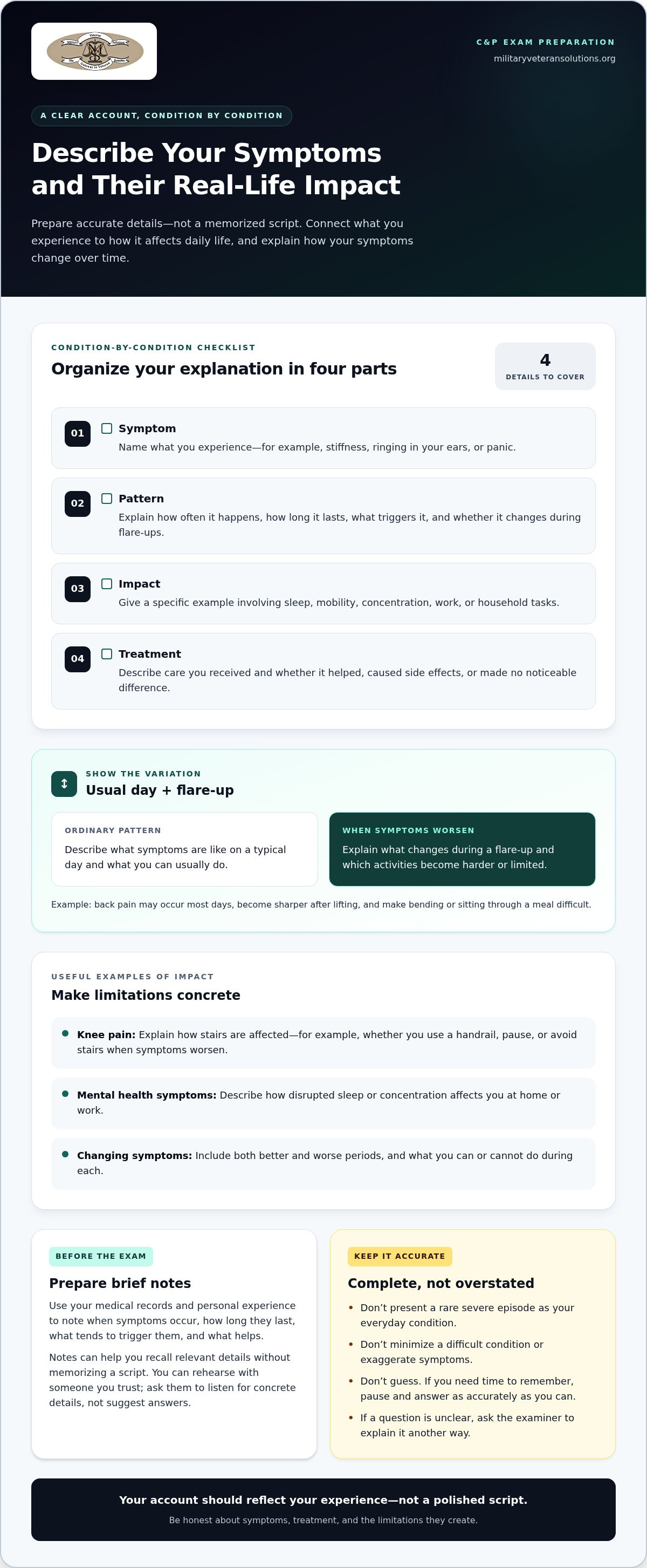
Before your C&P exam, prepare a clear account of your usual symptoms and their practical effects. Describe what happens on an ordinary day, then explain how a flare-up changes that pattern. For example, back pain might occur most days but become sharper after lifting, making it difficult to bend or sit through a meal. Specific examples connect symptoms with everyday functioning.
Write brief notes before the appointment, drawing on your medical records and personal experience. For each condition, record when symptoms occur, how long they last, what tends to trigger them, and what helps. Include treatments you’ve received and whether they eased symptoms, caused side effects, or made no noticeable difference. Notes can help you recall relevant details without memorizing a script.
Explain limitations directly. If knee pain affects your ability to use stairs, say whether you use a handrail, pause, or avoid stairs when symptoms worsen. If a mental health condition disrupts sleep or concentration, describe how that affects you at home or work. When discussing PTSD, anxiety, depression, or trauma, be honest about your symptoms, even if the subject feels difficult.
For each claimed condition, use this simple sequence to organize your explanation:
- Symptom: Name what you experience, such as stiffness, ringing in your ears, or panic.
- Pattern: Explain its frequency, duration, and whether it changes during flare-ups.
- Impact: Give a real example involving sleep, mobility, concentration, work, or household tasks.
- Treatment: Describe care received and the effect it had, consistent with your medical records.
Be complete without overstating. If symptoms vary, explain both better and worse periods, including what you can and cannot do during each. Don’t describe a rare severe episode as your everyday condition, but don’t minimize a difficult condition to appear composed. If you need time to remember, pause and give the most accurate answer you can.
One practical way to prepare for a C&P exam is to rehearse your explanation with someone you trust. Ask them to listen for concrete details, not suggest answers. Keep the focus on your experience and the condition connected to your disability compensation claim. Whether your paperwork concerns disability compensation or pension, accuracy matters: describe what you know, distinguish symptoms from assumptions, and don’t guess when you’re unsure.
Your account should be accurate, not polished. If an examiner’s question is unclear, ask them to explain it another way. Honest details about symptoms, treatment, and limitations help the examiner understand how your condition affects you. They can also make it easier to discuss difficult experiences during the appointment.
2. What can I expect during my C&P exam?
A VA C&P exam is a medical evaluation conducted by a VA healthcare provider or a VA-contracted provider. It gathers information about your diagnosis, whether a condition is connected to military service, and how severe it is and affects daily life or work.
The exam is one part of the disability claim process. The examiner prepares a report for the Department of Veterans Affairs, which considers it when deciding whether to grant disability benefits and what rating to assign. The examiner doesn’t make the decision and won’t know the outcome of your pending claim.
The exam format depends on the condition being evaluated. An appointment for one condition may take less than half an hour, while a claim involving several conditions may require more than one exam. You may answer questions, discuss your history, or complete an assessment related to the claimed condition.
- Arrive prepared: Check the appointment letter for the location, time, and instructions. Aim to arrive at least 15 minutes early.
- Answer plainly: Describe your experience without exaggerating or guessing. If you don’t understand a question, ask the examiner to clarify it.
- Take part in the assessment: Follow instructions for the condition being evaluated, and explain if pain or another symptom limits an activity.
- Keep the purpose in mind: A C&P exam collects claim information; it isn’t a visit for prescriptions or referrals.
Plan the trip using the address and travel details in your appointment letter. The VA’s goal is for veterans to travel no more than 50 miles to a C&P exam. If the location creates a serious barrier, contact the appointment provider promptly to discuss the issue rather than simply missing the exam. Missing a scheduled appointment could result in denial of a disability claim.
If you need to change the appointment, act quickly. The U.S. Department of Veterans Affairs advises veterans to try to reschedule at least 48 hours before the appointment, unless it’s an emergency. For an exam with a contract provider, the U.S. Department of Veterans Affairs says the appointment can be rescheduled only once, with the replacement within five days of the original appointment. Contact the number or provider identified in your appointment letter and explain the reason.
Knowing how to prepare for a C&P exam includes knowing what to do if the date or location becomes unworkable. Keep a record of rescheduling communications and any new appointment details. If you need support understanding how an examination relates to your claim, Veteran Claims Representation can help you consider the claim process and next steps.
3. Bringing hard-copy documents to the exam
Pack your appointment letter, identification, and relevant medical records in one folder. Check the letter for the exam location, date, and instructions before leaving. Keep documents for the condition being evaluated together so you can find a treatment note or test result without searching through unrelated paperwork.
Should you submit medical records or a DBQ before a C&P exam? Include relevant records and any completed Disability Benefits Questionnaire (DBQ) with your claim evidence, and bring copies to the appointment. These documents can help you refer to a diagnosis, treatment, or finding if the examiner asks about it.
Choose documents that help explain the claimed condition. A specialist’s note, for example, may describe a diagnosis, while imaging results or a treatment summary may show changes over time. If your file includes several conditions, use separate labeled sections. On a simple contents sheet, note each document’s date and provider, but don’t alter the records themselves.
Use this quick packing check before you travel:
- Appointment letter: Confirm the date, time, address, and any instructions.
- Identification: Bring the identification requested for the appointment.
- Medical records: Select relevant records that clarify the condition, treatment, or history.
- Claim support: Bring copies of submitted documents or a DBQ related to the condition.
- Notes: Keep a short list of document names and dates for easy reference.
A hard copy can help you point to a specific detail, but don’t assume that giving it to the examiner automatically adds it to your VA claim file. Keep your own copies, identify what each document relates to, and follow the submission instructions for claim evidence. Even if the examiner already has a record, your copy can help you answer questions accurately.
You may want a family member or someone close to you at the appointment. They can help recall observations, such as changes in sleep or mobility, and note important details afterward. However, the examiner may not allow them to attend the exam itself. Be ready to describe your condition in your own words, even if your companion can’t join you in the room.
Before the appointment, discuss with your support person which observations may be useful. Ask them to listen and take notes, not answer questions for you. They might, for instance, remember when you stopped driving at night or began needing help with a household task. Their observations can add context, but your explanation should remain accurate and personal.
Keep your folder accessible during travel and bring it into the appointment. Organized documents make it easier to find relevant information quickly and explain how each record relates to the condition being evaluated.
4. Reviewing military, VA, and private medical records
Before your C&P exam, review records from military service, VA care, and private treatment. These sources may document different parts of a condition’s history. For example, a service treatment record may note an injury, while later VA or private records describe ongoing symptoms and care. Compare dates and details so you can explain the timeline clearly.
When deciding a claim, the VA considers medical records, the C&P exam report, results of ordered tests, statements from you and others, and military and personnel records. Each can provide useful context. A treatment note may describe a diagnosis, while a test result may show a finding. Reviewing your records can help you identify evidence related to the condition and compensation you’re claiming.
Organize records by source and condition before reviewing them. Use separate sections for military service treatment records, VA records, and private medical records, then arrange documents by date within each section. A brief index can list the provider, document date, and subject, such as “knee evaluation” or “hearing test.” This makes relevant entries easier to find without rereading the entire file.
- Military records: Look for service treatment notes, injury reports, and relevant personnel records.
- VA records: Review diagnoses, treatment notes, test results, and follow-up care.
- Private records: Include relevant evaluations, prescriptions, imaging, and specialist notes.
- Timeline: Note gaps, changes, or conflicting dates to discuss accurately.
Check whether the records tell a coherent story. For example, compare an initial service injury entry with later treatment for the same body area. Note if a record uses different wording for the condition or if treatment paused and later resumed. Don’t change or interpret medical findings yourself. Write down questions and describe your personal experience alongside the documented care.
The VA may use the Acceptable Clinical Evidence (ACE) process to review medical records and decide whether an exam is needed. As a result, the record review can affect whether an in-person evaluation is part of the process. Make sure relevant evidence is organized and available with your claim materials rather than assuming the examiner will have every document you possess.
For each claimed condition, create a short reference sheet listing key record dates and providers. Use it to prepare for questions, not as a substitute for the records. If your military service records seem incomplete or difficult to interpret, Military Veteran Solutions can review them to help identify relevant information and organize your service history for your claim.
5. Reviewing claim information
Before the C&P exam, review claim information the examiner may not know in full. Go over the conditions you claimed, the evidence submitted, and the timeline you provided. For example, check whether your statement connects an in-service event with the condition you’re claiming today. This can help you spot gaps or inconsistencies before questions arise.
Review your C-file, also called your claims file, for records relevant to each claimed condition. Compare your statements with service records, medical evidence, and prior VA documents. Note any missing evidence or differences in dates, names, or descriptions. If your claim says symptoms began after an event but another record gives a different timeline, prepare to explain the difference accurately.
Next, look at the VA Schedule for Rating Disabilities in CFR, Title 38, Part 4. It provides criteria for evaluating disabilities. Use the schedule to understand which symptoms or findings relate to the condition and rating criteria. Don’t try to match yourself to a rating or rehearse phrases. Instead, identify relevant examples from your own experience and records.
- Check the claimed conditions: Confirm each condition you expect the exam to address.
- Trace the evidence: Identify records or statements supporting each condition and its history.
- Mark questions: Note unclear dates, missing documents, or conflicting descriptions.
- Prepare explanations: Write down factual context that clarifies a discrepancy or gap.
Keep your notes factual. If a record uses a different diagnosis term from your claim, note the wording and provider rather than assuming the terms mean the same thing. If treatment stopped, recall why, such as a change in symptoms or difficulty attending appointments. At the exam, answer what you know and distinguish personal recollection from information found in a record.
Reviewing your claim also helps you understand what the exam can and cannot establish. The examiner’s report contributes to the VA’s decision, but the examiner may not have your entire claim history. Be ready to clarify relevant details if asked. You don’t need legal representation to attend a C&P exam. If the VA denies an initial claim, an attorney may represent you in an appeal.
After reviewing your claim file, identify whether your main concern is an incomplete service history, unclear evidence, or a VA decision you need to challenge. For help assessing claim documentation and potential next steps, request support with your VA claim review.
Military Veteran Solutions: Filing VA appeals
Military Veteran Solutions helps veterans review VA decisions and pursue appeals when a disability claim is denied or the decision raises concerns. Its VA Decision Letter Analysis and Veteran Claims Representation can help you understand the decision and consider an appeal. Military Record Reviews can also help clarify service history relevant to a claim. A C&P exam is one part of the process; reviewing the decision and its stated reasons helps identify what needs attention next. If you’ve received a VA decision and need support understanding your options, contact Military Veteran Solutions.
Carry your claim forward with confidence
Knowing how to prepare for a C&P exam gives you a steadier starting point. After the appointment, stay engaged with your claim. Treat the exam as one checkpoint, then use the VA’s decision to understand what needs attention next.
When the decision arrives, read its reasoning carefully and compare it with the information you provided. If something remains unclear or the outcome raises concerns, focus on the specific issue you want addressed. A clear question about your claim can help make your next conversation more productive.
You don’t have to sort through that next step alone. Military Veteran Solutions can support veterans pursuing VA appeals and claims representation, including when a decision or military record needs closer review. Explore your VA claim options and decide what support fits your situation. Keep your records organized, stay attentive to notices, and move forward one informed step at a time.
Frequently Asked Questions
Do I Need a Lawyer for My C&P Exam?
No. You don’t need legal representation to attend a C&P exam or answer the examiner’s questions. Your role is to describe your experience accurately and provide relevant information. If the VA denies your initial claim, an attorney may represent you in an appeal. For the exam itself, focus on understanding each question and explaining your own history rather than preparing legal arguments.
How does my C&P exam get scheduled?
The VA arranges a C&P exam when it needs an evaluation to help assess your disability claim. Your appointment letter gives the date, time, location, and instructions, so read it carefully and keep it accessible. If the details conflict with your schedule, use the contact information provided with the appointment to address the issue promptly. A claim involving different conditions may require separate evaluations.
What can I do to help make my C&P exam successful?
Prepare to communicate clearly, not to produce a particular outcome. Review the condition being evaluated, identify records or events you may be asked about, and listen carefully before answering. Respond directly, distinguish what you remember from what you infer, and ask for clarification if a question is confusing. If an answer needs context, explain the relevant detail without turning it into a rehearsed speech.
What can I expect during my C&P exam?
The appointment may include questions about your history, a physical assessment, or a mental health evaluation, depending on the claimed condition. Musculoskeletal exams may focus on movement and function, while audiological evaluations assess hearing concerns. The examiner may ask follow-up questions to clarify an answer. You can request a pause if you need to collect your thoughts, then continue with an accurate response.
What if I disagree with the results of my C&P exam?
If you believe the exam report is inaccurate, you can challenge its accuracy or validity and request a new exam before the VA makes its final rating decision. Call 1-800-827-1000 to raise the concern. Be specific about the disputed issue, such as a missing symptom or factual error. To request a copy of exam results, submit VA Form 20-10206, according to the U.S. Department of Veterans Affairs.
What information will the VA use to make a decision?
The VA considers the C&P report alongside submitted medical records, ordered test results, statements from you and others, and military and personnel records. For example, a statement from someone who observes your daily functioning may add context to clinical notes. The decision considers the claim file as a whole, so one response during the exam isn’t the only evidence considered.
What is a Disability Benefits Questionnaire (DBQ)?
A Disability Benefits Questionnaire, or DBQ, is a form used to record medical findings about a condition relevant to a VA disability claim. A completed DBQ may provide structured information about symptoms, examination findings, and functional effects. It doesn’t replace your own account during a C&P exam. Keep the form consistent with your medical documentation and include it with claim evidence when relevant.
What should I bring to a C&P exam?
Bring your appointment letter, identification, and copies of relevant medical records. If you have a DBQ or a document that clarifies a condition’s history, keep it organized and easy to locate. A trusted person may offer observations or help you remember appointment details, but the examiner may not allow them in the exam room. Be prepared to attend and answer questions yourself.