
A poor C&P exam can affect how the VA evaluates your disability claim, but disagreeing with the result alone does not establish a reason for another exam. To understand how to request a new C&P examiner, document specific problems promptly and submit a written request explaining why the examination was inadequate.
If the examiner rushed the appointment, overlooked relevant medical history, or did not let you explain your symptoms, it is understandable to worry that the report will not reflect your condition. Focus your request on what happened and how it affected the evaluation, rather than simply saying you disagree with the findings.
This article explains when a new C&P exam may be appropriate, how to contact the VA about the problem, and how to document your concerns in your claim file. It also covers when a second opinion or an appeal may be a more useful way to address an unfavorable exam.
Key Takeaways
- Request another exam by describing specific problems with the original evaluation, not simply by disagreeing with its result.
- Document what happened promptly and submit a clear written statement for your claim file.
- Contact the VA Regional Office to explain your concerns and ask that your request be added to your file.
- Consider whether a second opinion or independent medical consultation could address gaps in the exam findings.
- If an unfavorable decision follows, review the decision and available appeal options before choosing your next step.
Can I Request a New Compensation and Pension (C&P) Exam?
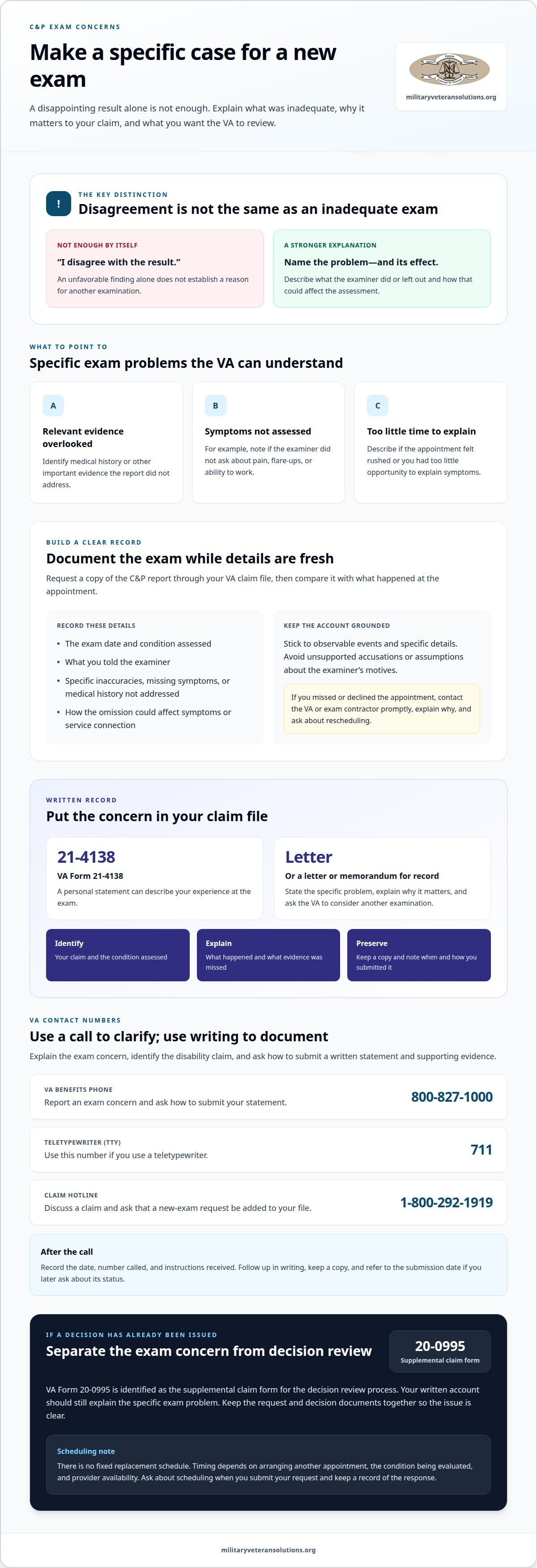
Yes. You can ask the VA to arrange another exam when you can identify a specific problem with the original evaluation. An unfavorable result alone is not enough. Explain what was inadequate and why it matters to your claim.
Signs of an Improper or Inadequate Exam
An exam may be inadequate if the examiner overlooks important evidence or fails to assess issues relevant to your disability. For example, the examiner may not ask about pain or your ability to work, may rush the appointment, disregard medical history, or give you too little opportunity to explain your symptoms. Describe these specific concerns rather than simply disagreeing with the rating.
The C&P report helps the VA assess your symptoms and whether a claimed condition is connected to military service. For a claim involving worsening symptoms, the findings may also inform whether a higher rating is warranted. If the report leaves out relevant information, identify what is missing and connect it to the issue the VA must decide. A request for another exam is stronger when it describes what the examiner did or failed to do.
Reviewing and Documenting Exam Concerns
Request a copy of the C&P report through your VA claim file, then compare its findings with what happened at the appointment. Note specific inaccuracies, symptoms that are missing, or medical history the report does not address. Record the exam date, what you told the examiner, and what you believe was overlooked. This gives the VA a focused account to review.
Submit your concerns in writing and keep a copy. A personal statement using VA Form 21-4138 can describe the exam experience; a letter or memorandum for record can also explain the issue. State the problem plainly, then explain how it could affect the assessment of your symptoms or service connection. Avoid relying only on broad claims that the examiner was unfair.
If you miss or decline a scheduled C&P exam, promptly contact the VA or the exam contractor to address the appointment. Explain why you could not attend and ask about rescheduling. If the exam did not take place, there is no examiner conduct to challenge.
There is no fixed replacement schedule. Timing depends on arranging another appointment with the VA or its contractor, the condition being evaluated, and provider availability. Ask about scheduling when you submit your request, and keep a record of the response.
To understand how to request a new C&P examiner, distinguish a request for another exam from a challenge to a decision already made. If the VA has issued a decision, the U.S. Department of Veterans Affairs identifies VA Form 20-0995 as its supplemental claim form. That form is relevant to the decision review process, while your written account should explain the specific exam problem. Keep the request and decision documents together so the issue is clear.
Contacting the VA Regional Office
Contact the VA about an inadequate C&P exam and clearly ask that your concerns be added to your claim file. A call can help you explain the problem, but a written request records what you reported and the evidence you want considered.
The VA’s main benefits phone number is 800-827-1000. Call to report an exam concern, identify the disability claim, and ask how to submit your written statement. If you use a teletypewriter, call 711. A separate claim hotline, 1-800-292-1919, is also identified for discussing a claim and asking that a new-exam request be added to your file.
Keep your explanation focused. Give the exam date, the condition assessed, and the specific problem. For example, say the examiner did not ask about symptoms during flare-ups or discuss relevant medical history. Explain how the omission could affect the VA’s review. Ask the representative to note your request and explain how to submit supporting evidence in writing.
Follow up with a written statement to the VA office handling your claim. Include your claim-identifying information, a concise account of what happened, and the action you are requesting. Attach relevant evidence, such as medical records or a personal account of symptoms omitted during the exam. Keep a copy and record when and how you submitted it.
The basic request is the same regardless of which VA office handles your claim: describe the exam problem, explain why it matters, and ask the VA to consider another examination. Use the information on VA correspondence to identify the office handling your file, and keep that correspondence with your submission.
After contacting the VA, note the date, the number you called, and any instructions you received. If the representative asks for a written statement, follow up rather than relying only on the call. If you have already sent a request, refer to its submission date when asking about its status. This creates a clear record of your communication and distinguishes an exam complaint from disagreement with the claim decision.
To explain how to request a new C&P examiner, connect each concern to a specific detail from the exam and the evidence it left out. Avoid unsupported accusations. A clear, organized account helps the VA understand what you are challenging and what review you want.
Reporting concerns about an examiner
Report concerns promptly and make your complaint specific enough for the VA to understand what happened. A written account can preserve details that are easy to forget, such as which symptoms you described, which questions the examiner skipped, and what happened during the appointment. Stick to observable events, not assumptions about the examiner’s motives.
Build your statement around the exam itself. Identify the condition being evaluated and describe the conduct or omission you are reporting. For example, explain that you tried to discuss how pain affects your ability to work, but the examiner moved on without asking follow-up questions. If the report later omits that limitation, describe the connection between the appointment and the missing information. Concrete examples help distinguish a procedural concern from dissatisfaction with the result.
Veterans can use VA Form 21-4138 to submit a personal statement about a bad C&P exam. Write in your own words, then review the statement for dates, condition names, and details that make the event understandable. If you don’t remember an exact phrase, summarize the exchange accurately instead of presenting a guess as a quotation. Keep a copy of the completed form and any related documents for your records.
A memorandum for record is another way to document your concerns and request another exam. Explain when the exam took place, what the examiner did or did not address, and why the problem matters to your claim. You can upload a memorandum to your VA file through an E-Benefits account. Keep the details consistent across your personal statement, memorandum, and later communications with the VA.
Separate a complaint about the examiner’s conduct from a request to correct the claim decision. A complaint describes what happened at the appointment; a decision challenge explains why the evidence or rating should be reviewed. If the examination failed to consider medical history or left out symptoms, say so directly. Disagreeing with a medical opinion does not, by itself, prove misconduct.
If the VA does not approve a second C&P exam, you can write a formal complaint letter to your state’s congressional representatives. Summarize the exam problem, the action you requested, and the response you received. Include copies of relevant claim correspondence or your submitted statement. Keep the original documents and send copies so your records remain complete.
Be precise and measured. A focused complaint records your concern and supports a clear request for review. If the examiner’s report contains a specific omission, name it and explain how it relates to your symptoms or claimed condition.
Requesting a second opinion
A second opinion can add medical perspective when a C&P report leaves important questions unresolved. The VA may request another exam to clarify confusion, correct errors, or obtain an opinion from a different medical professional. Identify the unanswered question in your request rather than simply asking for a more favorable conclusion.
Start with the specific gap in the existing report. For example, explain that the examiner discussed your diagnosis but did not address whether your condition is connected to military service. Or identify a missing discussion of aggravation or a secondary condition. Then state what a further medical opinion needs to address. This distinguishes a request for clarification from general disagreement with the examiner’s findings.
The VA may decide another C&P exam is appropriate when the existing evaluation needs clarification or correction. A new examiner can provide a different professional assessment, but another exam does not automatically change the claim outcome. The key question is whether the record has an unresolved medical issue that matters to your disability claim. Explain that issue clearly in your written request.
Can a veteran request a private medical exam instead of a VA C&P exam? You can seek an independent medical consultation, such as an appointment with a general practitioner or specialist, and submit it to supplement an unfavorable C&P exam. A private consultation does not automatically replace a VA exam; present it as additional medical evidence for your claim.
Choose a clinician whose expertise fits the question. For example, if the report concerns a particular medical condition, a specialist in that area may be able to address relevant findings. Explain what you want the consultation to assess, and provide relevant records so the clinician can consider your history. A written opinion is most useful when it addresses the disputed medical point rather than only restating a diagnosis.
When you submit a private opinion, identify the C&P finding it addresses and explain how the assessment relates to your claim. Keep the consultation report and related records together. If the VA has already issued a decision, reviewing the decision and available claim or appeal options may be more useful than treating another exam as the only response.
Make clear what kind of second opinion you are requesting. Say whether you want the VA to arrange another C&P evaluation or are submitting an independent consultation. For instance, you might request a new evaluation because the original report omitted a relevant medical question, while separately submitting a specialist’s written assessment. Tie each request to the evidence and issue under review.
A second opinion is most useful when it answers a specific question the current record leaves open. Compare the new assessment with the C&P report, identify any remaining disagreement, and explain why that difference matters to your claim.
How can you challenge an inadequate C&P examination in a VA claim or appeal?
Challenge an inadequate examination by linking a specific flaw to the disability issue the VA decided. Identify what the examiner missed, show where the claim record supports your concern, and explain what review you want. A general statement that the exam felt unfair does not explain why its findings should be reconsidered.
Start by comparing the C&P report with the decision letter and the evidence you have submitted. Look for a missing discussion of symptoms, medical history, or a relevant connection between your condition and service. For example, if the report does not address whether one condition worsened another disability, explain the omission and point to records that make the question relevant. Keep your explanation tied to the claim issue, not the examiner’s presumed intentions.
If the VA has not decided your claim, submit a written account of the exam problem with supporting evidence. A personal statement can clarify what happened, while an independent medical consultation may address an unanswered medical question. A general practitioner or specialist can provide an assessment to supplement an unfavorable C&P exam. Explain how that opinion relates to the disputed finding rather than submitting it without context.
If the VA has issued a decision, review the decision letter to understand what the VA relied on and which finding you’re challenging. The U.S. Department of Veterans Affairs identifies VA Form 20-0995 as the supplemental claim form. VA Form 20-0996 is identified as the Higher-Level Review form. Match your next filing to the decision issue and the evidence or exam error you want reviewed. Don’t treat a request for another exam as a substitute for responding to an unfavorable decision.
Make the correction you are requesting easy to understand. State the condition at issue, name the report finding you dispute, and describe the relevant evidence. If the report omitted a symptom, explain how it affects the evaluation. If it failed to address a medical question, identify the question and provide relevant records or an opinion that addresses it. Keep copies of your submission and supporting documents together.
Organizing a claim or appeal can be demanding, especially when an exam report and decision letter raise different issues. Get support with a VA claim appeal to review the decision and prepare a focused appeal based on the record.
Military Veteran Solutions: Filing VA appeals
Military Veteran Solutions, LLC helps veterans pursue VA appeals when an exam or decision raises unresolved concerns. Its VA Decision Letter Analysis and Veteran Claims Representation can help you understand the decision, identify issues affecting your claim, and consider an appeal based on the record.
Consider this support after an unfavorable decision, especially if a C&P report overlooked relevant evidence or failed to address a key medical question. A focused review can clarify what the decision relied on and which issues an appeal should address. Military Record Reviews may also help identify service documentation relevant to your claim.
If you’re ready to discuss your VA appeal, contact Military Veteran Solutions, LLC.
Move Forward With a Clear Claim Strategy
Let your next step reflect the full record, not only the frustration of one appointment. As you decide how to request a new C&P examiner, focus on what information the VA still needs to evaluate your claim. Clearly explaining the unresolved issue can help you approach the process with purpose and keep your attention on the benefits decision ahead.
If the decision has arrived and you are unsure how to proceed, take time to understand what it says about your claim and what response may be appropriate. You do not have to sort through it alone. Military Veteran Solutions, LLC can review your VA decision letter, help assess potential appeal options, and support you in organizing a path forward based on your circumstances.
Contact Military Veteran Solutions, LLC for help with your next step. Your experience deserves careful consideration, and a thoughtful plan can help you continue advocating for your claim.
Frequently Asked Questions
What if I had a bad C&P exam?
Write down what happened while the details are fresh, then compare your notes with the exam report. Focus on a specific discrepancy, such as a symptom you described that the report does not mention. If the issue affects your claim, tell the VA what you want reviewed and why. A clear record helps distinguish problems with the exam from disappointment with the medical opinion.
What should I do when I get my claim exam letter or phone call?
Confirm the appointment details and note whether the exam is arranged through the VA or a contract provider. Keep the letter, or record the caller’s name, organization, appointment information, and instructions. Check which claimed condition the appointment concerns so you can prepare relevant records and describe your symptoms accurately. If the time will not work, promptly contact the VA or contractor to discuss rescheduling.
Who will examine me?
Your claim exam may be conducted by a VA provider or a VA contract provider. The professional evaluates the claimed condition and provides findings for your disability claim, rather than ongoing treatment. Before the appointment, review your claim documents and be ready to describe how the condition affects daily activities. If you have concerns about the examiner’s conduct, record specific events rather than assumptions.
How can a veteran request a new VA C&P examiner?
Send the VA a written request explaining why the existing exam was inadequate and what a new evaluation should address. Identify the condition and appointment, then describe the specific gap, such as a relevant symptom or medical question that was left out. Submit the statement to your claim file and keep a copy. A request tied to the evidence gives the VA a clearer issue to review than a general request for another examiner.
What reasons justify requesting a different C&P examiner?
Specific exam problems can support a request, including a rushed evaluation, ignored medical history, or failure to ask about pain or ability to work. Explain how the omission affected the assessment. For example, if the report describes your condition without considering how symptoms limit your ability to work, identify the missing detail and its relevance. An unfavorable opinion alone, without a concrete problem with the exam, does not explain why another examiner is needed.
Who should a veteran contact to request a new C&P examiner?
Contact the VA about the claim exam by calling 800-827-1000, then follow up with a written request for the claim file. The VA also lists 711 for TTY access. Include identifying claim information and a concise account of the exam concern. If a contractor conducted the appointment, note the contractor’s name in your statement so the VA can connect your report to the correct exam.
Can a veteran refuse or reschedule a C&P exam with a specific examiner?
You can contact the VA medical center or contractor to discuss rescheduling, but refusing to attend may leave the VA without that examination’s findings. According to the U.S. Department of Veterans Affairs, tell the medical center or contractor at least 48 hours before a claim exam when rescheduling. For a contractor-scheduled exam, rescheduling is allowed once per exam, and the replacement appointment must fall within 5 days of the original.
What are VA rules for examiner conflicts of interest or bias?
If you believe an examiner had a conflict or showed bias, report the specific facts to the VA in writing. Describe the examiner’s statement or conduct, when it happened, and how it affected the evaluation. For example, quote or accurately summarize a comment that seemed to dismiss evidence before reviewing it. Keep the complaint factual, and distinguish observable behavior from your interpretation of the examiner’s motive.