
The strongest PTSD buddy letter doesn’t have to come from someone who served beside you. A competent, credible person over 18 can write one, provided they explain their relationship to you and describe what they personally observed. To understand how to write a buddy letter for PTSD, focus on specific changes, events, or symptoms the witness knows firsthand, not medical conclusions they can’t establish.
It’s understandable to wonder whether a friend or family member’s account will carry weight, especially when records don’t fully capture what happened or how life changed afterward. While listening to stories of navigating adversity on the I'm Still Rolling Podcast highlights the everyday realities of living with a disability, a VA lay statement serves a formal purpose: filling in context by describing what the writer observed, when they noticed changes, and how those changes affected daily life.
This guide explains what a VA buddy letter is, who can write one, and how to choose witnesses with firsthand knowledge relevant to the claim. You’ll also learn how to organize the account, keep it factual, and distinguish useful observations from speculation so the writer can describe the veteran’s experience clearly and credibly.
Key Takeaways
- Build the letter around the writer’s relationship to the veteran, the purpose of the statement, and clear firsthand details.
- Use VA Form 21-10210 to submit a buddy or lay statement, and complete its certification sections carefully.
- Choose a witness whose direct knowledge fits the claim, such as someone who observed an in-service event or changes in daily life.
- Make observations more useful by describing what changed, when it began, and how it affected the veteran’s behavior or abilities.
- Keep the account factual and focused; leave medical diagnoses and explanations of cause to qualified professionals.
What Is a VA Buddy Letter?
A buddy letter must be signed by its writer, but notarization isn’t universally required. If the statement isn’t submitted on VA Form 21-4138, include a certification that its contents are true and correct; written testimony may be certified or given under oath or affirmation under 38 CFR 3.200(b).
A VA buddy letter is a written lay-witness statement, not a medical expert opinion. For a PTSD disability claim, it can describe an event, symptoms, or changes the witness personally observed. Under 38 CFR 3.304(f), service connection involves a PTSD diagnosis, a medical link to an in-service stressor, and credible supporting evidence that the stressor occurred. If you're deciding how to write a buddy letter for PTSD, keep the witness’s firsthand knowledge at the center.
Watch this video for a practical overview of writing a buddy letter for a VA disability claim:
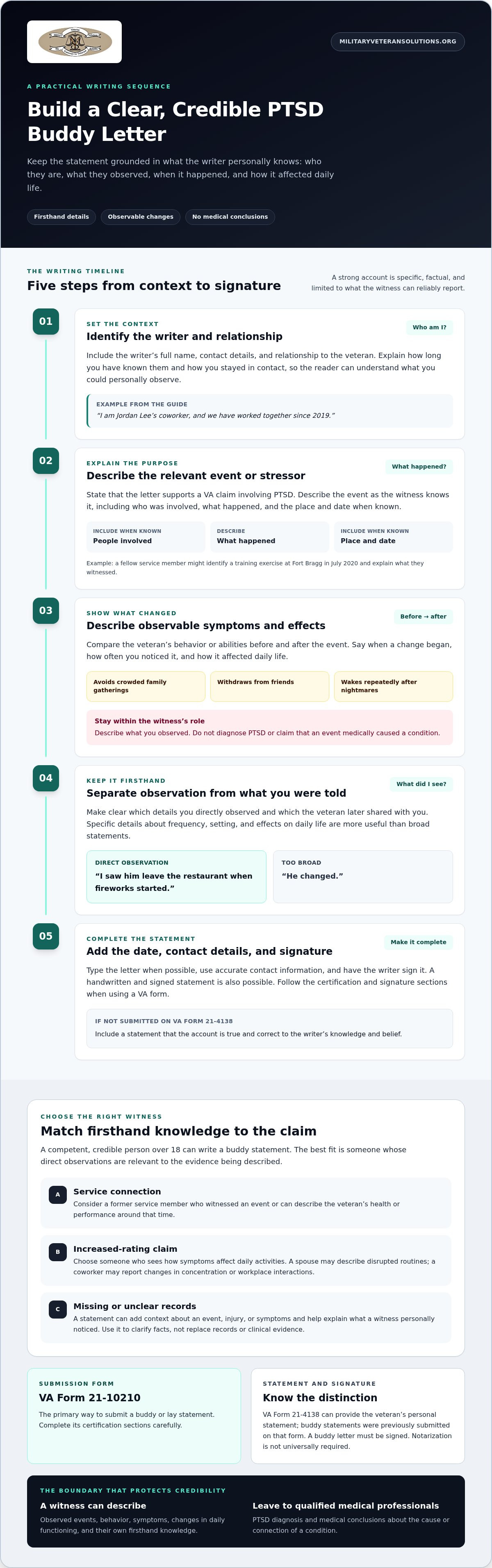
- Identify the writer and relationship. Start with the writer’s full name, contact details, and relationship to the veteran. A civilian friend can state how long they’ve known the veteran and how they stayed in contact. For example, “I am Jordan Lee’s coworker, and we have worked together since 2019.” This context helps explain what the writer could personally observe.
- Explain the purpose and relevant event. State that the letter supports a VA claim involving PTSD, then describe the event or stressor as the witness knows it. Include who was involved, what happened, and the place and date when known. A fellow service member might identify a training exercise at Fort Bragg in July 2020 and explain what they witnessed.
- Describe observable changes and symptoms. Compare the veteran’s behavior or abilities before and after the event. Use concrete examples, such as avoiding crowded family gatherings, withdrawing from friends, or waking repeatedly after nightmares. Explain when the change began and how often you noticed it. Don’t diagnose PTSD or claim that the event medically caused a condition. When considering how to write a buddy letter for PTSD, describe observable effects rather than medical conclusions.
- Keep the account specific and firsthand. Separate what you directly observed from what the veteran later told you. For example, write, “I saw him leave the restaurant when fireworks started,” rather than presenting someone else’s account as your own observation. Details about frequency, setting, and effects on daily life make the statement clearer than broad descriptions such as “he changed.”
- Add the date and signature. Type the letter when possible, include the date and accurate contact information, and have the writer sign it. The writer may also handwrite and sign the statement. When using a VA form, follow its certification and signature sections. Otherwise, include a statement that the account is true and correct to the writer’s knowledge and belief.
Who Can Write a Buddy Statement?
- Choose someone with firsthand knowledge. A competent, credible person over 18 can write a VA buddy statement. That may be a family member, friend, colleague, or fellow service member. Family members can describe changes they observed at home; someone who served with the veteran may know about service events or performance. According to the U.S. Department of Veterans Affairs, VA Form 21-10210 is the primary way to submit a VA buddy statement.
- Match the witness to the claim. For service connection, consider a former service member who witnessed an event or can describe the veteran’s health or performance around that time. For an increased-rating claim, choose someone who sees how symptoms affect daily activities. A spouse may describe disrupted routines, while a coworker may report changes in concentration or workplace interactions. The strongest witness is someone with relevant direct observations.
- Use statements to fill evidence gaps. A buddy statement can help explain an event, injury, or symptoms when service or medical records are missing or unclear. It can also add context to a VA claim or appeal by describing what a witness personally noticed. The Veteran’s Claims Assistance Act of 2000 requires the VA to assist veterans in developing their claims and to consider lay evidence such as buddy statements, according to U.S. Congress. Use the witness’s account to clarify facts, not replace records or clinical evidence.
- Keep the medical boundary clear. A witness can report observable mental health symptoms, behavior, and changes in daily functioning. They shouldn’t diagnose PTSD, determine its medical cause, or offer conclusions that require clinical expertise. For example, a family member can describe a veteran withdrawing from shared activities. A qualified medical professional addresses diagnosis and medical connection. This distinction keeps the statement focused on what the writer can reliably report.
- Choose the right form and submit it with the claim evidence. Use VA Form 21-10210 for a buddy or lay statement. VA Form 21-4138 can provide the veteran’s personal statement; buddy statements were previously submitted on that form. Mail Forms 21-10210 or 21-4138 to the VA Evidence Intake Center, P.O. Box 4444, Janesville, Wisconsin 53547-4444. There’s no useful target count: prioritize distinct firsthand accounts over repetitive letters. If a decision raises questions about the evidence, VA decision letter analysis can help clarify the issues to address.
A spouse's firsthand observations of PTSD-related changes
Avoid vague labels, speculation, and medical conclusions. Describe a specific change in a household routine, for example, rather than writing only that your spouse “seemed different.”
-
Record Observable PTSD-Related Changes
Build a dated account of what you personally saw at home, work, or social gatherings. Note the setting, the behavior, and what changed afterward. A sample timeline places difficulty recalling recent conversations in September 2022, forgetting an anniversary in June 2022, and frequently misplacing keys and a wallet in December 2022. Use only details that match your own observations.
Compare the veteran’s behavior or abilities before and after the change. A spouse of 15 years might describe a former habit of attending family dinners, then explain when the veteran began leaving early or avoiding them. Include frequency and effects on daily life, such as missed plans or interrupted conversations. Specific examples help show the progression of symptoms without relying on broad descriptions.
-
Separate Observations From Opinions
Clearly separate what you witnessed from what your spouse told you. If you didn’t see an in-service incident, don’t write as though you did. You can state when your spouse first told you about it, then describe the changes you personally noticed afterward. This helps the reader understand what the witness knows firsthand and where that knowledge ends.
Stick to observable facts. Under 38 CFR 3.159(a)(2), competent lay evidence comes from someone who knows the facts or circumstances and can describe observable matters. A spouse can report withdrawal, sleep disruption, or difficulty concentrating. Don’t diagnose PTSD or claim that a particular incident medically caused the condition; those conclusions require medical expertise.
- Describe an in-service event carefully. A spouse usually can’t provide firsthand observations of an event they didn’t witness. If the veteran described an incident after returning home, identify it as something the veteran shared, including when the conversation happened and what they said. Don’t present details from records or other people as your personal knowledge. If you witnessed an event, describe what you saw, where it happened, and who was present.
- Connect changes to a practical timeline. Put observations in sequence: the veteran’s earlier routine, the first change you noticed, and later effects. For example, explain that shared outings became less frequent, then describe a specific occasion when the veteran left early. Include how often a pattern occurred if you remember accurately. Don’t guess dates or make a symptom sound constant if you observed it only sometimes.
- Review the statement for common mistakes. Remove sweeping claims, contradictions, and assumptions about mental health. Replace “he never sleeps” with the nights or occasions you actually observed, and explain what you saw, such as waking from nightmares. Include relevant context, but keep each detail tied to your own knowledge. A focused account makes it easier to distinguish firsthand observations from opinions and secondhand information.
Choosing witnesses for service connection or increased ratings
- Match the witness to the question the claim raises. For service connection, prioritize someone who witnessed the in-service event, injury, or change in performance. A fellow service member may describe what happened during a deployment or training exercise. For an increased rating, choose someone who sees current symptoms and their effects on daily life. A family member might explain how nightmares disrupt sleep or withdrawal affects shared routines. The witness’s direct knowledge should fit the evidence needed.
- Consider who can address missing records. A buddy statement can add context when service or medical records don’t clearly document an incident, injury, or symptoms. A former unit member may recall an unrecorded event, while a civilian witness may describe what the veteran shared afterward and changes they personally noticed. Keep these accounts distinct. The writer should identify what they saw, what the veteran told them, and when each conversation or observation occurred.
- Choose civilian witnesses for observable effects. A spouse, friend, or coworker can describe behavior, abilities, and symptoms they directly observed. For example, a coworker might explain that the veteran began leaving noisy work areas, while a family member could describe missed gatherings or disrupted sleep. These details can illustrate effects on ordinary activities in an increased-rating claim. A civilian shouldn’t present a reported event as firsthand evidence or offer a medical explanation for the behavior.
- Use lay evidence as one part of the record. The Veteran’s Claims Assistance Act of 2000 requires the VA to assist veterans in developing their claims and to consider lay evidence such as buddy statements, according to U.S. Congress. A witness account can add relevant facts, especially when records leave gaps, but it doesn’t replace medical evidence or establish a diagnosis. Ask each writer to focus on the specific event, symptom, or functional change they know, rather than repeating another letter’s account.
- Review each letter for relevance and consistency. Compare the witness’s account with the claim timeline and available records. A service member might describe an incident during service, while a spouse documents later changes at home. Different perspectives can provide distinct evidence; repeated general statements add less useful detail. Ask writers to describe dates or settings they remember, clarify any unclear wording, and avoid guessing. For an appeal, connect the observations to the issue identified in the VA decision.
Who can write a buddy letter
A useful witness is defined by firsthand knowledge, not simply by military status or family role. Choose someone who can clearly explain what they observed and how they know it.
- Start with an adult who can provide a credible account. A competent, credible person over 18 can write a VA buddy statement. The writer may be a spouse, parent, friend, coworker, or former service member. They don’t need to share the veteran’s military background. A neighbor who regularly saw the veteran before and after deployment, for example, may describe changes in behavior that a distant relative never observed.
- Choose for firsthand knowledge, not closeness alone. A close relationship doesn’t automatically make someone the strongest witness. Ask what the person personally saw, heard, or experienced. A friend who met the veteran weekly may recall avoided gatherings or visible anxiety; a relative who rarely visited may know only what others reported. The letter should make the writer’s opportunities to observe clear.
- Use a fellow service member for events they witnessed. Someone who served with the veteran may describe an incident, changes in military performance, or conditions in the unit. For example, a former teammate might recall the veteran’s duties during a training exercise and notice a change afterward. The writer should distinguish what they witnessed from what the veteran later shared, rather than presenting secondhand details as personal knowledge.
- Ask civilians to describe behavior in familiar settings. Friends, spouses, and coworkers can often give a clearer account of daily effects. A spouse might describe the veteran leaving family events early, while a coworker may have noticed difficulty concentrating during meetings. These observations can explain how symptoms affect routines. The witness should report concrete examples, not diagnose a mental health condition or claim medical causation.
- Match the writer to the evidence gap. If military records don’t clearly describe an incident, prioritize someone who was present or knows relevant facts firsthand. If the claim concerns ongoing symptoms, choose someone who observed the veteran in relevant settings. A family member may describe changes at home, while a former unit member can provide service context. Different witnesses can contribute distinct details rather than repeat one another.
- Submit a focused statement with the right form. According to the U.S. Department of Veterans Affairs, VA Form 21-10210 is the primary way to submit a buddy or lay statement. Ask the writer to identify their relationship, explain the basis of their knowledge, and give specific examples. If you’re assessing how witness evidence fits a VA decision, request VA decision letter analysis to identify the issues the decision addressed.
Military Veteran Solutions: Filing VA appeals
Military Veteran Solutions, LLC helps veterans address disputed VA decisions through VA Decision Letter Analysis, Military Record Reviews, Veteran Claims Representation, and filing VA appeals. Turn to the firm when a decision doesn’t address relevant evidence, such as a witness statement, or when the records leave important questions about service or symptoms.
A focused review can clarify what the VA decision considered and what evidence may be relevant to an appeal. Buddy letters are one part of a claim record, so consider them alongside the decision and military service records. Military Veteran Solutions, LLC can review those materials with you and represent you in pursuing an appeal when appropriate.
Take the Next Step With a Clear Record
A witness’s account can become part of a larger claim record. Before submitting it, keep a copy and make sure the writer can explain each observation in their own words. Knowing how to write a buddy letter for PTSD helps you gather useful firsthand evidence. The next step is understanding how that evidence fits the VA decision and the rest of your file.
If the VA has already decided your claim, focus on the specific issues raised in that decision. Military Veteran Solutions, LLC provides Veteran Claims Representation, Military Record Reviews, and assistance filing VA appeals for veterans seeking to address a disputed decision. Reviewing the decision and relevant records can clarify what an appeal needs to address, including whether witness evidence speaks to an identified gap.
You don’t have to sort through the next step alone. Contact Military Veteran Solutions, LLC for help discussing your VA claim or appeal. A careful, organized approach can help you move forward with greater clarity and confidence.
Frequently Asked Questions
Competent: Is this something a witness can know?
A witness is competent to report facts they personally know and can describe. A person who saw a veteran leave a crowded room can report that observation; someone who only heard about it later should identify that information as secondhand. Under 38 CFR 3.159(a)(2), lay evidence concerns facts or circumstances the witness knows and observable matters. The writer’s knowledge should match the statement’s claims.
Credible: Does VA believe it?
The VA assesses whether a statement is believable in context; no wording guarantees that finding. A writer can make the account clearer by distinguishing remembered details from uncertainty, keeping the timeline consistent, and explaining how they know each fact. For example, a coworker can say they saw a veteran leave a meeting, but shouldn’t claim to know the reason unless the veteran explained it. Accuracy matters more than dramatic language.
Who Should Provide Your Statements?
Choose a writer whose observations address a specific gap in the claim. If the issue concerns functioning at work, a coworker with regular contact can offer relevant examples; if it concerns family routines, a household member may know more. Before asking someone to write, identify the question their account can answer. Don’t choose a witness solely because they are close to the veteran.
What is a buddy letter for a VA PTSD claim?
A buddy letter is a personal account offered as lay evidence in a VA claim, not a clinical assessment. Its value comes from providing context that a chart or service record may not show, such as how the veteran responded in a particular situation. A useful statement explains the witness’s knowledge rather than trying to establish a diagnosis through personal opinion.
Who can write a buddy statement for a PTSD claim?
A friend, relative, spouse, colleague, or former service member can write a letter if they have relevant knowledge to share. The best fit depends on the subject: a former unit member may know about service circumstances, while a neighbor could describe a change in social activity. A witness doesn’t need to have observed every aspect of the claim; they should clearly limit the statement to what they know.
What information should a buddy letter for PTSD include?
Give the VA enough context to understand the writer’s perspective: their name, how they know the veteran, and the setting where they made their observations. Then choose a few relevant examples and explain their impact. A brief account of a recurring pattern is often easier to follow than a long list of unrelated memories. Include the veteran’s full name so the statement can be matched to the claim.
How should a buddy describe firsthand observations of PTSD symptoms?
Use plain, specific details rather than labels. Instead of writing “the veteran had anxiety,” describe what happened, such as the veteran becoming quiet, leaving a gathering, or asking to sit near an exit. Explain the setting and what followed. If the behavior happened repeatedly, describe the pattern accurately without implying it occurred every time. This adds useful detail without turning the writer into a diagnostician.
Is there a VA form for a buddy letter, such as VA Form 21-10210?
Yes. The U.S. Department of Veterans Affairs identifies VA Form 21-10210 as the primary form for a buddy or lay statement. The veteran can use VA Form 21-4138 for a personal statement supporting the claim. Keep the writer’s account distinct from the veteran’s own explanation, even when both forms are submitted together, so each perspective remains clear.