
A VA disability rating for radiculopathy depends on the affected nerve and the severity of its impairment. For sciatic nerve conditions, common ratings include 10% for mild impairment, 20% for moderate impairment, 40% for moderately severe impairment, and 60% for severe impairment with marked muscular atrophy; complete paralysis can be rated at 80%. These levels show why the nerve involved and the documented symptoms matter.
It’s understandable to expect pain, tingling, or weakness to correspond directly to a particular rating. But the VA also considers nerve function, symptom severity, and how the condition affects you, so symptoms alone may not reveal the rating level.
This guide explains how the VA evaluates nerve severity, bilateral leg conditions, and cervical radiculopathy, as well as what options may be available after a denial. You’ll learn how the rating framework works and what evidence can help show the impact of your condition.
Key Takeaways
- The affected nerve and degree of impairment shape the rating, so connect your symptoms and functional limits to the nerve involved.
- When both legs are affected, the bilateral factor may increase the combined rating; VA uses a formula rather than simply adding percentages.
- Cervical radiculopathy is evaluated by the affected upper-extremity nerve group, with the major or minor arm influencing the rating level.
- If a decision doesn’t reflect your condition or evidence, review the decision letter and consider the available appeal options within the applicable deadline.
- Clear records of symptoms, nerve impairment, and day-to-day effects can help explain how radiculopathy affects your functioning.
What Are the VA Ratings for Radiculopathy?
Ratings depend on the affected nerve group and impairment severity. Common examples include 10% for mild sciatic impairment, 20% for moderate impairment, and higher levels for severe or complete paralysis.
The applicable diagnostic code and medical findings guide the rating for each nerve group. Cervical, thoracic, and lumbar conditions are evaluated under different nerve or spine rating frameworks.
For a visual overview of ratings across spinal regions, watch this video:
Radiculopathy by Spinal Region
Radiculopathy occurs when a nerve root near the spine is affected, often causing symptoms along the nerve’s path. Cervical radiculopathy can affect the neck, shoulder, or arm; thoracic symptoms may involve the middle back and torso; and lumbar symptoms commonly travel into the buttock or leg. The spinal region helps determine which nerve group and rating framework apply.
Severity Ratings for Cervical and Lumbar Conditions
Severity ratings reflect the affected nerve’s function and the extent of impairment, not simply the presence of pain. Cervical ratings can involve upper-extremity nerve groups, where the major or minor arm affects the evaluation. Lumbar radiculopathy commonly falls between 10% and 40%; sciatic nerve ratings can rise with greater impairment. The documented symptoms and functional effects help distinguish levels.
Lumbar Radiculopathy and Sciatic Nerve Ratings
Lumbar radiculopathy may involve the sciatic nerve, which carries signals through the lower back and leg. Diagnostic Code 8520 covers sciatic nerve paralysis, while Codes 8620 and 8720 address neuritis and neuralgia. Common sciatic ratings include 10% for mild impairment, 20% for moderate impairment, and 40% for moderately severe impairment. According to the Electronic Code of Federal Regulations, severe sciatic nerve impairment with marked muscular atrophy receives a 60% rating.
Diagnostic Codes for Lumbar Radiculopathy
The VA evaluates lower-extremity nerve conditions under 38 CFR § 4.124a, using the affected nerve and its impairment to determine the applicable code. For sciatic nerve conditions, Code 8520 is commonly used; complete sciatic paralysis can receive an 80% rating. Femoral nerve conditions use Codes 8526, 8626, and 8726. Thoracic radiculopathy is commonly rated under spinal diagnostic code 5238, rather than the sciatic nerve codes.
Ratings can also matter when service-connected conditions prevent substantially gainful employment. According to the Electronic Code of Federal Regulations, veterans with multiple VA ratings may qualify for TDIU with a combined disability rating of 70% and at least one disability rating of 40%, if they cannot hold substantially gainful employment.
Bilateral radiculopathy ratings and the bilateral factor
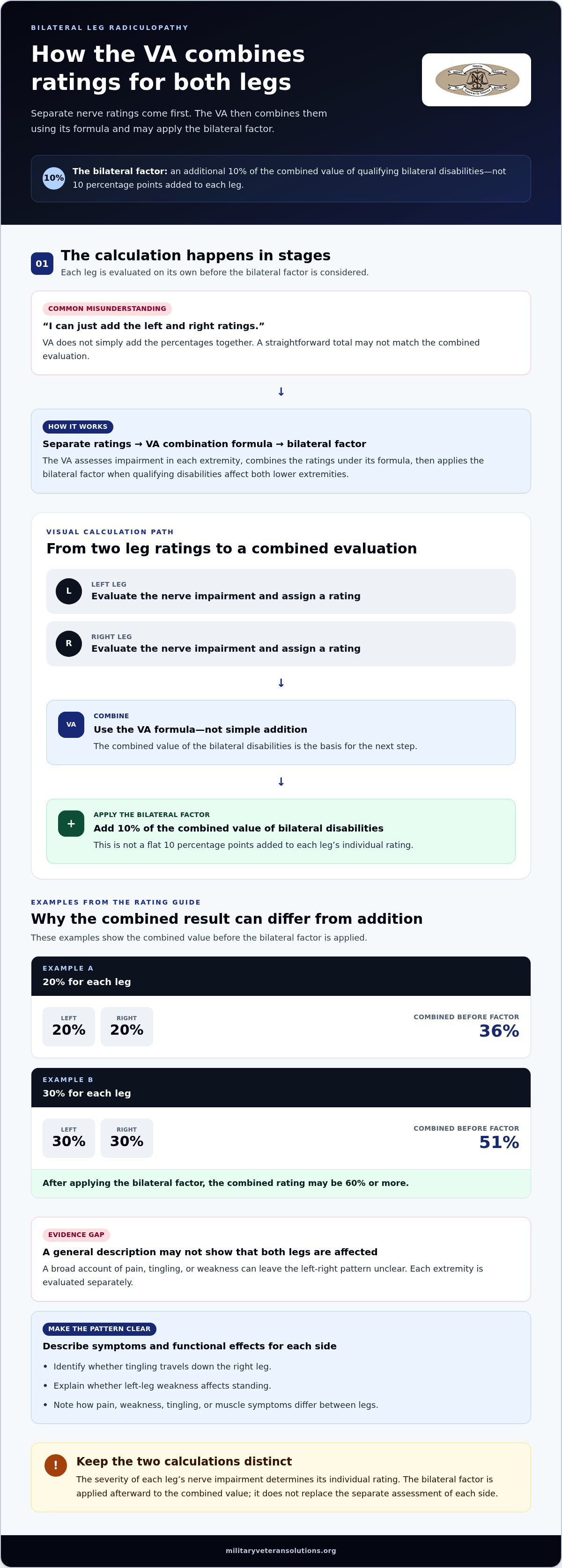
When radiculopathy affects both legs, the VA evaluates each extremity and combines the ratings using its formula. The bilateral factor may then increase the combined value for qualifying disabilities affecting both lower extremities. Because ratings do not simply add together, the final combined evaluation can differ from their straightforward total.
For example, two 20% ratings for left-leg and right-leg radiculopathy combine to 36% before applying the bilateral factor. The factor adds 10% of the combined value of bilateral disabilities to the overall VA rating. It isn’t a flat 10 percentage points added to each leg’s rating. Understanding that distinction helps explain why combined compensation calculations may not match simple addition.
How bilateral leg ratings are calculated
The VA evaluates nerve impairment in each leg separately, so the evidence should identify symptoms on the left and right. Tingling, weakness, pain, or reduced muscle function may affect each side differently. If the sciatic nerve is involved in both legs, records should describe the symptoms and functional effects on each side. This detail helps show that both extremities are affected, rather than describing the condition generally.
After the individual ratings are assigned, VA combines them under its formula rather than adding the percentages normally. For instance, two 30% ratings for bilateral lumbar radiculopathy combine to 51% before applying the bilateral factor. Applying the factor may result in a combined rating of 60% or more. These examples show why a pair of equal ratings can produce a different combined outcome from their arithmetic sum.
What the bilateral factor changes
The bilateral factor recognizes that disabilities affecting paired limbs can have a broader combined effect. It adds 10% of the combined value of bilateral disabilities to the overall rating. That calculation is distinct from assigning the underlying nerve ratings: the severity of each leg’s impairment still matters first. The factor may increase the combined evaluation when both lower extremities are affected, but it doesn’t replace the separate assessment of each side.
Clearly connect symptoms to each leg in the claim record. For example, describe whether tingling travels down the right leg, whether left-leg weakness affects standing, and how muscle symptoms differ. These details show the bilateral pattern instead of leaving the VA to infer it from broad descriptions. Ratings are still combined under the VA’s formula, so the final compensation evaluation will not necessarily equal the sum of the percentages.
If your decision appears to overlook one leg or the bilateral calculation, a focused review of a VA decision can help identify what the rating explanation addressed and what it may have missed.
What If the VA Denies Your Radiculopathy Disability Claim?
A denial may point to missing evidence about diagnosis, service connection, or the severity of nerve impairment. Read the VA decision letter to identify its stated reason, then match that issue to the evidence or review option that may address it.
Evidence for a radiculopathy claim may include radiating pain, tingling, numbness, or weakness, along with medical records documenting nerve involvement. It should also connect the condition to service or to an already service-connected back condition.
Rating Increases and Supplemental Claims
A rating increase addresses worsening symptoms or functional limitations, while an appeal challenges a decision you believe is incorrect. A supplemental claim may be an option if you have additional evidence relevant to the denied issue. Choose a route based on the decision’s explanation and what has changed or is newly documented.
Under the Appeals Modernization Act, veterans have 1 year from the VA’s decision letter to appeal. The deadline makes it important to read the letter promptly and identify whether the VA questioned diagnosis, service connection, or the assigned severity. If the decision overlooked evidence already in the record, explain that specific omission. If your condition has worsened, describe the change and its effect on daily function.
For direct service connection, the claim must show a current medical diagnosis linked to an in-service occurrence or incident that caused or aggravated the condition. Radiculopathy may also be claimed as secondary under 38 CFR § 3.310 when it stems from a service-connected back condition. The evidence and explanation should make that connection clear.
Exams and Supporting Medical Evidence
A Compensation and Pension (C&P) examination helps assess symptoms and functional effects, so prepare a clear account of both. Document symptoms for 2 to 4 weeks before the examination, including where pain or tingling travels and when weakness limits movement. Attend a required C&P exam; missing it can result in denial of the radiculopathy claim.
Medical records can help establish nerve involvement and its relationship to a spinal condition. An MRI or CT scan can document a physical relationship between a disc protrusion and a nerve root; X-rays cannot show soft tissues or nerves. Pair imaging with clinical records that describe symptoms, muscle weakness, and functional changes. A scan alone may not show how symptoms affect daily activities.
Focus your evidence on the concern stated in the VA decision. If the decision says the record doesn’t establish service connection, clarify the link between the diagnosed condition and the in-service event or service-connected back condition. If severity is disputed, describe specific limitations and cite supporting medical findings. A focused response helps the VA assess the issue, rather than just a general account of pain.
Cervical radiculopathy and upper-extremity nerve ratings
Cervical radiculopathy may be rated through upper-extremity nerve groups. The evaluation depends on the affected group, the severity, and whether the major or minor arm is involved.
Upper-Extremity Nerve Ratings
Upper-extremity ratings reflect the degree of nerve impairment in an affected arm. VA ratings for upper-extremity radiculopathy depend on the severity and effects of the nerve impairment. The diagnosis alone doesn’t determine the percentage; the documented nerve function and impairment level matter. Because the major or minor arm can have different rating levels, identify which side is affected in the medical record.
Radicular Group Ratings
The upper radicular group is one nerve group used to evaluate cervical radiculopathy affecting an arm. Mild impairment is rated at 20%. For moderate impairment, the rating is 40% when the major arm is affected and 30% when the minor arm is affected. This difference makes arm dominance a relevant factor, alongside the evidence describing the degree of nerve impairment.
Diagnostic Codes for Cervical Radiculopathy
Diagnostic Codes 8510, 8610, and 8710 apply to evaluations involving the upper radicular group and cervical radiculopathy. Code 8510 covers paralysis and has a 70% maximum rating. The related codes distinguish nerve conditions by type, while the rating level reflects severity. Knowing the code shown in a VA decision helps you compare the assigned evaluation with the documented diagnosis and impairment.
For severe upper-radicular-group impairment, the listed rating is 50% when the major arm is affected. Complete paralysis can reach 70% for the major arm and 60% for the minor arm. These levels differ because the VA’s schedule assigns distinct percentages by arm and impairment. A decision should identify the nerve group and explain how the evidence supports its severity classification.
The VA can evaluate objective neurological abnormalities associated with a spine disability separately from the musculoskeletal condition. Separate ratings for neurological and spine conditions aren’t pyramiding when they cover distinct manifestations. For example, a cervical spine evaluation and an upper-extremity nerve evaluation may reflect different effects of the condition. The key is whether each rating covers separate symptoms or functional impairment.
Each affected extremity can receive its own evaluation, and the VA combines ratings using its formula rather than ordinary addition. If cervical radiculopathy affects both arms, the decision should identify impairment on each side. Compare each assigned percentage with the arm involved, diagnostic code, and evidence of nerve function. This can help show whether the rating accounts for the cervical condition and its distinct effects in each arm.
VA disability rating levels for radiculopathy
Radiculopathy may contribute to total compensation through TDIU, but a nerve rating alone doesn’t establish temporary or permanent total status. TDIU may apply when the condition prevents substantially gainful employment and the applicable rating criteria are met.
The VA disability rating for radiculopathy depends on the affected nerve, its function, and impairment severity. Mild cases are typically rated at 10% to 20%, while moderate cases receive 20% to 40%. Severe incomplete paralysis may receive 50% or higher, and complete paralysis may correspond to ratings from 60% to 90%. The diagnostic code determines which levels apply.
For example, lumbar radiculopathy ratings vary with neurological impairment and nerve involvement. Sciatic nerve ratings can reach 80% for complete paralysis, while femoral nerve ratings range from 10% for mild impairment to 40% for complete impairment. Numbness or pain alone doesn’t establish a rating level. Evidence of nerve function, weakness, and effects on daily activities helps describe severity.
A degenerative spine condition and radiculopathy can involve distinct rating considerations. Radiculopathy may also be claimed as secondary under 38 CFR § 3.310 when it stems from a service-connected back condition. If both legs are affected, the bilateral factor may increase the combined evaluation. VA rates each extremity before applying its combined-rating method.
For TDIU, two rating pathways are relevant. A veteran whose radiculopathy rating is at least 60% may qualify if the condition prevents substantially gainful employment. According to the Electronic Code of Federal Regulations, veterans with multiple VA ratings may qualify for TDIU with a combined disability rating of 70% and at least one disability rating of 40%, if they cannot hold substantially gainful employment.
A VA disability rating for radiculopathy and TDIU address different questions: the rating measures impairment, while TDIU considers whether you can maintain substantially gainful employment. Describe how symptoms affect work tasks, such as standing, walking, lifting, or using an affected arm. Medical records and documentation of work-related effects can help explain the connection between radiculopathy and your limitations.
If your decision assigns a level that doesn’t reflect documented nerve impairment or work impact, get help appealing a VA rating decision and presenting the relevant evidence.
Military Veteran Solutions: Filing VA appeals
Military Veteran Solutions helps veterans address denied radiculopathy claims through VA Decision Letter Analysis and Filing VA Appeals. If a decision overlooked medical evidence, questioned service connection, or assigned a rating that doesn’t reflect documented impairment, a focused review can clarify the issue and support an appeal.
Veteran Claims Representation and Military Record Reviews can help connect the evidence in your claim to the VA’s decision. This support may be useful when you’re weighing appeal options or organizing records about nerve symptoms, service history, and functional effects.
A denial can feel like another hurdle, but you don’t have to sort through the decision alone. Contact Military Veteran Solutions to discuss your claim, or visit militaryveteransolutions.org.
Take the Next Step With a Clear Plan
Your next step is to turn the VA decision and your supporting records into a focused plan. The VA disability rating for radiculopathy matters because it affects how your condition is recognized, but the decision should also address the evidence and the specific issues in your claim.
Military Veteran Solutions can help you consider that next step through Veteran Claims Representation, Military Record Reviews, and Filing VA Appeals. If you’re weighing an appeal, organizing service records, or trying to understand what the decision means for your claim, focused support can help you move forward.
You deserve a clear understanding of your options before deciding how to proceed. Contact Military Veteran Solutions for support and take the next step with your claim.
Frequently Asked Questions
Can You Get Separate VA Ratings for Back Pain and Leg Pain?
Yes. The VA can rate a spine condition and associated neurological impairment separately when they cause distinct effects. For example, limited spinal movement may be evaluated separately from radiating leg pain and numbness caused by nerve involvement. Each evaluation must address different symptoms or functional effects, rather than rating the same manifestation twice. Review the decision’s explanation to see which symptoms each rating covers.
How does the VA rate radiculopathy by severity?
The VA evaluates the affected nerve, the degree of impairment, and the resulting functional limits. Sciatic nerve ratings commonly include 10% for mild impairment and 20% for moderate impairment, with higher levels for greater impairment. Your records can help clarify the difference between occasional tingling and weakness that interferes with standing or walking. Describe where symptoms travel, how often they occur, and what activities they limit.
How does VA distinguish mild, moderate, moderately severe, and severe radiculopathy?
The VA considers nerve function and the evidence of impairment, rather than relying on a symptom label alone. For sciatic nerve impairment, the listed levels include 10% for mild, 20% for moderate, and 40% for moderately severe impairment. Severe impairment with marked muscular atrophy is rated at 60%. A useful record describes specific changes, such as reduced strength, altered sensation, or visible muscle loss, and how they affect daily function.
How does VA rate cervical, thoracic, and lumbar radiculopathy?
The spinal region helps identify the nerve group and rating framework. Cervical radiculopathy can affect an arm and involve upper radicular group codes; lumbar radiculopathy may involve the sciatic or femoral nerve. Thoracic radiculopathy is commonly associated with spinal diagnostic code 5238. For a claim involving more than one region, make sure the medical records identify each diagnosis and distinguish its symptoms from those of other conditions.
Can VA assign separate ratings for radiculopathy in both legs or arms?
Yes. The VA can evaluate each affected extremity separately, so the evidence should distinguish left-side symptoms from right-side symptoms. For instance, one arm might have reduced grip strength while the other has numbness or tingling. The VA combines assigned percentages using its formula rather than ordinary addition. When both lower extremities are affected, the bilateral factor may also affect the combined evaluation.
How are radiculopathy ratings combined with a spine disability rating under VA rules?
The VA may assign separate evaluations when a spine condition and radiculopathy cause distinct manifestations. For example, the spine rating may address restricted movement, while a nerve rating addresses weakness or sensory changes in an extremity. Separate evaluations should not compensate for the same symptom twice. Compare the decision’s explanations for each condition and note whether a symptom, such as pain-limited movement, appears to be counted under both evaluations.
What diagnostic codes does VA use for radiculopathy?
The code depends on the affected nerve and the type of impairment. Sciatic nerve codes include 8520 for paralysis, 8620 for neuritis, and 8720 for neuralgia; femoral nerve codes include 8526, 8626, and 8726. Cervical upper-radicular-group evaluations use codes 8510, 8610, and 8710. Check the code in your decision letter and compare it with the nerve identified in your medical records.
How do I file a VA claim for radiculopathy or appeal a rating?
For a claim, document a current diagnosis and connect it to service or an existing service-connected condition. Radiculopathy linked to a service-connected back condition may be claimed as secondary under 38 CFR § 3.310. Include relevant medical records and attend a required C&P exam. To appeal a decision, identify the disputed issue and supporting evidence; under the Appeals Modernization Act, the deadline is 1 year from the VA’s decision letter.