
A denial for lack of evidence doesn’t always end your claim. If the VA denied your claim for lack of evidence, you may be able to seek review through an appropriate appeal option; generally, you have one year from an unfavorable decision to choose an option under the Appeals Modernization Act.
A reopened claim can still be denied, leaving you to decide whether to challenge how the VA assessed the record or submit evidence addressing what was missing. The right path depends on the reasons stated in the denial and whether you have new and relevant evidence. This article explains the main review options, the records and statements that may help establish service connection, and what to consider after a reopened claim is denied. You’ll also learn how to distinguish a review of the existing record from one that allows additional evidence, so your next step addresses the issue identified in the decision.
Key Takeaways
- Match the appeal path to the problem in the decision: an overlooked record calls for a different approach than evidence that was missing from the file.
- Higher-Level Review uses the evidence already submitted, so it may fit when you believe the VA misread or overlooked that record.
- Evidence for service connection should help connect a current condition to an event or injury during service, or show that service worsened a pre-existing condition.
- A Supplemental Claim may fit when you can provide new and relevant evidence the VA did not consider before.
- Private medical records may need to be requested for your claim, so identify relevant records and consider how they address the denial’s reasons.
What is the Best Appeal option When the VA Mischaracterizes Favorable Evidence?
If the VA misread favorable evidence, the right review option depends on whether the record is complete and what correction you’re seeking. Compare the decision’s explanation with the evidence it discusses, then choose a path that addresses the specific error.
Appealing an Evidence-Based Denial
An evidence-based appeal challenges how the VA assessed evidence already in your disability claim. Start with the decision notice: identify each favorable record, then note whether the VA overlooked it, described it inaccurately, or failed to explain its relevance.
For example, if the decision says your military records show no symptoms but cites a service treatment record documenting them, point out that contradiction. A Higher-Level Review may fit when you want the VA to reassess existing evidence, but you can’t submit new evidence through this option. If supporting records are missing, a Supplemental Claim may fit when you can submit new and relevant evidence.
Board of Veterans’ Appeals Review
A Board Appeal asks a Veterans Law Judge at the Board of Veterans’ Appeals to review the VA decision. Under the Appeals Modernization Act, you can choose Direct Review, Evidence Submission, or a Hearing.
Direct Review relies on the evidence already in the file. Evidence Submission allows additional evidence during its permitted window, while a Hearing lets you present your appeal to a Veterans Law Judge. Choose the lane that matches your need to clarify the record, add evidence, or speak at a hearing.
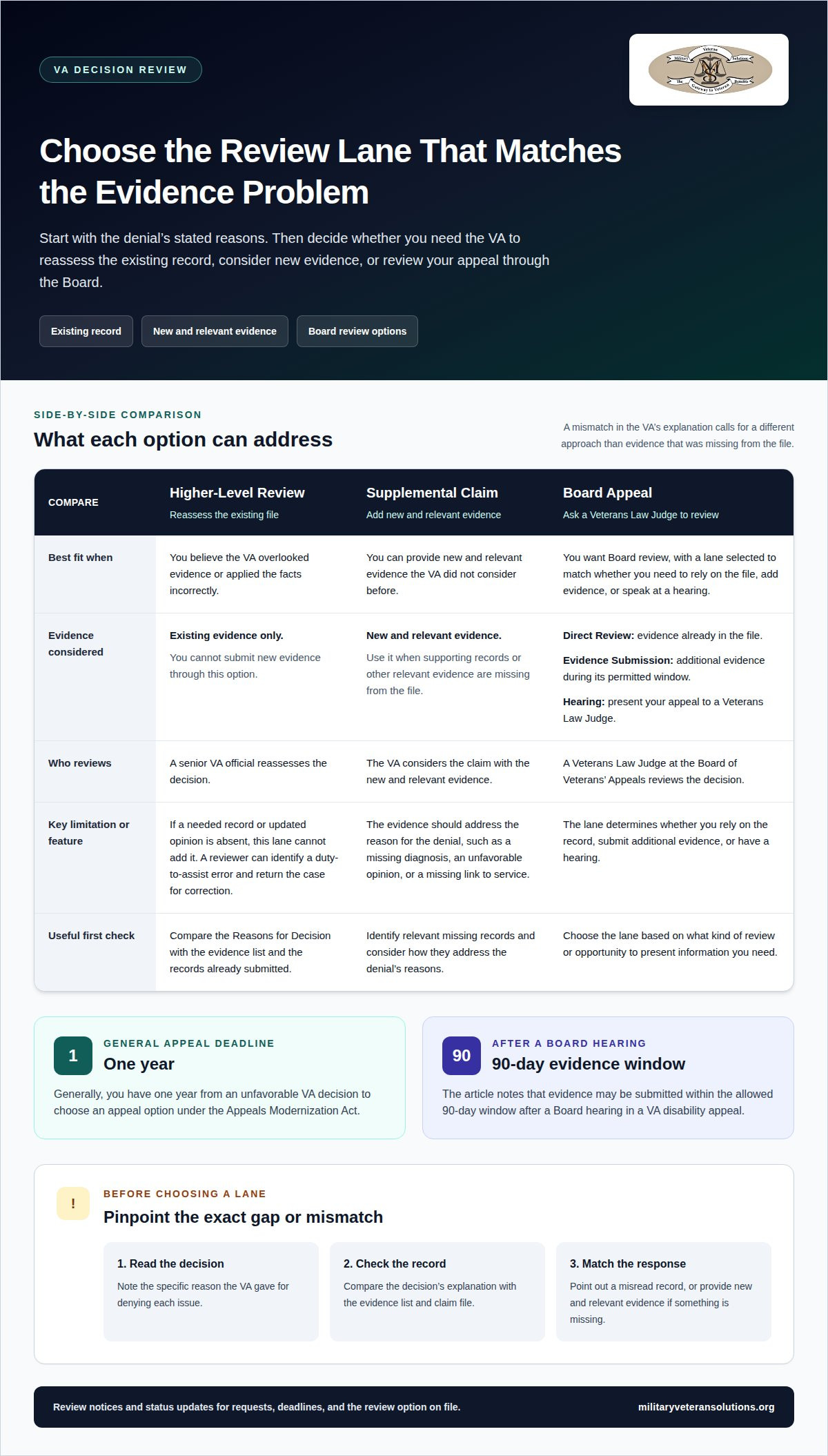
Deadlines can affect which options remain available. Generally, a veteran has one year from an unfavorable VA decision to choose an appeal option under the Appeals Modernization Act. A veteran may submit evidence within the allowed 90-day window after a Board hearing in a VA disability appeal, according to the U.S. Department of Veterans Affairs.
After the VA denies a reopened claim, you can appeal to the Board of Veterans’ Appeals or choose an appropriate administrative review option under the Appeals Modernization Act. A Board path may allow additional evidence or a hearing. If the denial mischaracterizes evidence, focus on the specific record and explain how it supports your claim.
To track a review, use the VA’s online claim status feature and watch for decision notices or requests for information. Check that the displayed review matches the option you filed, and read each notice for deadlines or next steps. If the status seems inconsistent with a notice you received, use the notice to identify the review and decision at issue before following up with the VA.
Higher-Level Review
A Higher-Level Review asks a senior VA official to reassess a decision using the evidence already in your file. Sign in to your VA account to access your decision letter, and use the VA’s records-request process to request your claim file.
Reasons for the Decision
The Reasons for Decision section explains why the VA granted or denied each issue in your VA disability claim. Read it alongside the evidence list and note the specific gaps the decision identifies, such as a missing diagnosis, an unfavorable medical opinion, or no link to military service.
Then compare each stated reason with the records already submitted. If the VA says it lacked treatment records but lists those records in the decision, identify the mismatch. Name the document, describe its relevant information, and explain how the VA’s account differs from the evidence.
Evidence Restrictions in Higher-Level Review
Higher-Level Review does not allow you to submit new evidence for consideration. The senior reviewer evaluates the existing record, so this option fits when you believe the VA overlooked evidence or applied the facts incorrectly.
For example, if your file already included a medical opinion connecting a diagnosis to service, point to where it appears and explain how the decision addressed it. If a needed record or updated opinion is absent, this lane cannot add it. A reviewer can identify a duty-to-assist error and return the case for correction.
Review Options and Eligibility
Decision review options are different routes for challenging a VA decision. The right route depends on the record and the correction you seek. Higher-Level Review suits disputes about evidence already submitted; a Supplemental Claim suits cases with new and relevant evidence. A Board Appeal offers Direct Review, Evidence Submission, and Hearing options.
Generally, you have one year from an unfavorable decision to choose an appeal option under the Appeals Modernization Act. Higher-Level Review has no new-evidence submission window because it reviews the existing file. The VA’s review timeline depends on the selected lane, the issues under review, and whether the record needs correction. Track notices and status updates so you can respond to VA requests.
Getting the Decision Letter and Claim File
Your VA decision letter explains the outcome and reasons for the decision. Sign in to your VA account to access available decision letters, then use the VA’s records-request process to seek your claim file. The file shows which records and opinions were considered.
Compare the decision letter with the claim file before choosing a review path. If you need help identifying a discrepancy, VA decision letter analysis can help clarify what the VA relied on and where the record may not match its explanation.
Requirements for establishing service connection
Service connection means the VA recognizes that military service caused or worsened a current disability. To support a claim, show a diagnosed condition, an in-service event or worsening, and evidence linking the two.
The VA may deny a claim when the record lacks a current diagnosis or documentation of an in-service problem. Service treatment records, medical records, personal statements, and a medical opinion can help address those gaps.
Elements of a Service Connection Claim
A service connection claim involves a current condition, an event or injury during service, and a connection between them. A current diagnosis establishes the condition being claimed, while service records or other evidence can document what happened during military service.
The evidence must then connect the current disability to that service event or show that service worsened the condition. For example, a record of an injury during active duty can support the in-service element, while later medical records can document continuing symptoms and treatment. Training may also be relevant when tracing a current disability to an incident during service.
Service Connection and Nexus Evidence
Nexus evidence links a current diagnosis to an in-service event or service-related worsening. A medical nexus letter or opinion can explain that relationship and address the facts in the veteran’s records.
Relevant evidence may include service treatment records, VA and private medical records, buddy statements, personal statements, and employment records. Each item can support a different part of the claim. A buddy statement, for example, may describe observable symptoms during service, while a medical opinion can explain how those symptoms relate to a current diagnosis. Details that align across records and statements make the evidence easier to assess.
A pre-existing condition may qualify for disability benefits if active-duty service worsened it. Use available medical records and descriptions of symptoms to distinguish the condition before service from changes during or after service. This helps show aggravation rather than relying only on the fact that the condition existed before service.
Veterans Service Organizations and VA-accredited attorneys can provide claims assistance. A VA-accredited attorney can review denial reasons, identify possible in-service evidence, and advise on an appeal path. A VSO may help veterans understand claim documentation and organize relevant evidence. Neither replaces the evidence itself: the record still needs to support the diagnosis, service event, and connection. The level of compensation may be considered separately from whether a condition is service connected.
Supplemental Claims
A Supplemental Claim asks the VA to review a prior decision using new and relevant evidence. It may fit when a disability claim was denied because the record lacked information you can now submit.
The Supplemental Claim Option
A Supplemental Claim requests reconsideration of a VA decision based on new and relevant evidence. It offers a way to address an identified gap instead of relying only on evidence already reviewed.
Start with the denial’s stated reasons, then identify which missing fact each new document addresses. If the VA found no current diagnosis, for example, a medical record documenting the condition may address that issue. If the decision found no connection to service, records or statements about the in-service injury may help explain the claim.
After a reopened claim is denied, a veteran can pursue an appropriate administrative review option or appeal to the Board of Veterans’ Appeals. A Supplemental Claim may fit when new and relevant evidence is available. Choose your next step based on the denial’s reasoning and whether additional evidence can address it.
New and Relevant Evidence
New and relevant evidence is information not considered in the prior review that relates to a disputed issue in the claim. It should add to the record and help address a reason the VA gave for its denial.
For instance, if the VA cited a lack of service records documenting symptoms, a statement from someone who observed those symptoms may add context. If the decision questioned a diagnosis, updated medical records may address that concern. A medical nexus letter may explain whether a current condition relates to service.
Organize each item around the decision’s findings. Pair a document with a short explanation of what it shows and which denial reason it addresses. A private medical record may be relevant, but the VA does not automatically have access to private records and must request them. Make clear which records are private and how they relate to the claimed condition.
Evidence should support the issue under review, not simply add pages to the file. A treatment record, for example, may document a diagnosis, while a personal statement may describe symptoms or events. Before submitting new material with a Supplemental Claim, consider whether it addresses the specific gap behind the denial.
Evidence for a denied claim
Evidence supports a disability compensation claim or addresses a reason for denial. Organize it around the VA’s notice: identify each missing or disputed fact, then connect relevant records or statements to that specific issue.
If the VA denied a claim for lack of evidence, the next step is not simply to add more paperwork. Identify what the decision says the record failed to prove. If it questions a current condition, focus on documentation of the diagnosis. If it questions service connection, look for records or statements that clarify the service event or its relationship to the condition.
- Diagnosis: Medical records can document a current condition and describe treatment or symptoms.
- Service event: Military records, personal statements, or buddy statements can describe an injury or symptoms during service.
- Connection: A medical opinion can explain how the current condition relates to service or worsened during service.
Private records need special attention. The VA does not automatically have access to a veteran’s private medical records and must request them. Identify the provider and relevant records in the claim process, and explain which denial reason those documents address. For example, a private diagnosis record may speak to a missing diagnosis, while a medical opinion may address the connection between that diagnosis and service.
Compare the VA’s notice with the record already submitted. Decision notices must identify favorable findings, which are generally binding later in the claims process. If the VA acknowledged a diagnosis but denied the claim because it found no service connection, focus on evidence addressing that remaining issue. Don’t spend your appeal re-proving a fact the VA already accepted.
Statements can clarify details documents may not capture, such as when symptoms began or how they affected daily activities. Keep each statement specific: identify the event, describe what the writer personally observed, and distinguish direct observations from later recollections. A buddy statement describing symptoms after a military injury serves a different purpose from a clinician’s opinion linking those symptoms to a current condition.
If the VA denied a claim for lack of evidence, the Board of Veterans’ Appeals offers review options that may use the existing record, allow additional evidence, or include a hearing. Match the evidence you need to the review path before submitting anything. A VA-accredited attorney can review the denial notice and evidence to help identify gaps or mischaracterized records. Request veteran claims representation to discuss how the evidence relates to your denial.
Military Veteran Solutions: Veteran Claims Representation
Military Veteran Solutions, LLC provides Veteran Claims Representation for veterans deciding how to respond to a VA denial. The team reviews VA decision letters, military records, and medical documentation to identify relevant evidence and help determine an appeal path.
Consider this support when the denial’s explanation does not match the records, key evidence may be missing, or you need help preparing a VA appeal. A focused review can clarify which issues the record supports and what evidence may address the VA’s stated reasons.
Contact Military Veteran Solutions, LLC to discuss your claim and possible next steps.
Choose a Clear Next Step
A denial can make the record feel settled, but a useful starting point is to ask: what specific point does the VA’s decision leave unresolved? Keep that question at the center of your response. A focused approach helps you avoid adding documents without purpose and makes it easier to explain why each item belongs in the record.
If you’re facing a VA denied claim for lack of evidence, treat the decision as a roadmap to the disputed issue, not as a final explanation of your service or condition. Consider what the VA accepted, what it questioned, and which review route can address the difference. Organize your response around the issue you want reviewed and why it matters to your claim. This gives your next step a clear purpose.
For support considering your situation and possible next move, contact Military Veteran Solutions. You don’t have to sort through the decision alone. Take the next step deliberately, with a clear focus on what you want the VA to understand.
Frequently Asked Questions
What happens if the VA still denies my reopened claim?
If the VA denies a reopened claim, you can request an appropriate administrative review or appeal to the Board of Veterans’ Appeals. Read the new decision to see whether it rejected added evidence, identified another gap, or repeated an earlier error. Then match your next filing to that issue. A Supplemental Claim may fit if you have new and relevant evidence; another review path may fit if you’re challenging how the VA assessed the record.
Can any type of evidence reopen my VA claim?
No. For a Supplemental Claim, the evidence must be new and relevant to an issue in the claim. A newly obtained medical record could document a diagnosis the VA found missing, while a statement from someone who witnessed an in-service event could add context. Unrelated documents may not address the reason for denial. Before submitting evidence, connect each item to a specific issue the VA discussed.
Does reopening guarantee back pay?
No. Reopening a claim does not guarantee back pay or an award of benefits. Filing a Decision Review Request within one year of a VA denial keeps the claim’s effective date intact, but that alone doesn’t determine whether compensation is granted or how much may be due. The eventual decision and effective date matter. Keep copies of your filings and VA notices to track the claim’s decision history.
So What Evidence Helps Correct A Mischaracterization?
Identify the exact record and compare it with the VA’s description. For example, cite a favorable medical opinion by its author and date, then explain which conclusion the decision misstated or left out. Pair the opinion with a relevant service or treatment record if it clarifies the issue. This focused comparison shows how the record bears on the disputed finding, rather than simply calling the evidence favorable.
What Are the Top Causes of VA Claim Denials?
A claim may be denied because the VA finds no current diagnosis, insufficient documentation of an in-service problem, or no link between service and the current disability. The denial may identify a specific evidence gap. Read the notice to learn which issue the VA considered unsupported. If it discusses a Compensation and Pension examination, compare its findings with the diagnosis and service history in your records.
What Assistance Is Available to Veterans?
Veterans can seek help understanding a decision and organizing a response. Military Veteran Solutions offers virtual consultations where you can discuss the denial and supporting records. A focused conversation can clarify what the VA decided, which documents relate to that issue, and whether an appeal or additional evidence better addresses it. This can help you make a more informed choice about your next step.
What Counts as “New and Relevant” Evidence?
New and relevant evidence is evidence not previously considered that relates to an issue in the claim. A recently obtained treatment record may address a missing diagnosis; a witness statement may help explain an in-service event the VA questioned. Evidence unrelated to the denial’s stated reasons may add little. Explain what each document shows and how it addresses a finding in the VA decision.
Why did the VA deny my claim for lack of evidence?
The VA may find that the record lacks a current diagnosis, documentation of an in-service injury or condition, or evidence linking the current disability to service. If the VA denied your claim for lack of evidence, read the decision notice to identify the specific missing element. Compare that explanation with the records you submitted. Your next step depends on whether evidence was absent, overlooked, or mischaracterized.