
Can a knee injury lead to flat feet, or will the VA treat the conditions as unrelated? The VA rating for flat feet secondary to knee injury depends on two separate questions: whether a service-connected knee condition caused or aggravated your pes planus, and how your foot symptoms meet the VA’s rating criteria. A limp or altered gait may help explain the connection, but the claim needs supporting evidence.
If you’re unsure whether your knee injury contributed to your flat feet, it helps to separate the connection question from the severity question. A current diagnosis, records documenting the knee condition, and a medical opinion that addresses the link can support secondary service connection. Your symptoms, examination findings, and the effect on daily activities help show how severe the foot condition is.
This guide explains the secondary-service-connection standard, the factors the VA evaluates when rating pes planus, and the medical records, personal statements, and other evidence that may support a claim. It also offers practical steps for finding gaps in your documentation before you file or respond to an unfavorable decision.
Key Takeaways
- The VA may consider flat feet secondary to a service-connected knee injury when evidence supports that the knee condition caused or aggravated pes planus.
- The VA rating for flat feet secondary to knee injury involves two distinct questions: whether the conditions are connected and how severe the foot symptoms are.
- Diagnostic Code 5276 considers symptoms and examination findings. A flat-foot diagnosis alone may not establish a compensable rating.
- Organize evidence by documenting your diagnosis, knee claim history, symptom timeline, and medical rationale for the connection.
- Review a VA decision’s findings and reasoning to identify what evidence may be missing and what steps could address the issue.
Can a Knee Injury Lead to a VA Rating for Flat Feet?
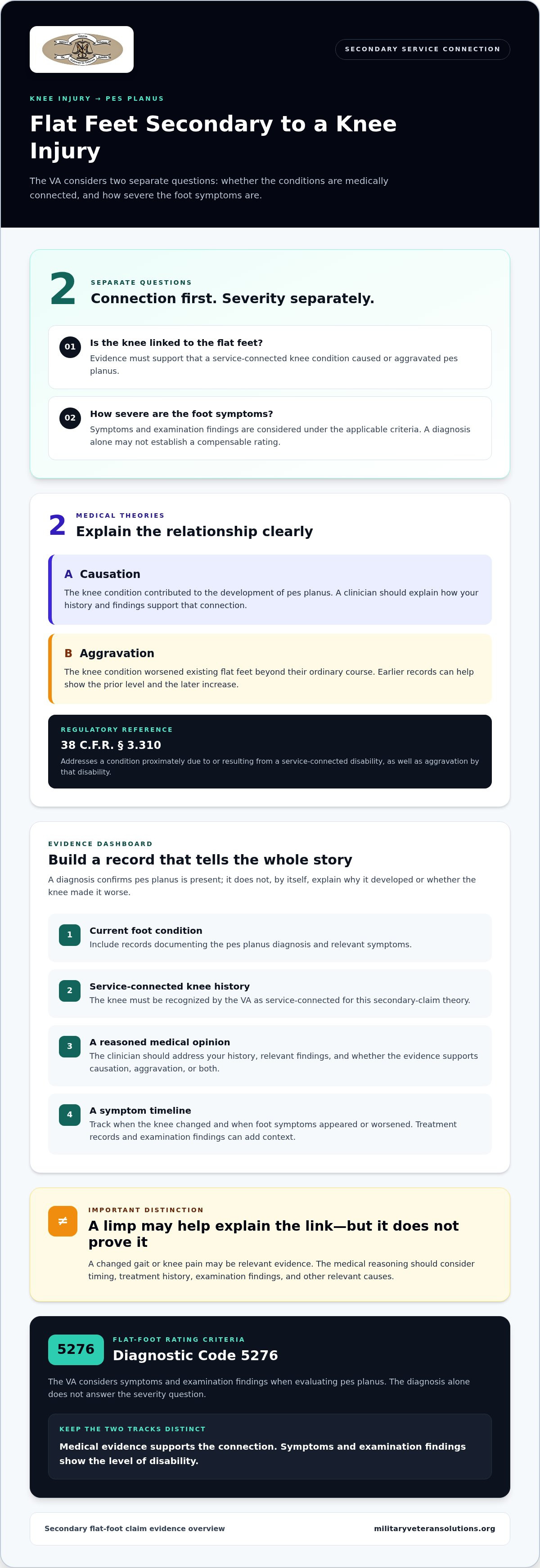
Yes. The VA may consider flat feet secondary to a service-connected knee injury if the evidence supports that the knee condition caused or aggravated the foot condition. The VA rating for flat feet secondary to knee injury involves two distinct questions: whether there’s a medically supported relationship between the conditions and how severely flat feet affect you. A diagnosis alone doesn’t answer either question.
Flat feet, also called pes planus, means the arches of one or both feet are lowered or absent. The condition varies. Some people have flat feet without meaningful symptoms, while others experience pain or difficulty standing and walking. The general overview of Flat feet (Pes Planus) explains common forms and causes, but a diagnosis alone doesn’t establish that military service or a knee condition caused your symptoms.
This video discusses flat feet alongside knee and back problems in a VA-claim context:
What does secondary service connection mean in this claim?
Under 38 C.F.R. § 3.310, a disability may be service-connected if it is proximately due to or the result of an already service-connected condition. The regulation also addresses a non-service-connected condition aggravated by a service-connected disability. These are different explanations, so the evidence should clarify which theory applies.
For example, a knee injury might change how you walk, and a medical professional may explain how that altered gait caused pes planus. Alternatively, you may have had flat feet before the knee condition worsened, with medical evidence explaining that the knee disability increased their severity beyond natural progression. This section concerns flat feet claimed as secondary to a knee condition, not a knee condition claimed as secondary to flat feet.
Does the knee injury have to be service-connected?
Generally, yes, for this specific secondary-claim theory. The knee condition is the primary disability, so the VA must recognize it as service-connected before it can serve as the basis for connecting a separate foot condition. An injury during service and a current knee diagnosis may be important evidence, but neither automatically means the VA has granted service connection for the knee.
Keep the distinction clear: the original injury is the event or condition you say began during or was caused by service; the VA’s service-connection determination is its decision recognizing the knee disability as related to service. If that determination hasn’t been made, the foot claim still needs evidence of its own link to the knee. If the knee is already service-connected, the next question is whether medical evidence connects it to the onset or worsening of pes planus. The VA considers the foot condition’s severity separately under the applicable rating criteria. Reviewing the knee decision alongside your medical records can help pinpoint which part of the claim needs support.
How VA Evaluates Whether a Knee Condition Caused or Aggravated Pes Planus
For a secondary claim, the VA needs evidence of a current foot condition and a supported relationship between that condition and the service-connected knee disability. A clinician’s diagnosis can establish that pes planus is present, but it doesn’t explain why it developed or whether the knee made it worse. The medical reasoning should address your history and circumstances.
Knee pain or a change in the way you walk may be relevant, but neither proves the connection on its own. The VA considers the full record, including medical findings, treatment history, and the timing of symptoms. A timeline showing when the knee condition changed and when foot symptoms appeared or worsened can help explain the claim.
What is the difference between causation and aggravation?
Causation means the knee condition contributed to the development of pes planus. Aggravation means the knee condition worsened existing pes planus beyond its ordinary course. These are distinct theories. Make clear whether the medical evidence supports one or both, rather than relying on a general statement that the conditions are related.
For aggravation, the record may need to show the foot condition’s earlier level of severity and how it changed. Under 38 C.F.R. § 3.310(b), the VA considers whether an increase in severity is attributable to the service-connected condition rather than natural progression. Older clinical notes, prior examinations, or other records describing earlier symptoms may help establish a point of comparison. The rule requires attention to evidence of baseline severity and the later increase.
What medical reasoning can connect the knee and foot?
A useful medical opinion does more than state that the knee caused flat feet. It explains the reasoning in light of your individual history. The clinician can review when the knee injury occurred, when foot symptoms or a diagnosis first appeared, whether your gait changed, and what examinations or treatment records show. The opinion should address relevant facts that support or complicate the proposed connection.
For example, a timeline might show a documented knee injury, a later period of limping, and subsequent reports of arch pain. That sequence can guide the medical analysis, but timing alone doesn’t establish causation. The clinician should explain whether the evidence supports a relationship and why, while accounting for other relevant causes or pre-existing foot symptoms. A bare conclusion gives the VA little reasoning to assess; an explanation based on your records makes the medical theory clearer.
Organize records by date and flag gaps, such as a long interval between knee treatment and the first foot complaint. Gaps don’t automatically defeat a claim, but an accurate timeline helps the reviewer understand what is documented and what needs explanation. Reviewing medical documentation alongside VA decisions can help identify missing links. For help reviewing claim records and decisions, explore veteran claims support.
VA Ratings for Flat Feet Secondary to Knee Injury
Establishing that pes planus is secondary to a knee condition and determining its percentage are separate steps. First, the VA decides whether the foot condition is service-connected. If it grants service connection, it then evaluates the severity of the flat feet under the applicable rating criteria. The knee injury may help explain the claimed connection, but it doesn’t determine the foot rating.
For pes planus, the VA uses Diagnostic Code 5276 in 38 C.F.R. § 4.71a. The schedule considers symptoms and examination findings, including pain with use or manipulation, deformity, swelling, calluses, and whether orthotics improve symptoms. A diagnosis alone doesn’t establish that a particular percentage applies.
How does the VA schedule rate pes planus?
The current DC 5276 schedule ranges from 0% to 50%. The criteria distinguish unilateral, meaning one foot, from bilateral, meaning both feet. The VA compares the evidence with the schedule rather than assigning a percentage simply because a record uses the term “flat feet.”
| Severity | One foot | Both feet | General criteria |
|---|---|---|---|
| Mild | 0% | 0% | Symptoms relieved by built-up shoes or arch supports. |
| Moderate | 10% | 10% | Pain on use or manipulation, with findings such as the weight-bearing line over or medial to the great toe or inward bowing of the Achilles tendon. |
| Severe | 20% | 30% | Marked deformity, accentuated pain on use or manipulation, swelling on use, and characteristic callosities. |
| Pronounced | 30% | 50% | Marked pronation, extreme tenderness of the plantar surfaces, marked inward displacement and severe Achilles spasm on manipulation, with symptoms not improved by orthopedic shoes or appliances. |
These are the schedule’s general levels, not a prediction of an individual decision. Examination reports and treatment records can show how often symptoms occur, what makes them worse, whether supports provide relief, and how the condition affects standing or walking. Check that the record describes relevant symptoms and findings in enough detail for the VA to assess the criteria.
Can the knee and flat feet receive separate ratings?
The VA may evaluate distinct service-connected conditions separately when the applicable rules allow it. Under the anti-pyramiding rule in 38 C.F.R. § 4.14, however, the same manifestation or functional impairment can’t simply be counted twice under different diagnostic codes. Whether separate evaluations are appropriate depends on the conditions and symptoms documented in the record.
The VA rating for flat feet secondary to knee injury isn’t determined by adding the knee percentage to a flat-foot percentage, and a grant of the secondary connection doesn’t guarantee a particular combined rating. Review the decision’s findings and reasons to see whether it addressed both service connection and the evidence of foot-related severity.
What Evidence Can Support a Secondary Flat-Foot Claim?
Build the claim in a sequence the reviewer can follow: document the current foot condition, map when knee and foot symptoms began or changed, gather relevant records, and address the medical relationship. Keep the two questions separate. Evidence of pain, deformity, or limits on standing can describe the current condition, but it doesn’t by itself explain whether the knee caused or aggravated it.
A strong evidence file addresses both what the foot condition is and why it is claimed to be connected to the service-connected knee disability. That distinction matters to a VA rating for flat feet secondary to knee injury because the VA evaluates the claimed relationship separately from the foot condition’s severity.
Which records help show the timeline and current condition?
Gather records that show the history of both conditions, not just the most recent examination. Sort them by date so the sequence is easy to follow. Useful documentation may include:
- VA and private treatment records describing the knee injury, diagnosis, treatment, or changes in walking.
- Foot examinations and treatment notes documenting pes planus, pain, tenderness, swelling, calluses, or use of arch supports or orthotics.
- Examination reports describing how symptoms affect standing, walking, or everyday activities.
- Your own statement describing when symptoms started, how they changed, and which activities are limited.
Personal statements can explain what you experience, but they shouldn’t substitute for a medical opinion about causation. Be specific and consistent. Describe when you first noticed arch pain, whether it occurs after standing or walking, and whether your ability to walk changed after the knee injury. If dates are approximate, say so rather than presenting an estimate as exact. Consistent details help the reviewer compare your account with the treatment record.
What should a medical opinion explain?
A medical opinion is most useful when it addresses your particular history rather than making a general statement that knee problems and flat feet can be related. It should identify the theory being considered: either that the knee condition caused pes planus or that it aggravated existing pes planus. The explanation should discuss relevant records, symptom timing, examination findings, and other factors that may affect the conclusion.
Check whether the opinion explains its reasoning and addresses evidence that may point in a different direction, such as foot symptoms documented before the knee worsened. A bare conclusion may leave the VA without enough explanation to assess the connection. A reasoned opinion supported by the record makes the medical rationale easier to evaluate.
Before filing or responding to a decision, arrange the records so the diagnosis, timeline, symptoms, and medical rationale are easy to locate. For help organizing military records and claim documentation, explore the Professional Military Record Review Service: Unlocking Evidence for VA Claims.
How to Move Forward With a Knee-Related Flat-Foot Claim
A clear claim file helps the VA assess the relationship between your knee condition and pes planus, then evaluate the foot condition itself. Before submitting a claim or responding to a decision, organize the key evidence and check that the records support the theory you’re presenting. Reviewing the file can reveal gaps and help you understand what each piece of evidence addresses.
What should you do before submitting or reviewing a claim?
Use this checklist to bring the main parts of your case together:
- Identify the conditions. Make clear that you’re claiming pes planus secondary to a specific knee condition, and keep the VA’s knee service-connection decision with your records.
- Build a timeline. Note when the knee injury and foot symptoms began, when diagnoses were documented, and when symptoms changed. Use medical records where possible, and label personal recollections clearly.
- Separate the evidence by purpose. Gather records describing the connection through causation or aggravation, along with examination findings that show the current severity and functional effects of the foot condition.
- Check the VA’s reasoning. If you have a decision, compare its findings and stated reasons with the medical records and opinions you submitted. Note which evidence the decision discusses, what it doesn’t address, and which questions it says remain unresolved.
Don’t judge a decision only by whether the VA granted or denied the claim. The explanation matters. For example, a denial might accept that pes planus is diagnosed but find that the evidence doesn’t establish a relationship to the knee. That calls for a different response than a decision questioning the diagnosis or evaluating the severity of the foot condition. The VA rating for flat feet secondary to knee injury turns on these distinct issues, so identify which one the decision addressed.
If the claim was denied, review the decision notice and consider appeal guidance, including Filing VA Appeals Help: A Strategic Guide to Overturning Denials in 2026, to understand possible next steps. Start with the specific reasons given and the evidence relevant to them. Avoid sending additional material without understanding what question it is meant to answer.
How can focused claims review help?
A focused review brings military records, VA decisions, and medical documentation together to identify inconsistencies or missing support. It can help you assess whether the file clearly presents the knee’s service-connected status, the foot diagnosis, the timeline, and the medical rationale. A virtual consultation gives you an opportunity to discuss your claim and possible next steps.
If you want support organizing the record or reviewing a VA decision, get help reviewing your VA claim.
Take the Next Step With a Clear Record
Start by gathering the records and VA decision that matter to your claim, then identify the unanswered question: does the evidence support the connection, the current severity, or both? A focused review can help you see where your file is clear and where additional explanation may be needed.
Military Veteran Solutions, LLC was founded by a disabled veteran who served ten years in the U.S. Army. The firm has more than 25 years of experience and offers virtual consultations, including review of VA decisions and medical documentation. Its claims representation and appeals services can help you organize the record, understand the issues in a decision, and consider practical next steps.
If you’re ready to move forward with the VA rating for flat feet secondary to knee injury, get help reviewing your VA claim. Military Veteran Solutions, LLC provides veteran claims representation, VA decision letter analysis, and appeals support.
Frequently Asked Questions
Can a VA examiner disagree with a private medical opinion?
Yes. The VA may weigh a private opinion against other medical evidence, including a VA examiner’s findings. A disagreement alone doesn’t make the private opinion unusable. Its value may depend on whether the clinician explains the conclusion, considers relevant records, and addresses your history. If an opinion was overlooked or the decision doesn’t explain why it was given less weight, note that issue when reviewing the decision or considering next steps.
Does VA always require a Compensation and Pension exam for a secondary claim?
No. A Compensation and Pension exam isn’t automatic for every secondary claim. The VA may request one if it needs additional medical information to decide the claim, but it may also assess the evidence already available. If you have a detailed private examination or medical opinion, submit it with the relevant records. If the VA schedules an exam, attend it and describe your symptoms and history accurately, even if they vary from day to day.
Can I submit a personal statement with a flat-feet claim?
Yes. A personal statement can describe what you have experienced in your own words, such as when foot discomfort started, how long you can stand, or whether walking has become harder. Include concrete examples, like needing to sit during an errand or changing activities because of foot pain. Keep it factual and distinguish what you observed from a medical conclusion about what caused the condition.
Does a knee injury have to be the original cause of flat feet?
No. The knee injury doesn’t have to be the original cause if the claim is based on aggravation. You may have had pes planus before the knee condition, but later experienced worsening that a medical professional attributes to the knee disability. The evidence still needs to support that theory. Be clear about whether you’re claiming the knee caused the foot condition or made an existing condition worse.
Can I claim flat feet if the diagnosis came after my knee injury?
Yes, a later diagnosis doesn’t automatically prevent you from making a claim. It can help establish when the condition was formally identified, but the diagnosis date may not be the date symptoms began. Treatment notes, earlier complaints, footwear or support use, and your recollection can help fill in the timeline. The VA rating for flat feet secondary to knee injury still depends on evidence supporting the claimed relationship, not timing alone.
What if the VA decision does not explain why it rejected the medical link?
Review the decision’s reasons and evidence list, then compare them with the opinion and records you submitted. Check whether the VA discussed the medical rationale, addressed important history, or relied on a contrary opinion. Keep the decision notice and note the specific point that appears unanswered. This focused review can help you understand available review or appeal options and what evidence may address the stated gap.
Will proving secondary service connection automatically give me a specific rating?
No. A grant of secondary service connection recognizes that the foot condition qualifies as related to the service-connected knee disability; it doesn’t by itself establish a particular percentage. The VA separately evaluates the condition under the rating schedule and the evidence of its severity. For instance, a service-connected condition may receive a noncompensable evaluation if the criteria for compensation aren’t met. Read the decision for both the service-connection finding and the assigned evaluation.