
What if the incident that changed your life never appeared in an official report? The absence of a report or service record doesn’t automatically make filing a VA claim for MST without records impossible. The VA may consider other evidence that helps support your account, including changes in behavior, personal statements, and relevant medical records.
It’s understandable to worry that missing documentation will end your claim before it’s fully considered. You may also feel anxious about recounting a traumatic experience. You deserve clear information and a process that treats your experience with care. MST describes an experience, not a diagnosis. A disability claim is generally for a condition caused or worsened by MST, such as PTSD, anxiety, or depression.
This guide explains what evidence may help when official records are missing, how to organize your statement and supporting accounts, and what steps to consider when preparing or pursuing a claim. You’ll also learn how reviewing military records, current medical records, and any VA decision can clarify the evidence picture. One missing document doesn’t tell the whole story.
Key Takeaways
- Learn how to organize available records and statements from before, during, or after service into a clearer evidence picture.
- See how a timeline can connect changes in your health or circumstances with the condition for which you’re seeking compensation.
- Understand practical next steps for filing a VA claim for MST without records, including identifying the claimed condition and following current VA form instructions.
- Find out how a comprehensive review of military records, VA decisions, and current medical records can help identify gaps and guide your next move.
- Explore how informed advocacy can support you in preparing or pursuing a claim without promising a particular outcome.
Can You File a VA Claim for MST Without Records?
Yes. Missing police reports, investigation files, or service records about the incident don’t automatically prevent you from filing a VA claim related to military sexual trauma (MST). The absence of a formal report is not the same as having no evidence for the VA to consider, and it doesn’t decide the claim by itself.
The VA uses MST to refer to sexual assault or sexual harassment experienced during military service. MST describes the experience, not a disability diagnosis. Disability compensation is sought for a current health condition caused or worsened by MST, not for the experience alone. For a broader overview of the term and its context, see Military Sexual Trauma on Wikipedia.
This video offers an overview of MST claims and related VA forms:
What does “without records” mean for an MST claim?
“Without records” can mean different things. You may never have made a formal report to law enforcement or military authorities, while your service treatment records or personnel file still exist. Or some records may be missing, incomplete, or silent about what happened. A lack of an incident report doesn’t necessarily mean there are no relevant records or other evidence.
For example, your file might not document the assault or harassment, but it could include a transfer request, a change in duty performance, or records of treatment received later. These details don’t prove MST by themselves, and no single document guarantees a particular decision. They may provide context for your account. Review the available evidence across the full period rather than treating one missing report as the whole case.
What must an MST-related disability claim address?
A claim needs to address both the in-service experience and the current health condition for which you’re seeking compensation. It must also present evidence supporting service connection, meaning a relationship between the condition and your military service, including the MST experience. The claimed condition might be PTSD, anxiety, depression, or another health condition. MST itself is not the diagnosis being rated.
The VA evaluates the claim under the rules that apply to the condition and evidence involved, considering the record as a whole. Evidence may include medical information, your account, and other relevant documentation. The evidence and standards can vary by claim. Filing a VA claim for MST without records doesn’t mean relying on one perfect document. It means explaining what happened as you’re able, identifying the condition, and helping the VA understand how the available evidence fits together. A silent file does not settle the question by itself.
What Evidence Can Support an MST Claim When No Report Exists?
Evidence doesn’t have to come from one official incident file. Depending on the claim and the evidence rules that apply, records and statements from before, during, or after service may help provide context. Understanding Military Sexual Trauma can also help explain how MST may affect people differently over time. No single item guarantees acceptance, and a change in behavior alone doesn’t establish what happened.
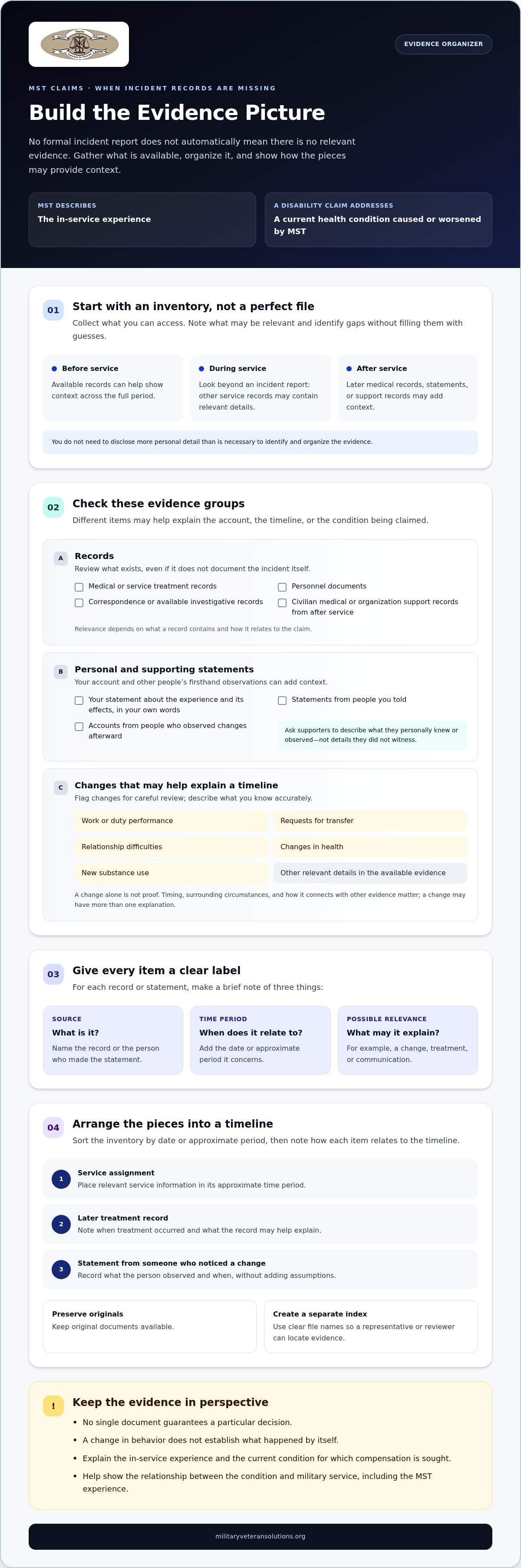
Start with an inventory, not an attempt to assemble a perfect file. Collect what you can access, note what may be relevant, and identify gaps without filling them with guesses. You don’t need to disclose more personal detail than is necessary to identify and organize the evidence.
Which records and personal statements may be relevant?
Consider whether you have relevant medical or service treatment records, personnel documents, correspondence, or available investigative records. Records created after service may also provide context, such as civilian medical documentation or records from an organization you sought support from. Their relevance depends on what they contain and how they relate to the claim.
Your statement can describe the experience and its effects in your own words. Statements from people you told, or from those who observed changes afterward, may add context. A friend might recall that you became withdrawn; a former colleague might describe a change in attendance. Ask supporters to focus on what they personally knew or observed rather than speculate about details they didn’t witness.
For each item, make a brief note of:
- Source: What the record is, or who made the statement.
- Time period: The date or approximate period it concerns.
- Possible relevance: What it may help explain, such as a change, treatment, or communication.
How can indirect evidence help explain a timeline?
Some changes may be worth flagging for careful review: a shift in work or duty performance, requests for transfer, relationship difficulties, changes in health, or new substance use. These details are not proof by themselves. Their timing, surrounding circumstances, and connection to other evidence matter. A change may have more than one explanation, so describe what you know accurately and don’t present an assumption as fact.
Arrange your inventory by date or approximate period. For example, list a service assignment, a later treatment record, and a statement from someone who noticed a change. Then note how each item relates to the timeline. Preserve original documents and create a separate index with clear file names. This helps a representative or reviewer locate evidence without requiring you to repeatedly retell every detail.
Evidence can come from multiple sources, with each item offering a different piece of context for the VA to evaluate. If you want help assessing how records fit together, MVS’s military and medical records review can help you examine the broader claim picture.
How Do Diagnosis and Medical Evidence Fit an MST Claim?
Keep three parts distinct: the experience, the health condition you’re claiming, and evidence that helps connect the two. MST describes an experience, not a diagnosis. A disability claim seeks compensation for a current health condition that the evidence relates to military service, including an MST experience. Documenting the experience alone doesn’t establish a current disability, and a diagnosis alone doesn’t automatically show how the condition relates to service.
Use this framework to see how the pieces fit:
| Part of the claim | What it means | Examples of relevant evidence |
|---|---|---|
| In-service experience | The event or experience during service that the claim identifies | Your account, relevant records, or supporting statements |
| Current condition | The health condition for which you seek compensation | Diagnosis, treatment notes, or other medical documentation |
| Relationship to service | Evidence addressing whether the condition is connected to service or the experience | Relevant medical records, clinician observations or opinions, and other evidence considered under applicable VA rules |
Why is a current health condition important?
Medical documentation can help describe a condition, when it was identified or treated, and how it affects daily life. PTSD, anxiety, and depression are examples of conditions that may be associated with MST, but they aren’t the only possible conditions. The appropriate claim depends on your circumstances and medical evidence.
An MST experience doesn’t automatically establish a disability, and this article can’t determine whether you have a diagnosis. If you have treatment records, organize them by date and note what each document says about symptoms, diagnosis, or their effects. If there are gaps in treatment, don’t assume that a missing record tells the entire story. Present the information accurately so the full evidence picture can be evaluated.
What does a medical opinion or nexus address?
A nexus is the connection between a current condition and military service. In plain language, evidence addressing nexus helps explain whether the condition may be related to the service experience described in the claim. A clinician’s opinion may contribute to that picture, alongside treatment records, your account, and other relevant evidence. A separate “nexus letter” isn’t automatically required in every situation. The evidence needed depends on the claim and the rules that apply.
For example, a medical record may document a condition and its symptoms without discussing their cause. Another clinical opinion might address whether the reported history and symptoms are consistent with a connection to service. These are different kinds of information. The VA evaluates them within the overall record rather than treating a single document as a guaranteed answer.
When filing a VA claim for MST without records, organize medical evidence around the claimed condition and its relationship to service, not just around the missing incident report. Keep copies of relevant records and note questions or inconsistencies for review. A comprehensive review of current medical records alongside military records can help clarify what the evidence addresses and where further explanation may be useful.
How to Prepare and File an MST Claim Without Incident Records
A clear preparation process can make the evidence easier to understand without turning your experience into a rigid checklist. Filing a VA claim for MST without records starts with identifying the health condition you’re claiming, then organizing the evidence you do have. Note missing documents and uncertain dates plainly. Don’t fill gaps with guesses or feel pressured to include details you aren’t ready to share.
Use this sequence to build a working claim file:
- Identify the condition. State the current health condition for which you’re seeking disability compensation. Keep the condition distinct from the MST experience itself.
- Gather available evidence. Collect relevant service, medical, and personal records, along with statements you want considered. Organize what you have, not what you think you’re supposed to have.
- Build a private timeline. Arrange key events and records in approximate date order. Mark uncertain dates as approximate and note unanswered questions rather than assuming an answer.
- Prepare the claim using current instructions. Check the VA’s current disability-claim guidance for the applicable forms and submission procedures. Requirements and form versions can change, so don’t rely on an old checklist or a form name copied from an outdated source.
For broader filing context, the VA claim assistance resource guide can help you understand where claim preparation fits within the process. Always use current VA instructions for the claim you’re submitting.
How can you organize evidence before filing?
Keep the timeline private and record only what you feel comfortable documenting. Group materials into folders for service records, medical care, personal statements, and later effects. Add a short index with each item’s date or approximate period, source, and what it may help explain. If a record is missing or a date is uncertain, label that clearly. An organized file should clarify the evidence, not force you to reconstruct details you can’t recall.
What should you review before submitting?
Before filing, confirm that the claimed condition and requested benefit are clearly identified and that each attachment is labeled. Compare dates and descriptions across your statement and records for consistency, but don’t pressure yourself to recall exact dates. If you remember only a general period, say so. Review the VA’s current instructions for filing and supporting statements. If you need help understanding how the evidence fits together, MVS provides claims representation and advocacy.
Keep a complete copy of the submitted claim and attachments. Save any submission confirmation or tracking information the VA provides, along with the date you filed. This gives you a record of what was sent and helps you refer to the same materials if questions arise. If you want an informed review of your service and medical records before moving forward, request support reviewing your VA claim evidence.
How MVS Can Help Review an MST Claim Without Records
When incident documentation is missing, it can be difficult to know how your available records fit together or what questions still need attention. Military Veteran Solutions, LLC (MVS) reviews military records, VA decision letters, and current medical records to help veterans assess the broader claim picture. Reviewing these materials together can bring relevant information into view and clarify what the documents do and don’t address.
MVS provides claims preparation, representation, and advocacy for veterans filing claims, including assistance with denied benefits claims. No representative can guarantee a VA decision. The VA makes its decision under the rules that apply to the claim and the evidence submitted. MVS is locally owned and not tied to any government entity. Its role is to support veterans, not to act on behalf of the VA.
What can a comprehensive review help clarify?
Looking at records together may reveal useful connections that are less apparent when each document is considered alone. A service record may establish a duty assignment or timeline; a later medical record may describe a condition and its effects; a VA decision letter may explain what evidence was considered or identify an issue in the decision. These materials don’t replace missing incident documentation, and their relevance depends on the individual claim. A careful review can help identify what the file supports, where information appears incomplete, and what questions may need follow-up.
For an overview of how military documents can contribute to claim evidence, MVS’s military record review guide provides related context. The goal is to understand and organize the claim record, not to provide medical treatment or representation in civil court.
If you’re filing a VA claim for MST without records, an individualized review may help you decide how to move forward with the documents you have, rather than treating one missing report as the only relevant fact. It can also help you prepare questions about the evidence or a VA decision before taking your next step.
How can veterans request support?
MVS offers virtual consultations by live video using a smartphone, tablet, or computer. You can discuss your claim concerns and the records or VA decision you want reviewed. The founder is a disabled veteran who served ten years in the U.S. Army, bringing personal military experience to the work of supporting veterans through the claims process.
Your experience deserves careful consideration. Schedule a free initial consultation to discuss support with your MST-related claim and the evidence available to you.
Take the Next Step at Your Pace
You don’t have to solve every evidence question at once. Choose one manageable next step, such as organizing the records you already have or writing down what you still need clarified. If some dates or details are uncertain, identify them honestly. A thoughtful claim begins with an accurate picture, not a perfect file.
Filing a VA claim for MST without records can feel daunting, especially when the experience is personal and the documentation is incomplete. You deserve support that takes both the evidence and your boundaries seriously. MVS reviews military records, VA decision letters, and current medical records to help you assess the claim picture. The founder’s experience as a disabled veteran who served ten years in the U.S. Army informs the firm’s veteran-focused approach.
Virtual consultations are available, and the initial consultation is free. If you’re ready to discuss a path forward, request a free initial consultation with MVS. You can take the next step without having every answer in hand.
Frequently Asked Questions
Can I file a VA claim for MST if I never reported the incident?
Yes. Never making a formal report doesn’t automatically prevent you from filing a claim. Filing a VA claim for MST without records means the VA will consider the evidence available under the rules that apply to your claim. A report is only one possible source of information; other records or statements may help describe the experience and the condition you’re claiming. Review current VA guidance, and don’t assume an unreported experience makes filing pointless.
Can I file an MST-related VA claim years after the experience?
You may still explore a claim even if years have passed. The time between the experience and filing doesn’t, by itself, determine whether you qualify; eligibility and any effective-date questions depend on the claim and applicable VA rules. If you’re concerned about the time gap, focus on gathering the records you can access and reviewing current VA filing guidance. Don’t delay solely because the experience happened years ago.
Does the VA require a police report for an MST claim?
The absence of a police report doesn’t automatically mean you have no evidence to submit. Depending on your circumstances and the rules that apply, other records, statements, or surrounding circumstances may be relevant. No single item guarantees that the VA will accept or corroborate an account. Include accurate information, clearly identify what you know firsthand, and review current evidence guidance before submitting materials.
Can an MST-related claim involve a condition other than PTSD?
Yes. MST is an experience, not a diagnosis, and a disability claim concerns a related health condition. PTSD is one possible example, but it isn’t the only condition that may be considered. The medical evidence and VA criteria for the specific claimed condition matter. If you’re unsure what condition your records identify, MVS can review your records and claim evidence. Don’t assume the experience alone establishes a diagnosis or entitlement.
Can I submit a personal statement with an MST claim?
You can prepare a truthful personal statement for your claim, following current VA instructions. You may describe what you remember and explain how the experience relates to the condition you’re claiming, using approximate dates if exact ones aren’t clear. Don’t guess to make the account sound more precise. Keep a copy with your claim records. MVS can help you review and organize your claim evidence if writing the statement feels difficult.
What can I do if the VA denies an MST-related claim?
Start by reading the decision letter and noting the VA’s stated reasons, including which evidence it discussed and what it found missing or unpersuasive. Available decision-review options and deadlines depend on the decision and current rules, so review them promptly rather than assuming you have unlimited time. The VA appeals guide explains the review process more broadly, but no appeal path guarantees a different outcome. MVS reviews VA decision letters and provides representation and advocacy for veterans pursuing appeals.