
The VA doesn’t put every disability rating on the same review calendar. If you’re wondering how often does the VA re-evaluate ratings, the answer depends on your condition and whether it’s expected to improve. A future exam may be scheduled, often two to five years after an initial rating when improvement is possible, but that doesn’t mean every veteran will be reviewed on a fixed timetable. An exam request can feel like a warning that your compensation is at risk. By itself, it isn’t a decision to reduce your rating.
You deserve to know what a review notice means and how to respond. This article explains common reasons the VA may request an updated examination, what rating protections can and can’t do, and why it’s important to attend exams and respond to requests. You’ll also learn how to read a notice, gather relevant records, and provide a factual account of your condition. If a decision reduces your rating, understanding the decision letter can help you identify next steps, including whether to seek support with an appeal.
Key Takeaways
- When asking how often does the VA re-evaluate ratings, focus on your specific condition and rating decision rather than expecting a universal timetable.
- A scheduled future exam or new evidence suggesting material improvement may lead the VA to review a condition.
- The five-, ten-, and twenty-year protections address different aspects of ratings and service connection, and each has limits.
- Read every notice carefully, note its deadlines, and follow the instructions for attending or rescheduling an examination and submitting information.
- Before responding to a proposed reduction or final decision, identify the condition involved, the evidence cited, the effective date, and your response rights.
How often does the VA re-evaluate ratings? There is no universal schedule
The VA does not re-evaluate every disability rating on a fixed, recurring schedule. If you’re asking how often does the VA re-evaluate ratings, the answer depends on your condition and the evidence in your case. The VA may schedule a future examination when the medical evidence suggests a disability could change, but not every rating comes with a planned review date. Some conditions may be considered unlikely to improve, while others may warrant an updated assessment.
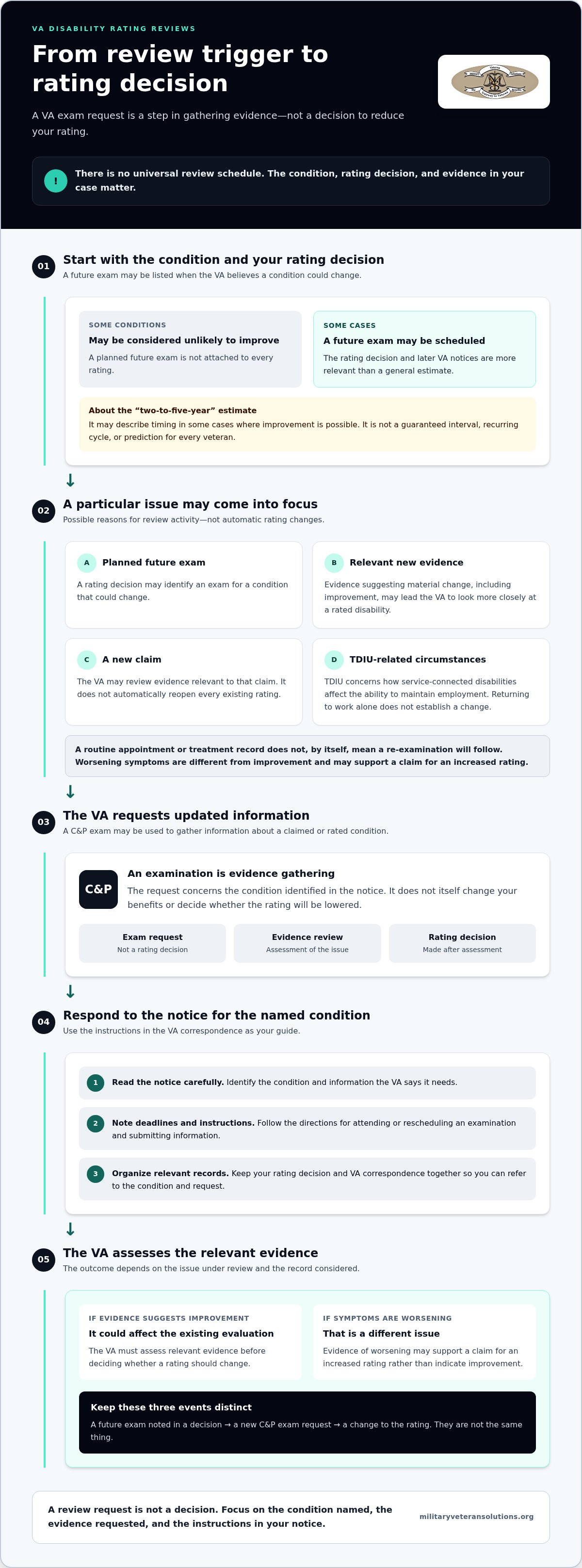
A Compensation and Pension (C&P) examination is an assessment the VA may use to gather information about a claimed or rated condition. A C&P exam request is not automatically a review of every disability rating you receive, and it doesn’t itself change your benefits. The reason for the exam and the condition being assessed matter. Check your rating decision and later notices for information about whether an examination is anticipated.
For a closer look at disability rating reviews, watch this video:
What does a future VA re-examination mean?
A future re-examination is an assessment the VA requests to get updated information about a condition that already has a rating. The VA may use that information to decide whether the existing evaluation remains appropriate. The exam is a step in gathering evidence, not a decision to lower your rating or end your compensation.
Future examinations are case-specific, not a universal review schedule for every VA rating. Read the rating decision for the condition involved and any explanation of whether the VA expects a future exam. If you receive an examination notice, it should explain what you need to do next.
Why do some veterans hear about a two-to-five-year timeframe?
The two-to-five-year estimate appears in some guidance for conditions the VA expects could improve. It can describe when a future exam may be scheduled in certain cases, but it is not a guaranteed interval, a recurring cycle, or a prediction for every veteran. Whether a review is planned depends on the condition and supporting medical evidence.
Don’t assume your rating will be reviewed within that window, or that it will never be reviewed because the window has passed. Your rating decision and VA notices are more relevant to your situation than a general estimate. If the VA schedules an exam, note which condition it concerns and what the VA says it needs to reassess.
In practical terms, distinguish among three events: a future exam noted in a decision, a new request for a C&P examination, and a change to the rating itself. They are not the same. Keep your decision and correspondence together so you can refer to the condition and instructions if the VA contacts you. If a notice is unclear, a review of the decision letter can help you understand what the VA is asking for before you respond.
What can trigger a VA rating review before or after a planned exam?
A future examination listed in a rating decision is one reason the VA may reassess a condition. A review may also arise when new evidence gives the VA a reason to look more closely at a rated disability. That doesn’t mean every new record, claim, or change in your circumstances automatically starts a review.
A possible review trigger is not an automatic rating reduction. The VA must assess the relevant evidence before deciding whether a rating should change. A request to examine a condition is a step in gathering information, not the outcome. If you receive a notice, focus on the issue it names and the evidence it says is relevant.
Can new medical evidence lead to a re-evaluation?
Evidence about a condition’s current severity may become relevant if it suggests a material change, including improvement that could affect the existing evaluation. Evidence describing worsening symptoms is different: it may support a claim for an increased rating rather than indicate that the condition has improved. The VA’s response depends on the issue under review and the record it considers.
A routine appointment or treatment record doesn’t, by itself, mean a re-examination will follow. Look at what the VA actually requests and which condition the request identifies. Keep relevant records organized so you can respond accurately if the VA asks for updated information.
Can a new claim or TDIU status affect review activity?
When you file a new claim, the VA may review evidence relevant to that claim. That doesn’t automatically mean every existing rating will be re-evaluated. Pay attention to the conditions and questions named in an examination notice or other correspondence rather than assuming a new claim has reopened all your ratings.
Total disability based on individual unemployability (TDIU) is a separate consideration because it concerns how service-connected disabilities affect a veteran’s ability to maintain employment. Returning to work does not, by itself, establish that a rating or TDIU status will change. The VA may consider the circumstances and evidence relevant to the issue, so respond to any specific request rather than relying on assumptions about what employment means.
These distinctions help answer how often does the VA re-evaluate ratings: a planned exam, new evidence, or activity related to another claim may prompt attention to a particular issue, but none creates a universal review cycle or guarantees a reduction. Treat the notice as your guide. Identify the condition, the requested information, and any response instructions. Don’t infer a decision from the trigger alone.
If a notice or decision letter leaves you unsure which evidence the VA is considering, a focused VA decision letter review can help clarify the issue and inform your next steps.
How the five-, ten-, and twenty-year VA rating protections differ
The five-, ten-, and twenty-year rules protect against certain VA actions; they are not deadlines after which a disability can never be reviewed. Each addresses something different: how the VA may reduce a long-standing rating, whether it may sever service connection, or how far it may lower a protected rating. Knowing which protection applies can help you interpret a notice without assuming it prevents every change.
| Time in effect | What the protection generally concerns | Key limit |
|---|---|---|
| Five years | Stabilization of a rating maintained at the same level | A reduction generally requires evidence of sustained improvement; the VA may still review the condition. |
| Ten years | Protection of service connection | Service connection may generally be severed only in limited circumstances, including fraud; this does not lock the percentage. |
| Twenty years | Protection against reducing a rating below its protected level | The rating is generally protected at the lowest level held during the 20-year period, subject to exceptions such as fraud. |
What does the five-year rule protect?
When a rating has remained at the same level for five years or more, the VA generally must consider whether the evidence shows sustained improvement before reducing it. The question is not simply whether a newer examination looks better on one point. The record must support improvement that is meaningful and lasting. This rule sets a standard for evaluating a proposed reduction; it doesn’t promise that the percentage can never change.
Five years also doesn’t mean the VA stops reviewing the condition. A review or examination may still occur. The protection concerns the basis for reducing a stabilized rating, not immunity from reassessment.
How are the ten- and twenty-year rules different?
The ten-year rule generally protects the underlying service connection from being severed after it has been in effect for ten years. It does not protect a particular percentage from reduction. For example, service connection could remain in place even if the VA separately considers whether the assigned evaluation should change under the applicable rules.
The twenty-year rule generally protects the rating level itself: the evaluation can’t be reduced below the lowest level held during the 20-year period, except in circumstances such as fraud. The protections therefore answer different questions. One concerns whether a condition remains service-connected; the other concerns a floor for the percentage.
These protections don’t create a universal answer to how often does the VA re-evaluate ratings. They also don’t mean you can ignore an examination notice. The exact dates, rating history, and reason for the VA’s action matter, and exceptions can apply. If a proposed change arrives, compare the notice with your rating history and read the decision’s explanation carefully. A VA decision letter analysis can help clarify which protection the VA addressed and what evidence it relied on.
What to do for VA exams or information requests
A VA notice may ask you to attend a Compensation and Pension (C&P) examination, provide information, or take another action. Read the entire notice, identify the condition and request, and mark every deadline or appointment detail. Follow the instructions in that specific notice, and keep a copy for your records.
Use this sequence to stay organized:
- Identify what the VA is asking for. Note the condition named, whether an exam is scheduled, and whether the notice requests records or a response.
- Mark the dates. Record any response deadline, appointment time, location, and instructions for contacting the VA or exam provider.
- Prepare relevant information. Gather records related to the condition and make a factual summary of your symptoms and their effects on daily activities.
- Follow through and keep proof. Attend the exam or promptly follow the notice’s rescheduling instructions. Keep copies of anything you submit and note when you sent it.
How should you prepare for a C&P examination?
Describe your condition accurately. Explain your typical functioning and any meaningful fluctuations, including how symptoms affect ordinary activities. If symptoms vary, for example, describe what a more difficult day looks like and how often that pattern occurs, as best you can recall. Don’t exaggerate or minimize. Follow appointment instructions, bring or provide relevant information as directed, and keep the examination notice and related correspondence together.
A brief written reminder can help you stay focused during the appointment. List the symptoms you experience, when they occur, and their functional effects. Use it as a prompt, not a substitute for answering questions openly and accurately.
What records and notices should you organize?
Keep the examination notice, the rating decision for the condition, and relevant medical documentation together. Add a simple record of when you received each notice, the deadline or appointment date, and when you sent any response. Retain copies of submitted materials and any delivery or submission confirmation you receive. This creates a clear timeline if questions arise about what you provided.
Make your records easy to review. Separate documents by condition and label them with a date or short description so you can find the item related to the VA’s request. The VA claims assistance resource guide offers related guidance on organizing and understanding a claim.
Knowing how often does the VA re-evaluate ratings won’t tell you how to respond to a particular notice. Let its instructions and deadlines guide you. If you’re unsure what a decision letter requests or which evidence it discusses, request VA decision letter analysis to better understand the issue and consider your next steps.
When a VA rating review raises concerns, understand the decision before acting
An examination notice, a proposed reduction, and a final rating decision are different stages. An examination gathers updated information. A proposal tells you the VA is considering a change, but it is not the final decision. A final decision explains what the VA has decided and may change your benefits. Knowing which document you received helps you respond to the right issue instead of treating every review notice as an immediate reduction.
Start by identifying the condition involved and what the VA says it relied on. Look for the evidence discussed, the proposed or decided rating, any effective date, and instructions about how and when to respond. Read the entire notice, including enclosures, and note any deadline in your correspondence. Don’t assume a response period or appeal option based on someone else’s case.
How do you understand a proposed reduction or final decision?
Read the notice from beginning to end, then compare its explanation with the rating decision and evidence you already have. If it’s a proposal, note that the VA is considering a reduction and follow the specific response instructions. If it’s a final decision, identify what changed, when the change takes effect, and what review or appeal options the letter describes. A proposal and a final decision call for different next steps.
As you read, write down questions: Which condition does this address? What evidence does the VA cite? What date or deadline appears? Which response rights are explained? These notes can help you organize a factual response or prepare for a discussion about possible next steps. A decision may be challenged through available review pathways, but no outcome is guaranteed. For a broader overview of the process, the VA appeals strategic guide explains considerations for veterans facing an unfavorable decision.
When can an advocate help you assess the next step?
A detailed review can compare the VA’s explanation with your rating history, service records, and relevant medical evidence. This can clarify what issue the decision addresses and whether the evidence discussed matches the condition and rating at stake. It helps you understand the record and available process, but it doesn’t promise that the VA will change its decision.
The question “how often does the VA re-evaluate ratings” can’t determine what action to take after a specific decision. The document, its evidence, and its instructions should guide your response. Military Veteran Solutions, LLC provides VA decision-letter analysis and virtual consultations for veterans who want help understanding those details. If you want support reviewing your notice or considering an appeal, explore VA claims and appeals support.
Take your next step with a clearer understanding
A rating review can bring uncertainty, but you can base your next move on the actual notice and decision rather than fear about what might happen. Keep your records organized, note any deadlines, and make sure you understand what the VA is asking you to address. If you’re still asking how often does the VA re-evaluate ratings, remember that your own correspondence is more useful than assuming a fixed timetable.
If you want help understanding a decision or considering an appeal, Military Veteran Solutions, LLC provides VA decision letter analysis and virtual consultations. The firm was founded by a disabled veteran who served ten years in the U.S. Army and reports more than 25 years of experience. Explore VA claims and appeals support to consider a next step for your situation.
Take it one document, one question, and one informed decision at a time. Contact Military Veteran Solutions, LLC for VA claims and appeals support.
Frequently Asked Questions
How often does the VA re-evaluate disability ratings?
The VA doesn’t automatically review every veteran’s rating on a fixed schedule. Some guidance refers to exams within two to five years for certain conditions, but that isn’t a universal timetable. Your rating decision may mention whether a future exam is anticipated. Review that decision and later VA correspondence for details specific to your condition, and don’t treat a general estimate as a scheduled appointment.
Does the VA review every disability rating every five years?
No. Five years is not a routine examination interval for every rating. The five-year stabilization rule concerns the standards for reducing certain ratings that have remained at the same level; it doesn’t mean the VA must schedule an exam at the five-year mark. Reaching five years doesn’t by itself generate an appointment notice. Check your decision and correspondence for any examination plans or requests.
Can the VA lower my rating without a new C&P examination?
Whether the VA can rely on existing evidence or needs a new examination depends on the facts, applicable rules, and action under consideration. A review notice alone doesn’t establish that your rating has changed. Check whether the letter requests an exam, proposes a reduction, or communicates a final decision. Those stages have different meanings. Follow the instructions and deadlines in your correspondence, and keep the notice with the relevant rating decision.
Does a permanent and total VA rating mean I will never be reviewed?
No. Permanent and total status generally means the VA considers the total disability permanent, and routine future examinations generally aren’t scheduled on that basis. It doesn’t promise that no review can ever occur. A later notice, for instance, may address a particular issue or evidence rather than signal a routine exam. Review your decision and any later correspondence to understand what the VA is considering.
What should I do if the VA schedules a re-evaluation?
Read the complete notice and note the appointment details, requested information, and any deadlines. Follow its instructions. If you can’t attend, use the stated rescheduling process promptly rather than simply missing the appointment. Before the exam, organize relevant records and make notes about symptoms and their effects on daily activities. Keep copies of correspondence and anything you submit. If a separate decision arrives later, review it on its own terms.
Can filing a new VA claim trigger a review of an existing rating?
A new claim may lead the VA to consider evidence related to the claimed condition, and some evidence may also concern an existing rating. But filing a claim doesn’t automatically reopen every rating. Records submitted for one condition may include information about another, for example, but the VA’s notice should clarify what issue it is addressing. Read that correspondence carefully, and keep evidence and claim documents organized by condition.
What do the VA's five-, ten-, and twenty-year rating protections mean?
They address different protections: the five-year rule concerns reduction standards for certain stabilized ratings, the ten-year rule generally concerns service connection, and the twenty-year rule generally protects a rating level. They aren’t interchangeable, and exceptions may apply, including fraud. If you’re relying on a protection, compare the time period and rating history in your records with the VA’s explanation. The precise wording and current rules matter to your situation.