
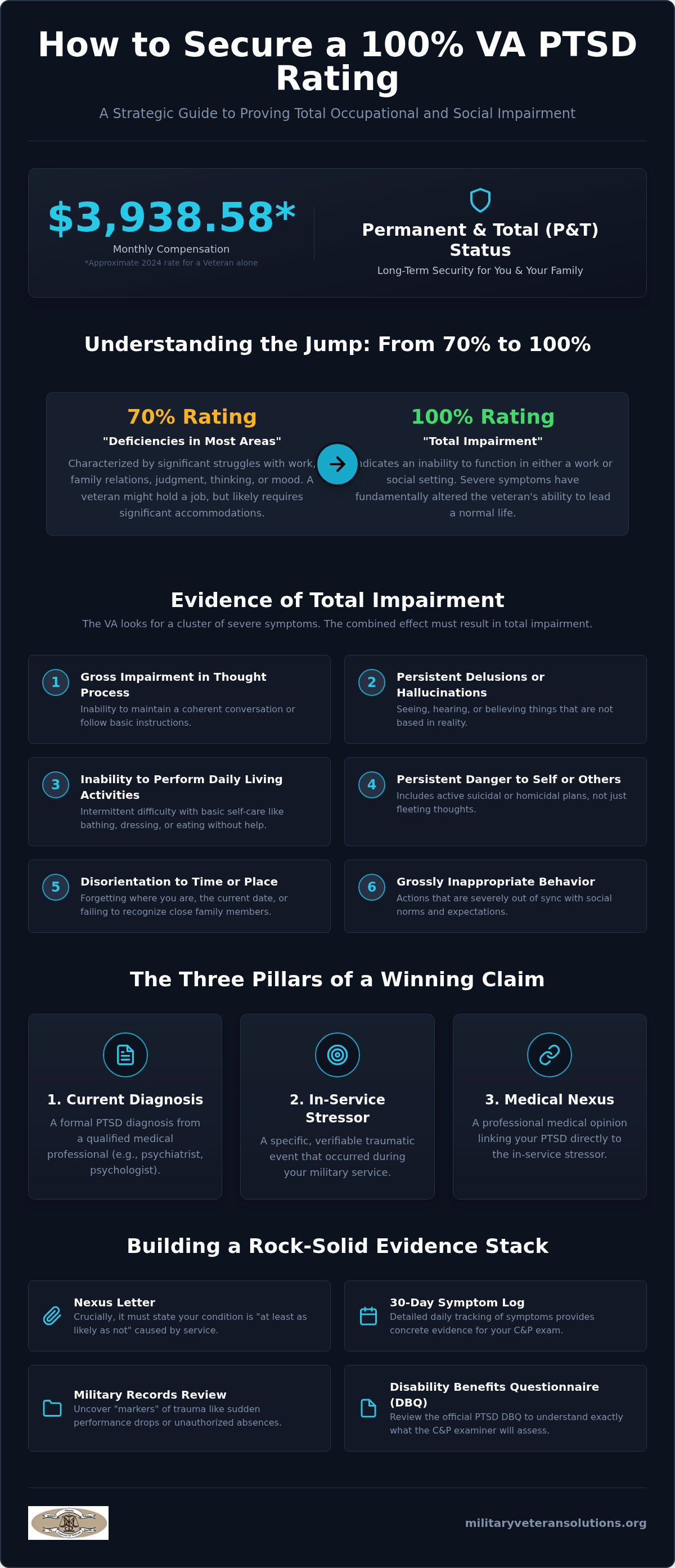
What if the reason you're currently stuck at a 70% rating isn't because your symptoms have improved, but because the VA doesn't yet see the full scope of your daily struggle? You know the reality of living with trauma; it's the missed work days, the strained relationships, and the constant hypervigilance that makes a normal life feel out of reach. It's exhausting to feel misunderstood by a C&P examiner who only sees you for thirty minutes. If you're wondering how to get a 100% PTSD rating, you aren't just looking for a check. You're looking for the $3,938.58 monthly compensation and the permanent and total status that provides long term security for your family.
We understand that the path to total disability is often buried under complex paperwork and rigid legal jargon. This guide simplifies that journey. You'll learn the exact evidence requirements, proven C&P exam strategies, and the specific advocacy steps needed to bridge the gap between your current rating and the 100% level you deserve. We'll preview the criteria for total occupational and social impairment and show you how to present a case that the VA cannot ignore. Your service was total; your benefits should be too.
Key Takeaways
- Understand the VA’s definition of "Total Occupational and Social Impairment" to see if your current symptoms meet the high threshold for a 100% rating.
- Identify the "three pillars" of a winning claim and why a professional audit of your service records is necessary to uncover hidden evidence.
- Develop a C&P exam strategy using a 30-day symptom log and a thorough review of the PTSD Disability Benefits Questionnaire (DBQ).
- Evaluate the differences between a schedular 100% rating and TDIU to ensure you receive the maximum compensation allowed by law.
- Learn the strategic steps for how to get a 100% PTSD rating by leveraging professional advocacy and a record-heavy approach to your VA claim.
Understanding the VA Criteria for a 100% PTSD Rating
The jump from a 70% rating to 100% is the steepest climb in the VA system. It represents the difference between "most" impairment and "total" impairment. You don't need to be a medical expert to see that your life has changed, but you must understand the legal standard the VA uses to measure that change. To learn how to get a 100% PTSD rating, you have to look past your diagnosis and focus on the specific functional limitations defined by federal law.
The General Rating Formula for Mental Disorders
The VA evaluates all mental health conditions using a single, unified scale. Whether you struggle with depression, anxiety, or Post-traumatic stress disorder, the examiner uses the same criteria to judge your level of disability. 38 C.F.R. § 4.130 is the legal bedrock for PTSD ratings. This regulation directs examiners to compare your symptoms against the "Average Veteran" standard. This standard assumes a person with no mental health limitations. If your symptoms prevent you from functioning like that hypothetical average person in any work or social setting, you move closer to a total rating.
Identifying Symptoms of Total Impairment
A 100% rating requires "Total occupational and social impairment." The VA looks for a specific cluster of severe symptoms to justify this level of compensation. These include:
- Gross impairment in thought processes: This isn't just "brain fog." It's an inability to maintain a coherent conversation or follow basic instructions.
- Persistent delusions or hallucinations: Seeing or hearing things that aren't there, or holding firm beliefs that aren't based in reality.
- Intermittent inability to perform activities of daily living: This means you sometimes cannot bathe, dress, or feed yourself without help.
- Persistent danger to self or others: This includes active suicidal or homicidal plans, not just fleeting thoughts.
- Disorientation to time or place: Forgetting where you are, what day it is, or failing to recognize close family members.
You don't need every symptom on this list to qualify. The VA's own rules state that the symptoms listed are examples, not a mandatory checklist. If your collective symptoms result in the same level of total impairment, you meet the criteria. The primary distinction is that at 70%, you might still hold a job with heavy accommodations. At 100%, the VA assumes you cannot work at all and cannot maintain healthy social connections. Understanding this nuance is the first step in learning how to get a 100% PTSD rating and securing the support you've earned.
Building Your Evidence Stack: Clinical Records and Stressors
A successful claim stands on three pillars: a current diagnosis, a specific in-service stressor, and a medical nexus linking the two. If one pillar crumbles, your claim fails. To understand how to get a 100% PTSD rating, you must move beyond just reporting symptoms to a doctor. You need a rock-solid evidence stack that corroborates your story through official channels. The VA isn't just looking for your word; they're looking for proof that your service caused a total shift in your ability to function.
Many veterans struggle because their primary stressor isn't clearly documented in their medical records. This is where a professional military record review becomes your strongest asset. We look for "markers" in your personnel file, such as sudden drops in performance, unauthorized absences, or rapid weight changes. These behavioral shifts often serve as silent evidence of a trauma that occurred but wasn't reported at the time. Unit logs and performance reports can verify your presence at a specific event even if you didn't seek medical help immediately.
The nexus letter is the final bridge. A qualified professional must state that it is "at least as likely as not" that your PTSD was caused by your service. Without this specific language, the VA can easily deny the connection. If you've already received a denial, our VA Decision Letter Analysis can help pinpoint exactly where your evidence fell short and how to fix it.
Medical Documentation Requirements
The VA relies heavily on its own records, but private clinical notes often provide a more intimate look at your daily life. You should gather every scrap of documentation from therapists, psychologists, and hospitals. Clinical notes must reflect the frequency, severity, and duration of your symptoms. A single mention of a panic attack isn't enough for a total rating. You need a documented history of gross impairment. Reviewing the criteria for VA disability compensation for PTSD ensures your records align with what the raters are looking for. A professional review of your file can spot missing evidence before you submit your claim.
Leveraging Lay Evidence (VA Form 21-10210)
Medical records tell the clinical story, but "Buddy Letters" tell the human story. Your spouse, children, or former unit members see the symptoms that a doctor might miss during a short visit. Use VA Form 21-10210 to collect statements from those who witness your "worst days." These statements should be specific. Instead of saying you are "angry," a witness should describe how you've withdrawn from family events or lost multiple jobs due to emotional outbursts. Mapping these observations directly to the criteria for how to get a 100% PTSD rating makes it harder for the VA to overlook your total impairment.
Navigating the C&P Exam: Proving Total Impairment
The Compensation and Pension (C&P) exam is often the most anxiety-inducing part of the process. It's a legal evaluation, not a medical treatment session. To understand how to get a 100% PTSD rating, you must treat this appointment with the same tactical precision as a mission. The examiner isn't your therapist. Their job is to fill out a form that determines your financial future. You need to walk into that room prepared to bridge the gap between your clinical diagnosis and the reality of your daily struggle.
Preparation is the only way to ensure the examiner sees the full scope of your disability. Follow these steps to ensure your reality is accurately captured:
- Review the DBQ: The Disability Benefits Questionnaire is the blueprint the examiner follows. Know the specific boxes they need to check to justify a 100% rating.
- Keep a 30-day log: PTSD often affects memory and concentration. Having a written log of your symptoms ensures you don't forget critical details under the pressure of the interview.
- Describe your "worst days": If you're having a rare "good day" on the date of the exam, don't let that be the snapshot the examiner takes. Describe your most severe episodes in detail.
- Focus on limitations: Clearly explain how your symptoms specifically prevent you from working or maintaining healthy relationships with others.
- Request the results: Always obtain a copy of the completed exam through a Freedom of Information Act (FOIA) request to analyze the examiner's findings.
Common C&P Exam Pitfalls for PTSD
Stoicism is a survival skill in the military, but it's a claim killer in a C&P exam. Veterans often "mask" their symptoms, instinctively trying to appear composed and capable. This leads to an underrated claim. Never start the exam by saying "I'm doing fine" when asked how you are. That's a social reflex, but the examiner will write it down as a clinical observation of stability. If the examiner seems to be rushing through the questions, stop them. Politely insist on explaining the full impact of your triggers and how they disrupt your life.
Corroborating Occupational Failure
The difference between 70% and 100% often hinges on your ability to maintain "substantial gainful employment." You should provide the examiner with evidence of job losses, demotions, or formal workplace accommodations. They will evaluate how you interact with supervisors and your ability to follow instructions. Total occupational impairment is a high bar, often overlapping with the criteria for Social Security Disabled-Worker Benefits. Using performance reviews that mention emotional outbursts or social withdrawal can provide the objective proof needed to understand how to get a 100% PTSD rating based on your inability to work.
Schedular 100% vs. TDIU: Two Paths to Total Benefits
Securing the highest level of compensation doesn't always require meeting every symptom in the 100% rating criteria. While the schedular 100% rating is based purely on the severity of your medical symptoms, there's a second, equally valid path to the same monthly payment. Total Disability based on Individual Unemployability (TDIU) recognizes that even if your PTSD is rated at 70%, its impact on your ability to work may be total. If you're struggling with how to get a 100% PTSD rating, you should evaluate which path fits your specific evidence stack. Sometimes, the most efficient route is combining VA disability ratings from other service-connected conditions to reach a total schedular rating through VA math.
The "Odd-Lot" doctrine is a critical legal concept often used in these cases. It argues that while a veteran might technically be able to perform some minor tasks, no employer in the real world would hire them due to their symptoms. Frequent outbursts, memory loss, or the need for constant supervision makes a veteran "unemployable" in a competitive labor market. If this sounds like your situation, you need a strategy that proves your symptoms make steady work impossible. Our team can help you navigate this complex process through expert veteran claims representation that focuses on your unique employment history.
TDIU Requirements for PTSD
To qualify for schedular TDIU, you generally need one service-connected disability rated at 60% or a combined rating of 70% with at least one condition at 40%. Since many PTSD ratings land at 70%, this is a common path for veterans who can't hold a job. The VA distinguishes between "marginal employment," like working a few hours for a family business, and "substantial gainful activity," which is a standard full-time job. If your income falls below the federal poverty level, you may still qualify. In complex appeals, vocational expert testimony is often used to prove that your PTSD triggers directly prevent you from maintaining a professional environment.
Permanent and Total (P&T) Status
A 100% rating is a victory, but 100% Permanent and Total (P&T) status is the ultimate goal for long term security. P&T means the VA doesn't expect your condition to improve and won't schedule you for future re-examinations. This status unlocks life-changing benefits like CHAMPVA healthcare for your family, Chapter 35 education assistance for dependents, and significant property tax exemptions in many states. You can request a P&T designation during your initial claim or as part of an appeal by providing medical evidence that your PTSD symptoms are chronic and unlikely to resolve. Securing this status provides the peace of mind that your benefits are protected for the rest of your life.
Strategic Advocacy: How Professional Representation Secures Your Rating
With the long-term security of a P&T status and associated property tax benefits, many veterans choose to focus on homeownership; you can learn more about Morgan Financial to see how they support veterans in finding the right mortgage solutions for their families.
Filing for a total disability rating is a high-stakes endeavor. Many veterans assume that telling the truth is enough. However, the VA requires that truth to be packaged in a specific, legal format. A professional veteran advocacy service provides the strategic layer between your story and the rater's desk. At Military Veteran Solutions, LLC, our approach is built on a foundation of veteran-led experience. We've lived the struggle and spent over 25 years mastering the administrative hurdles that keep you from the highest compensation level.
The value of professional representation is most evident when the VA issues a "silent denial." This happens when the agency ignores critical evidence already in your file. We identify these gaps and force the VA to acknowledge them. If you are researching how to get a 100% PTSD rating, you likely know that the system feels stacked against you. Professional advocacy levels the playing field by ensuring every piece of evidence is presented with maximum impact.
The Value of a Comprehensive Record Review
Medical doctors focus on current symptoms. They frequently miss the behavioral "markers" hidden in your personnel files. These markers, such as a sudden transfer, a loss of rank, or a period of unexpected leave, are often the clinical fingerprints of trauma. We bridge the gap between your service record and your current disability by identifying these indicators. Our virtual consultations provide nationwide access to elite-level advocacy, ensuring you have expert support regardless of your location. We look deeper than generic law firms to find the evidence that links your current struggles to your time in uniform.
Winning Your VA Appeal
If your initial claim was underrated or denied, filing VA appeals is the next tactical step. We analyze your VA Decision Letter with surgical precision to find legal and factual mistakes. In 2026, the average time to complete a decision has dropped to approximately 78.6 days. While the VA has processed over two million disability claims in the fiscal year, speed should never come at the expense of accuracy. We handle Higher-Level Reviews and Supplemental Claims by introducing new, relevant evidence or arguing that the rater failed to follow their own rules. Securing the highest rating requires an advocate who knows how to hold the VA accountable to the law. Learning how to get a 100% PTSD rating is a process of persistence and professional precision.
Secure Your Future with Professional Advocacy
You've served your country with honor; now it's time to ensure the VA honors its commitment to you. Achieving a total disability rating isn't about luck. It's about a disciplined approach to evidence, from mastering the 38 C.F.R. § 4.130 criteria to identifying hidden markers in your military records. Whether you pursue a schedular rating or TDIU, your focus must remain on proving total occupational and social impairment through a rock-solid evidence stack. Every detail matters when the goal is long term security for your family.
Understanding how to get a 100% PTSD rating is the first step toward reclaiming your stability. We're here to help you navigate the rest. As a veteran-owned firm founded by a former soldier with 10 years of Army service, we bring over 25 years of advocacy experience to your case. We specialize in comprehensive military record audits that uncover the evidence generic firms often miss. Don't let a poorly documented exam or an overlooked record stand between you and your benefits. Get a Professional Analysis of Your VA Decision Letter Today and let us help you secure the permanent and total status you've earned. You've fought the hard battles alone for long enough; let us take it from here.
Frequently Asked Questions
Can I get a 100% PTSD rating if I am still working?
Yes, it is technically possible, but it's extremely difficult to achieve. The 100% criteria require "total occupational and social impairment." If you're working a full-time job, the VA often argues your impairment isn't total. However, you may qualify if you work in a protected environment or have marginal employment where your income stays below the federal poverty level. Most veterans at this level find that maintaining steady work is impossible due to their triggers.
What is the average VA rating for PTSD in 2026?
While the VA doesn't publish a single average for every year, historical data shows that most ratings fall between 30% and 70%. In 2026, the VA continues to process over two million claims annually with an increased focus on efficiency. The 70% rating is the most common high-level benchmark. Jumping to the 100% level requires proving a complete inability to function in work and social settings, which is a high evidentiary bar.
Do I need a Nexus Letter to get a 100% rating?
A Nexus Letter is a vital tool for establishing service connection. It provides the medical link between your current diagnosis and the specific events that occurred during your service. Without a professional opinion stating your condition is "at least as likely as not" related to your time in uniform, the VA can deny your claim. This document is a cornerstone for anyone learning how to get a 100% PTSD rating through a comprehensive evidence stack.
What happens if my PTSD rating is reduced?
If the VA proposes a reduction, you have 60 days to submit new evidence and 30 days to request a hearing to fight the change. Reductions often occur if the VA believes your symptoms have improved significantly. You must provide clinical notes or lay evidence showing your condition remains severe. Professional advocacy is critical during this short window to ensure the VA doesn't strip away the compensation you rely on for your daily survival.
Is PTSD considered a permanent disability by the VA?
Not automatically. The VA often considers PTSD "subject to improvement" unless you're granted Permanent and Total (P&T) status. The agency may schedule re-examinations every few years to check for changes in your symptoms. If you reach age 55, have held the rating for 20 years, or provide medical evidence that your condition is unlikely to improve, you can secure P&T status. This protects your benefits and ends the cycle of future exams.
Can I apply for 100% PTSD and TDIU at the same time?
Yes, you can apply for both simultaneously. In fact, if you apply for an increase to 100% and indicate you are unable to work, the VA is legally required to consider TDIU as part of that claim. This gives you two distinct paths to the same compensation level. If your medical symptoms don't quite meet the 100% schedular criteria, your inability to maintain gainful employment can still secure the total benefit amount through TDIU.
How long does it take the VA to process a 100% PTSD claim?
As of late May 2026, the average time to complete a claim decision is 78.6 days. While the VA has significantly reduced the backlog, complex claims involving total disability or TDIU may take longer. The agency often needs to gather additional employment records or schedule multiple C&P exams to verify total impairment. You should expect a few months for a thorough review of a claim that involves such a high level of monthly compensation.
What symptoms are required for a 70% vs 100% PTSD rating?
A 70% rating involves "occupational and social impairment in most areas," often including suicidal ideation or near-continuous panic. A 100% rating requires "total" impairment. This includes symptoms like persistent delusions, gross impairment in communication, or being a constant danger to yourself or others. Understanding this specific distinction is the key to how to get a 100% PTSD rating, as you must prove that your functional loss is complete rather than just frequent.


