
A successful PTSD claim isn't just about having a diagnosis; it's about strategically connecting military records to current symptoms through a documented nexus. You've likely spent years managing the weight of your service, only to find that the VA claim process for PTSD feels like another battlefield. It's exhausting to relive your trauma on paper, especially when you're worried that a single mistake on Form 21-0781 or a skeptical C&P examiner could lead to a denial. You deserve to be heard, not interrogated.
We're here to change that narrative. This guide provides a clear, evidence-based roadmap to help you master these complexities and secure the benefits you've earned. We'll break down the "Big Three" evidence requirements, show you how to approach your C&P exam with confidence, and explain how a detailed military record review can turn a confusing application into a winning case. By the end of this article, you'll have a strategic plan to move from administrative confusion to a fair rating. It's time to stop guessing and start building a claim that stands up to scrutiny.
Key Takeaways
- Learn why a current medical diagnosis is the non-negotiable foundation of your claim and how a thorough military record review identifies the evidence you need.
- Discover how to properly document combat and non-combat stressors using Form 21-0781 to ensure your personal trauma is accurately represented.
- Master the strategy for your C&P exam, the most critical hurdle in the VA claim process for PTSD, by understanding the Disability Benefits Questionnaire (DBQ).
- Secure your maximum backpay by starting with a strategic "Intent to File" before gathering your comprehensive medical and service records.
- Gain clarity on how the VA assigns disability ratings and learn why professional decision letter analysis is the first step toward a successful appeal.
Understanding the VA Claim Process for PTSD in 2026
The VA claim process for PTSD isn't just a medical application; it's a rigorous legal and medical evaluation of your service-connected trauma. The VA uses specific criteria to determine if your mental health struggles are the direct result of your military service. If you approach this without a strategy, you risk being lost in a backlog of paperwork. You need to provide clear, undeniable evidence that meets the VA's high evidentiary standards. This isn't about proving you're "hurt" enough; it's about proving your symptoms are tied to your uniform.
The "Big Three" Requirements for Service Connection
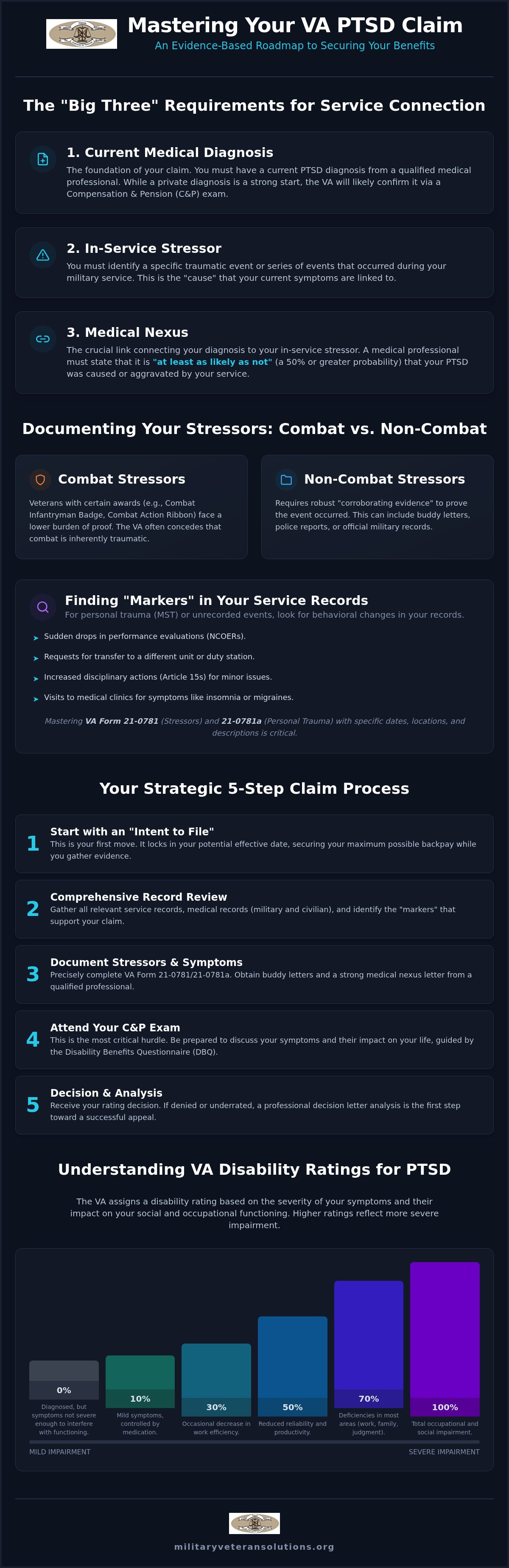
To win your claim, you must satisfy three distinct pillars of evidence. First, you need a current medical diagnosis of PTSD from a qualified professional. While a private diagnosis is a strong starting point, the VA often requires a Compensation and Pension (C&P) exam to confirm the diagnosis meets their specific clinical criteria. Don't be surprised if the VA examiner asks questions that seem repetitive. They're looking for consistency between your records and your current state.
Second, you must identify a credible in-service stressor. This is the specific traumatic event or series of events that occurred during your service. The final pillar is the nexus. The Nexus is the bridge between service and current health. Legally, this link must meet the "at least as likely as not" standard. This means there's at least a 50% probability that your PTSD was caused or aggravated by your time in uniform. Without this medical link, even the most severe symptoms won't result in a successful claim.
Presumptive vs. Non-Presumptive PTSD Claims
Your path through the VA claim process for PTSD depends heavily on the nature of your service. Combat veterans who earned certain badges or awards, such as the Combat Infantryman Badge or Combat Action Ribbon, often face a lower burden of proof for stressors. The VA generally concedes that combat is inherently traumatic. However, if you're filing a non-combat claim, your documentation must be much more robust. You'll need to provide buddy letters, police reports, or military records that verify the event happened.
Modern legislation like the PACT Act has also changed how the VA views mental health. While the PACT Act primarily focuses on toxic exposure, the secondary effects of these exposures can impact mental health. If you're dealing with PTSD related to the psychological toll of chronic illness from toxic exposure, your strategy must reflect that connection. Supporting your body during this time is essential, and West Vital Peptides LLC provides specialized wellness and recovery services that can help veterans manage the physical toll of chronic conditions. A thorough military record review is often the only way to ensure every piece of evidence is aligned before you submit your file. Don't leave these details to chance; the VA won't find the evidence for you.
Documentation is the backbone of the VA claim process for PTSD. Without a verified stressor, your diagnosis remains unlinked to your service. You must use VA Form 21-0781 for standard stressors or 21-0781a for personal trauma, including Military Sexual Trauma (MST). Combat veterans often have a more direct path because the VA concedes stressors for those with certain combat awards. However, non-combat veterans must provide robust "corroborating evidence" to prove the event occurred. If official records are missing or classified, you'll need secondary evidence like buddy letters or newspaper clippings to bridge the gap.
Mastering VA Form 21-0781 and 21-0781a
Precision matters more than volume. When you fill out these forms, provide specific dates, approximate locations, and clear descriptions of the incident. You don't need to over-share every painful detail; instead, focus on the facts that the VA can verify through unit records. For personal trauma, the 21-0781a is your tool to report sensitive incidents that might not appear in a traditional SITREP. Look for "markers" in your personnel files that show a change in behavior after the event. These might include:
- Sudden, unexplained drops in performance evaluations or NCOERs.
- Requests for transfer to a different unit or duty station.
- Increased disciplinary actions or Article 15s for minor infractions.
- Visits to medical clinics for physical symptoms like insomnia or migraines.
Finding "Markers" in Your Military Service Records
Official records don't always tell the whole story, but they often leave clues. A disciplinary action that seems random might actually be a psychological reaction to a traumatic event. Searching for these hidden proofs requires a meticulous eye. A professional military record review service identifies these subtle shifts that a casual observer might miss. Experts can cross-reference unit logs and daily reports to place you at the scene of a traumatic event, even if the event itself wasn't documented in your personal file.
Buddy letters are your secret weapon when official paperwork falls short. These lay statements from fellow service members, friends, or family members provide a human perspective on how the trauma changed you. They can verify that you were present during a specific event or describe the "before and after" of your personality. If you're struggling to find the right evidence, a virtual consultation can help you evaluate your current documentation and identify missing links. Don't let a lack of records stop you from filing; instead, use every available tool to build a comprehensive narrative of your service.
The Compensation and Pension (C&P) Exam Strategy
The C&P exam is the most critical hurdle in the VA claim process for PTSD. It is the moment where your medical records meet a clinical evaluation. During this appointment, the examiner uses a document called the Disability Benefits Questionnaire (DBQ) to record your symptoms and determine your level of occupational and social impairment. This scale is the primary tool the VA uses to assign your percentage rating. If you downplay your symptoms out of pride or habit, the examiner will record a higher level of functioning than you actually experience. You must show up on your worst day to ensure the record reflects the true severity of your condition.
What to Expect During the PTSD Evaluation
Expect questions that span your entire life. The examiner will ask about your childhood, your time in service, and how you function today. They're looking for a clear timeline of how the trauma changed your behavior. Some examiners may seem cold or clinical; don't let this rattle you. They're trained to look for "malingering" or inconsistent reporting. If your story matches the evidence found in a thorough military record review, you have nothing to fear. Consistency is your greatest ally in this environment. The examiner isn't your therapist, but they are the gatekeeper to your benefits.
Communicating Your Symptoms Effectively
When describing your life, focus on three factors: frequency, severity, and duration. Don't just say you're "anxious." Explain that you have panic attacks three times a week, they last for 40 minutes, and they're so severe you have to leave your workstation. Detail the impact on your family life and social circles. If you can't attend your child's school events because of crowds, or if you've lost friendships due to irritability, say so. This level of detail helps the examiner check the correct boxes on the DBQ for a fair rating.
Bring a copy of your personal statement to the exam. It's easy to forget critical details when you're under the stress of a high-stakes interview. Having your notes ensures you don't miss a symptom or a specific example of impairment. Remember, this isn't a therapy session; it's a forensic evaluation. Your goal is to provide an accurate, unvarnished picture of your daily struggle. If you've already received a denial, a VA decision letter analysis can help identify where your communication during the exam might have fallen short so you can correct it on appeal.
Step-by-Step Guide to Submitting Your PTSD Claim
Submitting your claim is the culmination of your preparation. It's the moment you transition from gathering evidence to demanding the benefits you've earned. However, this isn't a "fire and forget" process. You must be methodical. The VA claim process for PTSD is notorious for its administrative hurdles, and a single missing signature or an incomplete form can result in months of unnecessary delays. You've done the hard work of identifying your stressors; now you must ensure the VA's system receives that information in a way that forces a fair evaluation.
Phase 1: Preparation and Intent to File
The first thing you must do is submit an "Intent to File." Do this today. This simple step protects your effective date for up to one year, ensuring that if your claim is eventually approved, your backpay is calculated from this moment. While your Intent to File is active, you have a window to gather your evidence without losing money. During this time, order your C-File (Claims File). This document contains your entire claims history and military medical record. You cannot build a winning strategy if you don't know exactly what the VA already has on record. For help organizing these complex documents and ensuring nothing is missed, review this VA claim assistance resource.
You also need to draft your personal statement in support of the claim using VA Form 21-4138. This is your primary opportunity to speak directly to the rater. Use it to bridge the gap between your medical records and your daily reality. Detail your symptoms, their frequency, and how they disrupt your ability to maintain a job or healthy relationships. Be specific. A vague statement is easy to ignore; a detailed narrative of impairment is not.
Phase 2: Submission and Monitoring
When you're ready to submit, you'll choose between a Fully Developed Claim (FDC) and a Standard Claim. If you have gathered all your private medical records and military files yourself, the FDC is the superior path. It tells the VA that you've provided everything they need, which typically speeds up the decision timeline. Once submitted, track your claim through the VA.gov portal. You will see your claim move through several phases, including "Evidence Gathering, Review, and Decision."
Pay close attention when your status changes to "Preparation for Decision" (PFD). This means a rater has your file and is actively working toward a conclusion. If the VA sends a request for more evidence at any stage, respond immediately. Even if you've already sent the requested document, send it again. Delays in response are often interpreted as a lack of interest, which can lead to a premature denial. If the paperwork feels like too much to handle alone, you can schedule a virtual consultation to get expert guidance on your submission strategy. Don't let administrative exhaustion prevent you from securing your future.
Navigating Denials and Rating Increases
Receiving a denial letter feels like a punch in the gut. It's frustrating to pour your heart into an application only to have the VA reject your reality. But in the VA claim process for PTSD, a denial is often just the beginning of a successful appeal. It's not a final judgment; it's a tactical roadmap. The VA is telling you exactly where your evidence is thin. Whether you were denied service connection or given a rating that doesn't match your level of impairment, you have options to fight back and win.
Ratings for PTSD are assigned at 30%, 50%, 70%, or 100% based on your occupational and social impairment. A 30% rating suggests you're managing but have occasional symptoms that interfere with work. By the time you reach 70%, you're likely experiencing deficiencies in most areas, such as inability to maintain relationships or difficulty following instructions at a job. If your symptoms have worsened since your last evaluation, you don't need to start a new claim. You can file for an increase to ensure your compensation reflects your current struggle. This is why a professional VA decision letter analysis is the most strategic move you can make after a disappointing result.
Decoding the VA Decision Letter
Your decision letter is a legal document that contains "favorable findings." These are the facts the VA already concedes, such as your veteran status or the occurrence of an in-service stressor. Identifying these findings is critical. It prevents you from wasting time re-proving things the VA already accepts. Instead, you can focus your energy on pinpointing the exact evidence the VA claimed was missing, such as a stronger nexus or more detailed medical records. Following a strategic guide to overturning denials allows you to address these gaps with surgical precision rather than a "shotgun" approach.
Choosing the Right Appeal Path
You have three primary paths to appeal a decision. A Higher-Level Review (HLR) is best if you believe the rater made an error based on the evidence already in your file. You cannot submit new evidence here; it's a de novo review by a more senior rater. If you have "new and relevant" evidence, such as a more descriptive buddy letter or a private medical opinion, a Supplemental Claim is your best option. This allows you to add the missing piece of the puzzle to your record. For complex legal arguments, a Board Appeal puts your case in front of a Veterans Law Judge. Each path has its own timeline and requirements. Choose the one that addresses the specific reason for your denial to avoid years of unnecessary waiting.
Secure Your Earned Benefits with a Proven Strategy
The VA claim process for PTSD doesn't have to be a source of constant anxiety. By mastering the "Big Three" requirements and walking into your C&P exam with a clear understanding of the DBQ, you've moved from a position of uncertainty to one of informed advocacy. You now understand how to document stressors and choose the right appeal path if the initial decision falls short. This knowledge is your greatest asset in securing a rating that truly reflects your daily sacrifices. You've earned these entitlements; now it's time to claim them with confidence.
Military Veteran Solutions, LLC stands ready to reinforce your efforts. Our team, led by a 10-year Army veteran, specializes in uncovering the critical evidence the VA often misses. Through comprehensive military record reviews, we help you build a nexus that bridges the gap between your service and your current health. Don't let a complex system stand between you and the benefits you've earned through your commitment to this nation. We provide the professional authority and deep-seated empathy you need to navigate this final hurdle.
Get a Professional VA Decision Letter Analysis from Military Veteran Solutions, LLC today. It's time to stop fighting the system and start winning the benefits you deserve.
Frequently Asked Questions
How long does the VA claim process for PTSD take in 2026?
The VA claim process for PTSD typically takes between 120 and 150 days, though complex cases or appeals can extend much longer. High claim volumes and administrative backlogs often influence these timelines. You can speed up the decision by filing a Fully Developed Claim (FDC) with all medical records included. Tracking your status on the VA.gov portal helps you stay informed of any requests for additional evidence that could cause further delays.
Can I get VA disability for PTSD if I never saw combat?
Yes, you can receive disability benefits for PTSD without seeing combat. The VA recognizes that trauma occurs in many environments, including military sexual trauma (MST), serious training accidents, or witnessing tragic events. While combat veterans often have stressors conceded, non-combat veterans must provide more robust documentation. You'll need to use Form 21-0781a and provide markers like disciplinary records or buddy letters to prove the event occurred during your service.
What is a "Nexus Letter" and do I really need one for PTSD?
A Nexus Letter is a formal document from a medical provider that links your current PTSD diagnosis to a specific event during your service. While not strictly required if the C&P examiner provides a positive opinion, having one from a private doctor is a powerful strategic advantage. It establishes the "at least as likely as not" legal standard. This independent evidence often makes the difference between an approval and a denial during the evaluation phase.
What happens if I miss my PTSD C&P exam?
If you miss your PTSD C&P exam without a valid reason, the VA will likely deny your claim immediately. The exam is the primary way the rater evaluates your symptoms and assigns a rating. If you have an emergency, contact the VA or the third-party contractor right away to reschedule. You must show "good cause" for missing the appointment to keep your claim active and preserve your original effective date for backpay.
Can the VA take away my PTSD rating once I have it?
The VA can reduce or take away a PTSD rating if they find evidence of "sustained improvement" during a scheduled re-examination. However, protections exist. Ratings held for five years or more are considered "stabilized" and require a specific process to reduce. After 20 years, your rating is permanent and cannot be lowered unless it was granted through fraud. Most veterans with chronic symptoms find their ratings remain stable or increase as they age.
What is the average VA disability rating for PTSD?
While ratings range from 0% to 100%, the average disability rating for PTSD often falls around 70%. This level reflects "deficiencies in most areas," such as work, family relations, and judgment. Many veterans start at 30% or 50% and file for an increase as their symptoms become more severe or better documented. Your specific rating depends entirely on how the examiner records your symptoms on the Disability Benefits Questionnaire (DBQ) during your exam.
How do I prove a stressor if my records were lost or destroyed?
If your official records are missing, you must rely on secondary evidence to prove your stressor. This includes buddy letters from fellow service members who witnessed the event, police reports, or news articles from the time. You can also search unit logs or daily reports that place you at the scene. A professional military record review is often the best way to find these "markers" that corroborate your story when your personal file is incomplete.
Can I file for PTSD as a secondary condition to a physical injury?
You can absolutely file for PTSD as a secondary condition to a physical injury. For example, if a service-connected back injury causes chronic pain that leads to depression and PTSD symptoms, the mental health condition can be linked to the original injury. This is a common strategy in the VA claim process for PTSD when the trauma is tied to the psychological toll of living with a permanent, service-connected physical disability.


