
Your VA denial letter isn't a dead end; it's actually the blueprint for your eventual approval. Most veterans see a "denied" status and assume the fight is over, but in 2026, a denial is often just the first step toward a successful outcome. If you're currently searching for how to file a supplemental claim for va disability, you've likely realized that the system feels designed to keep you in the dark. It's incredibly frustrating to open a letter filled with confusing terminology and strict deadlines that feel impossible to meet. You served your country with honor, and now you're stuck fighting a bureaucracy just to access the benefits you earned.
We understand that the weight of this process can feel overwhelming. It's common to feel like the VA ignored your medical evidence or missed the most critical parts of your service record. This guide will show you how to transform that denial into an approval by decoding your decision letter and choosing the right appeal path. We'll provide a clear roadmap for your next steps, explaining the "new and relevant" evidence standard and how to secure the maximum disability rating you deserve.
Key Takeaways
- Identify the specific "Reasons for Decision" in your VA letter to pinpoint exactly which evidence was missing from your initial claim.
- Learn how to file a supplemental claim for va disability by gathering new and relevant evidence that overcomes previous denials.
- Discover why a formal medical diagnosis is mandatory and how a professional Nexus letter can bridge the gap between your service and your current condition.
- Understand the strategic difference between a Supplemental Claim and a Higher-Level Review to ensure you choose the most effective path to approval.
- Utilize specialized advocacy and military record reviews to uncover service connections that are frequently missed during the standard filing process.
Decoding Your VA Decision Letter: The Blueprint for Your Appeal
Receiving a denial from the U.S. Department of Veterans Affairs feels like a punch to the gut. However, that thick envelope contains more than just a rejection; it's the single most important document for your appeal. We view this letter as a diagnostic tool. It tells you exactly where the VA thinks your claim is weak. To find these answers, skip the standard "Summary of Benefits" and head straight for the "Reasons for Decision" section. This is where the VA rater lists the evidence they considered and, more importantly, what they found lacking. Understanding these specific missing links is vital before you learn how to file a supplemental claim for va disability. If you don't address the rater's specific concerns, your next attempt will likely face the same fate. Utilizing a professional VA decision letter review service is often the smartest first step to ensure you aren't guessing at what the VA wants to see.
The Three Pillars of a Successful Claim
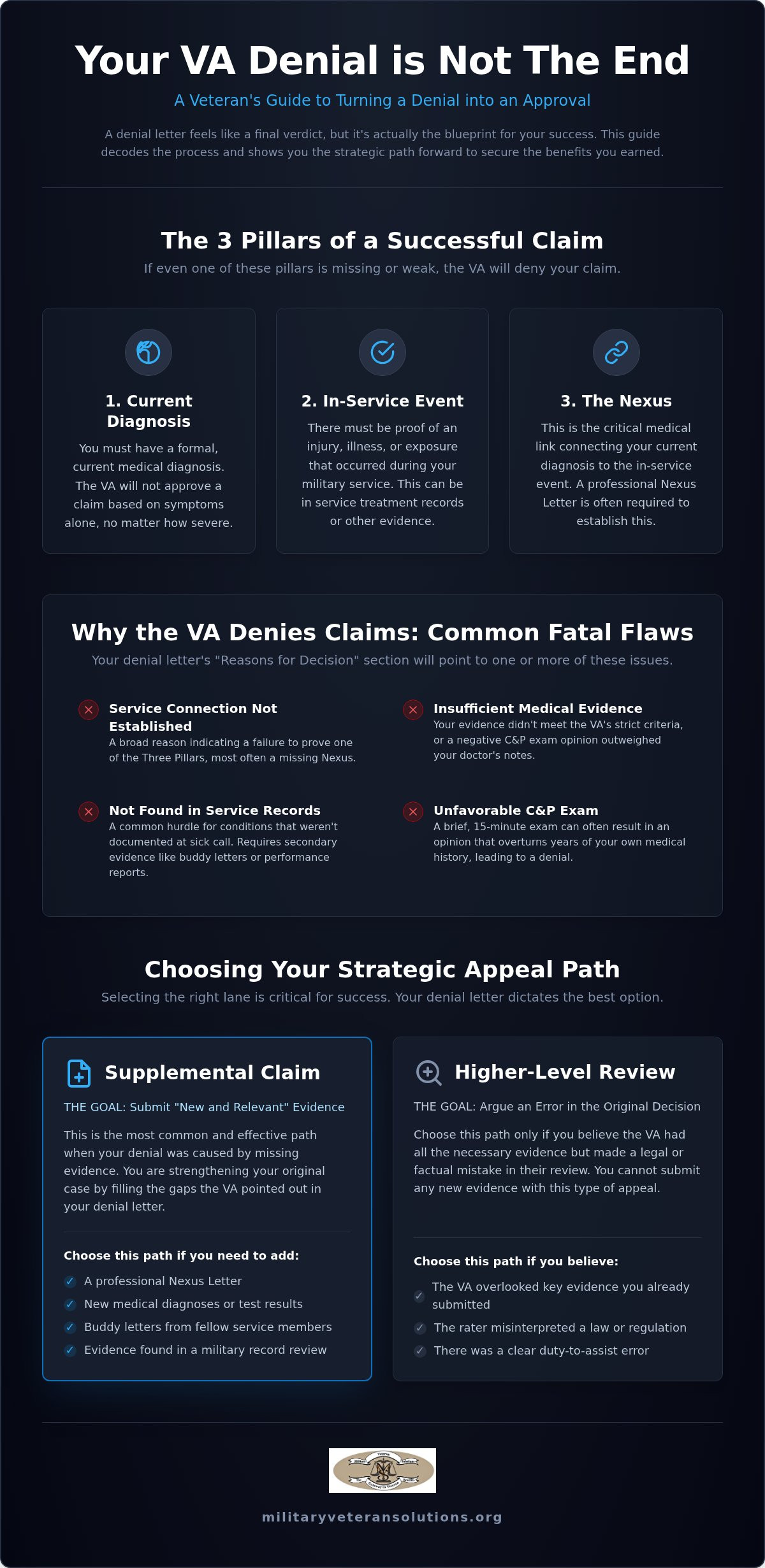
Every successful claim rests on three essential pillars. If one is missing, the VA will deny you every time. First, you must have a Current Diagnosis. The VA often claims a condition doesn't exist simply because your medical records aren't up to date or specific enough. Second, you need an In-Service Event. This is the proof that an injury, illness, or exposure occurred during your military service. Third, you need The Nexus. This is the medical link connecting your service event to your current diagnosis. Without a clear nexus, the VA won't acknowledge that your time in uniform caused your current health struggles. We help you identify which pillar is crumbling so you can shore it up before your appeal.
Common VA Denial Codes and Keywords
The VA uses specialized language that can be difficult to translate. When you see "service connection not established," it's a broad catch-all meaning you failed to prove one of the three pillars mentioned above. "Insufficient medical evidence" doesn't mean you aren't hurt. It usually means the evidence you provided didn't meet the VA's strict criteria or that a C&P examiner's opinion carried more weight than your private doctor's notes. Finally, "not found in service treatment records" is a common hurdle for veterans who didn't go to sick call. This is why a thorough military record review is critical. It allows us to find secondary evidence, such as performance reports or buddy letters, that proves your injury happened even if a medic didn't write it down at the time. Knowing these nuances is the key to understanding how to file a supplemental claim for va disability successfully.
Why the VA Denies Claims: Identifying Fatal Flaws
The VA doesn't deny claims at random. Most rejections stem from specific, identifiable fatal flaws that raters use to close a file. If you want to know how to file a supplemental claim for va disability that actually succeeds, you must first understand what went wrong in your initial application. In 2026, the most common reason for denial remains the missing nexus. This is the medical bridge between your time in uniform and your current health struggles. Without it, your claim is dead on arrival. Another frequent pitfall is the "No Diagnosis" trap. You might live with chronic pain every day, but if your medical records don't contain a formal diagnosis, the VA rater will conclude that no compensable condition exists. They require specific medical terminology, not just a description of your symptoms.
Administrative errors also sink thousands of claims annually. If you miss the one-year deadline to appeal, you lose your original effective date and potentially years of back pay. While the official guide on How to File a Supplemental Claim outlines the basic paperwork, it fails to mention how to avoid these tactical blunders. Our team at Military Veteran Solutions, LLC reviews these letters daily to ensure no veteran loses their benefits due to a simple form error.
The C&P Exam: Where Many Claims Fail
The Compensation and Pension (C&P) exam is often the weakest link in the chain. It's common for a rater to spend only 15 minutes with you, yet their opinion can overturn years of treatment history from your private doctors. You must review the resulting Disability Benefits Questionnaire (DBQ) for inaccuracies. If the examiner ignored your complaints or failed to review your file, you have the right to challenge their competency. Don't accept a biased report as the final word on your health; instead, use your supplemental claim to provide evidence that contradicts a flawed exam.
The Evidence Gap: Beyond Service Treatment Records
The VA frequently ignores lay evidence like buddy statements, viewing them as less credible than clinical notes. This is a mistake. These statements provide the "boots on the ground" context that records often miss. Additionally, many veterans fail to claim secondary conditions. If your service-connected tinnitus has led to severe anxiety, that is a valid avenue for increased compensation. Don't rely solely on the VA to gather your records. Take control of your evidence to ensure every overlooked entry is brought to light during your appeal.
Supplemental Claim vs. Higher-Level Review: Choosing Your Strategic Path
Choosing the correct appeal lane is the most critical strategic decision you'll make after a denial. If you select the wrong path, you risk losing months of progress or the ability to submit the very evidence that would win your case. Most veterans weigh the VA decision review options without understanding that each lane serves a specific purpose. While one focuses on correcting legal mistakes, the other allows you to bring fresh facts to the table. In 2026, the speed of the system has increased, but the complexity remains high. You don't want to waste time on a path that doesn't address the specific flaw in your decision letter.
When to File a Supplemental Claim
If your denial letter states that your evidence was "insufficient" or that a "nexus was not established," you need to know how to file a supplemental claim for va disability. This path is specifically designed for submitting "new and relevant" evidence. Under 2026 standards, evidence is relevant if it simply has a chance to influence the rater's decision. You'll use VA Form 20-0995 to re-open your claim. The primary advantage here is that as long as you file within one year of your denial, you keep your original effective date alive. This preserves your right to back pay. As of July 2026, the average processing time for a supplemental claim has dropped to just 58.8 days, making it the fastest way to get a new decision.
When a Higher-Level Review (HLR) is the Better Choice
Sometimes the VA has all the evidence it needs but simply makes a mistake. If you believe the rater ignored a specific medical report already in your file or misapplied a regulation, a Higher-Level Review is the better choice. This lane involves a more experienced rater looking for a Clear and Unmistakable Error (CUE). You can request an Informal Conference to argue your case directly to the senior rater. However, there is a major drawback. You cannot submit any new evidence during an HLR. If you discover a missing medical record after filing, you're stuck with what was already in the file. This is why understanding how to file a supplemental claim for va disability is often safer if you have even one piece of new information to add.
The third option is a Board Appeal (Form 10182), where a Veterans Law Judge reviews your case. While this is necessary for complex legal disputes, it's often the slowest route. In 2026, we typically recommend the Supplemental or HLR lanes first to resolve issues quickly at the regional level before escalating to a judge.
Closing the Evidence Gap: Proving Service Connection and Nexus
Winning your appeal isn't about being louder; it's about being more thorough. If you're looking at how to file a supplemental claim for va disability, you must realize that the VA rater needs a bridge of evidence they cannot ignore. In 2026, the PACT Act has opened doors for thousands of veterans, with over 458,000 claims processed in its first year alone. This legislation added more than 20 presumptive conditions for toxic exposure, which means the VA now assumes service connection for many illnesses. If your previous denial didn't account for these new rules, your supplemental claim is the perfect place to leverage them. You should also utilize VA Form 21-4138, the Statement in Support of Claim, to provide a clear narrative that ties your symptoms to specific events in your history.
The Art of the Military Record Review
Your medical records are only half the story. Often, the evidence needed to win is hidden in "silent" medical events where you made a complaint but never received a formal diagnosis. We look for entries in performance evaluations or even disciplinary records that signal a change in behavior, which can serve as critical proof for PTSD stressors. Many veterans miss these subtle clues because they don't know what to look for. This is where a professional military record review service becomes an invaluable ally. We dig through every page of your C-file to find the "smoking gun" that proves your condition started in service.
Building a Stronger Nexus
The nexus letter is the most powerful weapon in your appeal arsenal. To be "VA-proof" in 2026, a medical professional must state that your condition is "at least as likely as not" caused by your military service. This specific phrasing is non-negotiable. If a doctor says your service "could have" caused it, the VA will likely deny the claim again. A strong nexus also connects secondary conditions, such as proving that your service-connected back injury led to weight gain and subsequent sleep apnea. If you're struggling to connect the dots, our Veteran Claims Representation services can help you build a case that stands up to the toughest scrutiny. Understanding how to file a supplemental claim for va disability with a bulletproof nexus is the difference between another denial and the benefits you've earned.
Professional VA Appeal Advocacy: Why You Should Not Fight Alone
Fighting the VA alone is an uphill battle that often ends in exhaustion rather than approval. Many veterans believe they can simply follow the instructions on a form, but the system's complexity frequently leads to avoidable mistakes. Specialized advocacy goes beyond just filling out paperwork; it involves identifying tactical strategies that even traditional attorneys might overlook. While a lawyer might focus strictly on the legal interpretation of a regulation, a dedicated advocate with a military background knows how to read between the lines of your service records. We understand the culture, the acronyms, and the "silent" injuries that a civilian professional might miss. You don't have to navigate this daunting environment without a powerful ally by your side.
If you're currently trying to figure out how to file a supplemental claim for va disability, remember that the evidence you submit today determines your rating for years to come. Professional representation ensures that your submission isn't just "new and relevant," but also persuasive and complete. We analyze your decision letter with a focus on results, pinpointing the exact reason for the initial denial and building a rebuttal that the VA cannot ignore. Our goal is to help you win VA disability appeal outcomes by leveraging our deep institutional knowledge and specialized evaluation process.
The Military Veteran Solutions Advantage
Military Veteran Solutions, LLC brings a unique, veteran-owned perspective to every case. Our founder served 10 years in the Army, and our firm carries over 25 years of experience in the field. This isn't just a business for us; it's a mission to ensure no veteran is left behind by a broken administrative system. We focus on comprehensive military record reviews, finding the service connections that the VA rater often ignores. Because we offer virtual consultations nationwide, you can access expert support from the comfort of your home. We bridge the gap between formal professional service and personal mentorship, ensuring you feel seen and understood throughout the entire process.
Your Next Steps Toward Approval
Time is your most valuable asset in this process. You have a strict one-year deadline from the date of your denial letter to file an appeal and protect your effective date. If you miss this window, you lose the right to back pay that could amount to thousands of dollars. Before your va claim assistance consultation, gather your decision letter and any recent medical records. We'll use these to perform a dedicated analysis of your situation and provide a clear roadmap for your next appeal step. Don't let another day pass in frustration. Knowing how to file a supplemental claim for va disability is only half the battle; having the right representation is what secures the win. Schedule your review today.
Take Control of Your VA Appeal Today
A denial letter is a challenge, but it's never the final word. You've seen that decoding the VA's specific reasoning is the essential first step to identifying exactly which evidence was missing from your initial claim. Whether you need to bridge the evidence gap with a bulletproof Nexus letter or audit your military records for overlooked injuries, your strategy must be precise. Understanding how to file a supplemental claim for va disability is the key to reopening your case while protecting your original effective date for back pay.
You don't have to navigate this complex administrative system alone. Military Veteran Solutions, LLC was founded by a disabled veteran with 10 years of Army service, and we bring over 25 years of advocacy experience to your corner. We offer virtual consultations nationwide to ensure every veteran has access to dedicated, professional representation. Don't let strict deadlines or confusing terminology stand between you and the compensation you deserve. Get a Professional VA Decision Letter Analysis from Military Veteran Solutions today and start your path toward approval. Your service was honorable, and we're ready to help you secure the benefits you earned.
Frequently Asked Questions
How long do I have to appeal a denied VA claim?
You have exactly one year from the date stamped on your VA decision letter to file an appeal. Meeting this strict deadline is vital because it preserves your original effective date. If you miss this window, you lose the right to back pay dating back to your initial filing. We recommend starting the process immediately to ensure you have enough time to gather the necessary evidence for your specific appeal path.
Can I submit new evidence after a VA claim denial?
Yes, you can submit new evidence if you choose the Supplemental Claim path. This is the primary reason veterans learn how to file a supplemental claim for va disability after a denial. The evidence must be new and relevant, meaning the VA hasn't seen it before and it could influence the rater's decision. This is a lower bar than the old standard, making it significantly easier to reopen your case in 2026.
What is the difference between a Supplemental Claim and a Higher-Level Review?
The main difference lies in the evidence allowed. A Supplemental Claim lets you add new medical records or buddy statements to strengthen your case. In contrast, a Higher-Level Review is a closed-record review where a senior rater looks for errors in the original decision. You cannot add any new information during that process. Choosing the right lane depends entirely on whether your denial was caused by missing evidence or a rater's administrative mistake.
Will the VA pay me back pay if my appeal is successful?
Yes, the VA will pay back pay if your appeal is successful and you filed within the one-year deadline. This keeps your effective date alive, which is usually the date you first submitted your claim. If your appeal takes several months to resolve, you'll receive a lump-sum payment covering the difference between your old and new ratings for that entire period. Protecting this date is the primary goal of our dedicated advocacy work.
Do I need a lawyer to appeal my VA disability denial?
You aren't required to hire a lawyer, but navigating the bureaucracy alone is difficult. Many veterans find that specialized advocacy provides a more tailored approach than high-volume firms. We focus on in-depth military record reviews and nexus identification to build a stronger case. While a lawyer handles legal technicalities, an advocate with a military background understands the nuances of your service history and how it translates into the VA's complex rating schedule.
What happens if my Supplemental Claim is denied again?
If your Supplemental Claim is denied, you still have several options. You can file another Supplemental Claim if you obtain more new and relevant evidence. Alternatively, you can request a Higher-Level Review if you believe the rater made a legal error, or you can escalate the case to the Board of Veterans Appeals. The key is to keep your claim active by filing your next appeal within one year of the newest denial.
How much does it cost to have a professional review my VA decision letter?
We don't provide specific pricing here, as costs vary based on the complexity of the records and the level of advocacy required. However, the value of a professional review lies in identifying the fatal flaws that caused your denial. Investing in an expert analysis often prevents years of repeated denials and lost back pay. We provide nationwide virtual consultations to make this high-level expertise accessible to every veteran who needs a powerful ally.
Can I appeal a VA decision if I already have a 0% rating?
Yes, you can appeal a 0% rating if your symptoms warrant a higher compensation level. A 0% rating is actually a partial win because the VA has already conceded service connection. This means you've already cleared the hardest hurdle. Your appeal will focus on proving the severity of your symptoms through medical evidence. Learning how to file a supplemental claim for va disability can help you move from a non-compensable rating to the benefits you deserve.


