
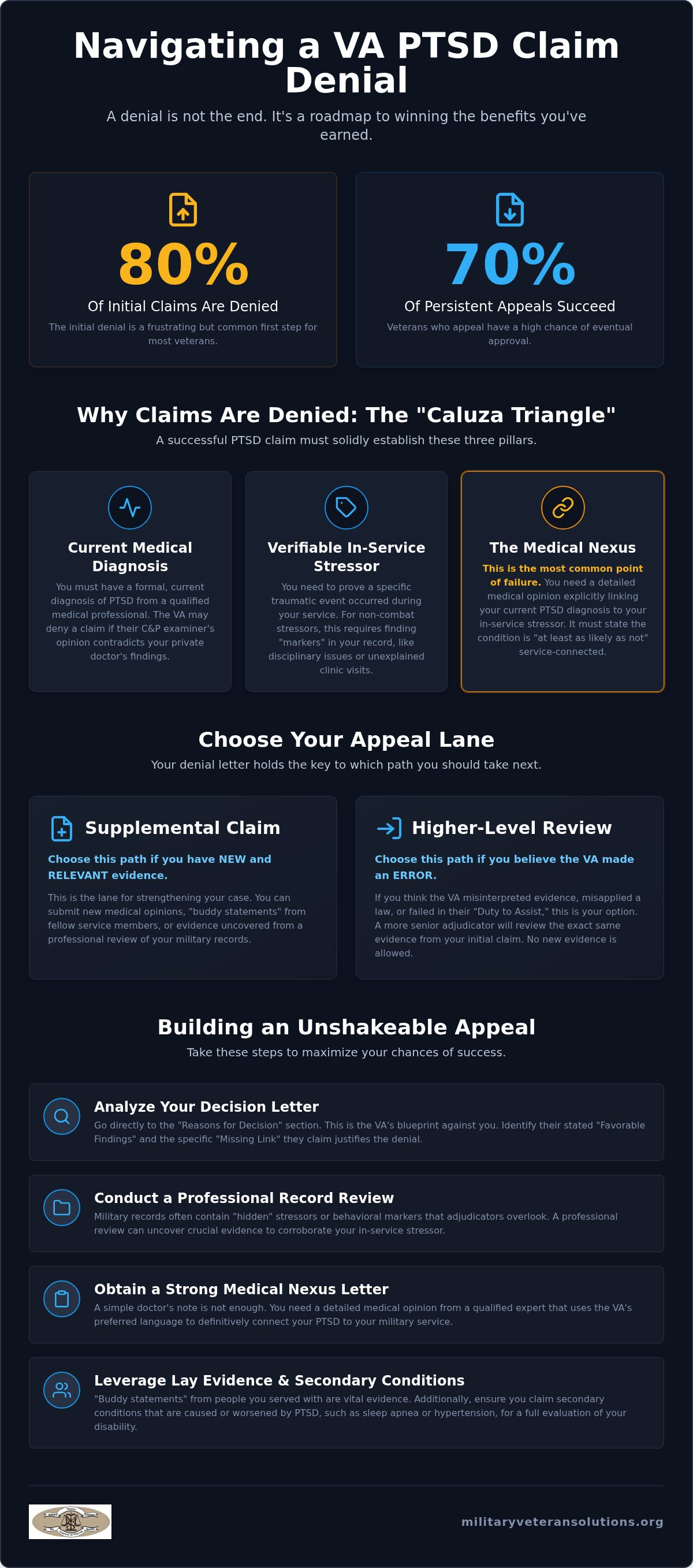
Roughly 8 out of 10 initial VA disability claims are denied. If you've just opened a letter stating your claim was rejected, you're likely feeling a mix of anger and exhaustion. It's frustrating to face a bureaucracy that seems to ignore your lived experience, but you shouldn't let the prospect of a va appeal for ptsd denial intimidate you. This rejection is often just the first step in a longer process where the odds actually shift in your favor. Approximately 70% of veterans who stick with the process and appeal their initial denial eventually receive the approval they deserve.
You deserve a clear path forward without the fear of filing the wrong form or losing years of back pay. We've designed this guide to help you identify the specific evidence gaps in your file and select the most effective appeal lane, whether that's a Supplemental Claim or a Higher-Level Review. You'll learn how to decode the VA's medical jargon and build a case that forces the system to recognize your symptoms. By the end of this article, you'll have a definitive plan to secure your earned benefits and access the 2026 compensation rates that support your long-term stability.
Key Takeaways
- Identify specific evidence gaps by analyzing the "Reasons for Decision" section of your VA letter, which serves as a strategic roadmap for your next steps.
- Choose the correct path for your va appeal for ptsd denial by determining if you need to submit new evidence via a Supplemental Claim or request a Higher-Level Review for existing errors.
- Strengthen your claim by conducting a professional military record review to uncover "hidden" stressors or behavioral markers that the VA adjudicator may have overlooked.
- Ensure your medical evidence satisfies the "Caluza Triangle" requirements, specifically focusing on the nexus link that proves your condition is at least as likely as not related to your service.
- Leverage specialized veteran-owned representation to navigate complex bureaucracy and avoid common filing errors that can delay your benefits for years.
Why the VA Denies PTSD Claims: Identifying the Missing Evidence
Opening a denial letter is a gut-wrenching experience, but it's important to realize that a rejection is usually a roadmap, not a dead end. Most veterans face a va appeal for ptsd denial because the VA adjudicator couldn't find one of three specific elements known as the "Caluza Triangle." This legal framework requires a current medical diagnosis, a verifiable in-service stressor, and a medical nexus that bridges the two. If even one of these pillars is weak, the VA will likely deny the claim, often using the frustrating phrase that your condition is not "at least as likely as not" incurred in or aggravated by your service.
The Three Pillars of Service Connection for PTSD
A current diagnosis is your starting point. You might have years of records from a private psychologist, yet the VA may still deny you based on a single, brief Compensation and Pension (C&P) exam. This happens when the examiner disagrees with your private doctor's findings. Next is the in-service stressor. Under 38 CFR § 3.304(f), the VA has different standards for combat versus non-combat stressors. If you didn't receive a Combat Action Ribbon or Purple Heart, the VA doesn't automatically "concede" that your stressor occurred. You must provide evidence of "markers" in your military records. These are behavioral shifts like sudden disciplinary issues, requests for unit transfers, or visits to the troop medical clinic for physical symptoms that don't have a clear cause. Finally, the medical nexus is the most common point of failure. A simple doctor's note saying you have PTSD is insufficient. You need a detailed medical opinion that uses the VA's preferred language to prove your service caused your current mental health state.
Common VA Mistakes in PTSD Adjudication
The VA is legally bound by the "Duty to Assist," meaning they must help you obtain records to support your claim. However, they frequently fail to pull old personnel files or overlook "buddy statements" from people you served with. These lay statements are vital evidence that can prove a stressor when official records are thin. Another frequent error is the failure to recognize secondary conditions. PTSD rarely exists in a vacuum; it often leads to or worsens conditions like sleep apnea, hypertension, or depression. If the VA ignored these linked conditions, they've failed to evaluate the full scope of your disability. Identifying these specific procedural errors is exactly how we begin to dismantle a va appeal for ptsd denial and secure the rating you've earned.
Analyzing Your PTSD Decision Letter for Strategic Evidence Gaps
Your VA decision letter isn't just a rejection. It's a blueprint for your victory. Most veterans see the word "Denied" and stop reading because the emotional weight is too heavy. That's a mistake. You need to skip straight to the "Reasons for Decision" section. This is where the VA lays out its battle plan against you, and it's exactly where you'll find the holes in their logic. This document tells you exactly what the VA thinks is missing, which is the most critical information for your va appeal for ptsd denial.
Look for the "Favorable Findings" first. This is a rare moment of transparency where the VA admits what they already believe. For example, they might concede that you have a formal PTSD diagnosis or that you served in a qualifying location. By identifying these concessions, you can narrow your focus to the "Missing Link." Is it the stressor verification or the medical nexus? A professional VA decision letter review service can spot subtle regulatory errors or overlooked evidence that a veteran might easily miss while dealing with the frustration of the denial.
Decoding VA Jargon in Mental Health Denials
The VA often uses coded language like "prohibitive evidence" to justify a denial. This typically means they found something in your records—perhaps an old pre-service medical note—that they're using to claim your PTSD isn't service-connected. You might also notice they prioritized a 15-minute C&P examiner’s opinion over a treating physician who has seen you for years. This is a common tactical error by the VA. They may also apply the wrong rating schedule for your symptoms, failing to account for how your PTSD actually impairs your social and industrial life. Understanding these nuances is the first step toward a successful VA claim review.
Turning "No" into "Not Yet": The Power of Analysis
Check the "Evidence" list at the beginning of your letter. This list is often incomplete. If you submitted buddy statements or private medical records that don't appear on that list, the VA failed in its duty to review your case. This oversight creates a clear path for a Higher-Level Review. If the evidence is listed but the nexus is still missing, you know you need a Supplemental Claim with a fresh medical opinion. Mapping these reasons to the right appeal lane saves you months of wasted time. Analyzing these documents requires a steady hand and a deep knowledge of the system, which is why a specialized military record review is often the turning point for a successful appeal.
Choosing Your Appeal Lane: Supplemental Claim vs. Higher-Level Review
Under the Appeals Modernization Act (AMA), you aren't stuck with a single, rigid process. You have choices. Selecting the correct path for your va appeal for ptsd denial depends entirely on what was missing from your initial claim. If you make the wrong choice, you could wait years for a result that should have taken months. It's vital to act within one year of your decision letter date to preserve your original effective date. This ensures you receive every penny of back pay owed to you from the moment you first filed. Missing this deadline means losing that potential back pay forever.
When to File a Supplemental Claim for PTSD
In 2026, the VA defines "new and relevant" evidence as information that wasn't previously considered and has a direct bearing on the missing elements of your claim. This is the lane you need if your decision letter pointed to a missing nexus or an unverified stressor. You'll use VA Form 20-0995 to submit this evidence. A fresh medical opinion or a detailed buddy statement can provide the specific details the VA needs to see. This lane is often the most effective way to fix a denial when the underlying issue is a lack of documentation. The VA's goal for completing these claims is roughly 125 days, making it a relatively fast option for veterans with new proof.
Strategic Use of the Higher-Level Review (HLR)
If the VA already has all the evidence they need but reached the wrong conclusion, a Higher-Level Review (HLR) is your best tool. You cannot submit new evidence here. Instead, a senior adjudicator reviews your existing file to find errors in the previous decision. The most powerful part of this process is the "Informal Conference." This is a scheduled phone call where you or your representative can point out exactly where the previous examiner missed a "Duty to Assist" error or ignored a piece of evidence already in your file. It's a high-stakes conversation that requires a deep understanding of VA regulations to be successful.
For complex legal arguments that require a judge's oversight, the Board of Veterans’ Appeals (BVA) remains the final tier. This is the "long road." While the BVA success rate was approximately 38% in fiscal year 2024, the timelines are significantly longer than the 125-day goal of the other lanes. In 2026, the Direct Review docket typically takes about a year, while the Hearing docket can stretch beyond three years. Most veterans find success much earlier by strategically using the Supplemental or HLR lanes first to address specific evidence gaps.
Strengthening Your PTSD Appeal with Professional Record Reviews
Winning a va appeal for ptsd denial requires more than just persistence; it requires a superior evidence package. The VA often denies claims because they lack a clear "stressor" or a direct link to your current symptoms. To fix this, you must take control of the narrative by auditing your own history. This process starts with a deep dive into your personnel and medical files to find what the VA missed during their initial review. You shouldn't rely on the VA to find the evidence for you.
Finding "Hidden" Stressors in Your Service Records
For veterans without a combat ribbon, proving a stressor is often the biggest hurdle. VA adjudicators frequently overlook "markers" that indicate a traumatic event occurred. These markers include sudden performance declines, requests for transfer, or unexplained physical ailments recorded in your sick call slips. By using a professional military record review service, you can uncover these vital pieces of evidence that corroborate your personal trauma. Once identified, these markers allow a medical professional to write a Nexus Letter using the VA’s required "magic words." They must state your condition is "at least as likely as not" caused by your service. This specific phrasing is non-negotiable for a successful va appeal for ptsd denial.
The Power of Lay Evidence in Mental Health Appeals
Lay evidence is often the deciding factor in mental health claims. You should utilize VA Form 21-10210 to gather Buddy Statements from those who knew you best, including family, friends, or fellow service members. These statements must describe your "before and after" behavior with extreme specificity. Did you stop attending family functions? Did you start having uncharacteristic outbursts at work? These observations bridge the gap between clinical notes and real-world impairment, providing a human perspective that data alone cannot capture.
Finally, you must submit a Statement in Support of Claim using VA Form 21-4138. This is your opportunity to describe your functional loss in your own words. Focus on how your symptoms prevent you from functioning in a traditional workplace or maintaining social bonds. Generic statements often lead to generic denials; specific examples of lost productivity or social withdrawal are what win appeals. If you feel overwhelmed by the volume of your records, let us handle the heavy lifting with a professional military record review to ensure no stressor is left behind.
Professional Advocacy: Why Specialized Representation Wins PTSD Appeals
Facing the VA alone is a recipe for burnout. While some online forums suggest you can manage a va appeal for ptsd denial on your own, the numbers tell a different story. Statistics show that veterans with professional representation see a significantly higher success rate, often exceeding 40% compared to just 26% for those who are unrepresented. This isn't just about checking boxes on a form. It's about having a protective ally who understands the heavy emotional toll of reliving your trauma for a C&P examiner and won't let the system overlook your sacrifice.
Our advocacy focuses on positioning your claim for a 100 percent VA disability rating by proving Total Occupational and Social Impairment. We don't just look for a service connection; we fight for a rating that reflects the true reality of your life. Through our virtual consultations, we provide expert filing VA appeals help to veterans across the nation. You get specialized expertise regardless of your location, ensuring your appeal is built on a foundation of professional analysis rather than guesswork.
Your Ally in the VA Appeals Process
Military Veteran Solutions, LLC brings more than 25 years of experience to your corner. As a veteran-owned firm, we speak your language and understand the nuances of military culture that generic law firms often miss. We know how to translate your service records into the specific language the VA requires. Our approach is exhaustive. We conduct a deep-dive analysis of your decision letter and military records to find the markers that win cases. We're committed to securing every dollar of back pay you've earned, ensuring the VA's mistakes don't cost you your financial security. For legal needs that extend into business or estate planning, Massingill Attorneys & Counselors at Law provides the professional guidance veterans need to protect their long-term assets, while Sullivan Group HR provides professional human resources outsourcing for those transitioning into leadership or business ownership roles.
For veterans who are inspired by their own claims process to pursue a legal career, Jackson-Wagner LLC offers specialized preparation for the California Bar Examination to help them successfully transition into the legal field.
For legal practices looking to further expand their reach and impact, Nexus Legal Group provides the necessary technology and infrastructure for MVA case acquisition for law firms.
The process of overturning a denial starts with a clear-eyed analysis of your decision letter. You've already done the hard work of serving; let us handle the heavy lifting of the appeal. When you prepare for your virtual consultation, have your most recent VA decision letter and your DD-214 ready. We'll walk through the "Reasons for Decision" together to map out your path to victory. Don't let a "no" from the VA be the final word on your health and future. Contact Military Veteran Solutions, LLC today and take the first step toward the benefits you earned.
Secure the Rating Your Service Earned
A denial letter is a hurdle, not the end of your story. By identifying the specific evidence gaps in your file and choosing the strategic appeal lane that preserves your back pay, you've already taken the most important steps toward a successful va appeal for ptsd denial. Success in 2026 requires more than just filling out forms; it demands a thorough audit of your military history to find the behavioral markers and stressors the VA adjudicators frequently overlook. You don't have to navigate this bureaucracy alone.
Military Veteran Solutions, LLC was founded by a disabled veteran with 10 years of Army service and brings over 25 years of advocacy experience to your corner. We specialize in comprehensive military record reviews and exhaustive decision letter analysis to ensure your appeal is built on facts, not guesswork. Don't let a complex system stand between you and the compensation you deserve. Get a Professional Analysis of Your VA Decision Letter Today and let us help you finish the fight. You earned these benefits through your sacrifice; it's time the system recognized that.
Frequently Asked Questions
How long do I have to appeal a VA PTSD denial in 2026?
You generally have exactly one year from the date printed on your VA decision letter to file an appeal. This timeline applies to Higher-Level Reviews and Board Appeals. For a Supplemental Claim, while you can file at any time, doing so within the one-year window is critical to preserve your original effective date. Missing this deadline often means forfeiting thousands of dollars in back pay that you cannot recover later.
Can I file a new claim for PTSD if my previous one was denied?
You cannot file a "new" initial claim for PTSD once a decision has been made. Instead, the Appeals Modernization Act requires you to file a Supplemental Claim using VA Form 20-0995. This allows you to reopen the case by providing evidence that the VA hasn't seen before. Starting a brand-new claim for the same condition is a common error that leads to administrative rejection and significant delays in receiving your benefits.
What is the "New and Relevant" evidence rule for PTSD appeals?
The "New and Relevant" standard is lower than the old "New and Material" rule. "New" means the VA didn't have the document when they made the last decision. "Relevant" means the information tends to prove or disprove a matter at issue in your va appeal for ptsd denial. This could include a fresh buddy statement, a new medical nexus letter, or military records that were previously overlooked by the initial adjudicator.
Is a Higher-Level Review faster than a Supplemental Claim for PTSD?
Both the Higher-Level Review and Supplemental Claim lanes share the same VA processing goal of approximately 125 days. However, the actual speed often depends on the complexity of your file and the current backlog. While HLRs are strictly reviews of existing evidence, Supplemental Claims require the VA to process new documents. If speed is your priority, ensuring your evidence is organized and clearly labeled before submission is more impactful than the lane choice itself.
Do I need a Nexus Letter to win my PTSD appeal?
A Nexus Letter is often the single most important document in your va appeal for ptsd denial. It provides the essential medical link between your current PTSD diagnosis and the specific stressor event that occurred during your military service. Without a clear statement from a qualified professional using the "at least as likely as not" language, the VA will likely maintain the denial. This letter effectively bridges the gap that often causes claims to fail.
Can I appeal a PTSD rating if it is too low (e.g., 30% instead of 70%)?
You can absolutely appeal a rating that doesn't accurately reflect your level of impairment. If the VA grants service connection but assigns a 30% rating when your symptoms warrant 70%, you can file a Higher-Level Review or Supplemental Claim. You must provide evidence showing that your occupational and social impairment meets the higher criteria. This often involves submitting new lay statements or a Statement in Support of Claim detailing your daily functional loss.
What happens if the Board of Veterans’ Appeals denies my PTSD claim?
If a Veterans Law Judge at the Board denies your claim, you have two primary options. You can file an appeal with the Court of Appeals for Veterans Claims (CAVC) within 120 days. Alternatively, you can file a Supplemental Claim back at the regional office if you have new and relevant evidence to submit. This "revolving door" allows you to keep the claim alive and preserve your effective date even after a Board-level rejection.
How much does it cost to hire a veteran advocate for a VA appeal?
Costs vary based on the specific services you require. Many advocates work on a contingency basis, taking a percentage of your back pay only if the appeal is successful. Others may charge flat fees for specialized military record reviews or decision letter analysis. It's important to discuss the fee structure upfront to ensure it aligns with your financial situation. An experienced advocate's goal is to maximize your rating and secure your full back pay.


